Cold Email for Implementation Services: Strategy Guide
Learn how to use cold email to sell software implementation and system integration services. Includes proven templates, targeting strategies, and best practices for implementation consultancies.
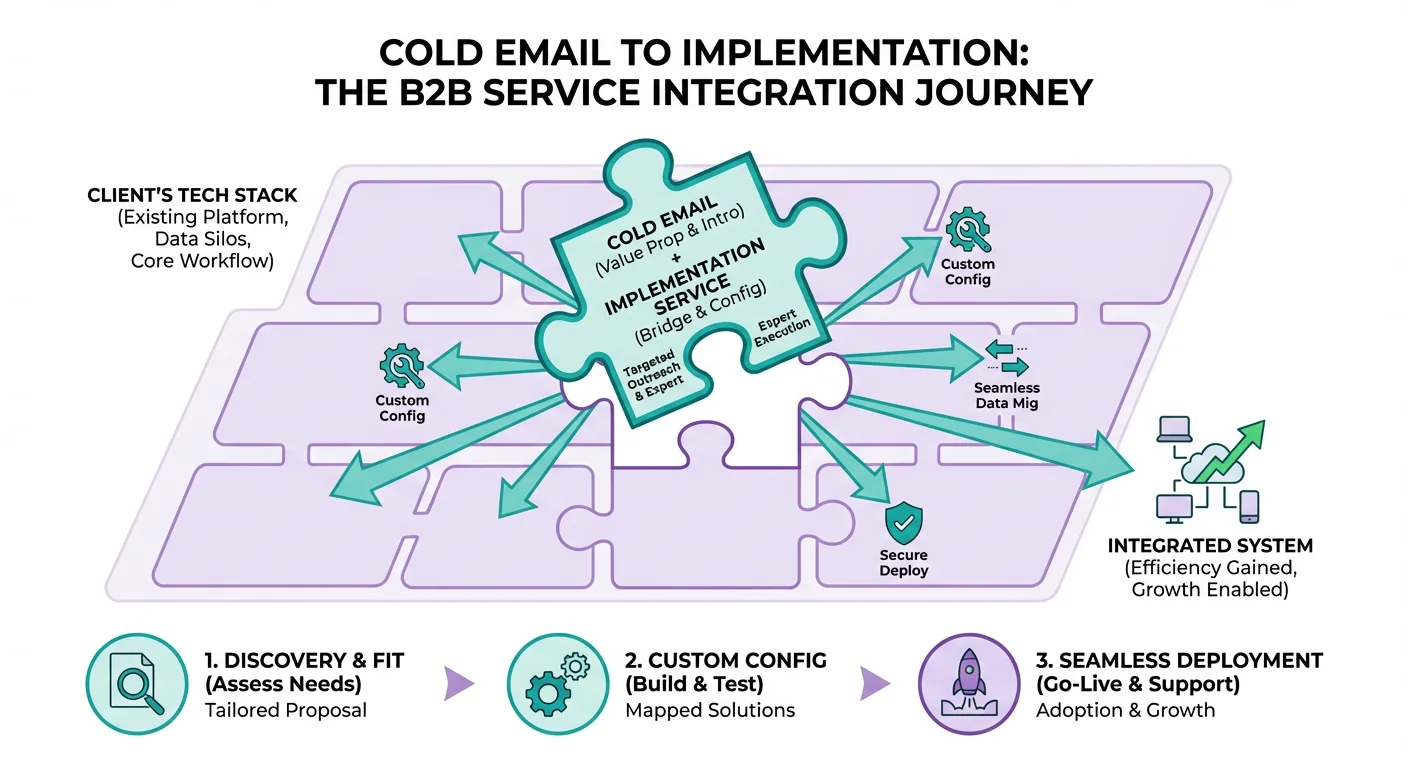
Cold email works for implementation services because it reaches decision-makers during critical technology adoption windows: platform purchases, upgrades, or migrations. Target companies showing buying signals like recent software purchases, leadership changes, or technology stack updates. Effective emails reference specific platforms or pain points, demonstrate relevant expertise, and lead with value rather than credentials. Implementation services have long sales cycles, so the job of a first email is to be the name that comes to mind when a project is finally approved.
Key takeaways
- Implementation prospects should typically have 200+ employees or complex technology needs to warrant professional implementation services.
- Four main implementation service types require different targeting: platform implementations, system integrations, migrations and upgrades, and custom development and configuration.
- Buying cycle signals that indicate implementation needs include recent software purchases, technology stack changes, growth triggers like funding rounds, leadership changes, and vendor end-of-life announcements.
- Decision-makers for implementation projects include IT leadership (CIO, CTO, IT Directors), functional leaders (CFO for ERP, VP Sales for CRM), project managers, and operations executives.
- Implementation decisions involve factors like platform-specific expertise, methodology, risk mitigation capabilities, technical credentials, and data migration experience.
Reviewed and updated September 15, 2026
Cold Email for Implementation Services: Complete Strategy Guide
Software implementation services are in high demand. Companies invest heavily in enterprise software, but realizing value from those investments requires expert implementation. The gap between buying software and successfully deploying it creates significant opportunities for implementation consultancies and systems integrators.
Cold email provides a direct path to reaching companies in active buying cycles or struggling with existing implementations. When you target the right companies with the right message, you connect with decision-makers who genuinely need your expertise.
This guide covers everything you need to know about using cold email to sell implementation services, from identifying prospects at the right stage to crafting messages that generate qualified conversations.
Why Cold Email Works for Implementation Services
Implementation services sit at a critical point in the technology adoption lifecycle. Companies making significant software investments need help maximizing ROI, and cold email reaches them at key decision moments.
Timing-sensitive opportunities. Implementation needs emerge around software purchases, upgrades, and expansion. Cold email reaches buyers during these windows.
Direct access to decision-makers. Implementation decisions involve IT leaders, operations executives, and project managers. Cold email connects you directly.
Technology-specific targeting. You can identify companies using specific platforms and reach them with relevant expertise.
Competitive positioning. Companies often start implementation conversations with software vendors first. Cold email ensures you're considered early.
Relationship building. Implementation projects have long sales cycles. Email sequences nurture relationships until projects are approved.
Types of Implementation Services
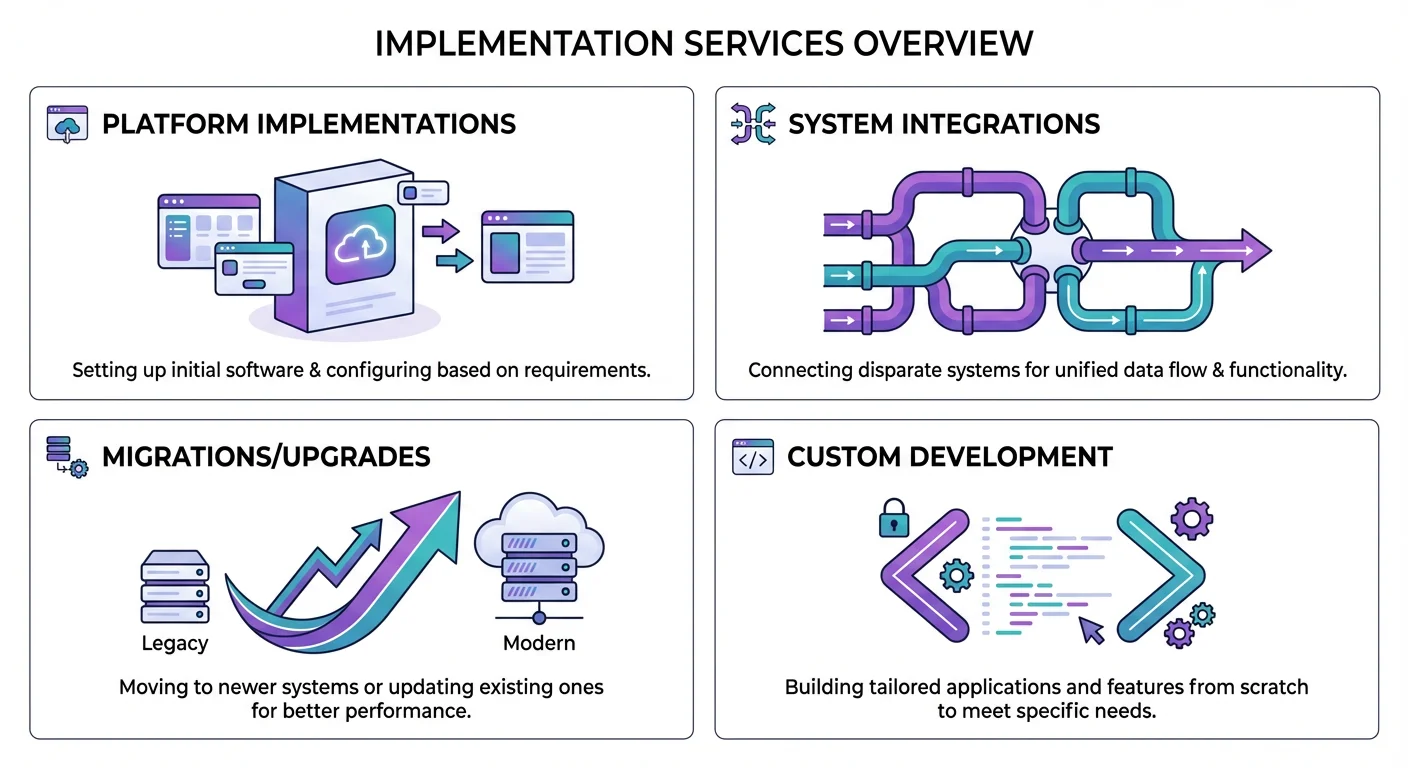
Different implementation services require different outreach approaches.
Platform Implementations
Full deployment of enterprise software platforms (ERP, CRM, HRIS, etc.):
Target audience. IT leaders, operations executives, finance leaders for ERP, sales leaders for CRM.
Decision factors. Platform expertise, methodology, team size, project management capabilities.
Outreach focus. Emphasize platform-specific experience, implementation methodology, and risk mitigation.
System Integrations
Connecting systems and enabling data flow between applications:
Target audience. IT leaders, data architects, operations teams dealing with disconnected systems.
Decision factors. Technical expertise, integration tool experience, data migration capabilities.
Outreach focus. Emphasize integration expertise, technical credentials, and efficiency improvements.
Migrations and Upgrades
Moving from legacy systems or upgrading to new versions:
Target audience. IT leaders managing outdated systems, executives concerned about technical debt.
Decision factors. Migration methodology, data integrity, downtime minimization, training support.
Outreach focus. Emphasize migration experience, risk management, and business continuity.
Custom Development and Configuration
Building custom functionality or configuring platforms for specific needs:
Target audience. Business leaders with unique requirements, IT teams with development backlogs.
Decision factors. Development expertise, platform knowledge, agile capabilities.
Outreach focus. Emphasize customization expertise and ability to translate business requirements into technical solutions.
Identifying Implementation Prospects
Implementation services require specific targeting because needs emerge at particular moments in the technology lifecycle.
Buying Cycle Signals
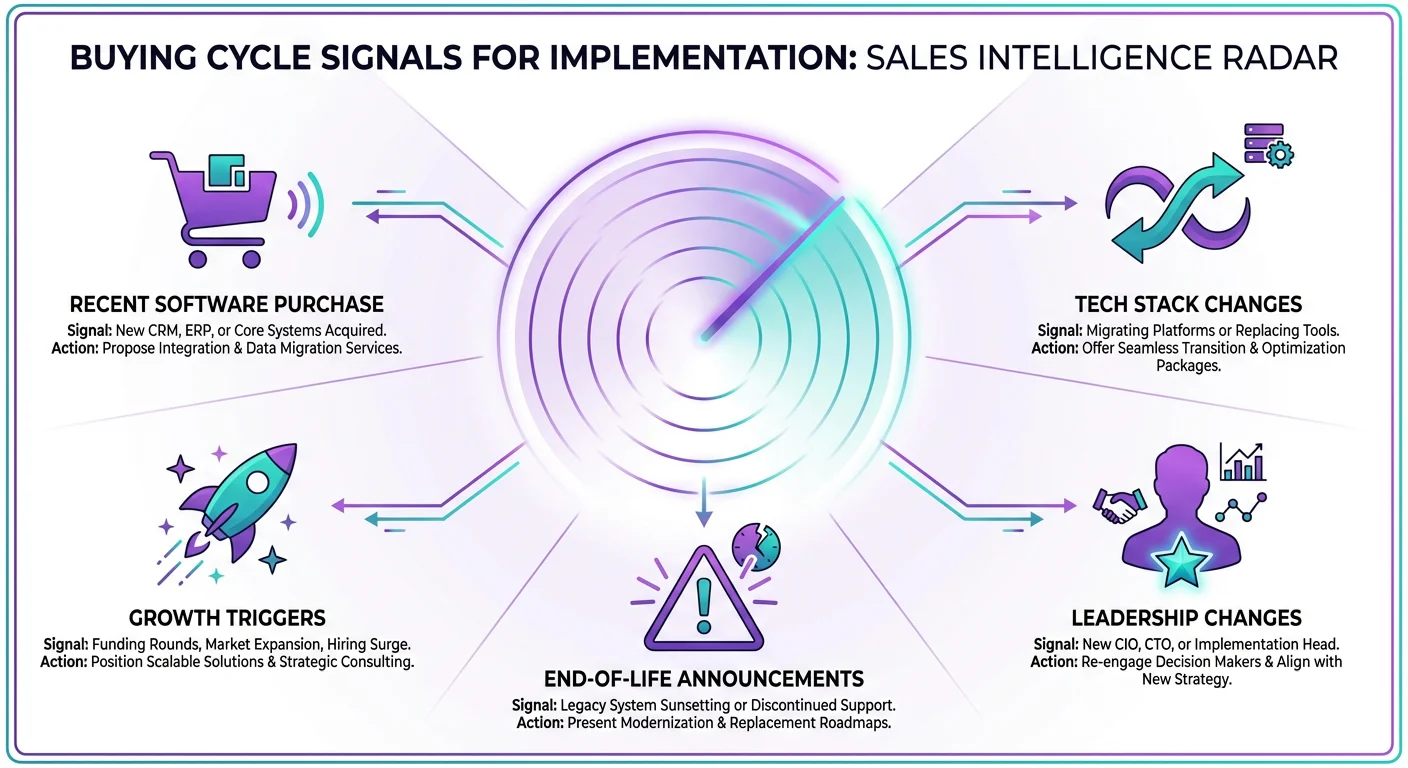
Recent software purchases. Companies that just bought software need implementation. Job postings, press releases, and news often reveal these purchases.
Technology stack changes. Public announcements or job postings mentioning new platforms signal implementation needs.
Growth triggers. Funding rounds, acquisitions, or rapid hiring often precede technology investments and implementations.
Leadership changes. New CIOs, CTOs, or operations leaders often drive technology refresh initiatives.
End-of-life announcements. Vendors discontinuing products force migration to alternatives.
Company Characteristics
Size and complexity. Organizations must be large enough to warrant professional implementation services. This typically means 200+ employees or complex technology needs.
Industry fit. Some industries have specific compliance or regulatory requirements that increase implementation complexity.
Technology maturity. Companies with existing IT infrastructure understand implementation value. Startups may try to implement in-house.
Budget indicators. Recent funding, strong financial performance, or technology investment announcements signal budget availability.
Contact Targeting
IT leadership. CIO, CTO, VP IT, IT Directors who own technology decisions.
Functional leaders. CFO for ERP, VP Sales for CRM, CHRO for HRIS. These leaders often drive platform selection.
Project leaders. PMO directors or project managers who oversee implementation projects.
Operations executives. COO or VP Operations for platforms affecting operational processes.
Building Your Implementation Prospect List
Quality data and accurate targeting determine outreach success.
Data Sources
Technology databases. BuiltWith, Slintel, and similar tools reveal technology stacks and recent changes.
LinkedIn Sales Navigator. Filter by company size, industry, job titles, and identify relevant contacts.
News monitoring. Track announcements about software purchases, digital transformation initiatives, or technology investments.
Job postings. Companies hiring for specific platforms often have implementation needs.
Software vendor partnerships. Some vendors share leads or certified partner opportunities.
Research for Personalization
Implementation outreach requires specific knowledge about each prospect:
Current technology. What platforms are they using? What's their likely technology maturity?
Recent changes. Have they announced new software purchases or technology initiatives?
Public challenges. Are there signs of implementation struggles, integration issues, or technical debt?
Industry context. What implementation challenges are common in their industry?
Email Verification
Always verify addresses before sending:
Verification services. NeverBounce, ZeroBounce, and similar tools validate addresses.
Technical contacts. IT professionals change roles frequently. Verify data freshness.
Domain validation. Ensure target domains accept email.
Crafting Implementation Services Cold Emails
Your email needs to communicate platform expertise, methodology credibility, and relevant experience.
Subject Line Strategies
Effective patterns:
- "[Platform] Implementation for [Company]"
- "[Name], [Platform] deployment expertise"
- "Maximizing [Company]'s [Platform] ROI"
- "[Platform] specialists for [Industry]"
Avoid:
- Generic vendor language
- Overly technical subjects
- Misleading subjects
- Sales-forward language
Email Structure
Opening (1-2 sentences). Reference something specific about the company: recent software purchase, technology initiative, or growth stage.
Challenge acknowledgment (1-2 sentences). Articulate implementation challenges relevant to their situation.
Solution positioning (2-3 sentences). Describe your implementation expertise and methodology. Focus on outcomes and risk reduction.
Proof points (1-2 sentences). Reference similar implementations, measurable results, or relevant credentials.
Call to action (1-2 sentences). Propose a specific next step: a call to discuss their implementation needs.
Tone for Technical Sales
Expertise-forward. Demonstrate platform knowledge and implementation experience.
Risk-aware. Acknowledge implementation risks and position yourself as risk mitigation.
Outcome-focused. Connect implementation to business value, not just technical success.
Partnership orientation. Position as a partner invested in their success, not a vendor completing a project.
Implementation Services Email Templates
Template 1: New Platform Detection
Subject: [Platform] Implementation Support for [Company]
Hi [Name],
I noticed [Company] recently [signal: job posting for Platform role, announcement, etc.]. Congratulations on the [Platform] investment.
[Platform] implementations require careful planning to realize full value. Companies that rush deployment often struggle with [common challenge 1] and [common challenge 2], leading to low adoption and disappointing ROI.
We specialize in [Platform] implementations for [industry/company type] companies. Our methodology addresses these risks through [approach element 1] and [approach element 2].
Recent implementations:
If [Company] is planning the [Platform] rollout, I'd welcome a conversation about how to set up for success. Worth 20 minutes?
[Your Name] [Title/Company]
Template 2: Integration Challenges
Subject: System Integration for [Company]
Hi [Name],
Companies running [System 1] and [System 2] often struggle with [integration challenge]. Manual workarounds create data inconsistencies and waste [type of resource].
I work with [company type] companies to build integrations that eliminate these friction points. Rather than [common approach with limitations], we [your differentiated approach] to ensure [outcome].
[Client example] was dealing with [similar challenge]. After implementing our integration, they [specific result].
If [Company] is experiencing integration friction between systems, I'd enjoy discussing how we might help.
[Your Name] [Title/Company]
Template 3: Migration Opportunity
Subject: [Legacy System] to [New System] Migration
Hi [Name],
With [Legacy System]'s [end of life / limitations / common pain points], many [industry] companies are evaluating alternatives. The migration decision is important, but the migration execution determines whether you actually realize the benefits.
We've helped [number] companies migrate from [Legacy System] to [New System]. Our methodology minimizes disruption while ensuring data integrity and team adoption.
Key outcomes for our migration clients:
- [Outcome 1]
- [Outcome 2]
- [Outcome 3]
If [Company] is considering or planning a migration, I'd welcome a conversation about how to approach it successfully.
[Your Name] [Title/Company]
Template 4: Industry-Specific
Subject: [Platform] for [Industry] Companies
Hi [Name],
[Platform] implementations in [industry] require understanding of [industry-specific requirement 1] and [industry-specific requirement 2]. Generic implementation partners often miss these nuances.
I specialize in [Platform] implementations for [industry] companies. Over [timeframe], I've helped [number] organizations in the sector deploy [Platform] with configurations that address [industry-specific need].
[Client in same industry] achieved [specific result] through an implementation designed for their [industry] requirements.
If [Company] is implementing or optimizing [Platform], I'd be interested in discussing how [industry]-specific expertise could add value.
[Your Name] [Title/Company]
Template 5: Optimization Opportunity
Subject: Getting More from [Platform] at [Company]
Hi [Name],
Many companies implement [Platform] but never realize its full potential. Features go unused, workflows remain inefficient, and ROI stays below expectations.
I help [company type] companies optimize their [Platform] deployments. Rather than rip-and-replace, we identify configuration improvements, workflow refinements, and adoption gaps that unlock value from existing investments.
Recent optimization projects:
If [Company]'s [Platform] deployment isn't delivering expected value, I'd enjoy discussing what's possible with optimization.
[Your Name] [Title/Company]
Where we differ from standard practice
Much of the advice on this page reflects how outbound is commonly run. We run it differently, and since this page sits on our site it is worth saying where the difference is and what it costs us.
- A sequence of messages to each prospect over several weeks
- Later messages often land in the same email thread
- Every contact is reached more than once, so a distracted reader gets another chance
- The later messages go only to people who did not answer the first
- Reputation cost accrues on the sending domain across everything else it sends
- One message, then that campaign is finished for that contact
- No thread replies and no bumps
- A non-responding audience becomes a new campaign with a genuinely different premise, not a reminder
- More of the work moves into targeting and into the one message
- We reach each contact less often, and that is the cost we accept
The reasoning is mechanical rather than moral. A follow-up arrives underneath a message the recipient has already seen and chosen not to answer, so it is delivered to the population most likely to mark it as spam, and the reputation cost of that lands on the sending domain across every campaign running on it. We set that cost against the replies a sequence recovers and decided the trade was not worth it. The full argument, with the numbers from our own campaigns, is in why we stopped using follow-ups.
Follow-Up Sequences for Implementation Sales
Implementation decisions often involve multiple stakeholders and budget approval. Consistent follow-up maintains relationships through the decision process.
Sequence Structure
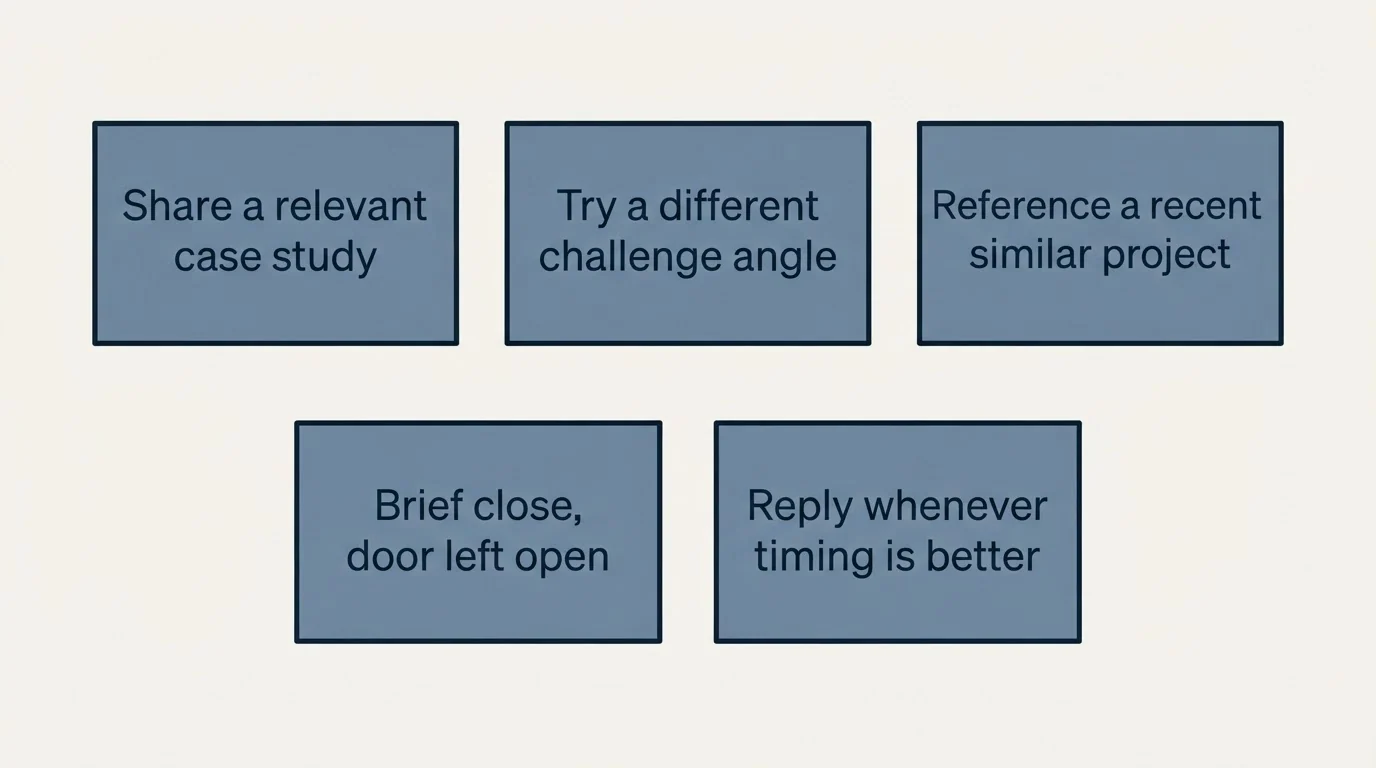
Email 2 (5-7 days later). Add value with relevant content: implementation guide, case study, or technology insight.
Email 3 (7-10 days later). Try a different angle: address different challenge or highlight different capability.
Email 4 (10-14 days later). Brief close leaving door open for future connection.
Follow-Up Templates
Follow-up 1:
Hi [Name],
Following up on my note about [Platform] implementation.
I thought this case study might be relevant: [Link]. It details how [similar company] approached their [Platform] deployment and the results they achieved.
The section on [specific topic] addresses challenges common to companies at [Company]'s stage.
Still happy to discuss if helpful.
[Your Name]
Follow-up 2:
Hi [Name],
One thing I should have mentioned: we recently completed [relevant project type] for [similar company]. They were facing [similar challenge] and needed [specific requirement].
The implementation took [timeframe] and delivered [specific outcome]. Their [role] described the experience as [brief testimonial].
If [Company] is evaluating implementation partners, I'd welcome the chance to discuss how we approach projects like yours.
[Your Name]
Final follow-up:
Hi [Name],
I've reached out a few times about [Platform] implementation and don't want to crowd your inbox.
If implementation support becomes a priority for [Company], I'd welcome the chance to connect. Just reply whenever timing is better.
Best, [Your Name]
Converting Implementation Inquiries to Projects
Getting interest is the first step. Converting to implementation projects requires navigating technical evaluation and procurement.
Discovery Process
Understand the project. What are they implementing? What timeline are they targeting? What resources do they have internally?
Identify stakeholders. Who else is involved in the decision? Technical evaluators? Executive sponsors? Procurement?
Assess complexity. What integration requirements, data migration needs, or customization demands exist?
Determine fit. Is this a project you can deliver successfully? Is it the right size and type for your team?
Proposal Development
Scope definition. Clearly define what's included and what's not. Implementation scope creep is a major project killer.
Methodology explanation. Describe how you approach implementations. Buyers want to understand your process.
Team and resources. Detail who will work on the project and what client resources are required.
Timeline and milestones. Provide realistic timelines with clear milestones.
Investment structure. Present pricing clearly, whether fixed fee, time-and-materials, or hybrid.
Risk mitigation. Address how you handle common implementation risks.
Stakeholder Navigation
Implementation decisions involve multiple stakeholders:
Technical evaluators. Focus on methodology, team expertise, and technical credentials.
Executive sponsors. Emphasize business outcomes, risk mitigation, and ROI.
Project managers. Address timeline, resource requirements, and collaboration approach.
Procurement. Provide documentation, compliance information, and contracting flexibility.
Measuring Implementation Campaign Success
Track metrics to optimize your outreach:
Outreach metrics:
- Emails sent and delivered
- Open rate (target: 40-60%)
- Reply rate (target: 5-15%)
- Meeting booking rate
Sales metrics:
- Meetings to proposal rate
- Proposal to project conversion
- Average project size
- Sales cycle length
Business metrics:
- Revenue from cold email-sourced projects
- Customer acquisition cost
- Project profitability
- Repeat business rate
Common Mistakes to Avoid
Generic platform messaging. Implementation needs vary widely. Customize based on platform, company size, and industry.
Leading with technology. Decision-makers care about business outcomes. Lead with value delivered, not technical capabilities.
Ignoring timing signals. Implementation needs are timing-dependent. Target companies showing active buying signals.
Weak follow-up. Implementation sales cycles are long. Consistent, value-adding follow-up is essential.
Overselling capabilities. Overpromising creates project risk. Be realistic about what you can deliver.
No differentiation. The implementation market is crowded. Clearly communicate what makes your approach distinctive.
Ignoring references. Implementation buyers rely heavily on references. Make them easy to provide.
Start Selling Implementation Services
Cold email provides implementation consultancies with direct access to companies making technology investments and struggling with existing deployments. When you target the right companies at the right time with relevant expertise, you connect with decision-makers who genuinely need your help.
The templates and strategies in this guide offer a foundation, but success depends on demonstrating genuine platform expertise and implementation methodology that reduces risk for buyers.
If you're looking to scale implementation services sales without building an internal outreach team, RevenueFlow can help. Our done-for-you cold email campaigns apply these principles to generate qualified implementation opportunities.
Get Your Free Campaign and start filling your implementation pipeline today.
Related Reading
Frequently asked questions.
Frequently asked questions- Why is cold email effective for selling implementation services?
- Cold email provides direct access to decision-makers during timing-sensitive windows when implementation needs emerge: around software purchases, upgrades, or expansions. It enables technology-specific targeting, allowing you to identify companies using particular platforms and reach them with relevant expertise. Implementation projects have long sales cycles, so the value of a first email is being known when budget is approved rather than closing anything on the spot. Cold email also ensures you're considered early, before companies default to working exclusively with software vendors.
- What are the main types of implementation services?
- The four main types are platform implementations (full deployment of ERP, CRM, HRIS), system integrations (connecting applications and enabling data flow), migrations and upgrades (moving from legacy systems or upgrading versions), and custom development and configuration (building unique functionality or tailoring platforms). Each type requires different targeting approaches, decision-makers, and messaging that emphasizes specific expertise like methodology, technical credentials, or risk management.
- What signals indicate a company needs implementation services?
- Key buying cycle signals include recent software purchases revealed through job postings or press releases, technology stack changes, growth triggers like funding rounds or acquisitions, leadership changes (especially new CIOs or CTOs), and vendor end-of-life announcements forcing migrations. Company characteristics also matter: organizations with 200+ employees, existing IT infrastructure, strong financial performance, or recent technology investment announcements are more likely to need professional implementation services.
- Who should I target when selling implementation services?
- Target IT leadership including CIOs, CTOs, VPs of IT, and IT Directors who own technology decisions. Also reach functional leaders like CFOs for ERP implementations, VPs of Sales for CRM, or CHROs for HRIS, as they often drive platform selection. Include project leaders such as PMO directors or project managers overseeing implementations, and operations executives like COOs or VPs of Operations for platforms affecting operational processes.
About the author.

Ben Carden is CRO at RevenueFlow, which builds and operates outbound revenue engines for B2B companies. Previously at Gartner Enterprise. Studied at London School of Economics.
Ben Carden · CRO
Connect on LinkedIn →Explore more.
Ready to scale your outreach?
We build GTM engines that book real meetings. See the receipts.
Related articles.
Cold Email for Affiliate Recruitment: Strategy Guide
Master cold email outreach to recruit high-performing affiliates who can drive significant revenue for your business with proven templates and strategies.
Cold Email for Reseller Partnerships: Strategy Guide
Learn how to use cold email to recruit resellers and channel partners who can expand your market reach and drive revenue through their existing customer relationships.