Cold Email Unsubscribe Rate Benchmarks: 2026 Data
Industry benchmarks show healthy cold email unsubscribe rates range from 0.2% to 0.5% per campaign. Learn what drives unsubscribes and how to keep yours within acceptable limits.

Healthy cold email unsubscribe rates range from 0.2% to 0.5% per campaign, calculated as unsubscribes divided by emails delivered, multiplied by 100. Rates above 1% indicate problems with targeting, messaging, or frequency requiring immediate attention. Benchmark rates vary by industry (professional services average 0.2-0.4%, technology/SaaS average 0.3-0.8%, and healthcare averages 0.3-0.9%) with smaller companies showing lower unsubscribe rates than enterprises.
Key takeaways
- Cold email unsubscribe rates below 0.5% indicate healthy campaign performance, while rates above 1% signal fundamental targeting or messaging problems requiring attention.
- Professional services recipients show the lowest unsubscribe rates at 0.2-0.4%, demonstrating higher tolerance for relevant business development outreach than other industries.
- Startups and small businesses (1-50 employees) maintain lower unsubscribe rates of 0.2-0.6% compared to enterprises (1000+ employees) at 0.6-1%, reflecting greater openness to vendor conversations.
- The unsubscribe rate formula is: (Unsubscribes ÷ Emails Delivered) × 100, providing a standard metric to track campaign health across sequences.
- Unsubscribe rates between 0.2-0.4% are classified as 'good' performance, while rates above 2% are considered critical and require campaign revision.
Reviewed and updated September 15, 2026
Cold Email Unsubscribe Rate Benchmarks: 2026 Performance Data
Unsubscribe rates in cold email campaigns tell you whether your messaging resonates with your target audience or pushes them away. While some unsubscribes are inevitable (and even healthy), rates above 1% signal problems with targeting, messaging, or sending frequency that require immediate attention.
This benchmark report provides industry standards for cold email unsubscribe rates, breaking down the data by industry, campaign type, and sequence position. Understanding these benchmarks helps you evaluate campaign health and identify optimization opportunities.
About This Data
The benchmarks presented in this report are compiled from publicly available industry research, aggregated data from email service providers, and typical ranges observed across B2B cold email campaigns. These figures represent industry estimates and general ranges rather than definitive standards. Your actual results will vary based on your specific industry, target audience, messaging approach, and sending patterns.
We recommend using these benchmarks as directional guidance while establishing your own baseline metrics through consistent tracking and testing.
Understanding Unsubscribe Rate
Unsubscribe rate measures the percentage of recipients who opt out of receiving future emails from your campaign or domain.
Unsubscribe Rate Formula
Unsubscribe Rate = (Unsubscribes / Emails Delivered) x 100
Example: If you deliver 1,000 emails and 3 people unsubscribe, your unsubscribe rate is 0.3%.
Why Unsubscribes Happen
Recipients unsubscribe from cold emails for several reasons:
- Irrelevant targeting: The offer has no connection to their role or needs
- Poor timing: They receive too many emails too quickly
- Low-value content: The message provides no useful information
- Aggressive approach: The tone feels pushy or spammy
- Wrong decision-maker: They have no purchasing authority
- Competitive saturation: They receive too much similar outreach
Understanding why people unsubscribe helps you address root causes rather than just measuring symptoms.
Cold Email Unsubscribe Rate Benchmarks
Here are general benchmarks for cold email unsubscribe rates based on industry data:
| Performance Level | Unsubscribe Rate | Interpretation |
|---|---|---|
| Excellent | Below 0.2% | Strong targeting and messaging alignment |
| Good | 0.2% - 0.4% | Healthy campaign performance |
| Average | 0.4% - 0.7% | Acceptable, room for optimization |
| Below Average | 0.7% - 1% | Targeting or messaging issues likely |
| Poor | 1% - 2% | Significant problems requiring attention |
| Critical | Above 2% | Campaign fundamentals need revision |
For cold email specifically, maintaining an unsubscribe rate below 0.5% indicates healthy campaign performance. Rates consistently above 1% suggest fundamental issues with your approach.
Unsubscribe Benchmarks by Industry
Different industries show varying tolerance for cold outreach, affecting unsubscribe rates.
Technology and SaaS
| Segment | Typical Unsubscribe Rate | Notes |
|---|---|---|
| Enterprise Software | 0.3% - 0.6% | Heavy cold email exposure increases opt-outs |
| SMB SaaS | 0.4% - 0.8% | More receptive but also more saturated |
| Developer Tools | 0.5% - 1% | Technical audiences prefer organic discovery |
| IT Services | 0.3% - 0.5% | Accustomed to vendor outreach |
Technology buyers receive significant cold outreach volume, making differentiation essential for keeping unsubscribe rates low.
Professional Services
| Segment | Typical Unsubscribe Rate | Notes |
|---|---|---|
| Consulting | 0.2% - 0.4% | Open to business development conversations |
| Legal Services | 0.3% - 0.6% | Relationship-driven, selective engagement |
| Accounting | 0.3% - 0.5% | Seasonal patterns affect tolerance |
| Marketing Agencies | 0.4% - 0.7% | Competitive landscape affects patience |
Professional services recipients typically show higher tolerance for relevant outreach, resulting in lower unsubscribe rates.
Healthcare and Life Sciences
| Segment | Typical Unsubscribe Rate | Notes |
|---|---|---|
| Healthcare IT | 0.4% - 0.7% | Compliance concerns affect engagement |
| Medical Devices | 0.3% - 0.5% | Established sales relationships |
| Pharmaceuticals | 0.5% - 0.9% | Heavy regulation affects preferences |
| Healthcare Services | 0.3% - 0.6% | Varies by role and organization size |
Healthcare recipients often have stricter email preferences due to regulatory environments and inbox management practices.
Financial Services
| Segment | Typical Unsubscribe Rate | Notes |
|---|---|---|
| Banking | 0.4% - 0.7% | Security-conscious, selective engagement |
| Insurance | 0.3% - 0.5% | Accustomed to business development |
| Investment Management | 0.4% - 0.8% | High-value targets, heavy outreach volume |
| FinTech | 0.3% - 0.6% | More digitally receptive |
Financial services professionals receive substantial vendor outreach, but appropriate targeting can maintain acceptable unsubscribe rates.
Unsubscribe Benchmarks by Company Size
Target company size affects unsubscribe behavior patterns.
| Company Size | Typical Unsubscribe Rate | Key Factors |
|---|---|---|
| Startups (1-10) | 0.2% - 0.5% | More open to vendor conversations |
| Small Business (11-50) | 0.3% - 0.6% | Limited time increases selectivity |
| Mid-Market (51-200) | 0.4% - 0.7% | Growing inbox competition |
| Mid-Enterprise (201-1000) | 0.5% - 0.8% | Established vendor preferences |
| Enterprise (1000+) | 0.6% - 1% | Heavy outreach volume, gatekeepers |
Smaller companies typically show lower unsubscribe rates due to greater openness to new solutions and less inbox saturation.
Unsubscribe Benchmarks by Sequence Position
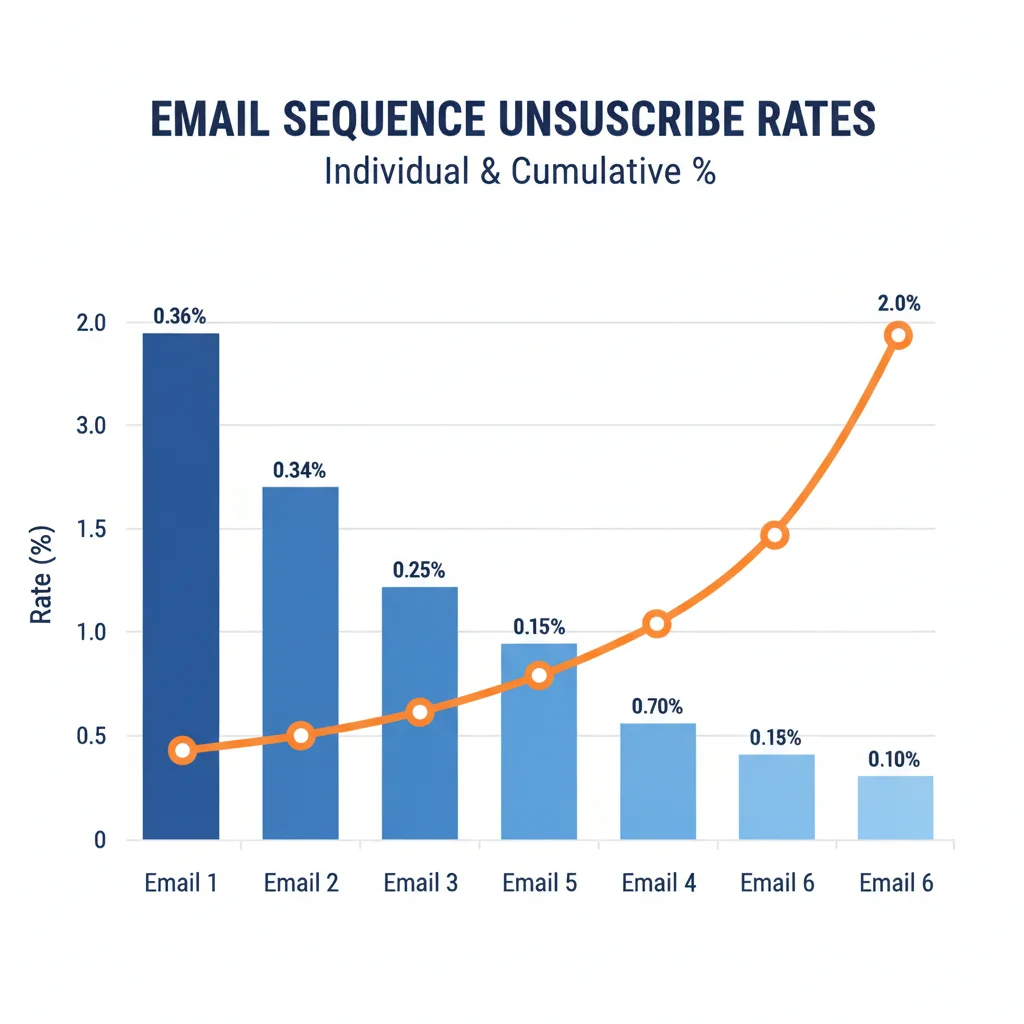
Unsubscribe rates vary based on where an email falls within a sequence.
| Email Position | Typical Unsubscribe Rate | Cumulative Unsubscribe |
|---|---|---|
| Email 1 | 0.3% - 0.6% | 0.3% - 0.6% |
| Email 2 | 0.2% - 0.4% | 0.5% - 1% |
| Email 3 | 0.15% - 0.35% | 0.65% - 1.35% |
| Email 4 | 0.1% - 0.3% | 0.75% - 1.65% |
| Email 5 | 0.1% - 0.25% | 0.85% - 1.9% |
| Email 6+ | 0.1% - 0.2% | 0.95% - 2.1% |
Key observations:
First emails generate the most unsubscribes because they reach the broadest audience before any self-selection occurs. Recipients who find your outreach irrelevant often opt out immediately.
Later emails see declining unsubscribe rates as the remaining recipients have already demonstrated some tolerance for your outreach. Those most opposed have already opted out.
Cumulative unsubscribe rates matter more than individual email rates. A sequence producing 2% total unsubscribes over 5 emails may indicate problems even if each individual email stays below 0.5%.
Unsubscribe Benchmarks by Email Frequency
Sending frequency significantly impacts unsubscribe rates.
| Sending Frequency | Typical Unsubscribe Rate | Risk Assessment |
|---|---|---|
| Weekly or less | 0.2% - 0.4% | Low risk |
| Twice weekly | 0.3% - 0.6% | Moderate risk |
| Every 2-3 days | 0.4% - 0.8% | Higher risk |
| Daily | 0.6% - 1.2% | High risk |
| Multiple per day | 1% - 3%+ | Very high risk |
Frequency fatigue is a primary driver of unsubscribes. Even interested prospects will opt out if they feel overwhelmed by email volume.
Optimal Spacing Guidelines
| Sequence Stage | Recommended Gap | Rationale |
|---|---|---|
| Emails 1-2 | 3-4 business days | Allow time to read and consider |
| Emails 2-3 | 4-5 business days | Respect initial non-response |
| Emails 3-4 | 5-7 business days | Avoid harassment perception |
| Emails 4+ | 7-10 business days | Very light touch only |
Unsubscribe vs. Spam Complaints
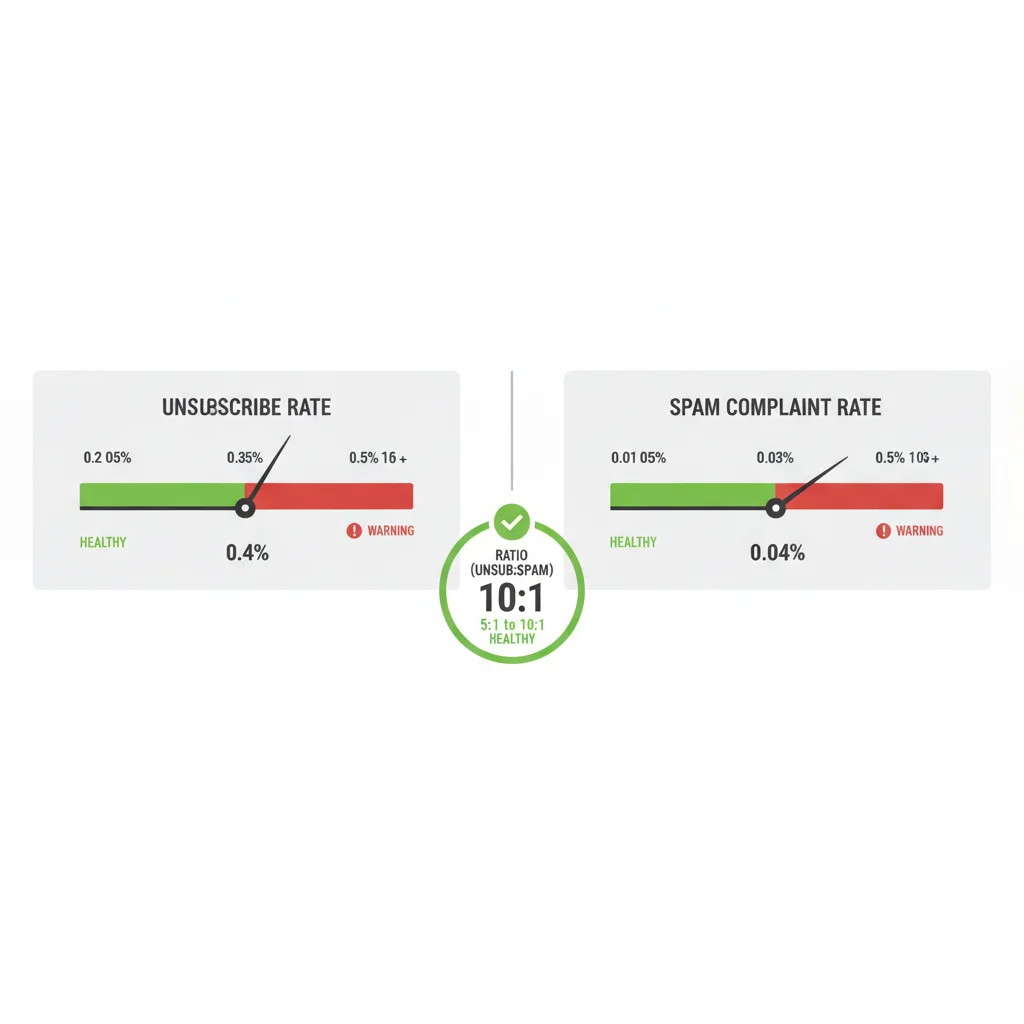
Understanding the relationship between unsubscribes and spam complaints helps contextualize your metrics.
| Metric | Healthy Range | Warning Threshold |
|---|---|---|
| Unsubscribe Rate | 0.2% - 0.5% | Above 1% |
| Spam Complaint Rate | 0.01% - 0.05% | Above 0.1% |
| Unsubscribe-to-Complaint Ratio | 5:1 to 10:1 | Below 3:1 |
A healthy unsubscribe-to-complaint ratio indicates that people who want to stop receiving emails can easily do so. When unsubscribes are difficult, recipients report spam instead, which causes significantly more reputation damage.
Making unsubscribe easy protects your sender reputation. A clear, one-click unsubscribe process is preferable to recipients marking you as spam.
Factors That Influence Unsubscribe Rates
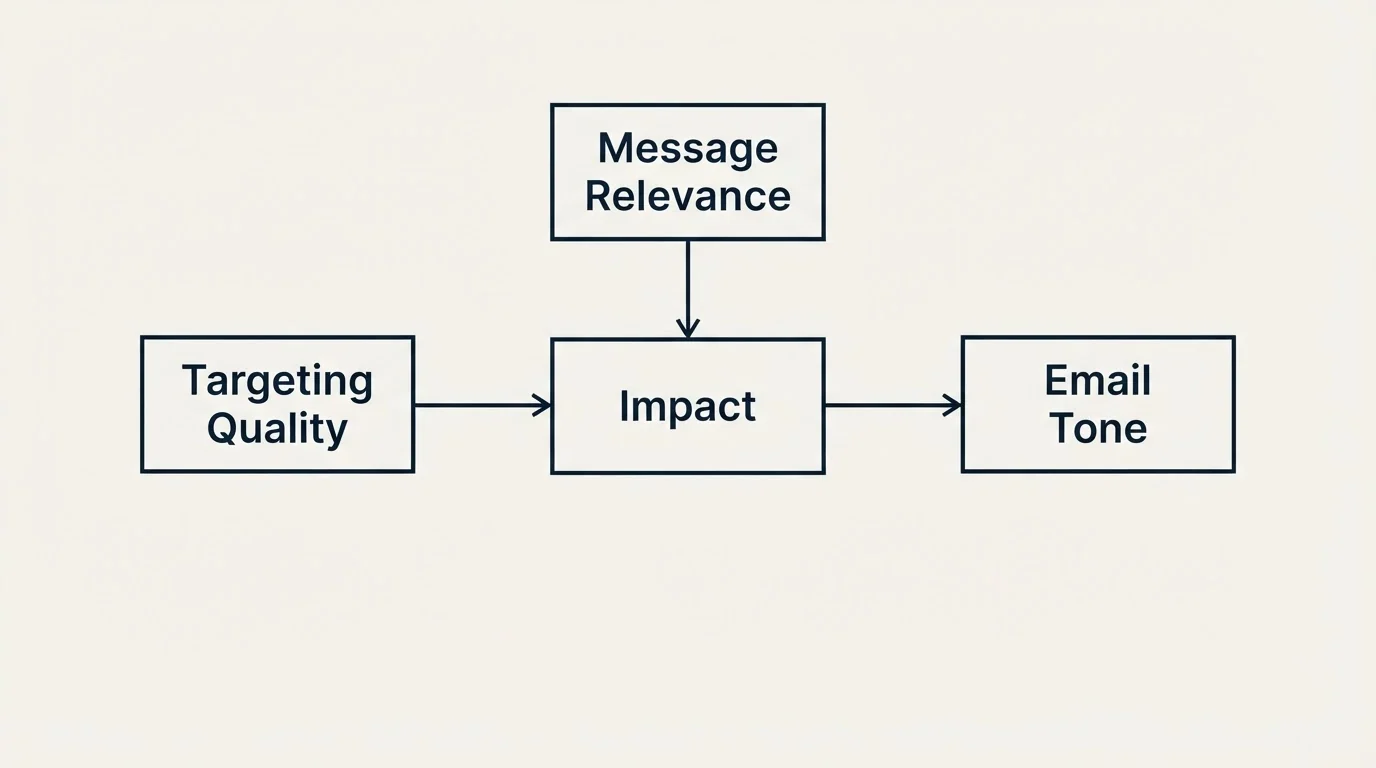
Targeting Quality
Impact: Very High
Poor targeting is the primary driver of elevated unsubscribe rates. When your emails reach people who have no use for your offer, unsubscribes follow.
| Targeting Factor | Unsubscribe Impact |
|---|---|
| Wrong industry vertical | High unsubscribes |
| Wrong company size | Moderate unsubscribes |
| Wrong decision-maker level | High unsubscribes |
| No purchase timing alignment | Moderate unsubscribes |
| Competitor customers | Variable based on approach |
Message Relevance
Impact: High
Even well-targeted prospects will unsubscribe from messages that fail to demonstrate relevance.
| Messaging Factor | Unsubscribe Impact |
|---|---|
| Generic templates | Higher unsubscribes |
| Personalized content | Lower unsubscribes |
| Clear value proposition | Lower unsubscribes |
| Feature-focused pitches | Higher unsubscribes |
| Problem-focused messaging | Lower unsubscribes |
Email Tone and Style
Impact: Medium
The tone of your emails affects how recipients perceive your outreach.
| Tone Factor | Unsubscribe Impact |
|---|---|
| Professional and helpful | Lower unsubscribes |
| Aggressive or pushy | Higher unsubscribes |
| Casual and conversational | Lower unsubscribes |
| Salesy or hyperbolic | Higher unsubscribes |
| Authentic and straightforward | Lower unsubscribes |
Strategies to Reduce Unsubscribe Rates
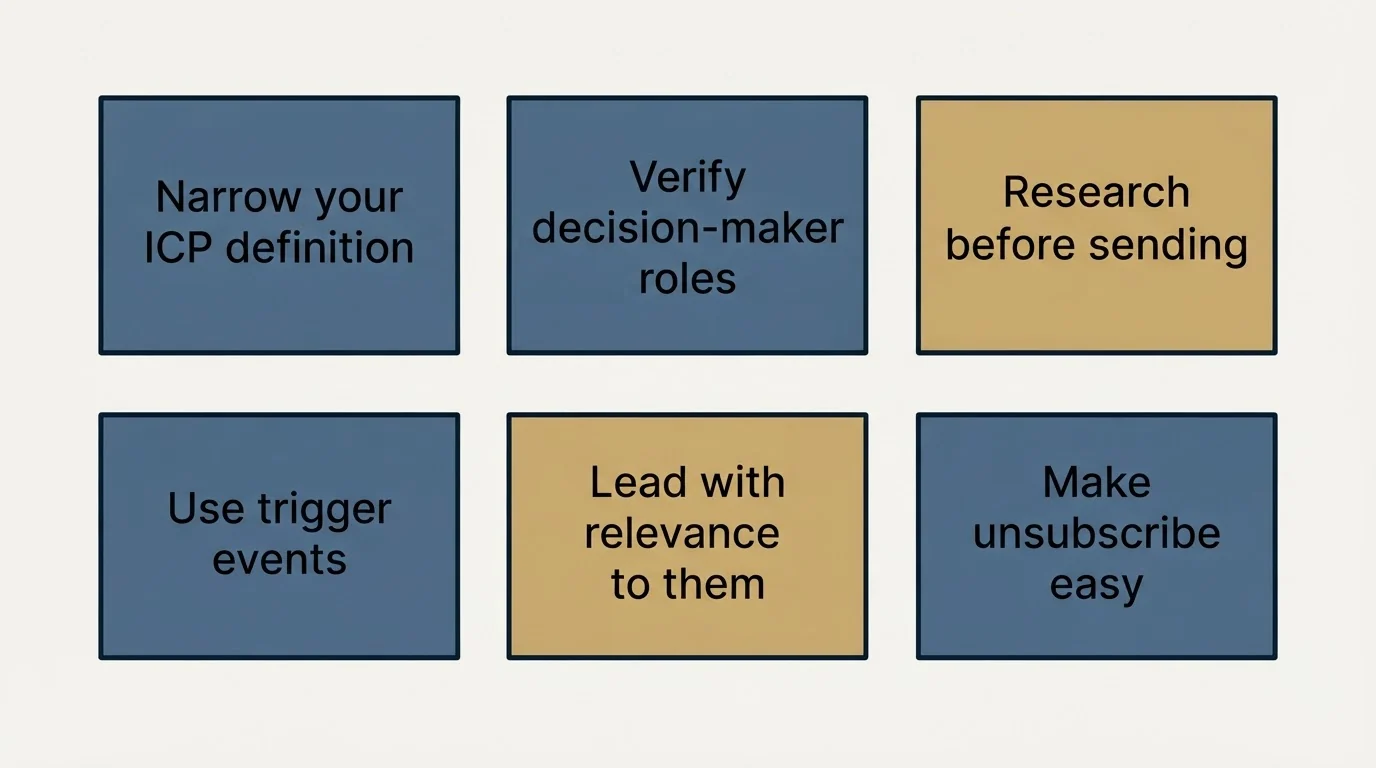
Improve Targeting Precision
-
Narrow your ICP definition. Broader targeting increases reach but also increases irrelevant sends that drive unsubscribes.
-
Verify decision-maker roles. Sending to people without purchasing authority wastes their time and increases opt-outs.
-
Research before sending. Understanding a company's situation helps you send only when relevant.
-
Use trigger events. Timing outreach around funding, hiring, or expansion signals improves relevance.
Optimize Messaging
-
Lead with relevance. Open with why you are reaching out to them specifically, not your company credentials.
-
Focus on problems, not products. Address challenges the recipient faces rather than listing your features.
-
Provide value in every email. Each touch should offer something useful, even if they never buy.
-
Avoid hyperbole. Overpromising creates skepticism and drives unsubscribes.
Manage Sending Frequency
-
Space emails appropriately. Allow at least 3-4 business days between touches in early sequence stages.
-
Limit sequence length. Most prospects who will respond do so within 4-5 emails.
-
Watch for fatigue signals. Rising unsubscribe rates on later emails indicate frequency problems.
-
Pause during busy periods. Holiday weeks and fiscal year-ends see lower tolerance for outreach.
Improve Unsubscribe Experience
-
Make unsubscribe easy. A clear, one-click option reduces spam complaints that damage reputation.
-
Offer frequency options. Some prospects prefer less frequent contact rather than complete opt-out.
-
Honor requests immediately. Delayed unsubscribe processing creates frustration and complaints.
-
Learn from unsubscribes. Exit surveys can provide insight into why people opt out.
How to Calculate and Track Unsubscribe Rates
Essential Metrics
| Metric | Formula | Target |
|---|---|---|
| Campaign Unsubscribe Rate | (Unsubscribes / Delivered) x 100 | Below 0.5% |
| Sequence Unsubscribe Rate | (Total Unsubs / Prospects) x 100 | Below 2% |
| Unsubscribe-to-Complaint Ratio | Unsubscribes / Spam Complaints | Above 5:1 |
Tracking Best Practices
-
Track by campaign and segment. Identify which lists, messages, or audiences produce higher unsubscribes.
-
Monitor sequence position. Determine if specific emails in your sequence drive disproportionate opt-outs.
-
Compare to reply rates. Healthy campaigns show higher reply rates than unsubscribe rates.
-
Watch trends over time. Rising unsubscribe rates indicate market fatigue or messaging degradation.
Warning Signs and Red Flags
Watch for these indicators of unsubscribe-related problems:
| Warning Sign | Potential Issue | Recommended Action |
|---|---|---|
| Unsubscribes above 1% | Targeting or messaging problem | Audit list quality and message relevance |
| Rising unsubscribes over time | Market fatigue or list quality decline | Refresh messaging and tighten targeting |
| High unsubs on email 1 | Poor initial targeting | Review ICP definition and list sources |
| High unsubs on later emails | Frequency too aggressive | Increase spacing between emails |
| Unsubs higher than replies | Fundamental approach problem | Reassess entire campaign strategy |
Interpreting Unsubscribe Data
When Low Unsubscribes Are Good
Low unsubscribe rates typically indicate:
- Strong targeting alignment
- Relevant, valuable messaging
- Appropriate sending frequency
- Good timing and personalization
When Low Unsubscribes Are Misleading
Low unsubscribe rates can be deceiving when:
- Open rates are also very low (emails going to spam, never seen)
- You are sending very low volume
- Recipients are marking as spam instead of unsubscribing
- Unsubscribe process is difficult to find
Always evaluate unsubscribe rates alongside other deliverability metrics for complete context.
- Strong targeting alignment
- Relevant, valuable messaging
- Appropriate sending frequency
- Good timing and personalization
- Open rates are also very low (emails going to spam, never seen)
- You are sending very low volume
- Recipients are marking as spam instead of unsubscribing
- Unsubscribe process is difficult to find
Setting Realistic Unsubscribe Goals
Based on industry benchmarks and best practices, here are reasonable targets:
| Campaign Type | Target Unsubscribe Rate | Acceptable Range |
|---|---|---|
| Highly targeted cold outreach | Below 0.3% | 0.3% - 0.5% |
| Broad cold campaign | Below 0.5% | 0.5% - 0.8% |
| Follow-up sequences | Below 0.2% | 0.2% - 0.4% |
| Re-engagement campaign | Below 0.8% | 0.8% - 1.2% |
Maintaining Healthy Unsubscribe Rates
Your unsubscribe rate reflects how well your outreach aligns with recipient expectations and needs. Keeping this metric low requires ongoing attention to targeting quality, message relevance, and sending frequency.
If you are experiencing elevated unsubscribe rates or want to optimize your cold email campaigns for better engagement, our team specializes in building targeted outreach programs for B2B companies.
Get a free campaign audit and see how your current unsubscribe rates compare to top-performing campaigns. We will identify specific opportunities to improve targeting and messaging that reduce opt-outs while increasing positive responses.
Related Reading
Frequently asked questions.
Frequently asked questions- What is a good unsubscribe rate for cold email campaigns?
- A good cold email unsubscribe rate ranges from 0.2% to 0.4%, with rates below 0.5% generally indicating healthy campaign performance. Rates between 0.4-0.7% are acceptable but show room for optimization. If your unsubscribe rate consistently exceeds 1%, you have significant targeting or messaging issues that require immediate attention. Excellent campaigns achieve rates below 0.2%, demonstrating strong alignment between messaging and target audience needs.
- How do I calculate my cold email unsubscribe rate?
- Calculate your unsubscribe rate by dividing the number of unsubscribes by the number of emails delivered, then multiplying by 100. For example, if you deliver 1,000 emails and 3 people unsubscribe, your rate is 0.3% (3 ÷ 1,000 × 100). Use emails delivered rather than emails sent to account for bounces and ensure accurate measurement. Track this metric consistently across campaigns to establish your baseline and identify trends.
- Why do unsubscribe rates vary by industry?
- Unsubscribe rates vary by industry because different sectors have different levels of cold outreach saturation and cultural acceptance of unsolicited emails. Professional services show the lowest rates (0.2-0.4%) because they're relationship-driven and open to business development. Technology buyers see more cold outreach, resulting in higher rates (0.3-0.8%). Healthcare professionals operate in regulated environments with stricter email preferences, averaging 0.3-0.9%. Understanding your industry benchmark helps set realistic performance goals.
- What does an unsubscribe rate above 2% mean?
- An unsubscribe rate above 2% is considered critical and indicates fundamental problems with your cold email campaign that require immediate revision. This typically signals poor targeting (reaching people outside your ideal customer profile), irrelevant messaging that provides no value, overly aggressive or spammy tone, or excessive email frequency that annoys recipients. At this level, you should pause campaigns, audit your target list, revise your messaging approach, and address root causes before resuming outreach.
- Do smaller companies have different unsubscribe rates than enterprises?
- Yes, smaller companies show significantly lower unsubscribe rates than enterprises. Startups (1-10 employees) average 0.2-0.5%, small businesses (11-50 employees) average 0.3-0.6%, while enterprises (1000+ employees) average 0.6-1%. This difference reflects that smaller companies are more open to vendor conversations, face less inbox saturation, and often lack established vendor preferences. Enterprise contacts receive heavy outreach volume and have gatekeepers, making them more likely to unsubscribe from non-essential communications.
About the author.

Hosun Chung is COO at RevenueFlow, which builds and operates outbound revenue engines for B2B companies. Previously at Gleacher Shacklock LLP. Studied at London School of Economics.
Hosun Chung · COO
Connect on LinkedIn →Explore more.
Ready to scale your outreach?
We build GTM engines that book real meetings. See the receipts.
Related articles.
Cold Email ROI Benchmarks: 2026 Performance Data
The 36x cold email ROI figure comes from email marketing surveys. What the published cold email data shows, and how to compute your own ROI.
Cold Email Spam Rate Benchmarks: 2026 Performance Data
Industry standards require keeping spam complaint rates below 0.1% to maintain sender reputation. Learn the benchmarks and strategies to protect your cold email deliverability.
Cold Email Follow-Up Benchmarks: 2026 Performance Data
The follow-up benchmarks kept intact and read against their own definitions, plus why RevenueFlow sends one message per campaign instead.
Cold Email Bounce Rate Benchmarks: 2026 Performance Data
A 3.04% platform bounce rate held 1.27% true hard bounces, 2.38% with blocks included, and 12.6% delay notices. What low bounce email data is made of.
Cold Email Subject Line Benchmarks: 2026 Performance Data
Industry data reveals that subject lines determine 35-50% of open rate variation. Discover the benchmarks for length, personalization, and format that drive the highest engagement.
Cold Email Personalization Benchmarks: 2026 Performance Data
LeadMagic, Cognism, Explorium and others sell funding and competitor signals. What published data ties to higher reply rates, and how to turn a signal into a line.