MailHeat vs Outplay: Email Warmup Tool vs Cold Email Platform Comparison
Compare MailHeat (email warmup tool) and Outplay (cold email platform) side by side. See pricing, features, and integrations to decide which one, or both, your stack needs.
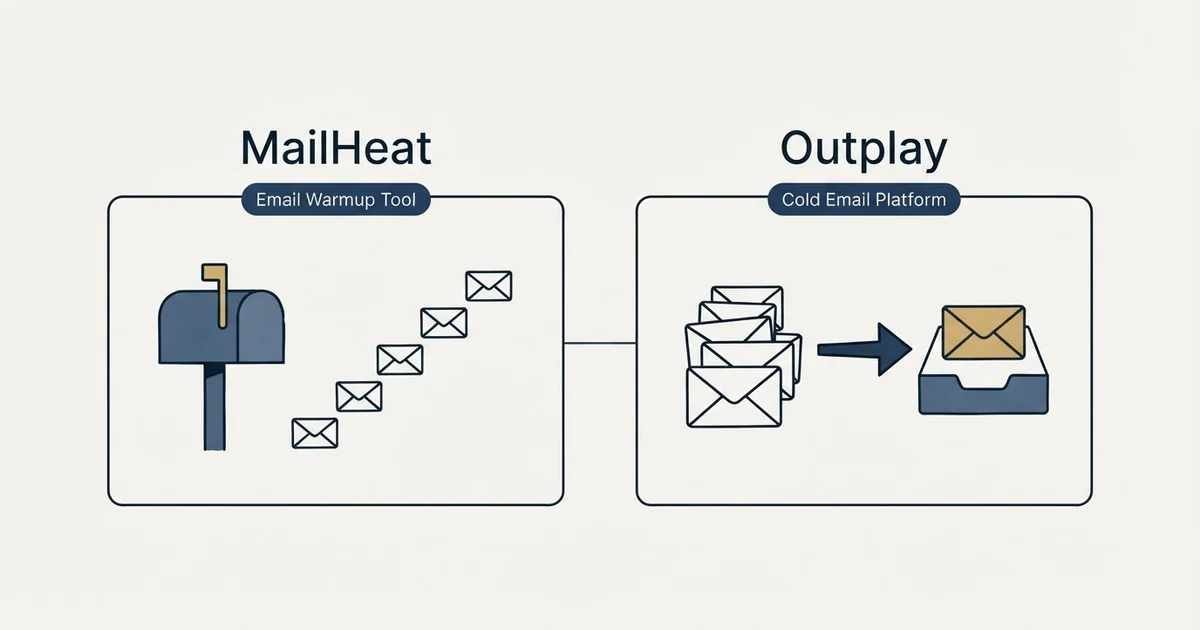
Compare MailHeat (email warmup tool) and Outplay (cold email platform) side by side. See pricing, features, and integrations to decide which one, or both, your stack needs.
Reviewed and updated September 5, 2026
MailHeat vs Outplay: Email Warmup Tool vs Cold Email Platform Comparison
MailHeat is an email warmup tool; Outplay is a cold email platform. Whether you need one, the other, or both depends on which part of the workflow you are buying for: email domain warming and deliverability on one side, cold email outreach on the other. This guide lays out what each vendor publishes.
The Quick Answer
MailHeat is an email warmup tool for email domain warming and deliverability; Outplay is a cold email platform for cold email outreach. By each vendor's own wording, MailHeat lists secure smtp connection and health & activity dashboard, and Outplay lists multi-channel outreach (email, phone, linkedin, sms, chat) and ai sequence writer.
Outplay offers a lower entry point at $0/mo compared to MailHeat at $69.99/mo.
If your priority is building sender reputation and improving inbox placement, MailHeat is the one built for it; for sending campaigns that land in the inbox and generate replies, that is Outplay. Many teams run one of each.
Understanding the Core Difference
MailHeat is Inbox warmup and deliverability platform that simulates the positive engagement mailbox providers reward across a warmup pool, with gradual pacing, a per-inbox health dashboard and deliverability expert consulting on the higher tiers.
Outplay is Multi-channel sales engagement platform with email sequences, dialer, LinkedIn automation, conversation intelligence, and AI SDR capabilities.
The two platforms take different approaches to solving the same core challenge.
Pricing Comparison
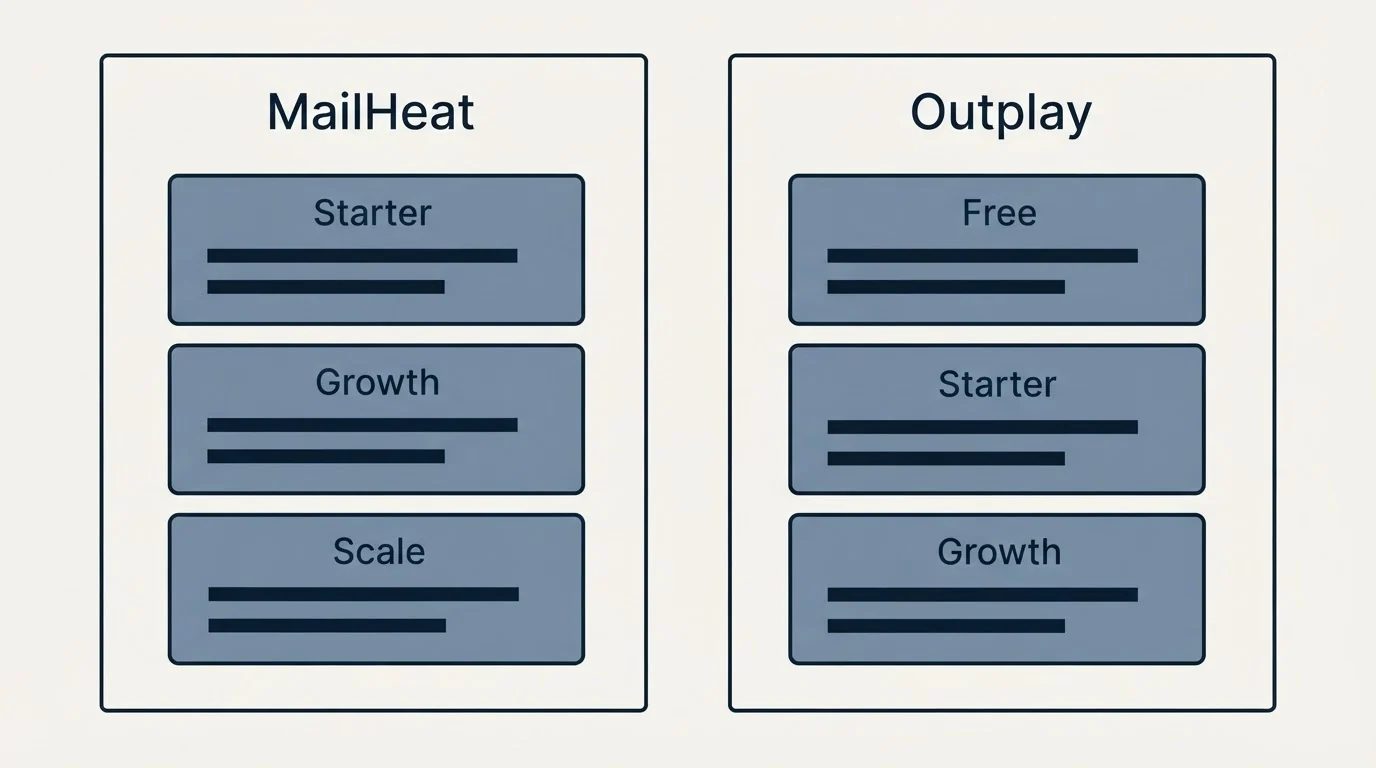
Starter
Free
MailHeat Pricing (as of September 2026)
| Plan | Price | Contacts | Emails |
|---|---|---|---|
| Starter | $69.99/mo | 1 account to warm (1 SMTP); 1 user | Up to 50 emails/day |
| Growth | $159.99/mo | Up to 3 accounts to warm (3 SMTPs); 2 users | Up to 200 emails/day per inbox |
| Scale | $479.99/mo | Up to 10 accounts to warm (10 SMTPs); 5 users | Up to 500 emails/day per inbox |
| Tailored Plan | Contact Sales | Unlimited accounts & SMTPs; unlimited users | Unlimited emails/day |
Source: MailHeat Pricing
Outplay Pricing (as of September 2026)
| Plan | Price | Contacts | Emails |
|---|---|---|---|
| Free | Free | 2000 Active Prospects per month | Unlimited |
| Starter | $39/mo | 5,000 active prospects/month | Unlimited |
| Growth | $89/mo | Unlimited | Unlimited |
| Enterprise | $139/mo | Unlimited | Unlimited |
| AI SDR | $99/mo | 1,000+ active prospects | Unlimited |
Source: Outplay Pricing
Pricing Analysis
Outplay offers the lower entry point ($0/mo vs $69.99/mo). Teams watching their budget will appreciate the savings, especially when starting out.
Outplay offers 5 pricing tiers compared to MailHeat's 4, giving you more granularity as you scale.
Outplay includes a free tier, which is helpful for evaluating the platform without upfront cost.
Features Breakdown
- Secure SMTP connection
- Health & activity dashboard
- Gradual warmup pacing
- Email & chat support
- Deliverability expert consulting
- Free Deliverability Audit
- and 2 more listed below
- Multi-channel outreach (email, phone, LinkedIn, SMS, chat)
- AI sequence writer
- Conversation intelligence
- Power dialer with auto voicemail drop
- Website visitor tracking
- A/B testing
- and 4 more listed below
MailHeat Key Features
- Secure SMTP connection
- Health & activity dashboard
- Gradual warmup pacing
- Email & chat support
- Deliverability expert consulting
- Free Deliverability Audit
- Success Manager
- Free tools
Outplay Key Features
- Multi-channel outreach (email, phone, LinkedIn, SMS, chat)
- AI sequence writer
- Conversation intelligence
- Power dialer with auto voicemail drop
- Website visitor tracking
- A/B testing
- Auto email rotation
- Spintax support
- AI objection handling
- Chrome extension
The two lists below are a diff of each vendor's own feature list by exact wording, so a capability both tools offer can appear on either side under a different name.
Listed only by MailHeat
- Secure SMTP connection
- Health & activity dashboard
- Gradual warmup pacing
- Email & chat support
- Deliverability expert consulting
- Free Deliverability Audit
- Success Manager
- Free tools
Listed only by Outplay
- Multi-channel outreach (email, phone, LinkedIn, SMS, chat)
- AI sequence writer
- Conversation intelligence
- Power dialer with auto voicemail drop
- Website visitor tracking
- A/B testing
- Auto email rotation
- Spintax support
- AI objection handling
- Chrome extension
Integration Ecosystem
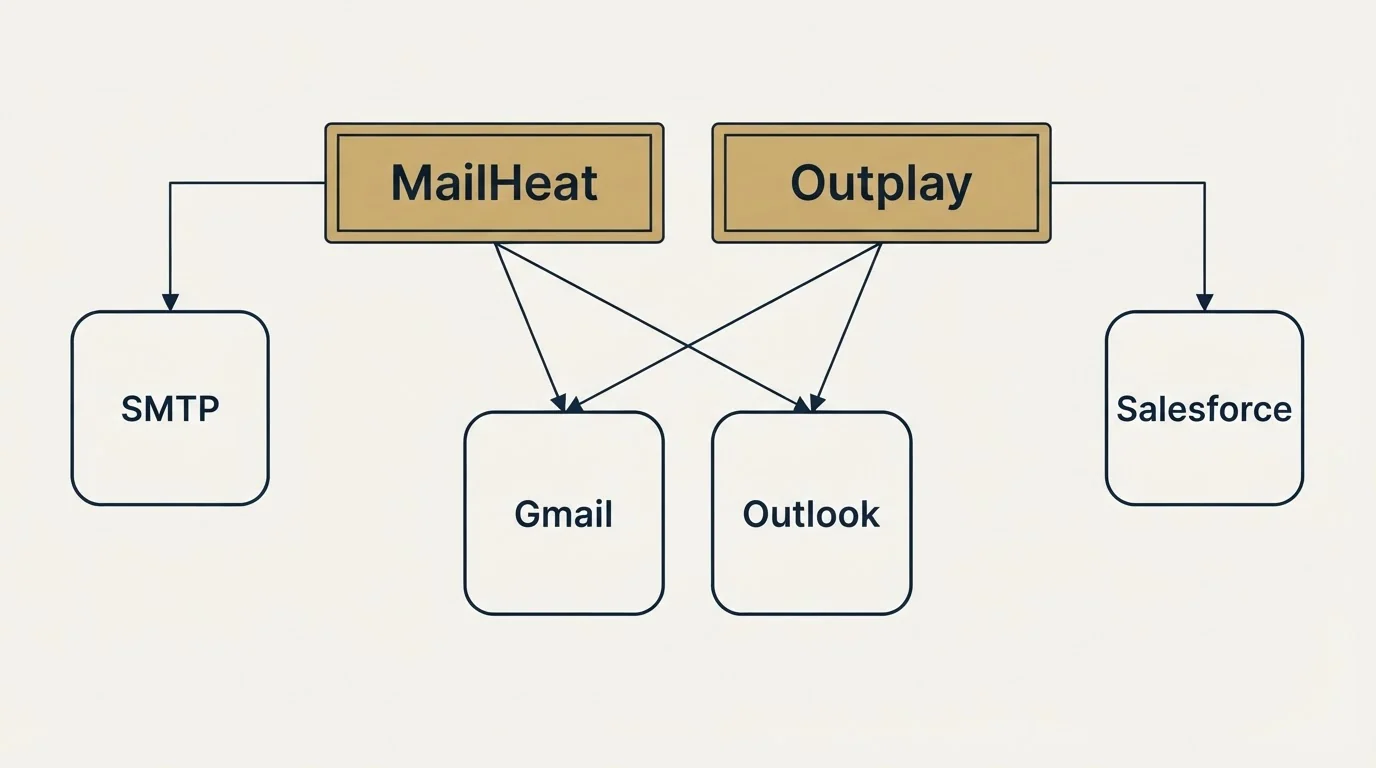
MailHeat Integrations
MailHeat connects with: SMTP, Gmail, Google Workspace, Microsoft 365, Outlook.
Outplay Integrations
Outplay connects with: Salesforce, HubSpot, Pipedrive, Microsoft Dynamics 365, Gmail, Outlook, Zapier, Slack, Calendly.
Shared Integrations
Both tools integrate with: Gmail, Outlook.
Integrations listed only by MailHeat: SMTP, Google Workspace, Microsoft 365.
Integrations listed only by Outplay: Salesforce, HubSpot, Pipedrive, Microsoft Dynamics 365, Zapier, Slack, Calendly.
Use Case Recommendations
Best Fit for MailHeat
- Enterprise buyers who prefer custom pricing and dedicated support
- Teams launching new email domains for outreach
- Organizations recovering from deliverability issues
- Agencies managing warmup across multiple client domains
Best Fit for Outplay
- Budget-conscious teams looking for an affordable cold email platform
- Teams that need a wide feature set (10 capabilities listed)
- Organizations with complex tech stacks needing broad integration support (9 integrations)
- Teams that want to start free and scale up as needs grow
Feature Comparison Summary
| Feature | MailHeat | Outplay |
|---|---|---|
| Starting Price | $69.99/mo | Free |
| Top Tier Price | Contact Sales | $99/mo |
| Total Features Listed | 8 | 10 |
| Integrations | 5 | 9 |
| Founded | N/A | 2019 |
Getting Started Checklist
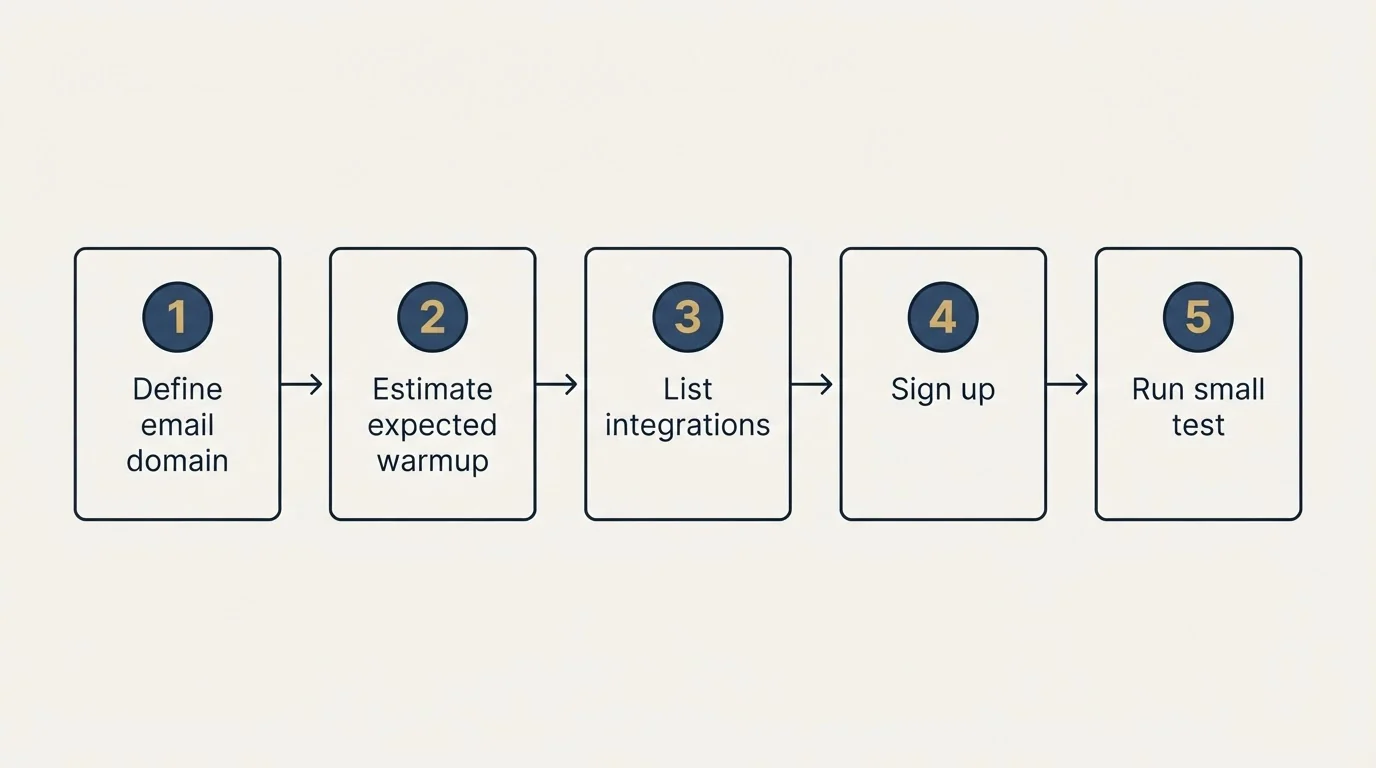
- Define your email domain warming and deliverability and cold email outreach requirements and monthly budget
- Estimate your expected warmup email volume and email sending volume to find the right tier
- List the integrations your team currently relies on
- Sign up for free trials or demos of both platforms
- Run a small test with each tool before making a commitment
- Evaluate the onboarding experience and support quality
Final Thoughts
MailHeat serves the email domain warming and deliverability side of an outbound stack and Outplay the cold email outreach side. Outplay offers a more accessible entry point, while MailHeat starts at $69.99/mo. Your decision should weigh pricing against the specific features that matter most for your workflow.
Start with a trial of each to see which platform fits your team's daily process. The best tool is the one your team actually uses consistently.
Pricing and features verified as of September 2026. Visit MailHeat and Outplay for current information.
About the author.

Tim Carden is CMO / CTO at RevenueFlow, which builds and operates outbound revenue engines for B2B companies. Studied at McGill University.
Tim Carden · CMO / CTO
Connect on LinkedIn →Explore more.
Ready to scale your outreach?
We build GTM engines that book real meetings. See the receipts.
Related articles.
Growbots vs MailHeat: Cold Email Platform vs Email Warmup Tool Comparison
Compare Growbots (cold email platform) and MailHeat (email warmup tool) side by side. See pricing, features, and integrations to decide which one, or both, your stack needs.
GetSales.io vs Yet Another Mail Merge: Sales Engagement Platform vs Cold Email Platform Comparison
Compare GetSales.io (sales engagement platform) and Yet Another Mail Merge (cold email platform) side by side. See pricing, features, and integrations to decide which one, or both, your stack needs.
Enginy vs Success.ai: Sales Engagement Platform vs Cold Email Platform Comparison
Compare Enginy (sales engagement platform) and Success.ai (cold email platform) side by side. See pricing, features, and integrations to decide which one, or both, your stack needs.
Artisan vs Yet Another Mail Merge: Sales Engagement Platform vs Cold Email Platform Comparison
Compare Artisan (sales engagement platform) and Yet Another Mail Merge (cold email platform) side by side. See pricing, features, and integrations to decide which one, or both, your stack needs.
Hexospark vs JustCall: Cold Email Platform vs Sales Engagement Platform Comparison
Compare Hexospark (cold email platform) and JustCall (sales engagement platform). See pricing, features, and integrations to decide which one, or both, your stack needs.
EmailBison vs Emelia: Cold Email Platform Comparison
Compare EmailBison and Emelia side by side. See pricing, features, and integrations to choose the right cold email platform for your needs.