Reply.io vs Vocus.io: Cold Email Platform Comparison
Compare Reply.io and Vocus.io side by side. See pricing, features, and integrations to choose the right cold email platform for your needs.

Reply.io and Vocus.io are both cold email outreach platforms, but they differ sharply on price and focus. Reply.io starts at $59/mo with 1 billion B2B contacts, AI SDR capabilities, and 9 integrations. Vocus.io starts at $5/mo with 10 listed features and 6 integrations built for Gmail and Google Workspace users.
Key takeaways
- Reply.io's entry plan costs $59/mo for 1,000 active contacts with unlimited emails, while Vocus.io's Basic plan costs $5/mo with 5 inboxes and 50 followups.
- Reply.io's top tier, AI SDR Starter, costs $800/mo, compared to Vocus.io's top tier, Growth, at $80/mo.
- Reply.io lists 9 features including unlimited email warmup and a 1 billion B2B contacts database, while Vocus.io lists 10 features including templates & snippets and branded URLs.
- Reply.io integrates with 9 tools including HubSpot, Copper CRM, and Zendesk Sell, while Vocus.io integrates with 6 tools including Gmail and Google Workspace.
- Salesforce, Pipedrive, and Zapier are integrations shared by both Reply.io and Vocus.io.
Reviewed and updated September 2, 2026
Reply.io vs Vocus.io: Cold Email Platform Comparison
If you are comparing cold email outreach tools, Reply.io and Vocus.io will likely both appear on your radar. They share some surface-level similarities, but the details reveal important differences in pricing, capability, and target audience.
The Quick Answer
By each vendor's own wording, Reply.io lists unlimited email warmup and 1 billion b2b contacts database, while Vocus.io lists email tracking and templates & snippets. A capability both offer can appear under different names, so read both feature lists below.
Vocus.io offers a lower entry point at $5/mo compared to Reply.io at $59/mo.
If your priority is sending campaigns that land in the inbox and generate replies, both tools target it. The right choice depends on your budget, team size, and the specific capabilities you need most.
Understanding the Core Difference
Reply.io is AI-powered sales engagement platform with 1B+ B2B contacts, multichannel sequences, and AI SDR capabilities.
Vocus.io is Email outreach platform for Gmail and Google Workspace. Sends personalized mass campaigns with automated follow-ups, tracks opens and link clicks per recipient, shares templates across a team and logs activity to a CRM.
The two platforms take different approaches to solving the same core challenge.
Pricing Comparison
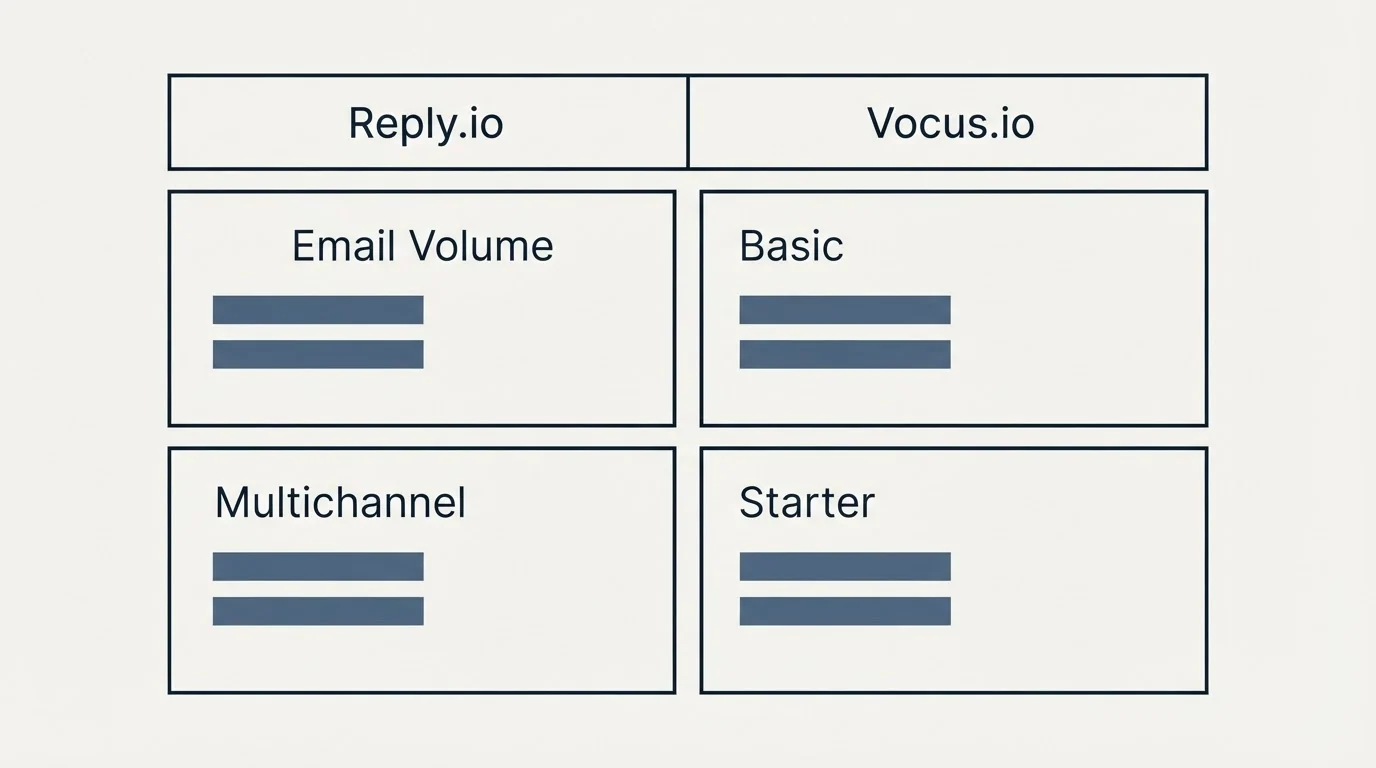
Email Volume
Basic
Reply.io Pricing (as of September 2026)
| Plan | Price | Contacts | Emails |
|---|---|---|---|
| Email Volume | $59/mo | 1,000 active contacts | Unlimited |
| Multichannel | $99/mo | Unlimited active contacts | Unlimited emails; 10 mailboxes |
| Agency Core | $210/mo | Unlimited clients & users | Unlimited mailboxes |
| AI SDR Starter | $800/mo | 1,000 active contacts | Unlimited mailboxes & warm-ups |
Source: Reply.io Pricing
Vocus.io Pricing (as of September 2026)
| Plan | Price | Contacts | Emails |
|---|---|---|---|
| Basic | $5/mo | 5 Inboxes; 50 Snippets | 50 Followups |
| Starter | $10/mo | 5 Inboxes; 100 Snippets | 100 Followups |
| Professional | $20/mo | 10 Inboxes; 200 Snippets | 500 Followups |
| Growth | $80/mo | 800 snippets | external SMTP support |
Source: Vocus.io Pricing
Pricing Analysis
Vocus.io offers the lower entry point ($5/mo vs $59/mo). Teams watching their budget will appreciate the savings, especially when starting out.
Features Breakdown
- Unlimited email warmup
- 1 billion B2B contacts database
- Anti-spam & deliverability suite
- LinkedIn automation (add-on)
- SMS and calls (add-on)
- AI personalization
- and 3 more listed below
- Email tracking
- Templates & Snippets
- Send Later & Snooze
- Automated Followups
- Salesforce & CRM Integration
- Campaigns
- and 4 more listed below
Reply.io Key Features
- Unlimited email warmup
- 1 billion B2B contacts database
- Anti-spam & deliverability suite
- LinkedIn automation (add-on)
- SMS and calls (add-on)
- AI personalization
- AI SDR capabilities
- Multi-workspace for agencies
- 14-day free trial
Vocus.io Key Features
- Email tracking
- Templates & Snippets
- Send Later & Snooze
- Automated Followups
- Salesforce & CRM Integration
- Campaigns
- Campaigns w/ Followups
- Campaigns w/ Attachments
- Branded URLs
- Teams
The two lists below are a diff of each vendor's own feature list by exact wording, so a capability both tools offer can appear on either side under a different name.
Listed only by Reply.io
- Unlimited email warmup
- 1 billion B2B contacts database
- Anti-spam & deliverability suite
- LinkedIn automation (add-on)
- SMS and calls (add-on)
- AI personalization
- AI SDR capabilities
- Multi-workspace for agencies
- 14-day free trial
Listed only by Vocus.io
- Email tracking
- Templates & Snippets
- Send Later & Snooze
- Automated Followups
- Salesforce & CRM Integration
- Campaigns
- Campaigns w/ Followups
- Campaigns w/ Attachments
- Branded URLs
- Teams
Integration Ecosystem
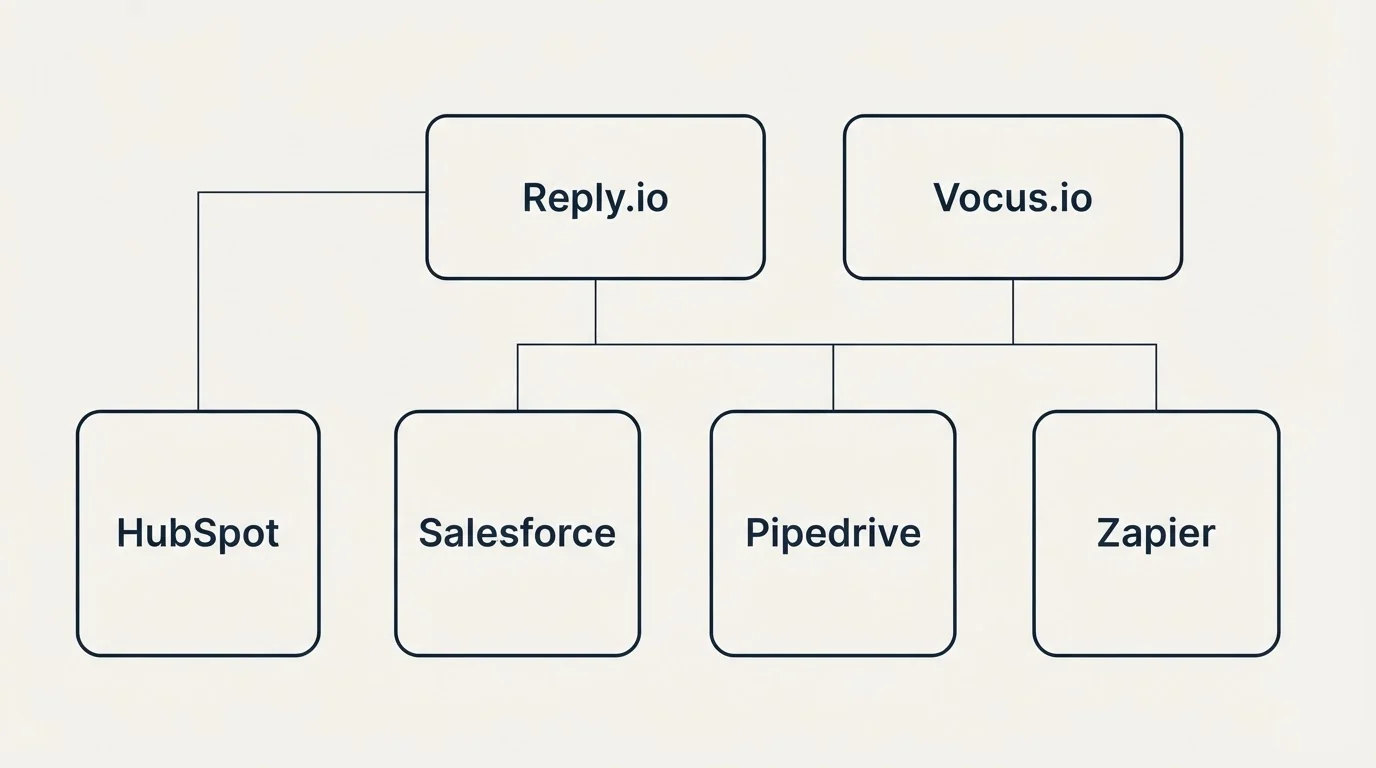
Reply.io Integrations
Reply.io connects with: HubSpot, Salesforce, Pipedrive, Copper CRM, Zendesk Sell, Close, Zapier, Make, n8n.
Vocus.io Integrations
Vocus.io connects with: Gmail, Google Workspace, Salesforce, Pipedrive, Zapier, Webhooks.
Shared Integrations
Both tools integrate with: Salesforce, Pipedrive, Zapier.
Integrations listed only by Reply.io: HubSpot, Copper CRM, Zendesk Sell, Close, Make, n8n.
Integrations listed only by Vocus.io: Gmail, Google Workspace, Webhooks.
Use Case Recommendations
Best Fit for Reply.io
- Organizations with complex tech stacks needing broad integration support (9 integrations)
- Sales teams running high-volume outbound email campaigns
- Agencies managing multiple client outreach programs
- SDR teams focused on pipeline generation
Best Fit for Vocus.io
- Budget-conscious teams looking for an affordable cold email platform
- Teams that need a wide feature set (10 capabilities listed)
- Sales teams running high-volume outbound email campaigns
- Agencies managing multiple client outreach programs
Feature Comparison Summary
| Feature | Reply.io | Vocus.io |
|---|---|---|
| Starting Price | $59/mo | $5/mo |
| Top Tier Price | $800/mo | $80/mo |
| Total Features Listed | 9 | 10 |
| Integrations | 9 | 6 |
Getting Started Checklist
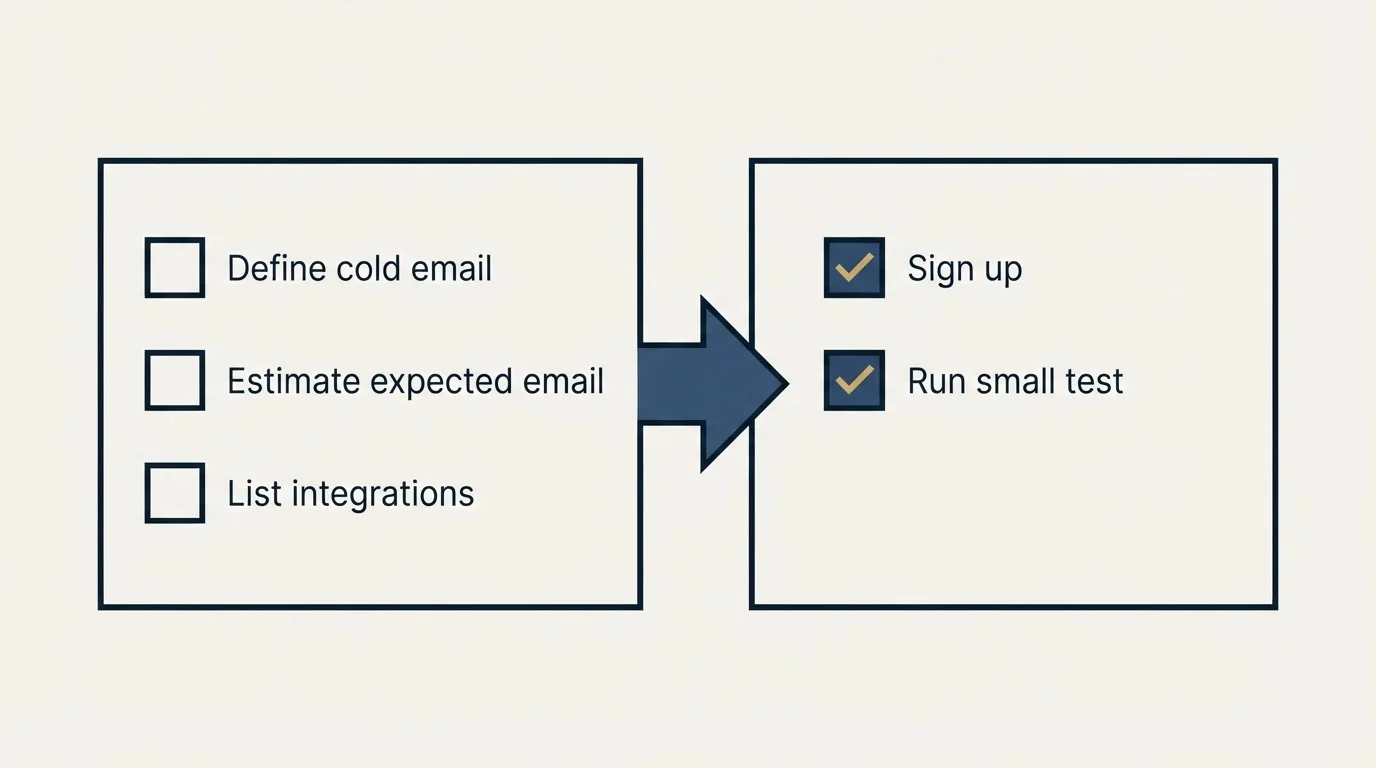
- Define your cold email outreach requirements and monthly budget
- Estimate your expected email sending volume to find the right tier
- List the integrations your team currently relies on
- Sign up for free trials or demos of both platforms
- Run a small test with each tool before making a commitment
- Evaluate the onboarding experience and support quality
Final Thoughts
Reply.io and Vocus.io both serve the cold email outreach market. Vocus.io offers a more accessible entry point at $5/mo, while Reply.io starts at $59/mo. Your decision should weigh pricing against the specific features that matter most for your workflow.
Start with a trial of each to see which platform fits your team's daily process. The best tool is the one your team actually uses consistently.
Pricing and features verified as of September 2026. Visit Reply.io and Vocus.io for current information.
Frequently asked questions.
Frequently asked questions- Which is cheaper, Reply.io or Vocus.io?
- Vocus.io is cheaper at the entry level, starting at $5/mo compared to Reply.io's $59/mo starting price. At the top tier, Vocus.io's Growth plan is $80/mo, while Reply.io's AI SDR Starter plan reaches $800/mo.
- What is the main difference between Reply.io and Vocus.io?
- Reply.io is an AI-powered sales engagement platform with over 1 billion B2B contacts, multichannel sequences, and AI SDR capabilities, while Vocus.io is an email outreach platform built specifically for Gmail and Google Workspace with tracking, templates, and automated followups.
- Does Reply.io or Vocus.io have more integrations?
- Reply.io has more integrations, listing 9 total including HubSpot, Salesforce, Pipedrive, Copper CRM, Zendesk Sell, Close, Zapier, Make, and n8n. Vocus.io lists 6 integrations, including Gmail, Google Workspace, Salesforce, Pipedrive, Zapier, and Webhooks.
- Which tool is better for agencies managing multiple clients?
- Both are recommended for agencies managing multiple client outreach programs, according to the article's use case recommendations. Reply.io additionally offers an Agency Core plan at $210/mo with unlimited clients and users and multi-workspace support.
- Which platform has more listed features, Reply.io or Vocus.io?
- Vocus.io lists 10 total features, one more than Reply.io's 9. Vocus.io's list includes campaigns, automated followups, and Salesforce & CRM integration, while Reply.io's list includes AI personalization, AI SDR capabilities, and a 1 billion B2B contacts database.
About the author.

Tim Carden is CMO / CTO at RevenueFlow, which builds and operates outbound revenue engines for B2B companies. Studied at McGill University.
Tim Carden · CMO / CTO
Connect on LinkedIn →Explore more.
Ready to scale your outreach?
We build GTM engines that book real meetings. See the receipts.
Related articles.
GetSales.io vs Yet Another Mail Merge: Sales Engagement Platform vs Cold Email Platform Comparison
Compare GetSales.io (sales engagement platform) and Yet Another Mail Merge (cold email platform) side by side. See pricing, features, and integrations to decide which one, or both, your stack needs.
Enginy vs Success.ai: Sales Engagement Platform vs Cold Email Platform Comparison
Compare Enginy (sales engagement platform) and Success.ai (cold email platform) side by side. See pricing, features, and integrations to decide which one, or both, your stack needs.
Artisan vs Yet Another Mail Merge: Sales Engagement Platform vs Cold Email Platform Comparison
Compare Artisan (sales engagement platform) and Yet Another Mail Merge (cold email platform) side by side. See pricing, features, and integrations to decide which one, or both, your stack needs.
Growbots vs MailHeat: Cold Email Platform vs Email Warmup Tool Comparison
Compare Growbots (cold email platform) and MailHeat (email warmup tool) side by side. See pricing, features, and integrations to decide which one, or both, your stack needs.
Hexospark vs JustCall: Cold Email Platform vs Sales Engagement Platform Comparison
Compare Hexospark (cold email platform) and JustCall (sales engagement platform). See pricing, features, and integrations to decide which one, or both, your stack needs.
EmailBison vs Emelia: Cold Email Platform Comparison
Compare EmailBison and Emelia side by side. See pricing, features, and integrations to choose the right cold email platform for your needs.