Cold Email for Assessments: Complete Strategy Guide
Learn how to use cold email to offer and book assessments with prospective clients. Includes proven templates, targeting strategies, and best practices for consultants and service providers.
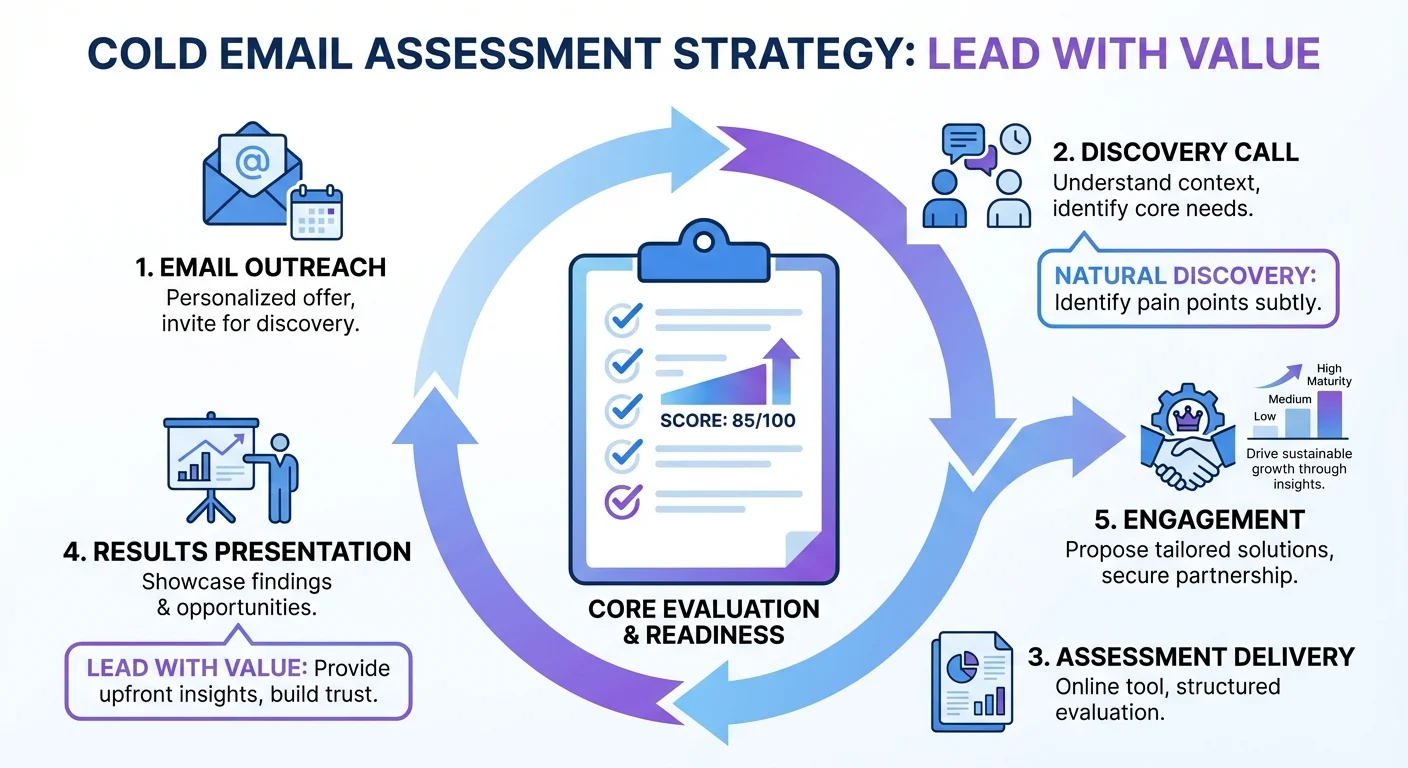
Cold email for assessments works by leading with diagnostic value rather than a sales pitch. Target decision-makers at companies large enough to have the complexity your assessment addresses, using maturity, readiness, capability, gap, or risk assessment frameworks. Design assessments that balance value to the prospect with sustainable delivery effort for you. The assessment format generates higher response rates because it provides concrete deliverables before any purchase decision, naturally reveals prospect needs during the evaluation process, and creates engagement that positions you for follow-on work.
Key takeaways
- Assessments generate higher cold email response rates than typical sales messages because they lead with diagnostic value and concrete deliverables before any purchase decision.
- Five main assessment types work for cold outreach: maturity assessments, readiness assessments, capability assessments, gap assessments, and risk assessments.
- Strong assessments include a structured questionnaire, scoring methodology, benchmarking data, findings summary, specific recommendations, and a suggested implementation roadmap.
- Target prospects at companies large enough to have relevant complexity, with budget capacity to act on recommendations, and contacts who have functional ownership over the assessed area.
- Delivery formats range from self-service online questionnaires with automated scoring to interview-based assessments, with hybrid approaches balancing scalability and personalization.
Reviewed and updated September 15, 2026
Cold Email for Assessments: Complete Strategy Guide
Assessments have become one of the most effective lead generation tools for B2B companies. Whether you offer readiness assessments, maturity assessments, capability assessments, or diagnostic evaluations, the assessment format creates value for prospects while simultaneously qualifying them for your services.
Cold email provides a direct channel to reach decision-makers with assessment offers. When positioned correctly, assessment outreach generates higher response rates than typical sales messages because it leads with diagnostic value rather than a pitch.
This guide covers everything you need to know about using cold email to book assessments, from designing your assessment offer to converting assessment participants into clients.
Why Cold Email Works for Assessment Offers
Assessments occupy a unique position in the B2B sales process. They provide measurable value to prospects while giving you detailed information about their needs and readiness to buy.
Lead with value. An assessment offers concrete deliverables before any purchase decision. This builds trust and reduces perceived risk.
Natural discovery. The assessment process reveals detailed information about prospect needs, priorities, and budget without aggressive qualification questions.
Expertise demonstration. A well-designed assessment showcases your methodology and knowledge more effectively than any pitch deck.
Engagement creation. Assessments require participation, creating investment and engagement that casual conversations don't achieve.
Competitive positioning. While others send generic outreach, your assessment offer provides immediate, tangible value.
Designing Your Assessment Offer
Before sending outreach, you need a clear, valuable assessment that you can deliver efficiently.
Assessment Types
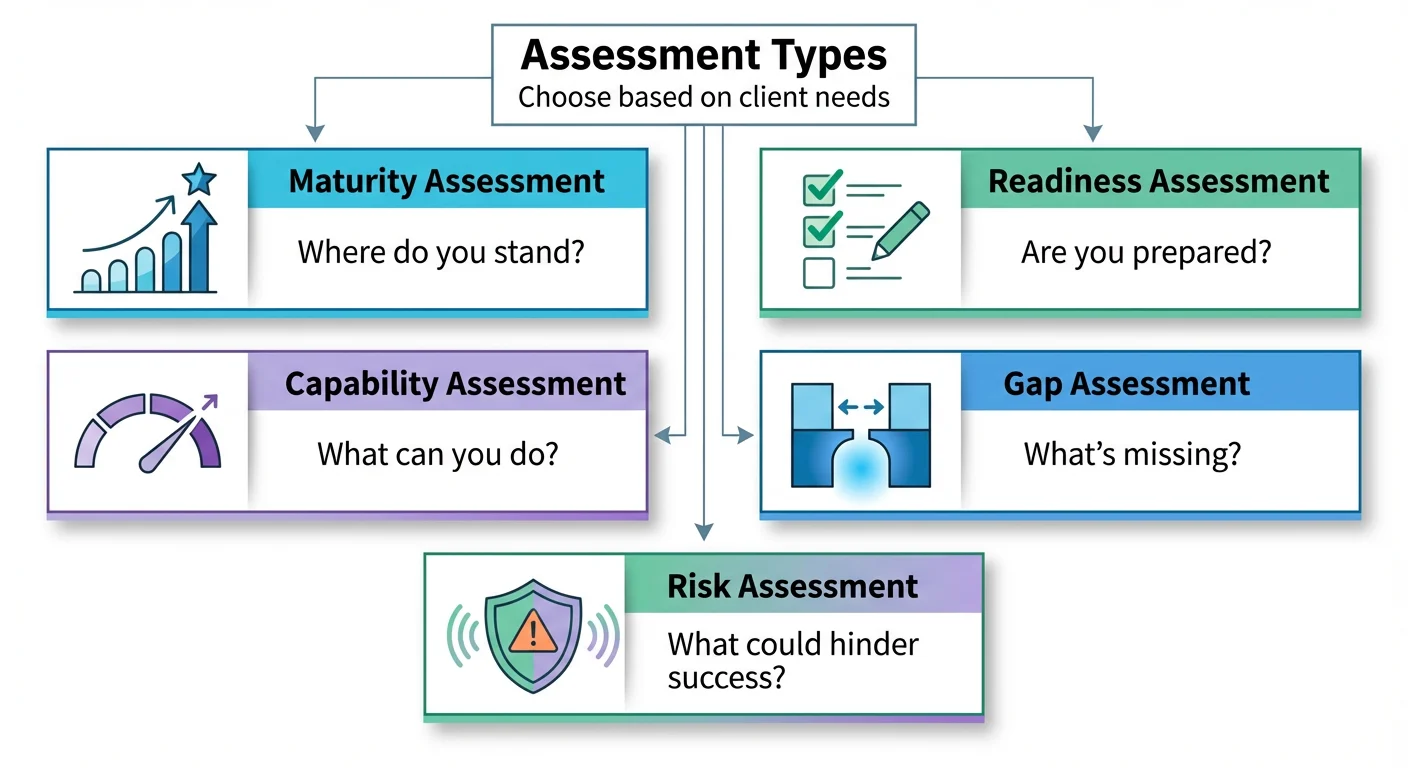
Maturity assessments. Evaluate where the organization stands on a maturity curve (e.g., digital maturity, security maturity, data maturity).
Readiness assessments. Determine whether the organization is prepared for a specific initiative, change, or implementation.
Capability assessments. Evaluate specific capabilities or competencies against benchmarks or requirements.
Gap assessments. Identify differences between current state and desired state across defined dimensions.
Risk assessments. Evaluate exposure to specific types of risk and prioritize mitigation efforts.
Assessment Components
A strong assessment typically includes:
Structured questionnaire. Questions designed to reveal the prospect's current state across relevant dimensions.
Scoring methodology. A framework that translates responses into meaningful scores or ratings.
Benchmarking. Comparison to industry standards, best practices, or peer organizations.
Findings summary. Clear articulation of what the assessment revealed.
Recommendations. Specific, prioritized actions based on assessment results.
Roadmap. Suggested sequence and timeline for addressing identified gaps.
Assessment Delivery Format
Consider how you'll deliver the assessment:
Self-service. Online questionnaire with automated scoring. Highest scale, lowest personalization.
Guided. Questionnaire completed with your guidance via call. More personal, moderate scale.
Interview-based. Discovery conversation using assessment framework. Most personal, lowest scale.
Hybrid. Self-service questionnaire followed by review call. Balances scale and personalization.
Balancing Value and Effort
The assessment should be valuable enough to attract interest but efficient enough to deliver sustainably:
Time investment. Define how much time you'll spend per assessment. This affects capacity and positioning.
Depth vs. breadth. A focused assessment on one area may be more valuable than a shallow review of many.
Deliverable quality. The assessment report should be professional and actionable.
Scalability. Consider how many assessments you can deliver per week or month.
Identifying Ideal Assessment Prospects
Assessments require significant effort. Targeting the right prospects ensures your investment generates quality opportunities.
Company Characteristics
Size and complexity. Organizations must be large enough to have the complexity your assessment addresses.
Budget capacity. The prospect should be able to act on recommendations, either independently or with your help.
Growth or change stage. Companies at inflection points often recognize the need for assessment.
Industry fit. Your assessment methodology should be relevant to their industry context.
Problem awareness. Some awareness of potential gaps makes prospects more receptive to assessment offers.
Contact Characteristics
Functional ownership. Target the person responsible for the area your assessment evaluates.
Authority level. They should be able to authorize follow-on work based on assessment findings.
Improvement orientation. Look for contacts who value data-driven improvement and external perspective.
Strategic role. People responsible for planning and strategy often value assessment insights.
Timing Signals
Planning cycles. Budget planning periods are natural times for assessment and prioritization.
Leadership changes. New leaders often want baseline assessments of their areas.
Strategic initiatives. Major initiatives often require readiness or capability assessments.
Competitive pressure. Market changes that threaten competitive position may prompt evaluation.
Building Your Assessment Prospect List
Quality data ensures your assessment offers reach receptive audiences.
Data Sources
LinkedIn Sales Navigator. Filter by company characteristics, job titles, and engagement signals.
Industry databases. ZoomInfo, Apollo, and similar tools provide company and contact information.
Event attendees. Conference and webinar participants often represent engaged professionals.
Content engagers. People who download related content or engage with relevant topics may be receptive.
Industry associations. Members of professional associations often value continuous improvement.
Segmentation for Personalization
Segment your list to enable relevant messaging:
By company size. Enterprise and SMB prospects have different assessment needs and concerns.
By industry. Industry-specific context makes assessment offers more relevant.
By role. Different roles care about different aspects of assessment findings.
By assessment type. If you offer multiple assessments, match prospects to the most relevant option.
Email Verification
Verify all addresses before sending:
Verification services. Use tools like NeverBounce or ZeroBounce to validate addresses.
Domain checks. Ensure target domains have valid email infrastructure.
List maintenance. Remove invalid addresses and previous bounces.
Crafting Assessment Cold Emails
Your email needs to communicate the assessment offer clearly while establishing credibility and relevance.
Subject Line Strategies
Subject lines should create interest and communicate value:
Effective patterns:
- "Free [Type] Assessment for [Company]"
- "[Type] Maturity: Where does [Company] stand?"
- "Complimentary [Type] evaluation"
- "[Name], [Type] benchmark opportunity"
Avoid:
- Generic subjects that don't communicate the offer
- Misleading subjects that don't match content
- Overly long subjects that get truncated
- Aggressive sales language
Email Structure
Opening (1-2 sentences). Reference something specific about the prospect or company that establishes relevance.
Problem or opportunity framing (2-3 sentences). Articulate why assessment matters in their context. What questions should they be able to answer?
Assessment offer (2-3 sentences). Present the assessment clearly: what it evaluates, how it works, and what they receive.
Value statement (1-2 sentences). Explain what they gain from participating regardless of next steps.
Credibility (1 sentence). Brief mention of relevant experience, methodology, or clients.
Call to action (1 sentence). Clear next step, typically a brief call to explain the assessment process and qualify fit.
Tone and Positioning
Educational rather than salesy. Position the assessment as a learning opportunity, not a sales tactic.
Expert perspective. You're offering specialized methodology and benchmarking they couldn't access otherwise.
No pressure. Make clear the assessment is valuable regardless of whether they engage further.
Professional authority. Convey confidence in your assessment methodology and expertise.
Assessment Email Templates
Template 1: Maturity Assessment
Subject: [Type] Maturity Assessment for [Company]
Hi [Name],
I work with [role type] at [company type] companies to help them understand where they stand on [type] maturity and what it would take to improve.
Most organizations I assess have significant gaps between their current state and where they want to be, but they don't have clear visibility into exactly where those gaps are or how to prioritize addressing them.
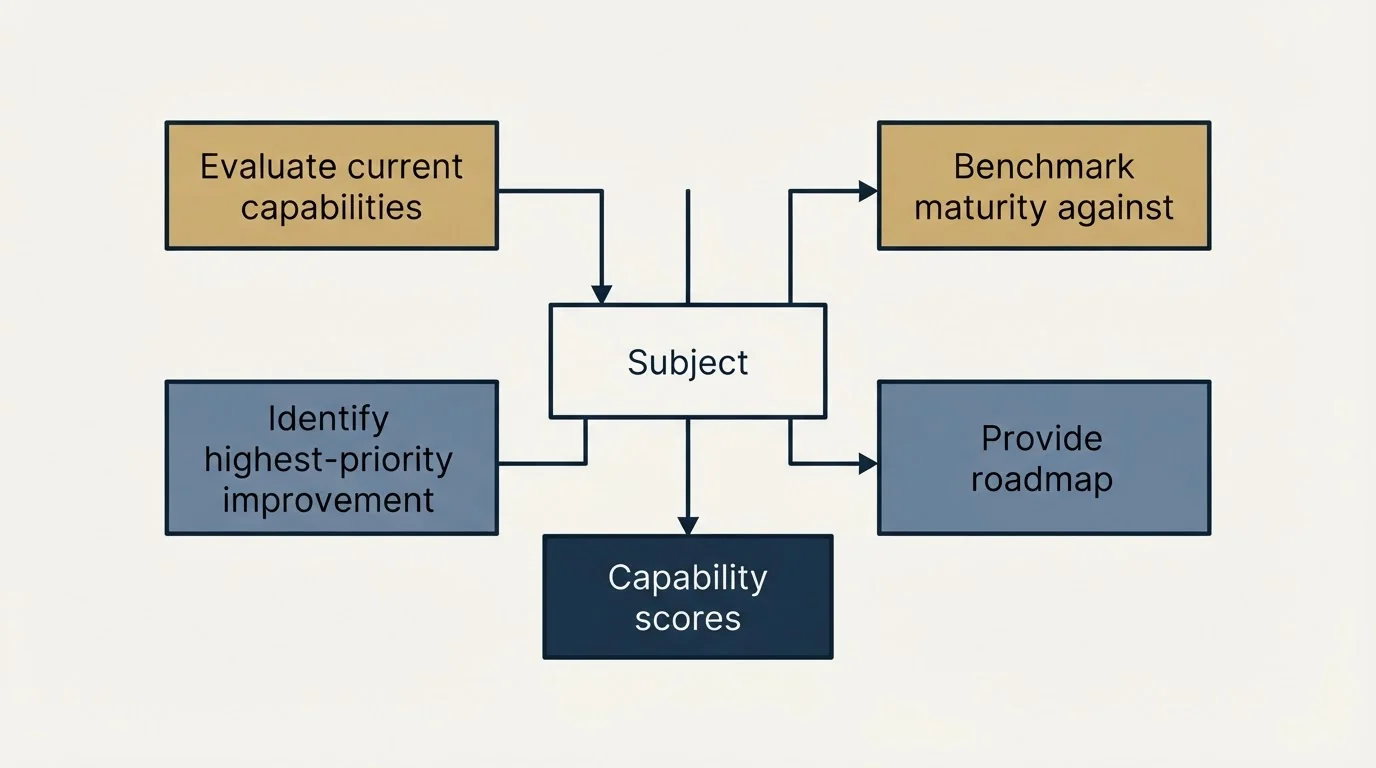
I'm offering a complimentary [Type] Maturity Assessment for [Company] that would:
- Evaluate your current capabilities across [number] key dimensions
- Benchmark your maturity against industry standards
- Identify your highest-priority improvement opportunities
- Provide a roadmap for advancing to the next maturity level
The assessment takes about [time] of your time and delivers a detailed report you can act on immediately.
I've conducted similar assessments for [client type], including [example]. Would this be valuable for [Company]?
If so, let's schedule a 15-minute call to discuss the process. [Calendar Link]
Best, [Your Name] [Title/Company]
Template 2: Readiness Assessment
Subject: [Initiative] readiness: is [Company] prepared?
Hi [Name],
Companies pursuing [initiative type] often underestimate what's required for success. The [statistic] failure rate isn't due to bad strategy; it's usually due to readiness gaps that weren't identified early enough.
I offer a complimentary [Initiative] Readiness Assessment that evaluates whether organizations have the [prerequisites: people, processes, technology, culture] in place to succeed. The assessment covers:
- [Readiness dimension 1]
- [Readiness dimension 2]
- [Readiness dimension 3]
- [Readiness dimension 4]
You'll receive a detailed readiness score with specific recommendations for addressing any gaps before they derail your initiative.
Given [Company]'s [relevant context], this might be useful timing. Would a 15-minute call to discuss the assessment be helpful?
[Your Name] [Title/Company]
Template 3: Capability Assessment
Subject: [Capability] evaluation for [Industry] companies
Hi [Name],
[Capability area] has become a competitive differentiator in [industry]. Companies that excel at it [positive outcome], while those with gaps [negative consequence].
I've developed a [Capability] Assessment that evaluates organizational capabilities across [number] dimensions and benchmarks results against [industry/peer] standards. Participants receive:
- Capability scores across key dimensions
- Comparison to industry benchmarks
- Gap analysis with prioritized recommendations
- Development roadmap
The assessment is complimentary and takes about [time] to complete. I've used it with [number] organizations, including [client examples].
Would it be useful to understand where [Company]'s [capability] stands relative to peers? I'm happy to explain the assessment process in a brief call.
[Your Name] [Title/Company]
Template 4: Benchmarking Focus
Subject: How does [Company] compare to [Industry] leaders?
Hi [Name],
I've assessed [capability/area] at [number] companies in [industry] over the past [timeframe]. The patterns are clear: leaders consistently [characteristic], while laggards struggle with [weakness].
I'd like to offer [Company] a complimentary assessment that shows exactly where you stand relative to these benchmarks. The assessment evaluates:
- [Dimension 1]
- [Dimension 2]
- [Dimension 3]
You'll receive a detailed report showing your scores, how they compare to the benchmark population, and specific recommendations for improvement.
This isn't a sales pitch. It's useful data you can act on regardless of whether we work together.
Interested? Here's my calendar: [Link]
[Your Name] [Title/Company]
Template 5: Trigger-Based
Subject: Assessment timing for [Company]
Hi [Name],
Congratulations on [trigger: funding, acquisition, new initiative, expansion]. That kind of [growth/change] often reveals [gaps/needs] that weren't visible before.
I offer a complimentary [Type] Assessment designed specifically for organizations in your situation. It evaluates:
- Current state across [key dimensions]
- Gaps that typically emerge during [trigger type]
- Priority areas for immediate attention
- Longer-term development recommendations
Companies like [similar company] have found this assessment valuable for [specific benefit] after [similar trigger].
Would it be useful to have this baseline as [Company] moves forward? I can explain the assessment process in a 15-minute call.
[Your Name] [Title/Company]
Where we differ from standard practice

Much of the advice on this page reflects how outbound is commonly run. We run it differently, and since this page sits on our site it is worth saying where the difference is and what it costs us.
- A sequence of messages to each prospect over several weeks
- Later messages often land in the same email thread
- Every contact is reached more than once, so a distracted reader gets another chance
- The later messages go only to people who did not answer the first
- Reputation cost accrues on the sending domain across everything else it sends
- One message, then that campaign is finished for that contact
- No thread replies and no bumps
- A non-responding audience becomes a new campaign with a genuinely different premise, not a reminder
- More of the work moves into targeting and into the one message
- We reach each contact less often, and that is the cost we accept
The reasoning is mechanical rather than moral. A follow-up arrives underneath a message the recipient has already seen and chosen not to answer, so it is delivered to the population most likely to mark it as spam, and the reputation cost of that lands on the sending domain across every campaign running on it. We set that cost against the replies a sequence recovers and decided the trade was not worth it. The full argument, with the numbers from our own campaigns, is in why we stopped using follow-ups.
Follow-Up Sequences
Assessment offers typically generate strong interest, but follow-up remains important for maximizing response rates.
Sequence Structure
Email 2 (4-5 days later). Add value with a relevant insight, case study, or benchmark data point.
Email 3 (5-7 days later). Emphasize a different aspect of the assessment or try a different angle.
Email 4 (7-10 days later). Brief, respectful close leaving the door open.
Follow-Up Templates
Follow-up 1:
Hi [Name],
Following up on my offer of a complimentary [Type] Assessment for [Company].
One thing I should mention: the assessment includes benchmarking against [number] other [industry/company type] organizations. This comparative data alone is often valuable for understanding where to focus improvement efforts.
Still happy to schedule if useful. [Calendar Link]
[Your Name]
Follow-up 2:
Hi [Name],
One additional thought on the [Type] Assessment I mentioned:
[Recent client] completed the assessment last month and discovered [specific insight]. They were able to [action] and [result] within [timeframe].
If [Company] is facing similar questions about [relevant area], the assessment could provide useful clarity.
Worth 15 minutes to discuss? [Calendar Link]
[Your Name]
Final follow-up:
Hi [Name],
I've reached out a couple times about a [Type] Assessment for [Company]. I'll stop filling your inbox.
If this becomes relevant in the future, the offer stands. Just reply whenever timing works better.
Best, [Your Name]
Converting Assessments to Engagements
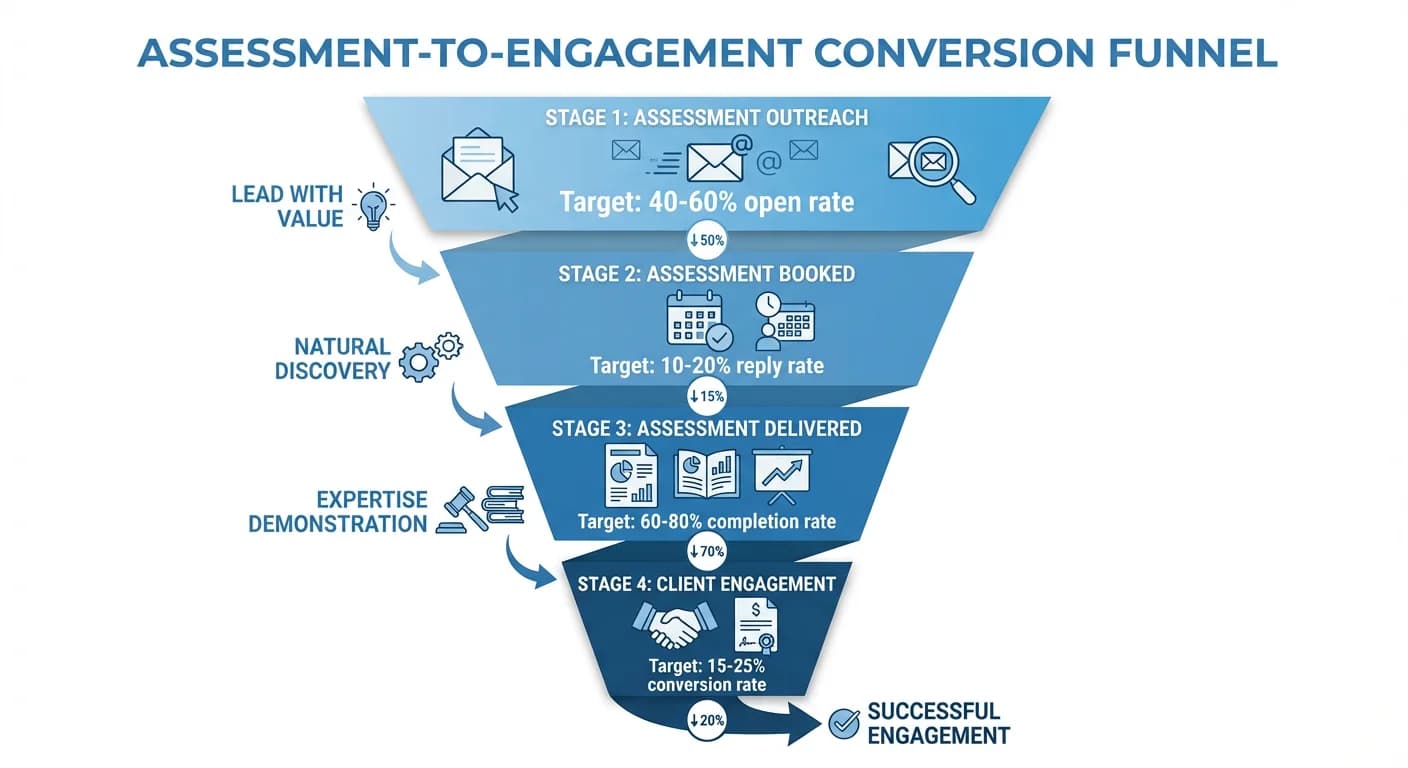
The assessment is the beginning of the relationship, not the end. Converting assessment participants to paying clients requires thoughtful follow-through.
Assessment Delivery Excellence
Professional presentation. The assessment deliverable should reflect the quality of your work.
Live review. Present findings in a live session rather than just sending a document. This allows discussion and relationship building.
Actionable insights. Focus on what they can do with the findings, not just what you observed.
Clear prioritization. Help them understand what matters most and why.
Post-Assessment Conversation
Discovery questions. Use the review session to understand their reaction to findings and priorities.
Resource discussion. Explore what resources (time, budget, people) they have to address identified gaps.
Timeline understanding. Learn about their planning horizons and decision processes.
Next step proposal. If appropriate, outline how you could help with implementation or further analysis.
Nurturing Assessment Participants
Not everyone will engage immediately after assessment:
Value-add follow-up. Share relevant content and insights periodically.
Progress check-ins. Ask how they've acted on assessment recommendations.
Update offers. Offer to reassess periodically to measure progress.
Referral requests. Ask if they know others who would benefit from assessment.
Measuring Assessment Campaign Success
Track metrics to optimize your assessment outreach:
Outreach metrics:
- Emails sent and delivered
- Open rate (target: 40-60%)
- Reply rate (target: 10-20% for assessment offers)
- Assessment booking rate
Assessment metrics:
- Assessments completed
- Assessment completion rate (started vs. finished)
- Assessment-to-proposal rate
- Assessment-to-engagement conversion
Business metrics:
- Revenue from assessment-sourced clients
- Average engagement value
- Time from assessment to close
- Assessment ROI
Common Mistakes to Avoid
Overselling during assessment. The assessment should focus on delivering value, not pitching services.
Generic assessments. Cookie-cutter assessments feel impersonal. Customize based on company context.
Delayed delivery. Deliver assessments promptly while interest is high.
No follow-up process. Plan the post-assessment conversation and nurture sequence in advance.
Unclear methodology. Explain how you arrive at scores and recommendations. Transparency builds trust.
Scope creep. Define clear boundaries to deliver sustainably.
Weak call-to-action. Make the next step clear and easy to take.
Start Booking Assessments
Assessment offers represent one of the most effective cold email approaches for B2B service providers. They create genuine value, demonstrate methodology, and naturally qualify prospects for further engagement.
The templates and strategies in this guide provide a foundation, but success depends on delivering quality assessments that generate genuine interest in your services.
If you're looking to scale assessment outreach without building an internal team, RevenueFlow can help. Our done-for-you cold email campaigns apply these principles to generate assessment requests for consultants and service providers.
Get Your Free Campaign and start filling your assessment calendar today.
Related Reading
Frequently asked questions.
Frequently asked questions- Why do assessment offers get better cold email response rates?
- Assessment offers generate higher response rates because they lead with diagnostic value rather than a sales pitch, providing concrete deliverables before any purchase decision. This approach builds trust, reduces perceived risk, and positions you as an expert. Assessments also create natural engagement: prospects must participate, which creates investment in the relationship. While competitors send generic outreach, your assessment offer provides immediate, tangible value that helps prospects understand their current state and improvement opportunities.
- What should I include in a cold email assessment offer?
- A strong assessment offer should include a structured questionnaire designed to reveal the prospect's current state, a scoring methodology that translates responses into meaningful ratings, benchmarking against industry standards or peer organizations, a findings summary, specific prioritized recommendations, and a suggested roadmap with sequence and timeline. The assessment should be valuable enough to attract interest but efficient enough to deliver sustainably. Consider whether you'll use a self-service format, guided approach, interview-based method, or hybrid that balances scale with personalization.
- Who should I target with cold email assessment offers?
- Target decision-makers at companies large enough to have the complexity your assessment addresses, with budget capacity to act on recommendations. Focus on contacts with functional ownership over the assessed area and authority to approve follow-on work. Ideal prospects include those in strategic roles responsible for planning, people with improvement orientation who value data-driven insights, and organizations at growth or change stages. Look for timing signals like planning cycles, leadership changes, major strategic initiatives, or competitive pressure that make assessment offers especially relevant.
- What types of assessments work best for cold email outreach?
- Five assessment types work effectively for cold outreach. Maturity assessments evaluate where organizations stand on a maturity curve like digital or security maturity. Readiness assessments determine if organizations are prepared for specific initiatives or implementations. Capability assessments evaluate competencies against benchmarks. Gap assessments identify differences between current and desired states. Risk assessments evaluate exposure to specific risks and prioritize mitigation. Choose the type that best aligns with your expertise and the problems your target prospects face.
About the author.

Ben Carden is CRO at RevenueFlow, which builds and operates outbound revenue engines for B2B companies. Previously at Gartner Enterprise. Studied at London School of Economics.
Ben Carden · CRO
Connect on LinkedIn →Explore more.
Ready to scale your outreach?
We build GTM engines that book real meetings. See the receipts.
Related articles.
Cold Email for Affiliate Recruitment: Strategy Guide
Master cold email outreach to recruit high-performing affiliates who can drive significant revenue for your business with proven templates and strategies.
Cold Email for Reseller Partnerships: Strategy Guide
Learn how to use cold email to recruit resellers and channel partners who can expand your market reach and drive revenue through their existing customer relationships.