Best SugarCRM Alternatives in 2026
Looking for alternatives to SugarCRM? Compare the top CRM platforms by pricing, seat minimums, features, and integrations.
The best SugarCRM alternatives depend on team size, because every Sugar Sell plan now carries a 15 user minimum. Under fifteen sellers, HubSpot, Zoho CRM, Pipedrive, Freshsales or Capsule cost less from the first seat. At fifteen and above, compare Salesforce and Dynamics 365 Sales on fit.
Key takeaways
- SugarCRM's rendered pricing page announces that SugarCRM is now SugarAI, and lists Sugar Sell Standard at $59, Advanced at $85 and Premier at $135 per user per month, billed annually.
- Every Sugar Sell plan carries a 15 user minimum, so the smallest Standard bill is $885 a month, or $10,620 a year, as illustrative list-price arithmetic.
- Against Salesforce Pro Suite at $100 a user, the list-price lines cross at nine sellers; below that the per-seat ladder is cheaper, above it Sugar Standard is.
- Sugar's own FAQ describes its fit as mid- to large-size organisations, with industry solutions for manufacturing and wholesale distribution and 180+ ERP integrations.
Reviewed and updated September 18, 2026
SugarCRM's rendered pricing page now carries a one-line banner, "SugarCRM is now SugarAI", and every Sugar Sell plan beneath it carries a 15 user minimum. At the Standard rate of $59 per user per month, billed annually, the smallest possible bill is fifteen seats. For a team of six sellers, that minimum is the whole case for looking at SugarCRM alternatives. For a team of forty that runs on an ERP, the case runs the other way. This page covers both, with every price read from the vendor's own pricing page.
What are the best SugarCRM alternatives?
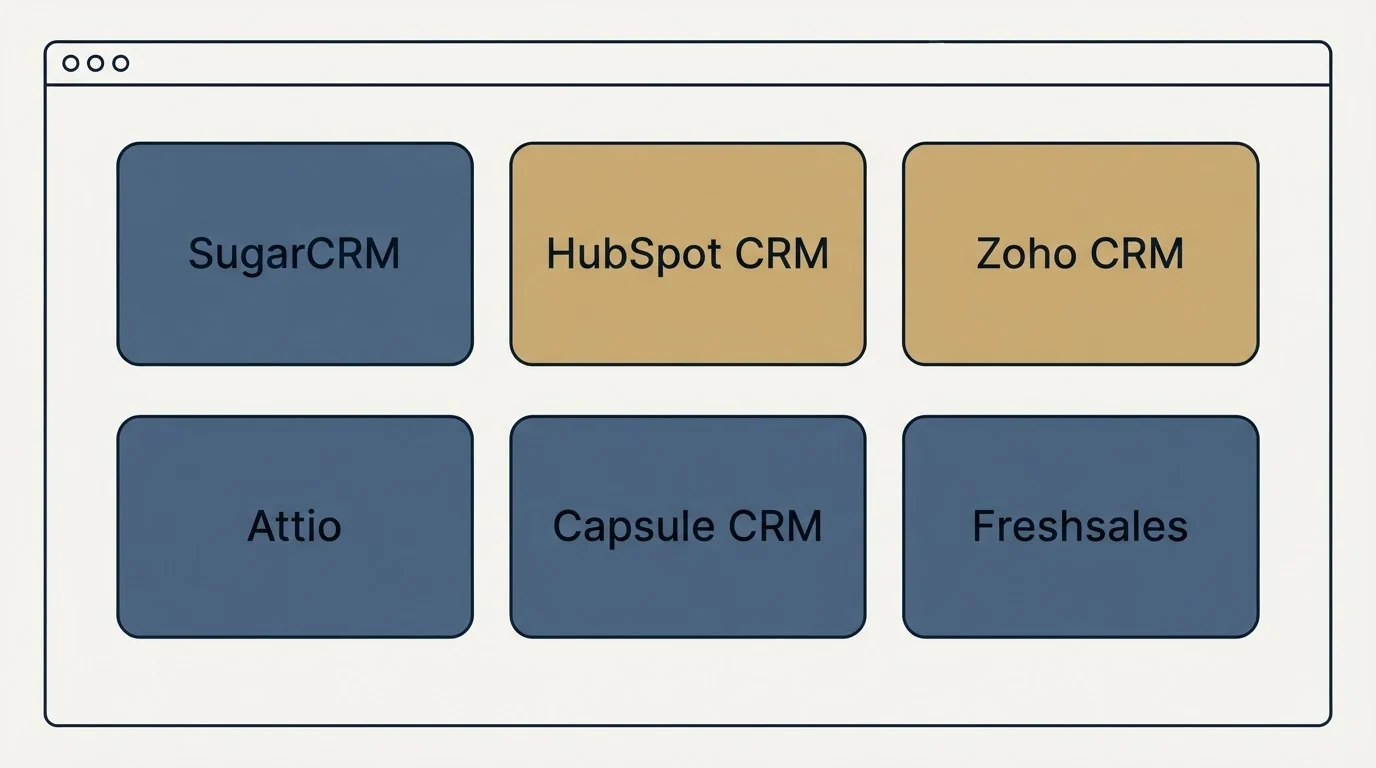
The best SugarCRM alternative depends on team size first. Under fifteen sellers, a per-seat CRM with no minimum costs less from the first seat: HubSpot, Zoho CRM, Pipedrive, Freshsales or Capsule. At fifteen and above, Sugar's minimum stops mattering, and the real comparison is with Salesforce and Dynamics 365 Sales on customisation, ERP fit and support. The table below prices 15 alternatives.
What SugarCRM, now SugarAI, costs and includes
Sugar Sell, the CRM product, lists three plans on the pricing page, each priced per user per month, billed annually, with a 15 user minimum. Standard is $59 and covers accounts and contact management, lead and opportunity management, quote management, activity and pipeline management, business process management, reporting and analytics, mobility and basic support. Advanced is $85 and adds mail and calendar integration, case management, bug tracking and standard support. Premier is $135 and adds geo mapping, Discover, double the managed file and data storage, enhanced support and a LinkedIn connector.
Marketing automation (Sugar Market) and customer service (Sugar Serve) are separate products on the same page. The page's own FAQ also steers buyers away from the list: asked which tier is right, it asks for the size of the company, the number of licences, the products and the length of contract, and puts together an offer. The list prices are a starting point for a quote, and the full arithmetic sits in SugarCRM cost.
The 15-seat minimum, worked through
Illustrative arithmetic, using only list prices and ignoring discounts, tax and add-ons. Fifteen seats of Standard at $59 is $885 a month, or $10,620 a year billed annually, and that is the floor whether the team has fifteen sellers or five. For five sellers it works out at $177 per actual user a month.
Set that against two per-seat ladders with no minimum. Salesforce's Pro Suite at $100 per user per month costs $500 for those five sellers, and HubSpot's Professional seat, which starts at $50 a month, costs $250. The Salesforce line crosses Sugar's at nine sellers: nine Pro Suite seats reach $900 a month, above Sugar's $885 floor, and from there Sugar Standard is the cheaper list price of the two. HubSpot Professional stays below Sugar Standard at every team size, because its per-seat rate is lower to begin with. None of this weighs features, so read it as a first filter only.
Sugar Sell Standard · 15 users · billed annually
15 users at $59 per user per month 1
= $885 a month 2
= $10,620 a year, billed annually 3
- 1Every plan on the page carries a 15 user minimum, so five sellers still buy fifteen seats.
- 2For five sellers that works out at $177 per actual user a month.
- 3The FAQ asks for licences, products and contract length, and puts together an offer.
SugarCRM alternatives for teams under fifteen seats
For a small team, the question is simply what a per-seat CRM with no minimum costs from the first seat.
HubSpot's CRM product page lists a free CRM for up to two users and 1,000 contacts, then Starter at $15 per seat a month, a price it marks as a discount for new customers only, Professional from $50 and Enterprise from $75. The head-to-head is in HubSpot CRM vs SugarCRM.
Zoho CRM's pricing page is titled "Free for 3 users". From this box it served rupees, with Standard at ₹800 per user a month, Professional at ₹1,400, Enterprise at ₹2,400 and Ultimate at ₹2,600, so read it in your own currency. The direct comparison is SugarCRM vs Zoho CRM.
Pipedrive served pounds to a headless browser here: Lite at £14, Growth at £39, Premium at £59 and Ultimate at £79 per seat per month, billed annually, with a free 14-day trial. It is a pipeline tool first; see Pipedrive vs SugarCRM for where that leaves gaps against Sugar's quote and case management.
Freshsales lists Growth at $9, Pro at $39 and Enterprise at $59 per user a month, billed annually. Sales sequences and territory management sit on Pro, and the page offers a 21-day trial in place of a free plan.
Capsule served pounds: Free for a maximum of 2 users and 250 contacts, Starter at £14 per user a month billed annually, and Growth at £27 with workflow automations.
Close, Salesmate, Copper, Insightly, Salesflare, Streak, Attio and monday CRM are priced in the table below. None of them lists a seat minimum on its plan cards.
SugarCRM alternatives for larger, ERP-linked sales teams
Sugar's own FAQ describes its fit as mid- to large-size organisations, particularly companies that rely on repeat sales from their existing customer base, with industry solutions for manufacturing and wholesale distribution among others. It says it can integrate with an ERP and counts 180+ ERP integrations. If that describes the business and the team is past fifteen seats, staying on Sugar is a serious option, and the alternatives have to beat it on fit rather than price.
Salesforce lists a Free Suite at $0, Starter Suite at $25 per user a month billed monthly or annually, Pro Suite at $100, and Core, Advanced and Max at $195, $395 and $550 per user a month billed annually. The comparison of the two platforms is Salesforce vs SugarCRM.
Dynamics 365 Sales is Microsoft's option, with Professional at $65 per user a month paid yearly for core sales force automation, Microsoft 365 interoperation, reporting and dashboards, and Enterprise at $105. For a business that already runs on Microsoft 365, that interoperation is the argument.
Zoho CRM Enterprise, at ₹2,400 per user a month on the rupee page, is the value case at this size, with the same currency caveat as above.
Past fifteen seats without an ERP at the centre of the business, the comparison widens to HubSpot Professional, Salesforce and Zoho CRM, judged on customisation and support rather than on the seat minimum.
All 15 alternatives, priced from their own pages
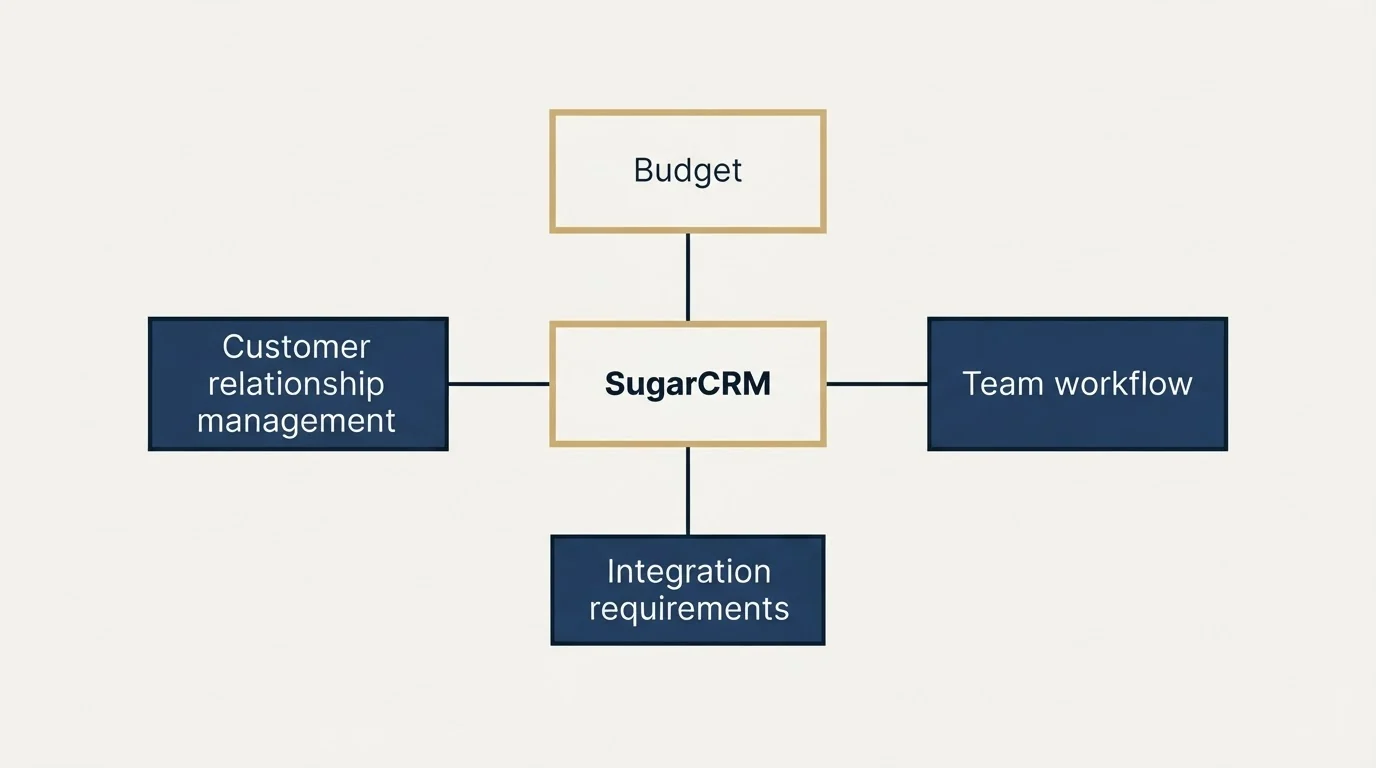
Several pages geo-served pounds or rupees to this box, so each row keeps the currency its page served.
| Tool | Entry price on its own pricing page | Unit and terms |
|---|---|---|
| SugarCRM (SugarAI), for reference | Standard $59 | per user a month, billed annually, 15 user minimum |
| HubSpot CRM | Free for up to two users; Starter $15 | per seat a month, new-customer price |
| Zoho CRM | Free for 3 users; Standard ₹800 | per user a month, rupees |
| Attio | Free up to 3 seats; Plus £27 | per user a month, annual (£34 monthly) |
| Capsule CRM | Free for 2 users; Starter £14 | per user a month, billed annually |
| Freshsales | Growth $9 | per user a month, billed annually |
| monday CRM | Basic £10 or £13 | per seat a month, by billing term |
| Pipedrive | Lite £14 | per seat a month, billed annually |
| Close | Solo $9 annual, $19 monthly | per user a month, 1 user |
| Salesmate | Basic $23 | per user a month |
| Salesforce | Free Suite $0; Starter Suite $25 | per user a month |
| Copper | Basic $23 annual, $29 monthly | per seat a month |
| Insightly | Plus $29 | per user a month, billed annually |
| Salesflare | Growth $29 annual, $39 monthly | per user a month |
| Streak | Pro $49 or $59 | per user a month, by billing term |
| Dynamics 365 Sales | Professional $65 | per user a month, paid yearly |
What to check on the alternative's plan card
Sugar's cheapest plan bundles more than a contact list, so compare like with like before a lower per-seat number wins the argument. Standard already includes quote management, business process management and reporting and analytics. Advanced adds case management and bug tracking, which is service work, and Premier adds geo mapping and a LinkedIn connector. Mark which of those the team uses today, then find each one on the alternative's own plan card and note the tier it sits on. A per-seat price that has to climb two tiers to include quotes is a different number from the one on the headline.
Implementation time is the other hidden line. Sugar's own FAQ puts its implementation timeline at anywhere from a couple of weeks to a few months, depending on complexity, and a replacement for a configured Sugar instance carries the same kind of range. Budget the project, not just the licence.
Before you switch off Sugar
Sugar's plans are billed annually, so the cheapest day to leave is the renewal date. Put it in the calendar before comparing anything else.
Export accounts, contacts, opportunities, quotes and cases while the licence is live. Sugar's FAQ says it supports REST and SOAP APIs, which is the route for anything a file export misses.
Business processes, quote templates and reports are configuration rather than data, so they are rebuilt in the new tool. Rebuild the few that the team actually runs rather than all of them.
If the ERP integration is the reason Sugar was bought, confirm the replacement's connector to that ERP before signing, because that is the one piece a migration cannot patch later.
The short version
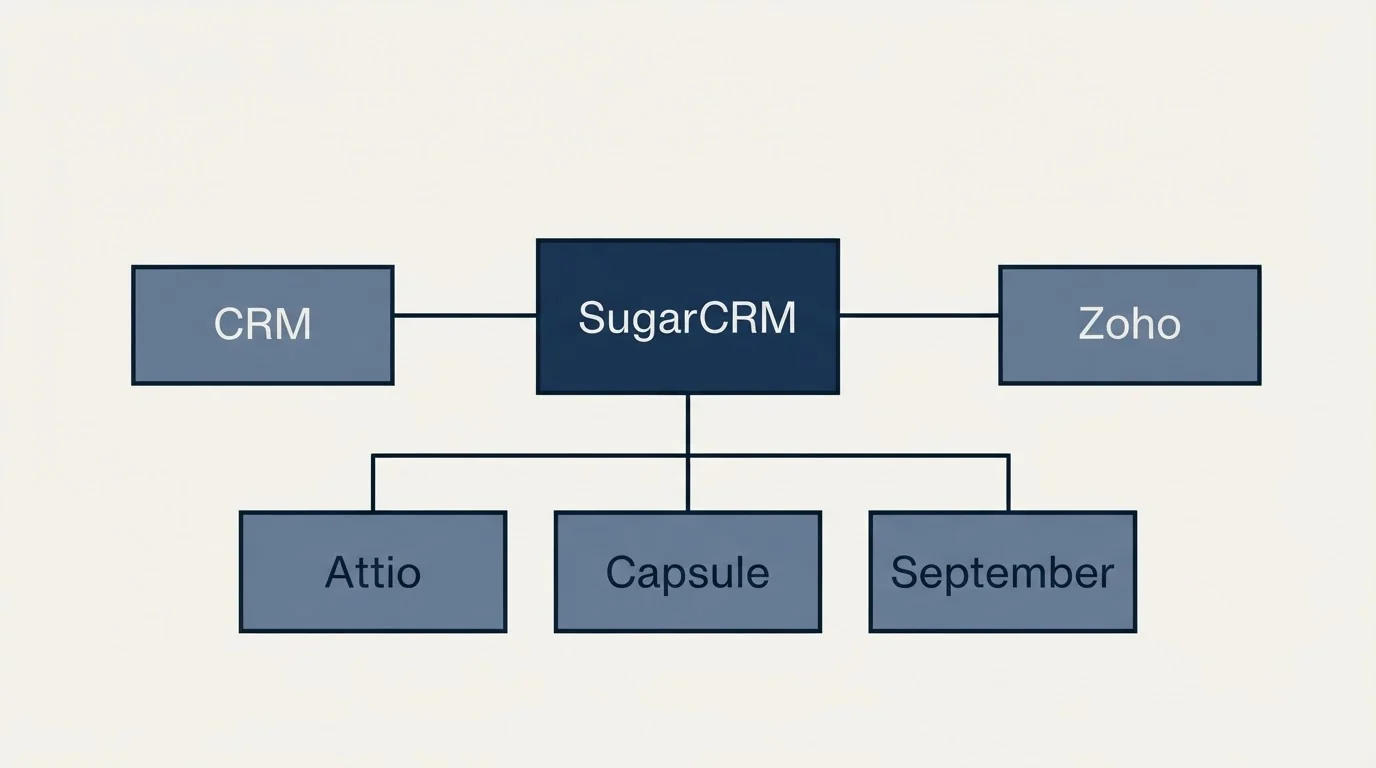
Under fifteen sellers, the minimum decides it: HubSpot, Zoho CRM, Pipedrive, Freshsales or Capsule costs less from the first seat. At fifteen and above, with an ERP at the centre of the business, Sugar is on home ground and the comparison is with Salesforce and Dynamics 365 Sales. Either way, read the billing basis and the currency on each pricing page before comparing a single number.
A CRM records the pipeline and does not create it. If the pipeline itself is the problem, RevenueFlow books qualified meetings on a pay-per-meeting basis.
Pricing and features are taken from the vendors' own pages. Verify current terms with the vendor before relying on them.
Frequently asked questions.
Frequently asked questions- What are the best SugarCRM alternatives?
- It depends on team size. Every Sugar Sell plan carries a 15 user minimum, so under fifteen sellers a per-seat CRM with no minimum costs less from the first seat: HubSpot, Zoho CRM, Pipedrive, Freshsales or Capsule. At fifteen seats and above, the comparison is with Salesforce and Dynamics 365 Sales on customisation, ERP fit and support.
- What is a good SugarCRM alternative for a small team?
- For a team under fifteen sellers, any per-seat CRM without a seat minimum avoids paying for unused licences. HubSpot's free CRM covers up to two users, Zoho CRM is free for 3 users, Capsule is free for 2 users, and Freshsales Growth lists $9 per user a month billed annually. Pipedrive served pound prices from Lite at £14 per seat.
- How much does SugarCRM cost?
- SugarCRM's pricing page, which now announces SugarCRM is now SugarAI, lists Sugar Sell Standard at $59, Advanced at $85 and Premier at $135 per user per month, billed annually, each with a 15 user minimum. As list-price arithmetic, the smallest Standard bill is fifteen seats at $59, which is $885 a month or $10,620 a year.
- Is SugarCRM now called SugarAI?
- Yes. SugarCRM's rendered pricing page carries the banner SugarCRM is now SugarAI, and its FAQ refers to the product as SugarAI throughout. The CRM plans are still sold as Sugar Sell, alongside Sugar Market for marketing automation and Sugar Serve for customer service, on the same pricing page.
About the author.

Tim Carden is CMO / CTO at RevenueFlow, which builds and operates outbound revenue engines for B2B companies. Studied at McGill University.
Tim Carden · CMO / CTO
Connect on LinkedIn →Explore more.
Ready to scale your outreach?
We build GTM engines that book real meetings. See the receipts.
Related articles.
HubSpot CRM vs Twenty: CRM Platform Comparison
Compare HubSpot CRM and Twenty side by side. See pricing, features, and integrations to choose the right CRM platform for your needs.
AroundDeal vs Salesflare: Data Enrichment Tool vs CRM Platform Comparison
Compare AroundDeal (data enrichment tool) and Salesflare (CRM platform) side by side. See pricing, features, and integrations to decide which one, or both, your stack needs.
Evaboot vs Microsoft Dynamics 365 Sales: Data Enrichment Tool vs CRM Platform Comparison
Compare Evaboot (data enrichment tool) and Microsoft Dynamics 365 Sales (CRM platform) side by side. See pricing, features, and integrations to decide which one, or both, your stack needs.
Agile CRM vs Copper: CRM Platform Comparison
Compare Agile CRM and Copper side by side. See pricing, features, and integrations to choose the right CRM platform for your needs.
Agile CRM vs LeadIQ: CRM Platform vs Data Enrichment Tool Comparison
Compare Agile CRM (CRM platform) and LeadIQ (data enrichment tool) side by side. See pricing, features, and integrations to decide which one, or both, your stack needs.
Kommo vs Luru: CRM Platform vs Sales Engagement Platform Comparison
Compare Kommo (CRM platform) and Luru (sales engagement platform) side by side. See pricing, features, and integrations to decide which one, or both, your stack needs.