Cold Email for Market Research: Complete Strategy Guide
Master the art of using cold email to gather market insights, validate product ideas, and understand customer needs with proven outreach strategies and templates.
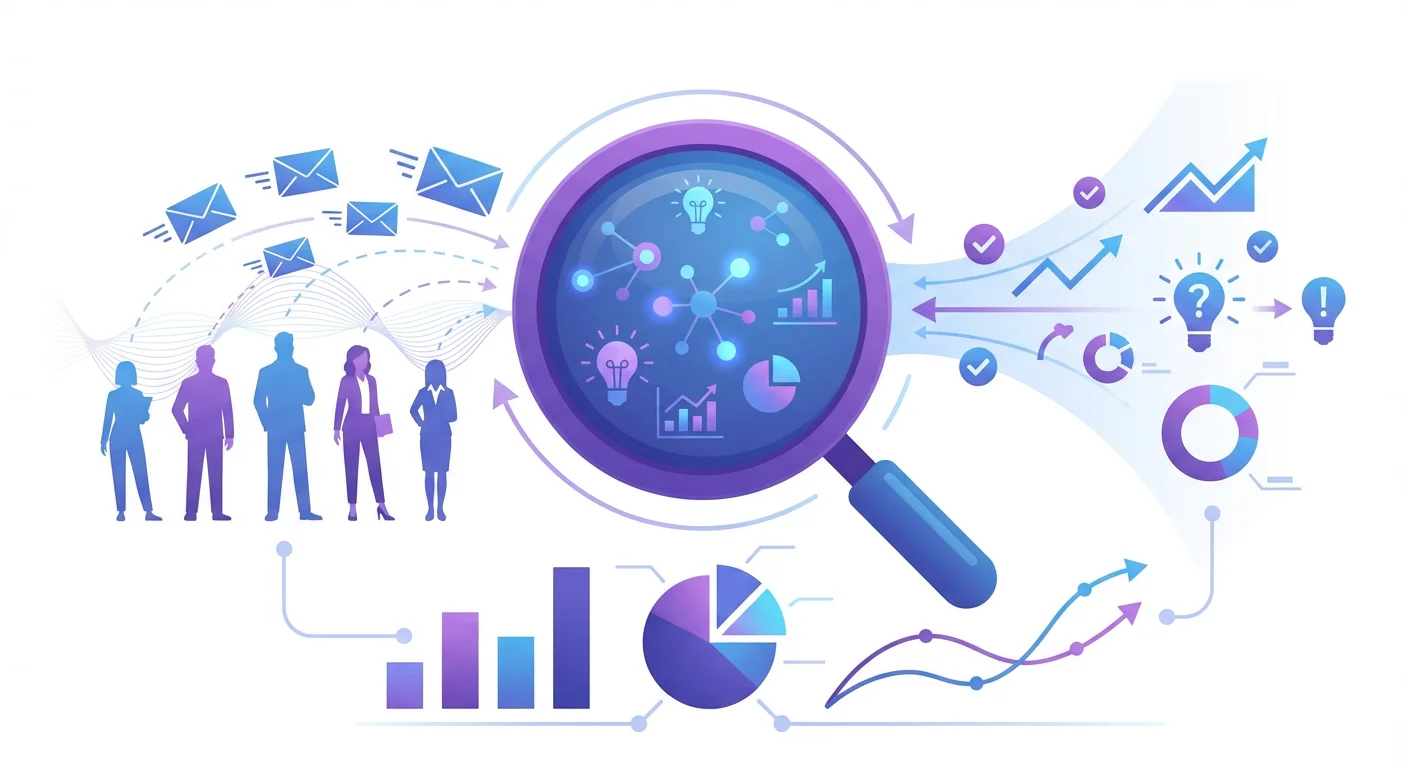
Cold email works for market research when it asks for expertise rather than budget. Define the decision the research informs, write specific questions, segment the list, and send one short email asking for 15 or 20 minutes in return for the findings. The four templates here cover direct requests, expert consultation, validation and competitive research.
Key takeaways
- A market research email asks a stranger for expertise rather than budget, so it centers on their experience and offers the findings in return.
- Start from the decision the research must settle, then write questions a conversation can answer.
- Segment the list and keep interviewing until new conversations stop telling you anything new.
- Send one email and leave the thread alone; a reminder lands under a message the reader already chose not to answer.
Reviewed and updated September 21, 2026
A market research email asks a stranger for their expertise rather than their budget, and a good market research email template is built around that difference. Surveys yield low response rates, focus groups are expensive and geographically limited, and a research firm is a budget line of its own. Cold email offers an alternative that combines direct access to your target market with enough reach to hear from the people whose opinions matter.
When done correctly, cold email research generates qualitative insights from the exact people whose opinions matter for your business. You can validate product concepts, understand buying criteria, map competitive landscapes, and identify unmet needs by reaching out directly to potential customers and industry experts.
A related question comes up often: how quickly a research-driven cold email team can build and verify a custom ICP database for a traditional industry. No fixed number of days holds, because the build is as fast as that industry is findable online and verification adds a pass on every address. What a buyer can hold a provider to is an outcome, and ours is stated on our campaign page: the first qualified meeting is refunded if we do not book it within 30 days.
Why Cold Email Works for Market Research
Cold email succeeds as a research methodology because it addresses the core challenges of traditional approaches.
Access to hard-to-reach respondents. Decision makers who ignore surveys often engage with thoughtful, personalized emails. A VP of Engineering who deletes generic survey requests might respond to a well-crafted email asking for 15 minutes of their expertise.
Targeted precision. Cold email reaches specific titles, company sizes, industries and experience levels, so the answers come from the people whose view you need.
Qualitative depth. Respondents who engage share context, nuance and examples that structured surveys miss.
Cost efficiency. Each additional email costs little next to recruiting research participants through a panel or hiring a consultancy.
Speed of execution. A cold email research campaign can start as soon as the question and the list are ready, rather than waiting on a panel or an agency's schedule.
Defining Your Research Objectives
Clear research objectives determine every aspect of your cold email approach, from who you target to what you ask. Poorly defined objectives produce scattered data that fails to drive decisions.
Go or no-go, a price, a feature, a segment: the research exists to settle one of them.
Questions a conversation can answer, never "do people want this?"
By stage, industry, role or current solution, so segments can be compared.
Stories and examples over opinions, recorded with permission.
Every finding gets a confidence level, an action and an owner.
Types of Research Suitable for Cold Email
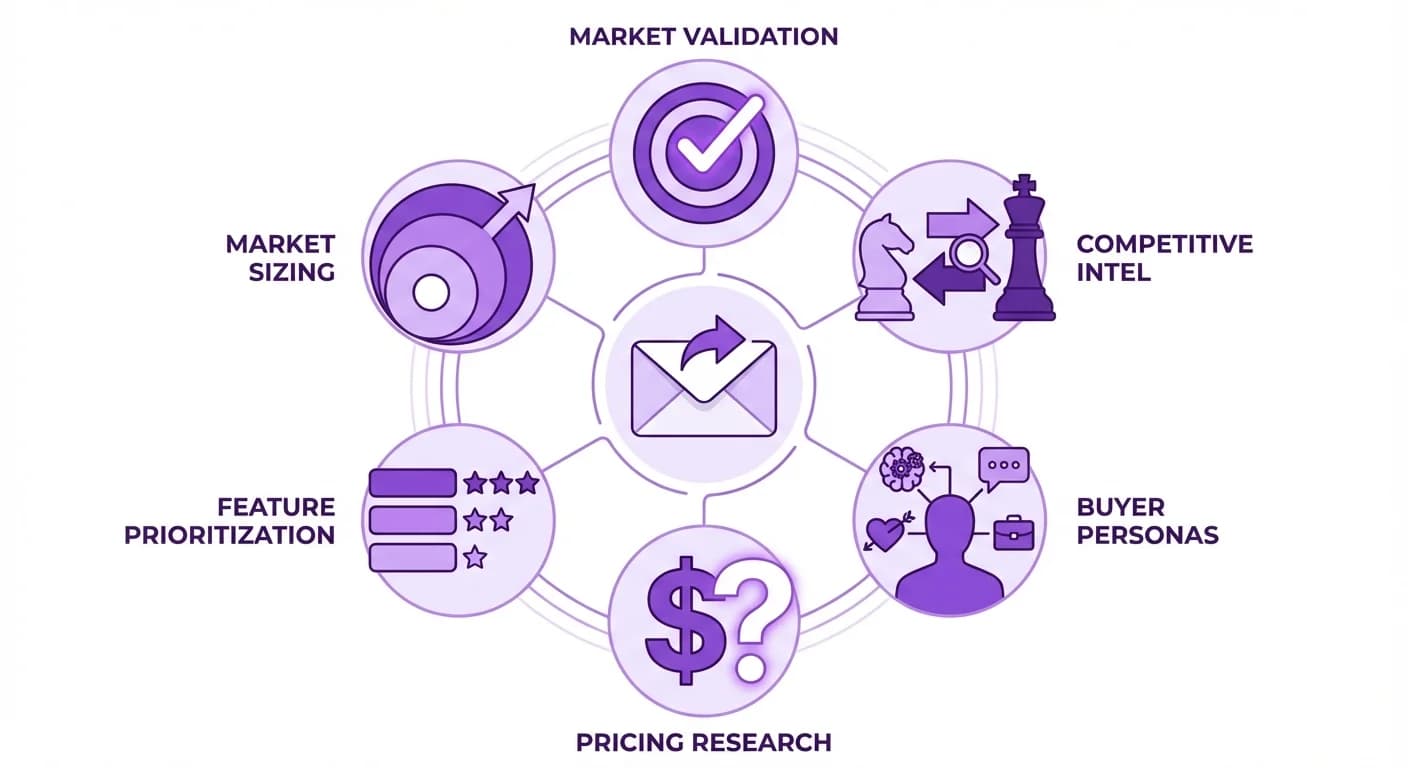
Market validation research. Testing whether a problem exists and whether your proposed solution resonates with potential buyers. This research informs go/no-go decisions on product development.
Competitive intelligence. Understanding how prospects evaluate alternatives, what they like and dislike about current solutions, and what gaps exist in the market.
Teams researching a regulated market like medical devices will find insights on navigating approval gates and buying committees useful for shaping interview questions around procurement realities.
Buyer persona development. Gathering insights about buying processes, decision criteria, stakeholders involved, and information sources that influence purchasing decisions.
Pricing research. Exploring willingness to pay, price sensitivity, and how pricing compares to perceived value and competitive alternatives.
Feature prioritization. Identifying which capabilities matter most to different customer segments and how they would rank potential features or improvements.
Market sizing and segmentation. Understanding market characteristics, segment sizes, and how different groups approach the problem you solve.
Crafting Specific Research Questions
Transform broad research areas into specific questions that cold email conversations can answer.
Vague: "Do people want our product?" Specific: "How do marketing directors at B2B SaaS companies currently solve [problem]? What do they spend on current solutions? What would make them consider switching?"
Vague: "What features should we build?" Specific: "When evaluating [product category], which three capabilities are most important? What's missing from current solutions that would significantly improve your workflow?"
Vague: "How should we price?" Specific: "What budget do you have allocated for [solution type]? How does that compare to what you currently spend? What would need to be true for a solution to justify a [X%] premium?"
Building Your Research Prospect List
The quality of your research depends entirely on reaching the right respondents. Random outreach produces unreliable data.
Identifying Research Targets
Start by defining your ideal research participant profile based on your research objectives.
Demographic criteria:
- Job title and seniority level
- Company size (employees or revenue)
- Industry vertical
- Geographic location
- Years of experience in role
Behavioral criteria:
- Active responsibility for the problem you're researching
- Decision-making authority for relevant purchases
- Recent experience evaluating or implementing solutions
- Demonstrated thought leadership or expertise
Segmenting Your Research Sample
Divide your target list into segments that allow you to compare responses across groups.
By company stage: Startups may have different needs than enterprises By industry: Vertical-specific variations in how problems manifest By role: Different stakeholders have different priorities By solution type: Current solution influences perception of alternatives
Plan to reach enough respondents in each segment for a pattern to show itself rather than a single voice. The practical signal is saturation: when new conversations in a segment stop telling you anything new, that segment is covered.
List building sources
LinkedIn Sales Navigator filters by title, company, industry and seniority. Conference speaker and attendee lists, professional association directories, and the people commenting on relevant posts all identify practitioners who are already thinking about your topic.
Crafting Research Outreach Emails
Research outreach emails differ fundamentally from sales or partnership emails. You're asking for time and expertise without offering immediate tangible value. This requires emphasizing why participating benefits them.
Why people say yes
Professionals take part in research because they enjoy discussing their own expertise, because they get a say in products they may use, because being consulted as an expert is flattering, and because the findings are useful to them. A good research email activates those motives and makes saying yes easy.
Market research email templates
| Template | The angle | Best for |
|---|---|---|
| Direct request | A plain question and a time ask | Most research |
| Expert consultation | Their published work | Practitioners who write or speak |
| Market validation | Shaping what you build | Early product decisions |
| Competitive research | How they choose | Positioning and switching triggers |
Template 1: Direct research request
Subject: A question about [their problem area]
Hi [Name],
We're researching how [their role type] professionals handle [specific challenge], and your perspective would help.
We're exploring [what you're trying to learn] to inform [how the research will be used, such as product development or market entry]. Your experience at [their company], particularly [relevant aspect of their background], is exactly the kind we're hoping to learn from.
Would you have 20 minutes for a call? We'll share a summary of what we learn from other [their role type] leaders in return.
[Your name]
P.S. If a call doesn't suit, a few sentences in reply on [specific question] would help just as much.
Template 2: Expert consultation
Subject: Your expertise on [topic]
Hi [Name],
Your [article/post/talk] on [topic] made a point about [specific point] that stayed with us.
We're running a research project on how companies approach [problem], and we're speaking to practitioners with hands-on experience. The questions we're exploring:
- [Research question 1]
- [Research question 2]
- [Research question 3]
Could we have 20 minutes of your time? Everyone who takes part receives the findings report.
[Your name]
Template 3: Market validation
Subject: Building something for [their role type]: your input
Hi [Name],
We're developing a new approach to [problem area] for [their role type] professionals, and we want to be sure it solves a problem that matters.
Before we build further, we're talking to people who deal with [challenge] daily. A short conversation would tell us:
- How significant [problem] is in your current workflow
- What you've tried, and what worked
- What an ideal solution would look like
Your input will shape what we build. Would 15 minutes work?
[Your name]
Template 4: Competitive research
Subject: How [their role type] evaluate [solution category]
Hi [Name],
We're researching how [their role type] professionals choose [solution type], and your experience with [relevant responsibility] at [their company] is exactly what we'd like to learn from. In particular:
- Which criteria matter most when you compare options
- Which information sources you trust during an evaluation
- What would make you switch from your current solution
This isn't a sales conversation. Everyone who takes part receives the findings.
Would you be open to 15 minutes?
[Your name]
Conducting Research Conversations
Converting email responses into valuable research data requires preparation and skill. The conversation itself is where insights emerge.
Preparing for research calls
Write a discussion guide, but let the conversation run; a research call should feel like a discussion, not an interrogation. Rank the questions so the important ones come first if time runs short, read the participant's profile and recent work, and with permission record the call so you can listen rather than take notes.
Interview Best Practices
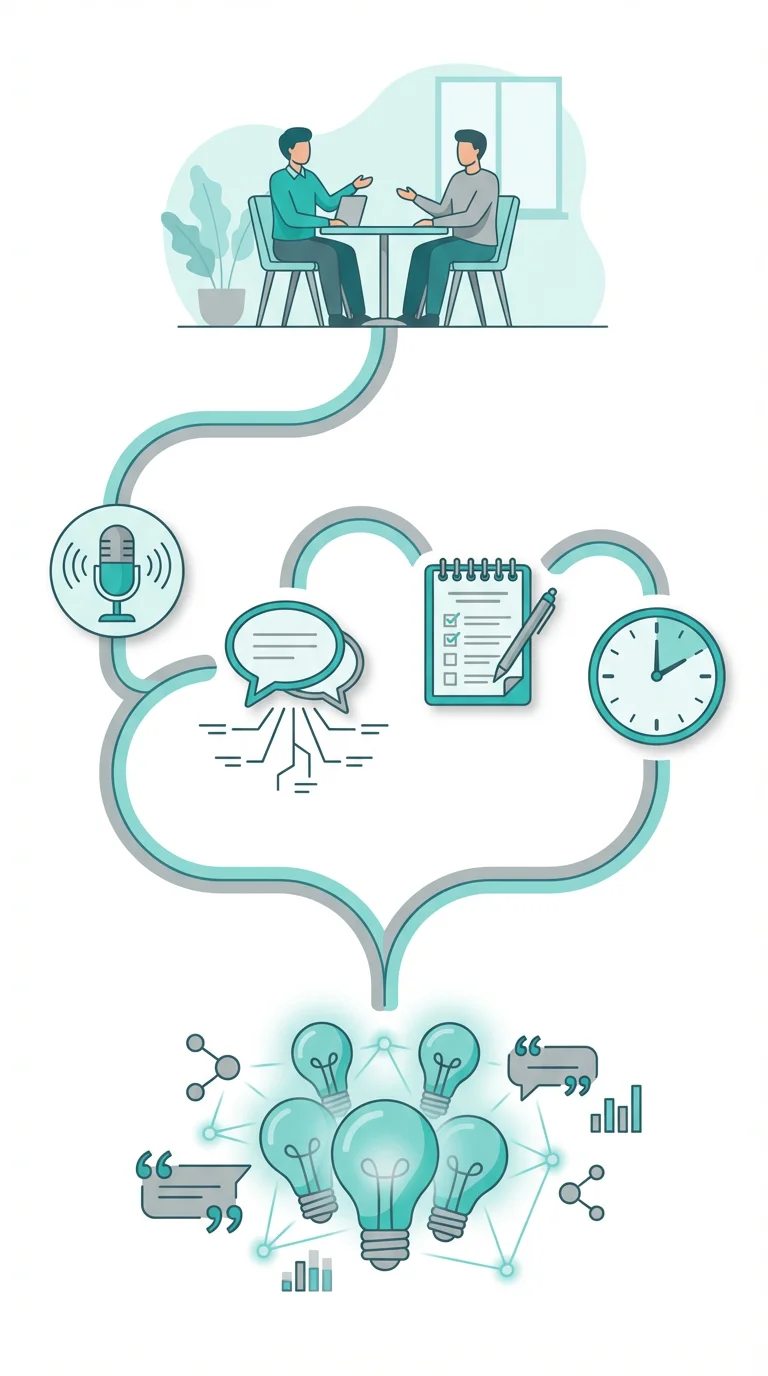
Start broad, then narrow. Begin with open-ended questions that let participants share context, then probe specific areas of interest.
Ask for stories and examples. Questions like "Can you tell me about a time when..." generate concrete data rather than abstract opinions.
Embrace silence. After a participant responds, pause briefly before your next question. They often fill silence with additional insights.
Follow unexpected threads. When participants mention something surprising, explore it. The best insights often emerge from unscripted directions.
Avoid leading questions. "Don't you think X is a problem?" biases responses. Ask "How do you feel about X?" instead.
Quantify when possible. When participants describe problems, ask follow-up questions about frequency, time spent, and costs. "How often does that happen? How much time do you spend on that?"
Closing research conversations
Play back the main points to check you heard them right, ask who else is worth speaking to, say how the research will be used and when the summary will arrive, and send a short thank-you note.
After the first email
Research outreach is tempting to chase, because busy professionals often mean to reply and never get round to it. We do not send reminders, and the section below sets out why.
Where we differ from standard practice
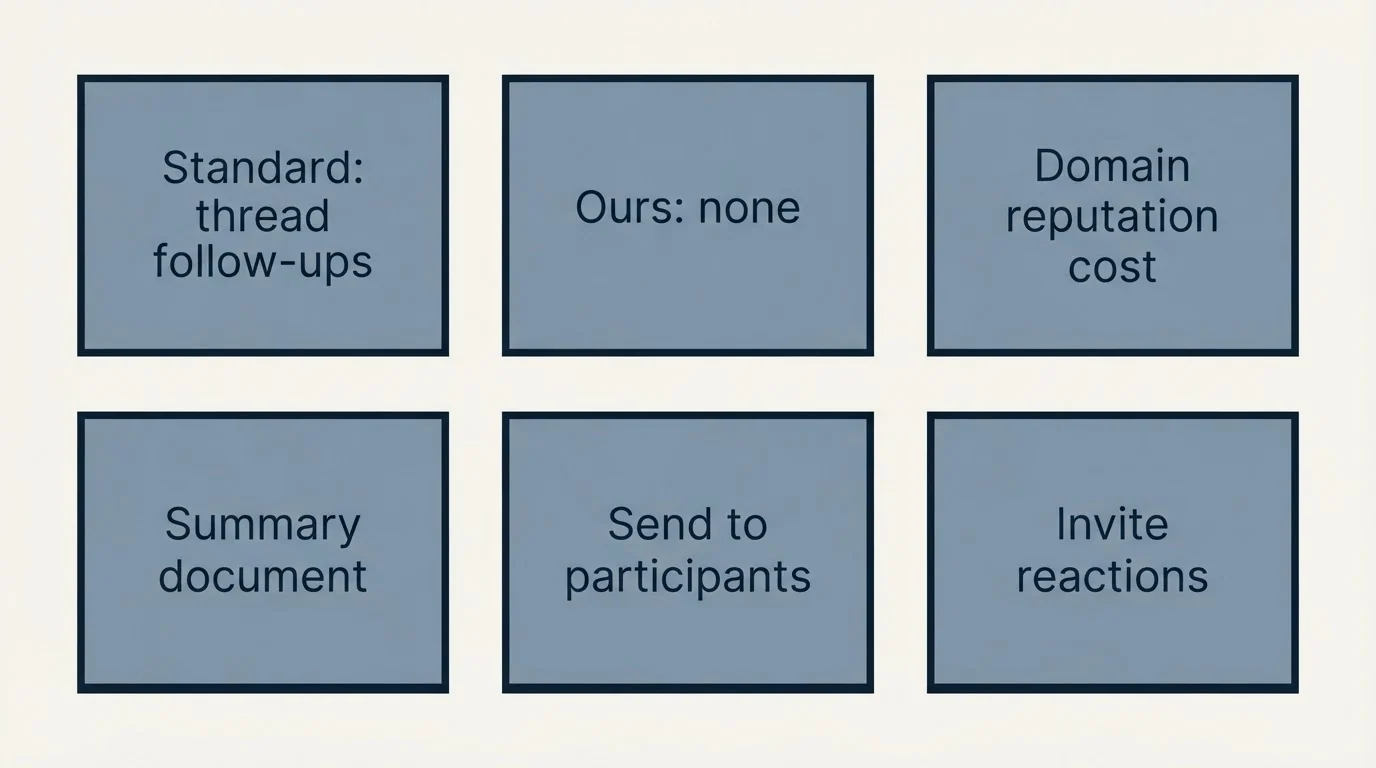
Much of the advice on this page reflects how outbound is commonly run. We run it differently, and since this page sits on our site it is worth saying where the difference is and what it costs us.
- A sequence of messages to each prospect over several weeks
- Later messages often land in the same email thread
- Every contact is reached more than once, so a distracted reader gets another chance
- The later messages go only to people who did not answer the first
- Reputation cost accrues on the sending domain across everything else it sends
- One message, then that campaign is finished for that contact
- No thread replies and no bumps
- A non-responding audience becomes a new campaign with a genuinely different premise, not a reminder
- More of the work moves into targeting and into the one message
- We reach each contact less often, and that is the cost we accept
The reasoning is mechanical rather than moral. A follow-up arrives underneath a message the recipient has already seen and chosen not to answer, so it is delivered to the population most likely to mark it as spam, and the reputation cost of that lands on the sending domain across every campaign running on it. We set that cost against the replies a sequence recovers and decided the trade was not worth it. The full argument, with the numbers from our own campaigns, is in why we stopped using follow-ups.
When someone does not reply
Leave the thread alone. A second message in the same thread arrives underneath the one the reader already chose not to answer, which is the population most likely to mark it as spam. If the question still matters, it goes into a separate email at a later date, never a reply stacked on the first, and the research plan budgets enough names that nobody has to be chased to fill it.
Sharing Research Findings
Fulfilling your promise to share findings maintains credibility and can generate additional insights.
Create a summary document. Compile key findings into a 2-3 page summary that provides value without revealing proprietary analysis.
Send to all participants. Even people who didn't end up scheduling calls appreciate receiving the research summary.
Invite reactions. Ask recipients to share any additional thoughts prompted by the findings. This often generates follow-up conversations.
Analyzing and Acting on Research Data
Raw interview notes and email responses require systematic analysis to produce actionable insights.
Organizing Research Data
Transcribe all conversations. Detailed transcripts enable pattern identification that notes miss.
Create a tagging system. Tag responses by theme (pain points, current solutions, evaluation criteria, feature requests, etc.) to enable cross-interview analysis.
Build a response matrix. Create a spreadsheet mapping participants against key questions to identify patterns and outliers.
Identifying Patterns
Frequency analysis. How often do specific themes appear across conversations? Problems mentioned by 8 of 10 participants differ from those mentioned by 2.
Segment comparison. Do different segments (by company size, industry, role) respond differently? These variations inform targeting and positioning.
Intensity scoring. Not all mentions are equal. Track how emphatically participants discuss topics. Strong emotional responses signal significant opportunities or concerns.
Contradiction identification. When participants disagree, explore why. Both perspectives may be valid for different contexts.
Translating Insights to Action
Research only matters if it changes decisions. For each key finding, document:
What we learned: The specific insight from research Confidence level: How consistent was this finding across participants? Implication: What does this mean for our strategy, product, or messaging? Action: What specific changes will we make based on this insight? Owner: Who is responsible for implementing the action?
Common Research Email Mistakes
Avoid these errors that undermine research email effectiveness.
Do
- Center the email on their expertise
- Name the time: 15 or 20 minutes, on named days
- Keep the first email to one ask
- Check each respondent fits the profile
Avoid
- Making it about your company or product
- Paying for opinions you want to be honest
- A list of questions in the first email
- Explaining away findings you did not want
The two that cost the most are the first and the last. An email about your company rather than their expertise gives nobody a reason to reply, and research that keeps telling you the proposed solution does not resonate is doing its job: the purpose is to learn the truth, even when it is inconvenient.
Research Email Checklist
Use this checklist to ensure your research outreach succeeds.
Before Starting:
- Research objectives clearly defined
- Specific questions documented
- Target participant profile established
- Prospect list built and segmented
- Discussion guide prepared
Email Content:
- Subject line indicates research context
- Personalized opening showing relevance
- Clear explanation of research purpose
- Specific time commitment requested
- Value proposition for participant (findings, influence, etc.)
After the email:
- Scheduling process streamlined
- Thank you template ready
- Findings summary format planned
Analysis:
- Transcription process established
- Tagging system defined
- Analysis framework ready
- Action planning template prepared
Building your research practice
Start with one focused question, document what works, and turn it into templates. Each project refines the method and widens the circle of people willing to talk to you, which is how cold email becomes a lasting way to understand your market.
Need help with your market research outreach? Our team specializes in cold email campaigns that generate high-quality responses from hard-to-reach audiences. Request your free custom campaign and let us help you gather the insights that drive better decisions.
Related Reading
Frequently asked questions.
Frequently asked questions- How do you write a market research email?
- Ask for their expertise, not their budget. Say what you are researching and why their experience fits, name a specific time such as 20 minutes, and offer the findings in return. Keep the first email to one ask, and save detailed questions for the call itself rather than the inbox.
- How many research interviews do you need per segment?
- There is no universal number. Plan enough conversations in each segment for a pattern to appear rather than a single voice, and stop when new interviews in that segment stop telling you anything new. Segments that disagree are worth more interviews, not fewer, because the disagreement is often the finding.
- Should you follow up on a market research email?
- We do not. A reminder in the same thread lands under a message the reader already chose not to answer, the group most likely to mark it as spam. If the question still matters, send a separate email later and budget enough names that nobody needs chasing to complete the research.
- Should you pay people for research interviews?
- For most B2B research, sharing the findings is enough motivation, and payment can attract people who come for the incentive and bias what they say. Where a panel or a hard-to-reach specialist genuinely needs compensation, decide it before outreach and offer it to everyone in the segment on the same terms.
About the author.

Ben Carden is CRO at RevenueFlow, which builds and operates outbound revenue engines for B2B companies. Previously at Gartner Enterprise. Studied at London School of Economics.
Ben Carden · CRO
Connect on LinkedIn →Explore more.
Ready to scale your outreach?
We build GTM engines that book real meetings. See the receipts.
Related articles.
Cold Email for Affiliate Recruitment: Strategy Guide
Master cold email outreach to recruit high-performing affiliates who can drive significant revenue for your business with proven templates and strategies.
Cold Email for Reseller Partnerships: Strategy Guide
Learn how to use cold email to recruit resellers and channel partners who can expand your market reach and drive revenue through their existing customer relationships.