Instantly vs Mailarrow: Cold Email Platform Comparison
Compare Instantly and Mailarrow side by side. See pricing, features, and integrations to choose the right cold email platform for your needs.

Mailarrow is cold email software that sends from mailboxes you bring, priced at $39, $59 and $99 a month for 6,000, 60,000 and 150,000 emails. Instantly's Outreach plans cost $47, $97 and $358 a month. Mailarrow is cheaper at most volumes under 60,000 emails; Instantly's Hypergrowth wins between 60,001 and 100,000.
Key takeaways
- Mailarrow's pricing page lists Basic, Professional and Growth at $39, $59 and $99 a month, for 2,000, 20,000 and 50,000 active prospects and 6,000, 60,000 and 150,000 emails.
- Mailarrow provides no mailboxes and no leads, according to its FAQ; you connect your own inboxes and import your own prospects.
- Instantly's Outreach plans cost $47, $97 and $358 a month, or $37.6, $77.6 and $286.3 on yearly billing, with unlimited email accounts and warmup.
- At monthly list prices Mailarrow is cheaper up to 60,000 emails and from 100,001 to 150,000, and Instantly is $2 cheaper between 60,001 and 100,000.
Reviewed and updated September 21, 2026
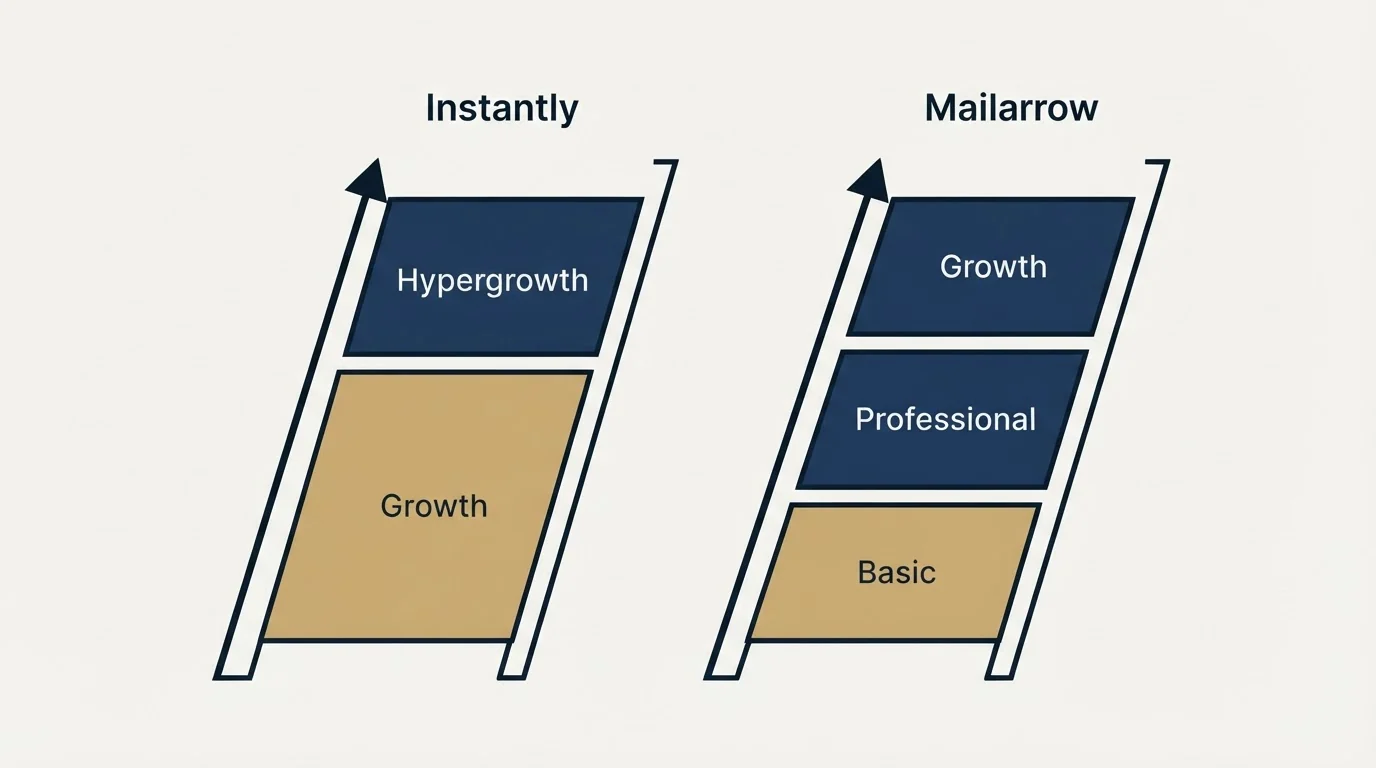
Mailarrow is a cold email tool that sends from mailboxes you bring, charges by prospects and monthly sends, and starts at $39 a month on its Basic plan. Instantly sells the same job from $47 a month and charges by uploaded contacts and monthly emails. Both connect unlimited mailboxes and include unlimited warmup, so the choice between them comes down to where each ladder's limits fall against your own volume.
What Is Mailarrow?
Mailarrow is cold email outreach software: you connect your own mailboxes, import your own prospects, and it runs personalized sequences, warmup and reply tracking from one place. Its FAQ says it provides no mailboxes and no leads, and that it sends through your email provider's own servers, so a Gmail inbox sends from Google's IPs. Plans start at $39 a month with a 7-day free trial.
Its pricing page lists the working parts on every plan: AI personalization with website-based icebreakers, sending mailbox rotation across multiple accounts in one campaign, bulk prospect import by CSV, API or copy-paste, custom properties, sending schedules by timezone and day, click and open tracking, and reply and out-of-office tracking with stop on reply. The homepage offers the 7-day free trial with no credit card required.
Mailarrow Pricing
| Plan | Monthly | Active prospects | Emails a month | Mailboxes |
|---|---|---|---|---|
| Basic | $39 | 2,000 | 6,000 | Unlimited |
| Professional | $59 | 20,000 | 60,000 | Unlimited |
| Growth | $99 | 50,000 | 150,000 | Unlimited |
Active prospects means the prospects in your database, excluding deleted ones, and every plan carries unlimited email warmup and AI personalization. The page has a Monthly and Annually switch, and a second set of the same three cards appears on it at $32, $49 and $70 a month. The switch did not respond in a headless browser, so this page does not state which billing term those lower figures belong to; confirm the annual rate at checkout.
Source: Mailarrow Pricing
Instantly Pricing
Instantly's pricing page opens on monthly billing for its Outreach plans: Growth at $47 a month, Hypergrowth at $97 and Light Speed at $358, with Enterprise priced on a call. The yearly toggle shows $37.6, $77.6 and $286.3 a month. Every Outreach plan lists unlimited email accounts and unlimited email warmup.
| Plan | Monthly | Yearly, per month | Uploaded contacts | Emails a month |
|---|---|---|---|---|
| Growth | $47 | $37.6 | 1,000 | 5,000 |
| Hypergrowth | $97 | $77.6 | 25,000 | 100,000 or 125,000 |
| Light Speed | $358 | $286.3 | 100,000 | 500,000 |
| Enterprise | Custom | Custom | 100,000+ | 500,000+ |
The page disagrees with itself on Hypergrowth: the monthly card lists 125,000 emails a month, while the yearly card and the plan comparison list 100,000. This comparison uses 100,000.
Source: Instantly Pricing
Where the Two Ladders Cross
Both ladders sell monthly sends and a contact ceiling, and they break at different points, so the cheaper tool changes with your volume. Assuming the contact limits also fit, the cheapest plan on each side runs like this at monthly list prices. Up to 5,000 emails a month, Mailarrow Basic at $39 undercuts Instantly Growth at $47. Between 5,001 and 6,000, Basic still fits while Instantly jumps to Hypergrowth at $97. From 6,001 to 60,000, Mailarrow Professional at $59 sits against Hypergrowth at $97. From 60,001 to 100,000 the order flips, and Hypergrowth at $97 is $2 under Mailarrow Growth at $99. From 100,001 to 150,000, Mailarrow Growth at $99 sits against Light Speed at $358. Above 150,000, Mailarrow's pricing page stops at Growth, and Instantly's Light Speed runs to 500,000.
The contact ceilings can overturn that order. Mailarrow counts active prospects at 2,000, 20,000 and 50,000, while Instantly counts uploaded contacts at 1,000, 25,000 and 100,000, so a list that outgrows 25,000 contacts pushes Instantly to Light Speed well before its email allowance runs out.
A Worked Cost at Two Volumes
The two cases below are illustrative: the volumes are invented, and the prices are the vendors' own monthly list prices.
A team sending 40,000 emails a month to 15,000 prospects fits Mailarrow Professional at $59, with room to 20,000 prospects and 60,000 emails, and Instantly Hypergrowth at $97, with room to 25,000 contacts. Mailarrow is $38 a month cheaper, or $456 over a year.
Grow the list to 40,000 prospects at 90,000 emails a month and the picture changes. Mailarrow Growth still fits at $99, because it allows 50,000 prospects and 150,000 emails. Instantly's email allowance on Hypergrowth would cover 90,000, but 40,000 contacts is past its 25,000 ceiling, so the team needs Light Speed at $358, which is $259 a month more than Mailarrow.
40,000 emails, 15,000 prospects. Mailarrow Professional, $59. Instantly Hypergrowth, $97. Mailarrow is $38 a month cheaper.
90,000 emails, 40,000 prospects. Mailarrow Growth still fits at $99, with room to 50,000 prospects.
The contact ceiling binds. 40,000 contacts is past Hypergrowth's 25,000, so Instantly needs Light Speed at $358.
The gap. Light Speed is $259 a month more than Mailarrow Growth for the same sends.
Illustrative arithmetic only. The volumes are invented for the comparison.
Features Side by Side
Instantly's plan comparison lists unlimited email accounts and warmup, advanced warmup capabilities, advanced sequences and scheduling, A/Z testing, a global block list, reputation protection and bounce detection, its Unibox, and API access, webhooks and integrations. Mailarrow's lists unlimited mailboxes and warmup, AI personalization, sending mailbox rotation, detailed campaign analytics, bulk prospect import, custom properties, sending schedules, and click, open and reply tracking. Instantly's product menu also sells a lead database, verification and a CRM as products of their own, where Mailarrow's FAQ says it offers no lead generation. These are list-membership claims, so check a specific need against the other vendor's pages before treating it as missing.
Instantly lists
- Unlimited email accounts and warmup
- Advanced sequences and scheduling
- A/Z testing and a global block list
- Reputation protection and bounce detection
- Unibox, and API access, webhooks and integrations
- Separate products Lead database, verification, CRM
Mailarrow lists
- Unlimited mailboxes and warmup
- AI personalization with website-based icebreakers
- Sending mailbox rotation
- Bulk prospect import by CSV, API or copy-paste
- Click, open, reply and out-of-office tracking
- FAQ No mailboxes and no leads provided
How Each One Sends
Mailarrow's FAQ is explicit that it runs no sending servers of its own. Mail leaves through the provider of each inbox you connect, so a Gmail inbox sends from Google's IPs and an Outlook inbox from Microsoft's, which makes each message look as if you had sent it yourself. Instantly's Light Speed card lists an SISR System and its Enterprise card a Private Deliverability Network, infrastructure under Instantly's own names. Below those rungs, on either tool, deliverability comes down to the mailboxes and domains a team owns and how gently it spreads volume across them.
Integration Ecosystem
Mailarrow's FAQ says you can connect it to any CRM through its open API and webhook infrastructure, and that native integrations with HubSpot, Salesforce, Close and Pipedrive are being worked on. Mailboxes come from providers such as Gmail, Outlook and Zoho, and its warm-up partner is TrulyInbox.
Instantly's integrations marketplace features HubSpot, Slack and Zapier, and lists lead-enrichment partners such as Findymail and BetterContact. For a team that wants a CRM connected without writing to an API, that difference matters more than any line on the pricing page.
Who Should Pick Which
Pick Mailarrow when the volume sits under 60,000 emails a month. It is the cheaper ladder in every band up to 60,000 emails, provided the list fits its prospect limits, and a team that already owns its mailboxes and lists pays only for sending.
Pick Instantly between 60,001 and 100,000 emails with a list under 25,000 contacts, where Hypergrowth is the cheaper plan, or above 150,000 emails, where Mailarrow's pricing page stops at Growth.
Pick Instantly when a native CRM connection matters today. Its marketplace lists HubSpot, where Mailarrow's native CRM integrations are still in progress.
For the wider field, see the alternatives to Mailarrow and the alternatives to Instantly. Mailarrow's warm-up partner is compared directly in Mailarrow vs TrulyInbox.
Where Each One Sits In A Cold Outbound Stack
Both tools occupy the sending slot, and both assume you bring mailboxes and lists. House practice keeps that slot thin: one message per campaign, no bumps and no thread replies, and volume spread across many low-volume mailboxes so no single address carries too much. That makes unlimited mailboxes, which both vendors list, the feature that matters most under that practice.
Neither tool decides whether a meeting counts. That is agreed in writing before launch, against criteria the client sets, and it is never contingent on budget, timing or job title.
Getting Started Checklist
- Count monthly sends and the size of the list you will keep live, then find the band each ladder puts you in.
- Check the contact ceiling as well as the email allowance: Instantly's 25,000 on Hypergrowth binds first for large lists.
- Line up your own mailboxes before trialling Mailarrow, since it provides none.
- Decide how the CRM connects: Mailarrow through its API and webhooks, Instantly through its marketplace.
- Confirm the annual rate at checkout on both, since Mailarrow's switch did not respond here and Instantly's Hypergrowth card lists two email allowances.
- Run each free trial on the same small list before committing.
Final Thoughts
Mailarrow and Instantly sell the same job on ladders that break at different points. Mailarrow is the cheaper of the two for most volumes under 60,000 emails a month and for lists between 25,001 and 50,000 contacts; Instantly is cheaper between 60,001 and 100,000 emails on a list under 25,000 contacts, and it is the only one of the two with a published plan above 150,000. Put your own monthly volume and list size against both tables, and the answer is usually on one line.
Related Reading
- Best Mailarrow Alternatives
- Best Instantly Alternatives
- Mailarrow vs TrulyInbox
- Mailarrow vs Smartlead
- Instantly vs Smartlead
If you would rather have the sending run for you, RevenueFlow books qualified meetings on a pay-per-meeting basis and publishes client results.
Pricing and features are taken from the vendors' own pages. Verify current terms with the vendor before relying on them.
Frequently asked questions.
Frequently asked questions- What is Mailarrow?
- Mailarrow is cold email outreach software. You connect your own mailboxes and import your own prospects, and it runs personalized sequences, warmup, mailbox rotation and reply tracking. Its FAQ says it provides no mailboxes and no leads and sends through your email provider's own servers. Plans start at $39 a month, with a 7-day free trial and no credit card.
- How much does Mailarrow cost?
- Mailarrow's pricing page lists Basic at $39 a month for 2,000 active prospects and 6,000 emails, Professional at $59 for 20,000 and 60,000, and Growth at $99 for 50,000 and 150,000. Every plan has unlimited mailboxes and warmup. A second set of cards shows $32, $49 and $70; confirm the annual rate at checkout.
- Is Mailarrow cheaper than Instantly?
- Usually, but not everywhere. Up to 60,000 emails a month Mailarrow's cheapest fitting plan costs less than Instantly's, and from 100,001 to 150,000 its Growth plan at $99 sits against Light Speed at $358. Between 60,001 and 100,000 emails, Instantly's Hypergrowth at $97 is $2 cheaper than Mailarrow Growth, if your list fits 25,000 contacts.
- Does Mailarrow integrate with HubSpot?
- Not natively yet. Mailarrow's FAQ says you can connect any CRM through its open API and webhooks, and that native integrations with HubSpot, Salesforce, Close and Pipedrive are being worked on. Instantly's integrations marketplace lists HubSpot today, which matters for a team that wants the CRM connected without building against an API.
About the author.

Tim Carden is CMO / CTO at RevenueFlow, which builds and operates outbound revenue engines for B2B companies. Studied at McGill University.
Tim Carden · CMO / CTO
Connect on LinkedIn →Explore more.
Ready to scale your outreach?
We build GTM engines that book real meetings. See the receipts.
Related articles.
GetSales.io vs Yet Another Mail Merge: Sales Engagement Platform vs Cold Email Platform Comparison
Compare GetSales.io (sales engagement platform) and Yet Another Mail Merge (cold email platform) side by side. See pricing, features, and integrations to decide which one, or both, your stack needs.
Enginy vs Success.ai: Sales Engagement Platform vs Cold Email Platform Comparison
Compare Enginy (sales engagement platform) and Success.ai (cold email platform) side by side. See pricing, features, and integrations to decide which one, or both, your stack needs.
Artisan vs Yet Another Mail Merge: Sales Engagement Platform vs Cold Email Platform Comparison
Compare Artisan (sales engagement platform) and Yet Another Mail Merge (cold email platform) side by side. See pricing, features, and integrations to decide which one, or both, your stack needs.
Growbots vs MailHeat: Cold Email Platform vs Email Warmup Tool Comparison
Compare Growbots (cold email platform) and MailHeat (email warmup tool) side by side. See pricing, features, and integrations to decide which one, or both, your stack needs.
Hexospark vs JustCall: Cold Email Platform vs Sales Engagement Platform Comparison
Compare Hexospark (cold email platform) and JustCall (sales engagement platform). See pricing, features, and integrations to decide which one, or both, your stack needs.
EmailBison vs Emelia: Cold Email Platform Comparison
Compare EmailBison and Emelia side by side. See pricing, features, and integrations to choose the right cold email platform for your needs.