Sales Automation for B2B Teams: Tools and Strategy
Most B2B teams automate the wrong things and destroy conversion rates. Learn what to automate (CRM, scheduling, campaign sending) and what to keep human for maximum ROI.
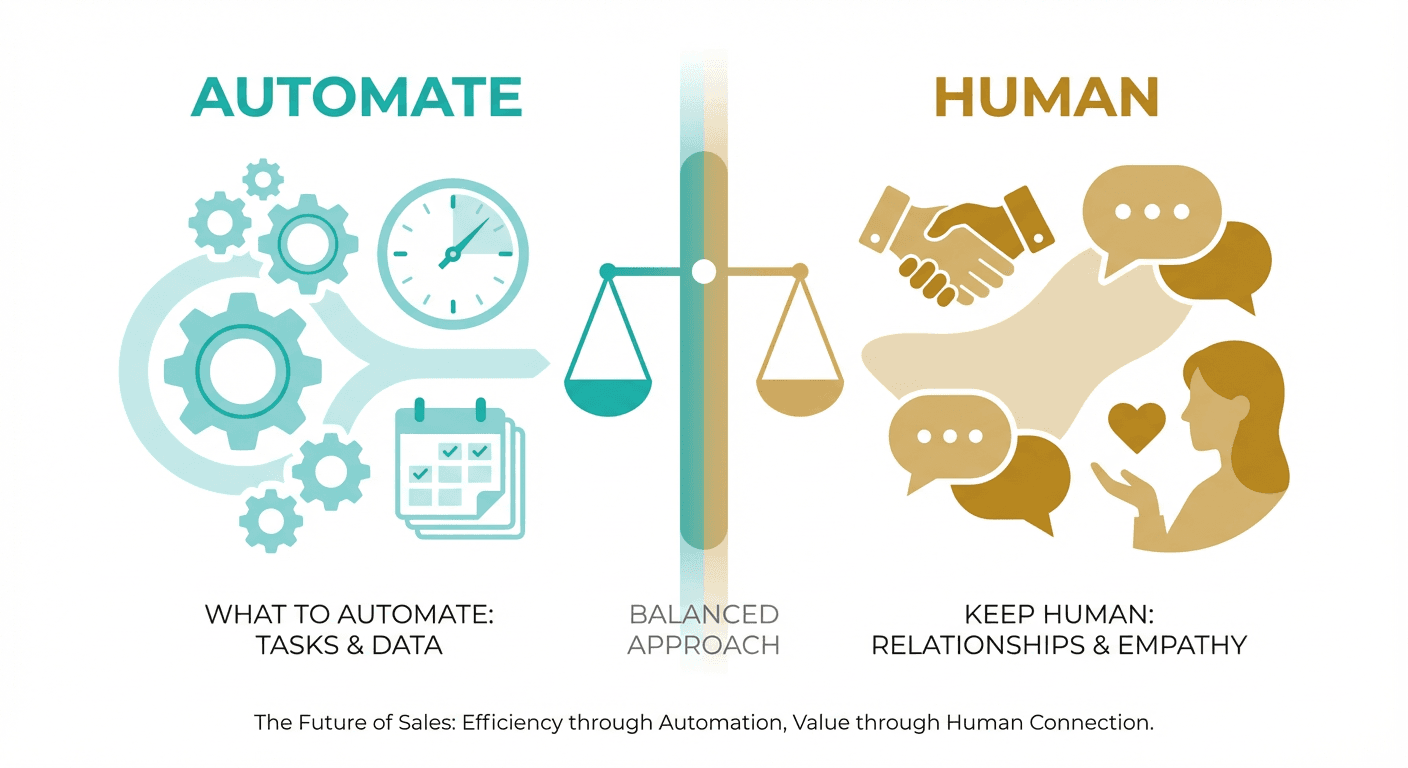
B2B sales teams should automate administrative tasks (CRM data entry, meeting scheduling, post-meeting reminders, campaign sending, and lead routing) while keeping discovery calls, first outreach content, negotiations, objection handling, and relationship building human. The key principle is to automate busy work but preserve the human touch in relationship-building and trust-building activities. Proper implementation saves 15+ hours per rep weekly and increases conversion rates by 20-40% through faster response times to qualified leads.
Key takeaways
- Sales reps spend 20-30% of their time on CRM data entry, which can be automated to reclaim 10+ hours per week per rep.
- Eliminating scheduling friction with automated booking tools increases meeting booking rates by 40%.
- Automated follow-up task triggers increase follow-through by 30% or more, preventing deals from falling through cracks.
- Lead scoring and routing automation produces a 20-40% conversion lift by ensuring hot leads reach top reps immediately.
- Basic automation stacks cost $200-500 monthly and deliver 5-10x ROI before counting revenue impact from faster follow-ups.
Reviewed and updated September 5, 2026
Sales Automation for B2B Teams: What to Automate (And What Not To)
Most B2B sales teams automate the wrong things.
They automate the parts that should be human. Then manually do the parts that should be automated.
The result? Longer sales cycles, lower conversion rates, and prospects who feel like they're talking to robots.
An automated sales process is a set of separate decisions rather than one system: which steps are mechanical and reversible, which ones reach a buyer, and which ones need a judgement no rule can make.
The decision to automate your sales process is therefore several smaller decisions taken one step at a time.
Analysts and platform vendors call this category sales force automation (SFA), and an outbound team needs roughly three of the dozen capabilities that definition covers.
Sales force automation platforms differ widely in which of those capabilities they prioritize, so a comparison of cold email tools helps narrow the choice.
Marketing automation and sales automation come out of the same toolbox and get searched as one phrase; the split that matters is ownership, with marketing automation firing on inbound behaviour and sales automation firing on the state of a record a rep already owns.
The Automation Paradox
Here's what most companies get wrong:
They automate:
- Discovery calls (should be human)
- First outreach (should have human elements)
- Objection handling (requires context)
They manually do:
- Data entry (pure time sink)
- Meeting scheduling (email tennis)
- Follow-up reminders (forgettable admin)
The fix is simple: Automate the busy work. Keep the relationship work human.
What to Automate (The Short List)
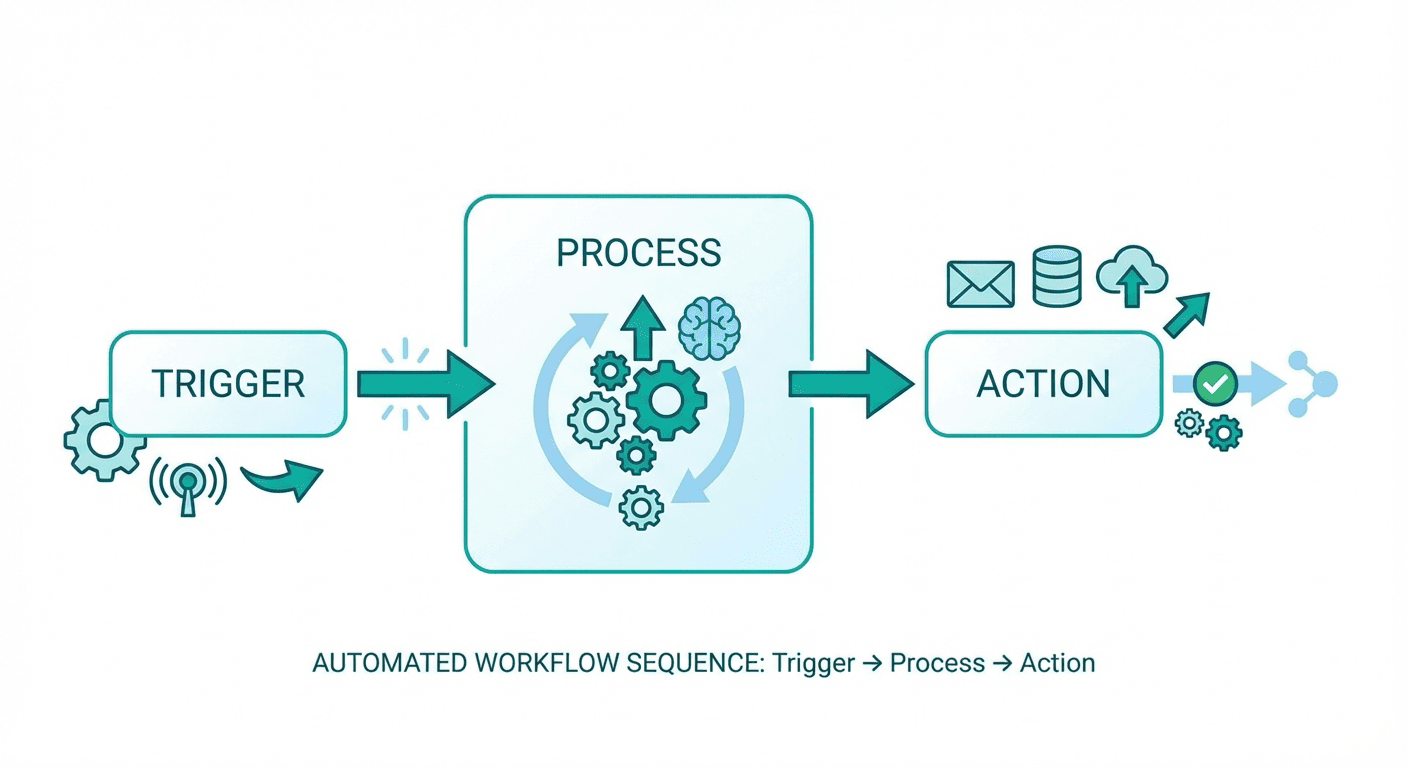
Skip the 47-tool tech stack. These five automations handle 80% of the value:
Doing it right is a boundary rather than a tool count. Automate the parts of the motion with one correct answer, keep a person on the parts where the answer depends on the account, and re-read that boundary whenever a tool offers to move it.
1. CRM Data Entry
Reps spend 20-30% of their time updating the CRM. That's insane.
Set up auto-capture for emails, calendar events, and call logs. Use Clay or Clearbit to auto-enrich contact data. Your CRM should fill itself.
AI sales forecasting tools explain which CRM and activity signals these systems can actually read, and where recorded history simply runs out.
The payoff: 10+ hours back per rep per week. That's an extra day of actual selling.
2. Meeting Scheduling
The "when are you free?" email chain is a conversion killer. By the time you agree on a time, they've lost interest.
Use Calendly, Cal.com, or Chili Piper. Prospect clicks link, picks time, done. Confirmation and reminders happen automatically.
The payoff: We've seen booking rates jump 40% just by eliminating scheduling friction.
Where we differ from standard practice
Much of the advice on this page reflects how outbound is commonly run. We run it differently, and since this page sits on our site it is worth saying where the difference is and what it costs us.
Inside sales automation is the same short list read from a desk rather than a territory. The work is already digital, so the constraint is not capture but judgement: the automations that pay are the ones removing a wait, and the ones that cost you are the ones removing a decision about who to contact and why now.
- A sequence of messages to each prospect over several weeks
- Later messages often land in the same email thread
- Every contact is reached more than once, so a distracted reader gets another chance
- The later messages go only to people who did not answer the first
- Reputation cost accrues on the sending domain across everything else it sends
- One message, then that campaign is finished for that contact
- No thread replies and no bumps
- A non-responding audience becomes a new campaign with a genuinely different premise, not a reminder
- More of the work moves into targeting and into the one message
- We reach each contact less often, and that is the cost we accept
The reasoning is mechanical rather than moral. A follow-up arrives underneath a message the recipient has already seen and chosen not to answer, so it is delivered to the population most likely to mark it as spam, and the reputation cost of that lands on the sending domain across every campaign running on it. We set that cost against the replies a sequence recovers and decided the trade was not worth it. The full argument, with the numbers from our own campaigns, is in why we stopped using follow-ups.
3. Follow-Up Task Creation
Reps forget to follow up. Or they follow up too late. It's human nature.
Set up automatic task triggers:
- No reply in 3 days → Follow-up task appears
- Meeting completed → Next-step task created
- Proposal opened → Check-in task triggered
The payoff: 30%+ increase in follow-through. Deals stop falling through the cracks.
4. Email Sequences (Done Right)
Manually sending follow-ups is tedious and inconsistent. But here's where most teams screw up: they automate sequences that feel automated.
The rules:
- Max 2-3 emails per sequence
- Personalize the first touch
- Stop the second they reply
- Never automate without proper deliverability setup
The payoff: 5-10x more outreach capacity without sounding like a robot.
5. Lead Scoring and Routing
When every lead gets the same response time, hot leads go cold while reps chase tire-kickers.
Auto-score based on company size, engagement, and intent signals. Route high-scorers to your best reps immediately.
The payoff: 20-40% conversion lift just by responding faster to the right people.
What NOT to Automate
This matters more than what you automate.
Discovery Calls
This is where trust gets built. You can't automate your way to understanding someone's real problems.
"Book a time on my calendar" with zero human touch kills conversion. At minimum, have a brief human exchange before sending the booking link.
First Outreach Content
Automate the delivery, not the message.
Mass-blasting 10,000 people with identical emails doesn't scale. It just scales your spam complaints. Personalize the content, automate the sending.
Negotiation
I've seen teams try to automate pricing discussions with calculators and bots. It never works.
Pricing conversations require context, relationship capital, and the ability to read the room. Automate proposal generation, keep the discussion human.
Objection Handling
Template responses to "it's too expensive" feel like template responses.
Objections are opportunities. They need human judgment, not canned answers.
Relationship Building
The moment someone gets an automated "Congrats on your promotion!" message, they know you didn't actually care enough to write it yourself.
Automate the reminder to reach out. Make the actual outreach personal.
The Implementation Order
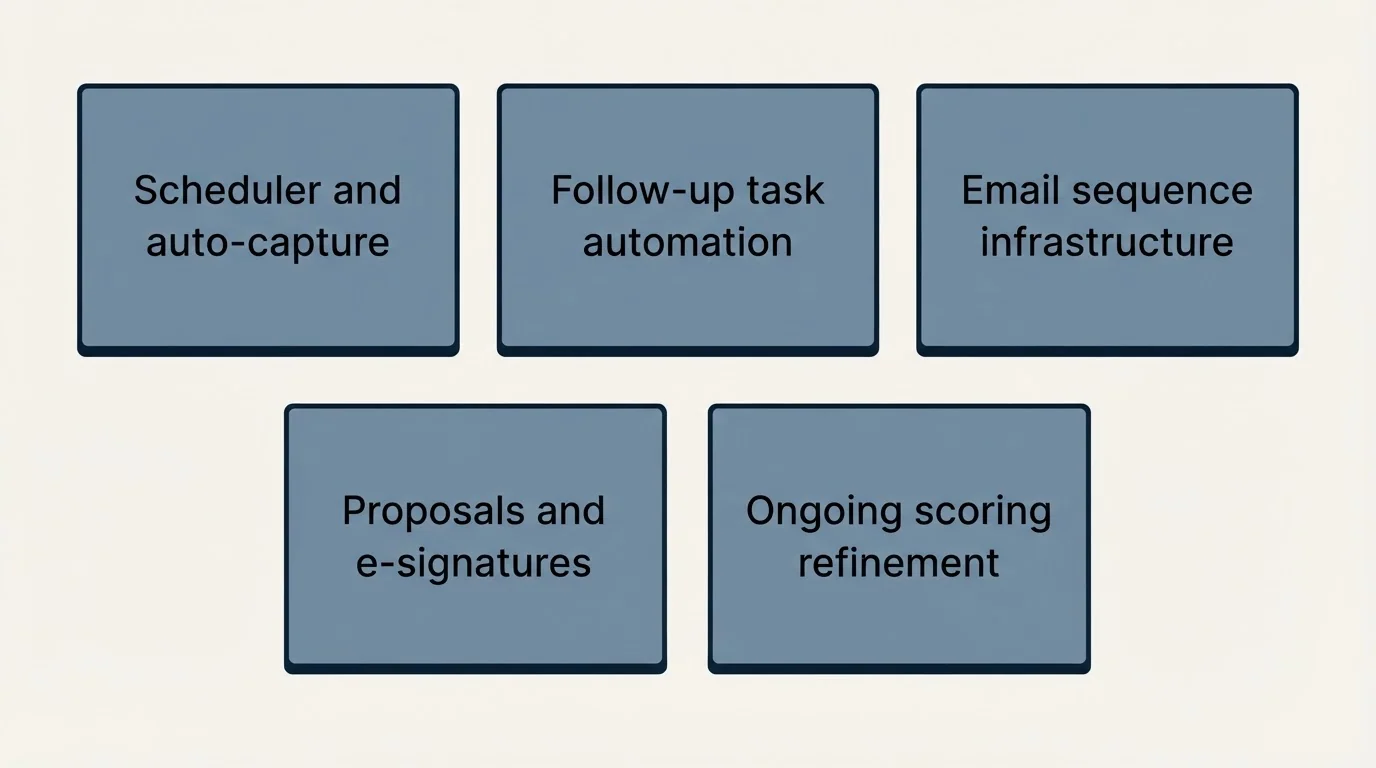
Don't try to automate everything at once. Here's the sequence that actually works:
Week 1-2: Meeting scheduler + CRM auto-capture. Immediate time savings, zero risk.
Week 3-4: Follow-up task automation. Plug the leaks in your pipeline.
Week 5-8: Email sequences with proper infrastructure. Test small, then scale.
Week 9-12: Proposal automation + e-signatures. Accelerate your close process.
Ongoing: Lead scoring refinement based on what's actually converting.
The Mistakes That Kill ROI
Automating Before You Have Product-Market Fit
If you don't know what messaging works, automating it just broadcasts failure faster.
Test manually first. Find what converts. Then automate the winner.
Over-Automating
When prospects start replying "Is this automated?", you've gone too far.
The goal isn't to remove humans. It's to free humans for the work that matters.
Set It and Forget It
Automation without optimization gets stale fast. Review quarterly:
- Are email sequences still converting?
- Is lead scoring accurate?
- Are follow-ups happening?
Bad Data In, Bad Automation Out
Automation amplifies data quality problems. Outdated emails mean bounces. Wrong titles mean irrelevant targeting.
Clean your data before you automate against it.
The Real Cost-Benefit
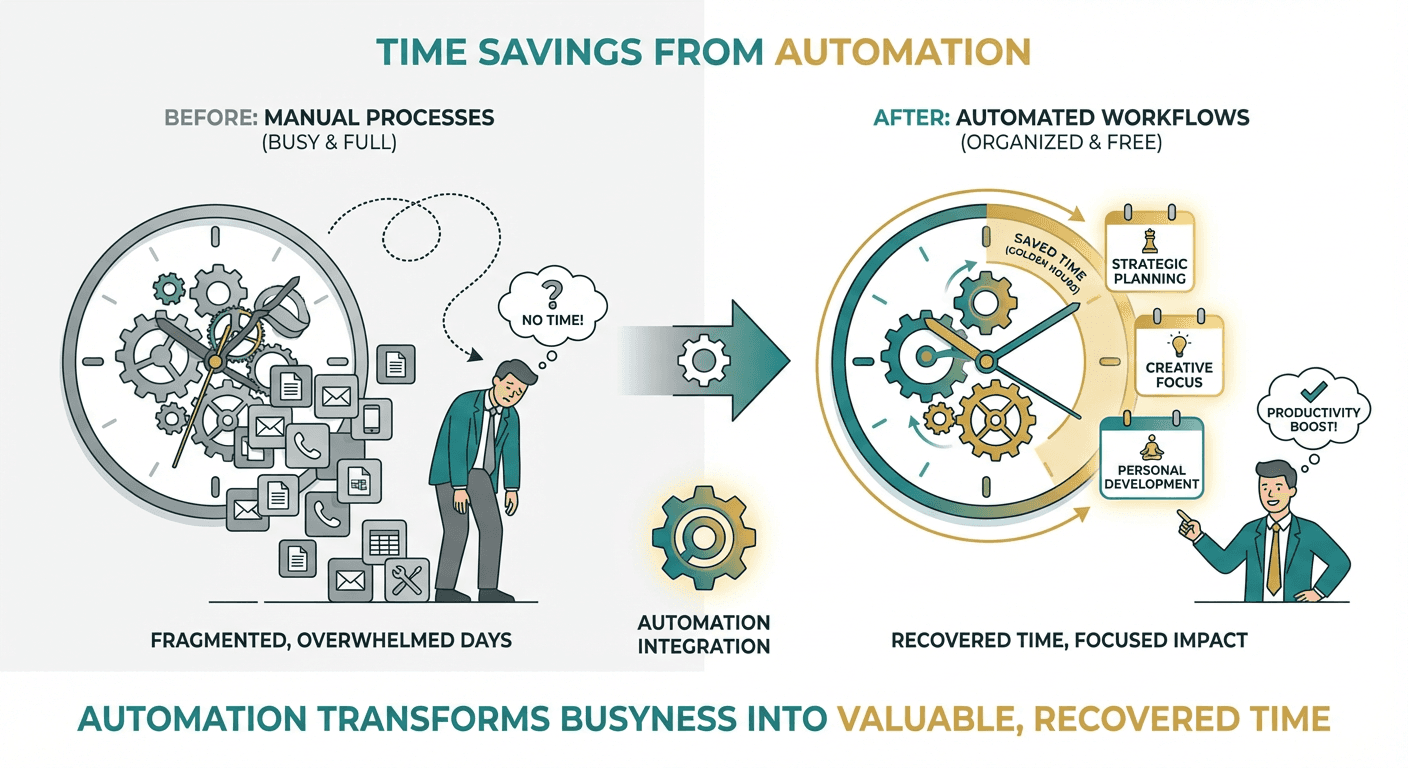
Let's be honest about the math:
Basic automation stack: $200-500/month Time saved: 15+ hours per rep per week Break-even: If your rep's time is worth more than $13-33/hour, automation pays for itself
For most B2B teams, that's a 5-10x return before you even count the revenue impact of faster follow-ups and better lead routing.
The Bottom Line
Sales automation isn't about removing humans from sales.
It's about removing humans from busy work so they can do what actually drives revenue: building relationships and closing deals.
The companies that win aren't the ones with the most sophisticated automation. They're the ones who automated the right things and kept the right things human.
Start here:
- Auto-capture everything into your CRM
- Eliminate scheduling friction
- Never forget a follow-up
- Personalize at scale (not blast at scale)
- Route hot leads fast
Get these right before you buy another tool.
Need help building your automation stack? See if you qualify for our done-for-you outreach infrastructure setup.
Frequently asked questions.
Frequently asked questions- What sales activities should B2B teams automate?
- Automate CRM data entry, meeting scheduling, post-meeting task creation, campaign sending, and lead scoring with routing. These administrative tasks consume 20-30% of rep time but require no human judgment. Auto-capture emails and calendar events, use scheduling links instead of email tennis, trigger internal tasks automatically after meetings, and route high-scoring leads to your best reps immediately for maximum conversion.
- What should you never automate in B2B sales?
- Never automate discovery calls, first outreach content, negotiation, objection handling, or relationship building. These require human judgment, context, and trust-building that automation destroys. You can automate delivery mechanisms and reminders, but the actual content and conversations must remain personal. When prospects ask 'Is this automated?', you've automated too much and damaged conversion rates.
- How much time does sales automation actually save?
- Proper sales automation saves 15+ hours per rep per week. CRM auto-capture alone recovers 10+ hours weekly that reps currently spend on data entry. Meeting schedulers eliminate back-and-forth email chains. Automated follow-up tasks prevent forgotten outreach. For a basic automation stack costing $200-500 monthly, teams typically see 5-10x ROI before counting revenue improvements from faster response times and better lead routing.
- What order should I implement sales automation?
- Start with meeting schedulers and CRM auto-capture in weeks 1-2 for immediate time savings and zero risk. Add post-meeting task automation in weeks 3-4 to stop pipeline leaks. Implement outbound campaign sending with proper infrastructure in weeks 5-8, testing small before scaling. Roll out proposal automation and e-signatures in weeks 9-12 to accelerate closes. Finally, continuously refine lead scoring based on actual conversion data.
- What's the biggest mistake companies make with sales automation?
- The biggest mistake is automating before achieving product-market fit. If you don't know what messaging works, automation just broadcasts failure faster. Test manually first, identify what converts, then automate the proven approach. Other critical errors include over-automating until prospects feel they're talking to robots, setting automation and forgetting to optimize it quarterly, and automating against bad data which amplifies quality problems across your entire outreach.
About the author.

Tim Carden is CMO / CTO at RevenueFlow, which builds and operates outbound revenue engines for B2B companies. Studied at McGill University.
Tim Carden · CMO / CTO
Connect on LinkedIn →Explore more.
Ready to scale your outreach?
We build GTM engines that book real meetings. See the receipts.
Related articles.
Monthly Sales Meeting Agenda: What the Month Decides
The weekly meeting triages deals in flight. The monthly one closes a period and changes the list. Six blocks, ninety minutes, one output each.
Sales Activity Tracking: What the Record Has to Say
Most activity tracking fails at capture rather than analysis. The unit you count decides what every later number can mean, and no tool fixes a wrong choice.
Sales Call Planning: The Plan a Booked Call Needs
A call cannot produce a commitment nobody named in advance. The four fields a call plan carries, and why the ask has to be decided before the meeting opens.
Lifecycle Stage, Lead Status, Deal Stage: Three Fields
Lifecycle stage records position, lead status records activity, and deal stage lives on the deal. Merging them breaks funnel reporting in ways nobody notices for a year.
The Seven-Step Sales Process: What Each Step Assumes
Prospecting through follow-up, walked one box at a time. Each of the seven steps carries an assumption about the buyer, and most of them have quietly stopped holding.
The Five-Step Sales Process: What You Stop Checking
Cutting a process to five steps is a decision about which checks you drop. Which deals the short version fits, and the two loss patterns that say it does not.