Saleshandy vs Snov.io: Cold Email Platform Comparison
Compare Saleshandy and Snov.io side by side. See pricing, features, and integrations to choose the right cold email platform for your needs.
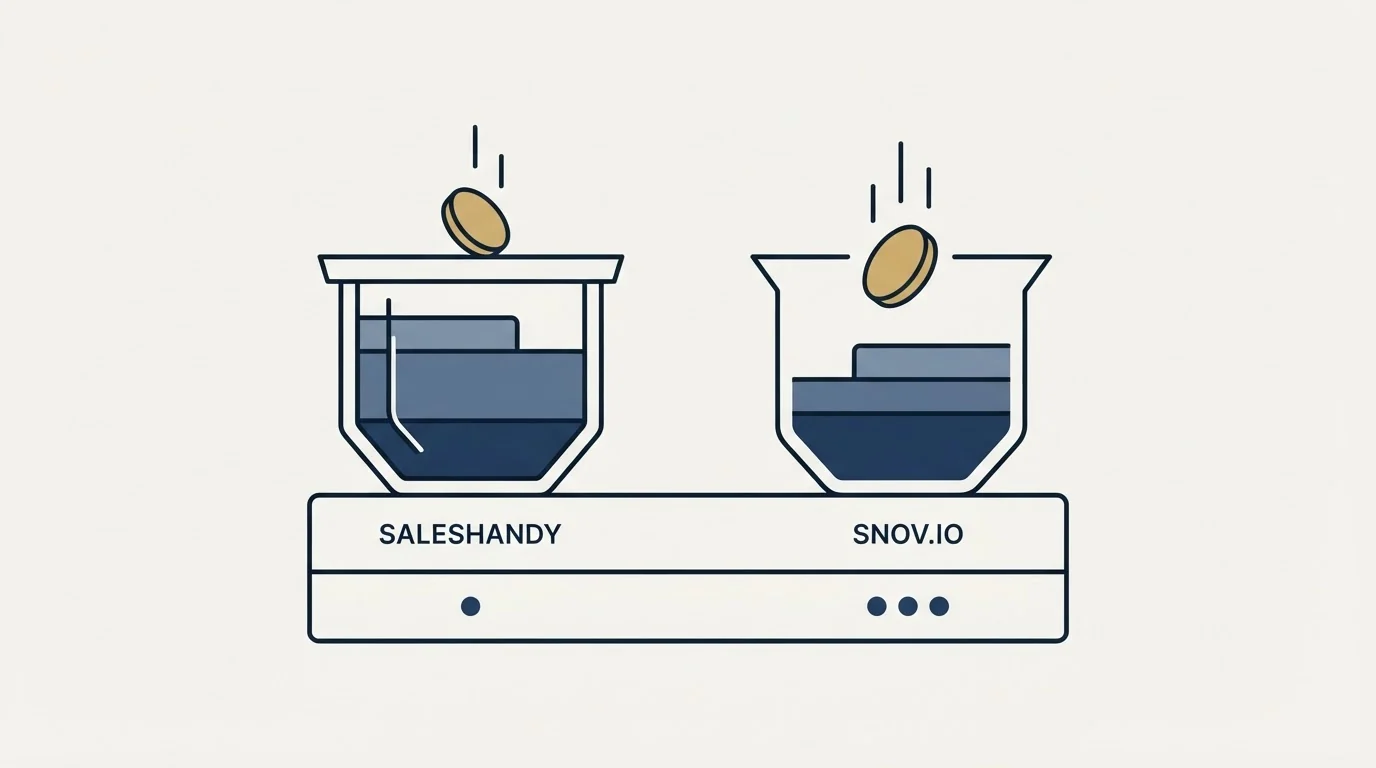
Saleshandy meters emails sent and caps users at one, ten and unlimited, from $41 a month billed monthly or $34 on annual, with unlimited email accounts throughout. Snov.io meters recipients held, leaves emails unlimited, and includes the lead database, from $39 a month for 5,000 recipients.
Key takeaways
- Snov.io includes the database and verifier; Saleshandy expects data to arrive from somewhere else.
- Saleshandy's seat caps are one on Starter and ten on Pro, with unlimited only on Scale.
- Snov.io's managed mailboxes are $5 a month each and LinkedIn slots $69 a month each, outside the plan.
- Saleshandy's annual rates are $34, $76 and $149 against monthly figures of $41, $99 and $189.
Reviewed and updated August 28, 2026
Saleshandy vs Snov.io: Cold Email Platform Comparison
Saleshandy gives away the mailboxes and counts the seats. Snov.io gives away the sends and counts the recipients, then sells you the database that fills them. Two teams with the same list can land on either side of this depending on how many people touch it.
The Quick Answer
Saleshandy: Starter $41 a month billed monthly or $34 on annual for 6,000 emails and one seat, Pro $99 or $76 for 100,000 emails and ten seats, Scale $189 or $149 for 200,000 emails and unlimited seats. Email accounts unlimited on every tier.
Snov.io: Trial free, Starter $39 a month for 5,000 recipients, Pro S $99 for 25,000, Pro M $189, Pro L $369, with emails unlimited on every paid tier. LinkedIn slots $69 a month each, managed mailboxes $5 a month each.
Snov.io includes the data. Saleshandy includes the mailbox pool without a seat penalty until the second user.
Understanding the Core Difference
Saleshandy is a cold email platform with unlimited connected mailboxes on every tier and a hard seat cap instead: one user on Starter, ten on Pro, unlimited only on Scale.
Snov.io is a sales suite that bundles a lead database and email finder with the sequencing tool, priced on the number of recipients you can hold rather than on sends.
Saleshandy meters sends and caps users. The email allowances are generous and the seat caps are tight, so the upgrade trigger for most teams is a person: one user on Starter, ten on Pro, unlimited only on Scale. Email ACCOUNTS are unlimited throughout, which is the resource cold sending actually consumes.
Snov.io meters recipients held and leaves sends unlimited. Its ladder is therefore about audience size rather than campaign volume, which suits a programme that works the same list repeatedly.
The other difference is the database. Snov.io includes one and Saleshandy does not, so a like for like comparison has to add a data subscription to the Saleshandy column or accept that the two are covering different amounts of the stack.
Pricing Comparison
Starter, billed monthly
Starter
Saleshandy pricing
| Plan | Monthly | Billed annually | Users | Emails/month |
|---|---|---|---|---|
| Starter | $41/mo | $34/mo, $408/year | 1 user | 6,000 |
| Pro | $99/mo | $76/mo, $912/year | 10 users | 100,000 |
| Scale | $189/mo | $149/mo, $1,788/year | Unlimited | 200,000 |
Two corrections to numbers that circulate widely. Saleshandy's plans are not the old Outreach Starter / Pro / Scale / Scale Plus ladder at $36, $99, $199 and $299, and the page's headline figures are the ANNUAL rates with the monthly price shown underneath. And the "unlimited team members" claim attached to Saleshandy in older comparisons is wrong: the page says plainly that Starter is a single seat and Pro covers a team of ten, with only Scale unlimited. Email accounts are unlimited on all three.
Source: Saleshandy Pricing
Snov.io pricing
| Plan | Price | Recipients | Emails |
|---|---|---|---|
| Trial | Free | 100 recipients | Limited |
| Starter | $39/mo | 5,000 recipients | Unlimited |
| Pro S | $99/mo | 25,000 recipients | Unlimited |
| Ultra | See note below | 400,000 recipients | Unlimited |
The table skips two published tiers, Pro M at $189 a month and Pro L at $369. And Snov.io's page contradicts itself on Ultra: the plan card reads Custom with a Contact Sales button, while the plan-comparison row prices it at $738 a month. Both are on the same page, so treat Ultra as quoted rather than listed and ask which number applies.
Two costs sit outside the plan price. LinkedIn account slots are billed separately at $69 a month per slot, and managed mailboxes are $5 a month per email account.
Source: Snov.io Pricing
What the two cost at a realistic volume
Take an invented but ordinary case: 25,000 prospects contacted in a month, three people, list needs sourcing, fifteen sending mailboxes. The arithmetic is illustrative and uses list prices only.
On Snov.io, 25,000 recipients is Pro S at $99 a month with sourcing included and sends unlimited. Fifteen managed mailboxes at $5 each adds $75, so about $174 unless you bring your own addresses.
On Saleshandy, 25,000 emails fits Pro's 100,000 allowance and three people fit its ten seats, so $99 a month billed monthly or $76 on annual. Mailboxes cost nothing. The list still has to be sourced, which is a separate subscription.
Whether that separate subscription costs more or less than $75 is the whole comparison, and it usually costs more.
Reading the price ladders against each other
Read Saleshandy's headline as the annual rate, with the monthly figure underneath: $34, $76 and $149 against $41, $99 and $189. Read its seat caps as the real ladder, because the email allowances rarely bind first.
Read Snov.io's recipient cap rather than any send number, and add the two costs that sit outside the plan: $69 a month per LinkedIn slot, $5 a month per managed mailbox.
One page-level warning: Snov.io's own page contradicts itself on Ultra, showing a Custom card with a Contact Sales button alongside a comparison row priced at $738 a month. Ask which applies.
Features Breakdown
- Unlimited email accounts
- Unlimited teams, with seats capped at 1, 10 and unlimited by tier
- AI-powered email sequences
- Email warmup included
- Email verification credits
- 852M+ verified contacts in the lead database
- and 4 more listed below
- Email finder and verifier
- Unlimited email sending
- Drip campaign sequences
- Built-in sales CRM
- Email warmup
- Unlimited mailbox warm-ups (Pro+)
- and 4 more listed below
Saleshandy key features
- Unlimited email accounts
- Unlimited teams, with seats capped at 1, 10 and unlimited by tier
- AI-powered email sequences
- Email warmup included
- Email verification credits
- 852M+ verified contacts in the lead database
- Unified inbox
- A/B testing (up to 26 variants)
- Spintax support
- Whitelabel for agencies (Scale+)
Snov.io key features
- Email finder and verifier
- Unlimited email sending
- Drip campaign sequences
- Built-in sales CRM
- Email warmup
- Unlimited mailbox warm-ups (Pro+)
- LinkedIn automation (add-on)
- Bulk prospect search
- Team collaboration with unlimited seats
- Chrome extension
Saleshandy's list is a sending list: unlimited connected mailboxes, warmup, a unified inbox, sequence branching, deliverability tooling.
Snov.io's spans sourcing and sending: a lead database, an email finder and verifier, sequencing, a light CRM, warmup.
Both cover the sending job competently. Only one covers the finding job, and only one leaves seats uncapped at the bottom of the ladder.
Integration Ecosystem

Saleshandy connects with: HubSpot, Salesforce, Pipedrive, Zoho CRM, Zapier, Make, n8n, Slack, Gmail, Outlook.
Snov.io connects with: HubSpot, Pipedrive, Zapier, Make, Calendly, Phantombuster, Gmail, Outlook.
Both tools integrate with: HubSpot, Pipedrive, Zapier, Make, Gmail, Outlook.
Both connect to the usual CRMs and mailbox providers. Snov.io additionally exposes its finder through an API, which matters when enrichment has to run inside another workflow.
If your data already comes from a provider you trust, Saleshandy's narrower footprint is not a disadvantage. If it does not, Snov.io's API is part of what you are buying.
Who Should Pick Which
Pick Snov.io if the list has to be built. The database and verifier are inside the price and removing a data vendor usually saves more than the difference.
Pick Saleshandy if the data is already handled. Unlimited email accounts with a large send allowance is a clean, cheap sending layer.
Pick Snov.io if the same audience is worked repeatedly. Unlimited sends against a recipient cap is exactly the right shape for that.
Pick Saleshandy if volume is very high and the team is under ten. 200,000 emails a month on Scale is more sending headroom than the Snov.io tiers here describe.
Where each one sits in a cold outbound stack
Snov.io spans the sourcing and sending slots. Saleshandy sits in the sending slot and expects the slot above it to be filled by someone else.
Our own doctrine keeps that slot deliberately thin: one message per campaign, no bumps and no thread replies, and volume spread across many low-volume mailboxes so no single address carries too much. LinkedIn runs as its own motion rather than as a step inside an email sequence, because a second LinkedIn message lands under the one that was ignored and reads as a bump whatever the campaign structure says.
Both include warmup, so neither needs the separate warm-up line that a Woodpecker or GMass budget carries.
Switching between them
These migrate cleanly, because both hold mailboxes rather than living inside one. Export contacts, sequences and the suppression list, reconnect the sending addresses, and let warmup settle before restarting campaigns.
Leaving Snov.io ends database access, so export anything you have found before the subscription lapses. Leaving Saleshandy ends nothing upstream, because nothing upstream was included.
Disconnect mailboxes from the old platform before connecting them to the new one; two tools warming the same address is a misconfiguration.
Feature Comparison Summary
| Saleshandy | Snov.io | |
|---|---|---|
| Priced on | Emails sent, with seat caps | Recipients held |
| Entry price | $41/mo Starter, $34 on annual | $39/mo Starter |
| Users | 1 on Starter, 10 on Pro, unlimited on Scale | Not the metered unit |
| Email accounts | Unlimited on every tier | $5/mo per managed mailbox |
| Email volume | 6,000 / 100,000 / 200,000 a month | Unlimited on every paid tier |
| Lead database | Not included | Included |
| Not the model | $69/mo per account slot | |
| Best fit | Sending when data is handled | Sourcing and sending together |
Getting Started Checklist
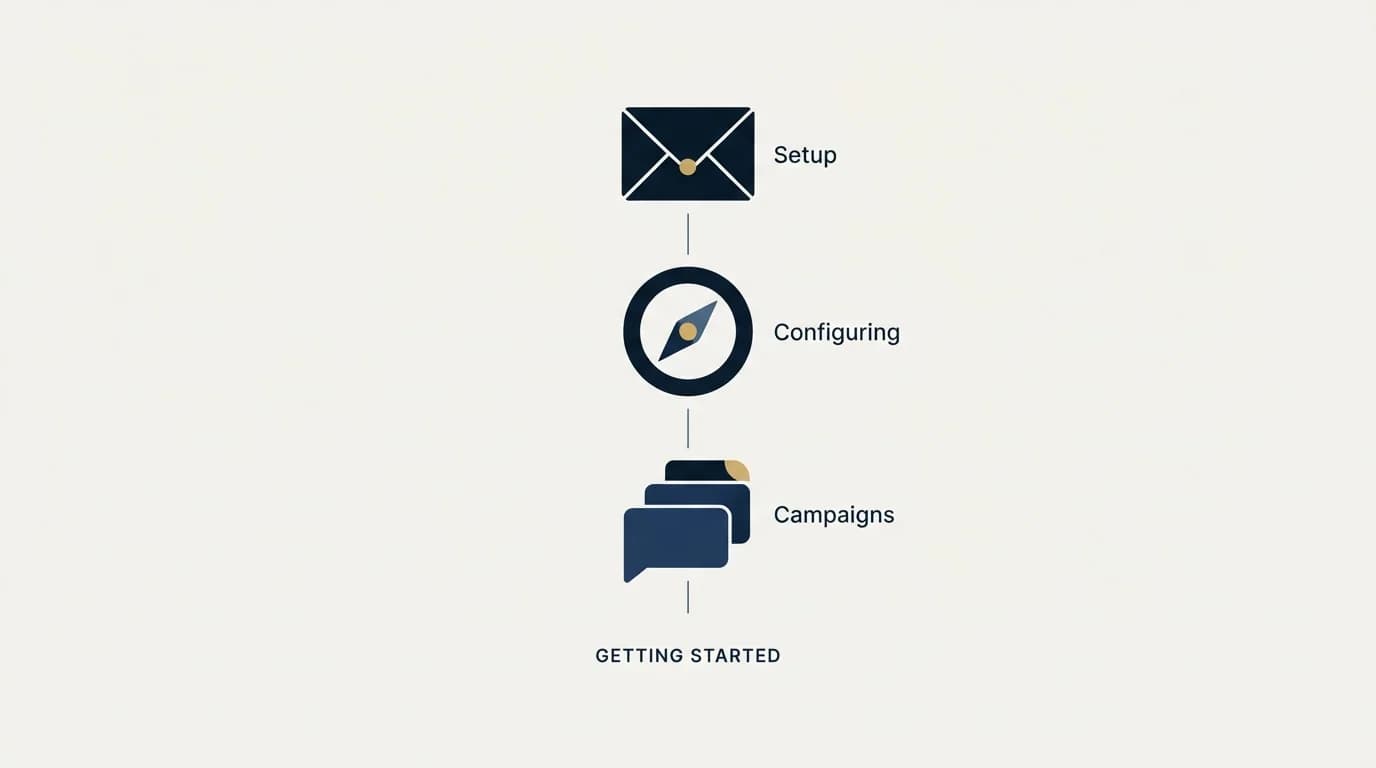
- Decide whether the list has to be built. If yes, price a data vendor into the Saleshandy column.
- Count seats against Saleshandy's caps of one and ten.
- Read Snov.io's recipient cap rather than its send allowance.
- Add Snov.io's mailbox and LinkedIn lines before comparing totals.
- Ask Snov.io which Ultra price applies, since its page publishes two.
- Warm every new sending address before the first campaign.
Final Thoughts
Saleshandy is a clean sending layer for a team that already has data. Snov.io is a sourcing and sending suite for a team that does not.
Price the missing half into whichever column lacks it, and the comparison becomes straightforward.
Related Reading
- Best Saleshandy alternatives
- Best Snov.io alternatives
- Instantly vs Saleshandy
- Saleshandy vs Smartlead
- Instantly vs Snov.io
- Outplay vs Snov.io
If you would rather have the sourcing and the sending run for you, RevenueFlow books qualified meetings on a pay-per-meeting basis and publishes client results.
Pricing and features are taken from the vendors' own pages. Verify current terms with the vendor before relying on them.
Frequently asked questions.
Frequently asked questions- Which is cheaper?
- It depends on whether the list has to be built. At 25,000 prospects a month, Snov.io Pro S is $99 with sourcing included plus $75 for fifteen managed mailboxes; Saleshandy Pro is $99 monthly or $76 on annual with mailboxes free and a data subscription still to buy.
- Is Saleshandy unlimited on team members?
- No. Its page states that Starter is a single seat and Pro covers a team of ten, with only Scale unlimited on users. What is unlimited on every tier is email ACCOUNTS. Older comparisons that credit Saleshandy with unlimited team members have that exactly backwards.
- Do I need mailboxes from Snov.io?
- No, you can bring your own. Snov.io sells managed mailboxes at $5 a month per address as a convenience, so fifteen of them is $75 on top of the plan. If you already run your own sending domains and addresses, that line disappears from the comparison entirely.
- Which Snov.io Ultra price is right?
- Ask them. Its own pricing page publishes two answers: a plan card reading Custom with a Contact Sales button, and a plan-comparison row pricing Ultra at $738 a month. Both appear on the same page, so treat Ultra as quoted rather than listed.
About the author.

Tim Carden is CMO / CTO at RevenueFlow, which builds and operates outbound revenue engines for B2B companies. Studied at McGill University.
Tim Carden · CMO / CTO
Connect on LinkedIn →Explore more.
Ready to scale your outreach?
We build GTM engines that book real meetings. See the receipts.
Related articles.
GetSales.io vs Yet Another Mail Merge: Sales Engagement Platform vs Cold Email Platform Comparison
Compare GetSales.io (sales engagement platform) and Yet Another Mail Merge (cold email platform) side by side. See pricing, features, and integrations to decide which one, or both, your stack needs.
Enginy vs Success.ai: Sales Engagement Platform vs Cold Email Platform Comparison
Compare Enginy (sales engagement platform) and Success.ai (cold email platform) side by side. See pricing, features, and integrations to decide which one, or both, your stack needs.
Artisan vs Yet Another Mail Merge: Sales Engagement Platform vs Cold Email Platform Comparison
Compare Artisan (sales engagement platform) and Yet Another Mail Merge (cold email platform) side by side. See pricing, features, and integrations to decide which one, or both, your stack needs.
Growbots vs MailHeat: Cold Email Platform vs Email Warmup Tool Comparison
Compare Growbots (cold email platform) and MailHeat (email warmup tool) side by side. See pricing, features, and integrations to decide which one, or both, your stack needs.
Hexospark vs JustCall: Cold Email Platform vs Sales Engagement Platform Comparison
Compare Hexospark (cold email platform) and JustCall (sales engagement platform). See pricing, features, and integrations to decide which one, or both, your stack needs.
EmailBison vs Emelia: Cold Email Platform Comparison
Compare EmailBison and Emelia side by side. See pricing, features, and integrations to choose the right cold email platform for your needs.