Cold Email for Conference Speaking: Complete Strategy Guide
Learn how to use cold email to secure speaking opportunities at industry conferences and events. Includes proven templates, pitch strategies, and best practices for speaker outreach.

Cold email effectively secures conference speaking slots by directly connecting you with event organizers who receive numerous submissions. Success requires understanding organizer priorities (they want actionable content, audience draw, and reliable speakers), then crafting personalized pitches that demonstrate topic-audience fit, prove speaking credibility, and offer clear value. Build speaking credentials through smaller events first, research target conferences systematically, and develop essential assets including a speaker bio, headshot, and session descriptions before outreach.
Key takeaways
- Conference organizers prioritize speakers who deliver actionable value to attendees, draw audiences, and demonstrate professional reliability over promotional or recycled content.
- A tiered conference targeting approach (starting with smaller Tier 2 and 3 events to build credentials before pursuing prestigious Tier 1 opportunities) increases acceptance rates.
- Essential speaker assets include multiple-length bios (50, 100, and 200 words), professional headshots, speaking reels, session descriptions, and testimonials from previous engagements.
- Systematic conference discovery uses industry calendars, aggregator platforms, competitor research, and social media monitoring to identify speaking opportunities.
- Cold email outreach requires researching the specific event's audience, theme, and previous speakers to personalize pitches that demonstrate clear alignment rather than generic topic proposals.
Reviewed and updated September 15, 2026
Cold Email for Conference Speaking: Complete Strategy Guide
Conference speaking provides a platform to establish thought leadership, connect with your target audience, and build credibility at scale. A single conference talk can position you as an expert, generate leads, and create content you can repurpose for months. The challenge is that desirable speaking slots are competitive, and conference organizers receive numerous speaker submissions. Cold email provides a direct channel to event organizers and increases your chances of securing valuable speaking opportunities.
A guide to cold email for awards nominations explains how similar outreach can secure nominations and build credibility through industry recognition.
This guide covers everything you need to know about using cold email to land conference speaking engagements, from identifying the right events to crafting proposals that get accepted.
Why Conference Speaking Matters
Speaking at industry events delivers benefits that few other activities can match.
Thought leadership positioning. Being invited to speak signals expertise to your audience. Conference organizers have validated your knowledge by giving you a platform.
Since building authority through speaking pairs naturally with other outreach channels, the guest blogging outreach strategy explains how to pitch editors for similar visibility gains.
Direct audience access. Conferences gather your target audience in one place, giving you unfiltered access to potential customers, partners, and collaborators.
Beyond conference stages, cold outreach also opens doors to one on one guidance, and the guide to pitching potential mentors explains how to frame a small, specific request that gets a reply.
Content creation. A single conference talk generates material for blog posts, videos, social media content, and sales collateral.
Networking opportunities. Speakers receive privileged access to other speakers, organizers, and attendees.
Lead generation. Well-executed talks generate inbound interest from attendees who want to learn more.
Brand visibility. Your company's name appears in conference marketing, reaching audiences before and after the event.
Personal development. Preparing and delivering talks sharpens your thinking and communication skills.
Understanding Conference Organizer Priorities
Effective outreach requires understanding what event organizers need from speakers.
- Value for attendees
- Audience draw
- Professional delivery
- Fresh perspectives
- Low risk
- Promotion support
- Topics covered before
- Too promotional
- Unproven speakers
- Poor fit
- Difficult logistics
- Lack of preparation
What Organizers Want
Value for attendees. Organizers succeed when attendees leave satisfied. They want speakers who deliver actionable, valuable content.
Audience draw. Speakers with existing audiences or compelling topics help drive ticket sales and attendance.
Professional delivery. Organizers need speakers who will show up prepared, engage the audience, and handle logistics smoothly.
Fresh perspectives. The same speakers and topics year after year diminish event value. Organizers seek new voices and angles.
Low risk. Organizers worry about speakers who cancel, deliver poorly, or create problems. Reliability matters.
Promotion support. Speakers who actively promote their sessions support the event's marketing efforts.
What Gets Speakers Rejected
Topics covered before. Recycled presentations from other conferences or topics the event has featured recently.
Too promotional. Talks that are thinly veiled sales pitches rather than educational content.
Unproven speakers. Without evidence of speaking ability, organizers take a significant risk.
Poor fit. Topics that don't align with the event's audience, theme, or format.
Difficult logistics. Speakers with complex requirements or scheduling inflexibility create problems.
Lack of preparation. Vague proposals or incomplete submissions signal potential issues.
Finding Conference Speaking Opportunities
Systematic identification of speaking opportunities prevents missed chances.
Research Methods
Industry event calendars. Many industries maintain event calendars. Check association websites and trade publications.
Conference aggregator sites. Platforms like Lanyrd, Eventbrite, and specialized sites list conferences across industries.
Competitor research. Where have competitors or industry peers spoken? These events may welcome similar speakers.
Previous speaker searches. Search for where thought leaders in your space have presented.
Social media monitoring. Follow conferences and organizers. They often announce call-for-proposals on social channels.
LinkedIn events. The platform surfaces professional events relevant to your network and interests.
Google searches. Queries like "[your industry] conference [year]" or "[topic] speaking opportunities" surface options.
Evaluating Conference Value
Before pursuing a speaking slot, evaluate whether the event warrants your investment:
Audience alignment. Does the attendee profile match your target audience?
Event reputation. Is this event respected in your industry? Who has spoken previously?
Audience size. How many attendees, and how many will attend your session?
Geographic relevance. Does the location make sense given travel costs and your target market?
Content format. What session formats are available (keynote, breakout, panel, workshop)?
Speaking terms. Does the event cover travel, provide compensation, or require payment to speak?
Promotion value. How will the event promote your session and share content afterward?
Building Your Target List
Create a tiered list of conference targets:
- Tier 1: Dream events with large audiences and high prestige
- Tier 2: Strong events with relevant audiences and solid reputation
- Tier 3: Smaller events where you can build experience and speaking credentials
Start with Tier 2 and 3 to build your track record before pursuing Tier 1 opportunities.
Building Your Speaker Profile
Conference organizers evaluate speakers, not just topics. Build credibility before reaching out.
Essential Speaker Assets
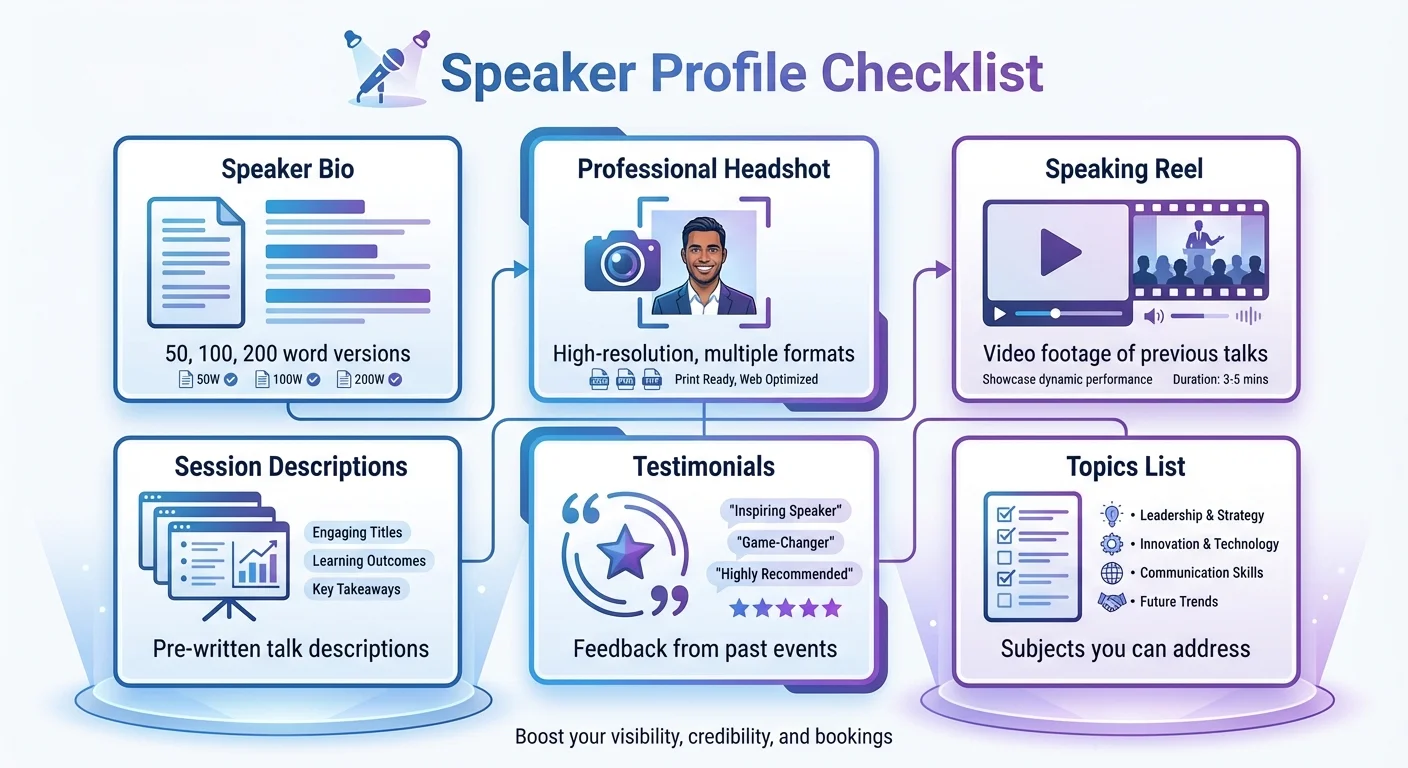
Speaker bio. A professional bio highlighting your expertise and speaking experience. Multiple lengths (50 words, 100 words, 200 words) for different needs.
Professional headshot. High-resolution images in multiple formats for conference marketing.
Speaking reel. Video footage of previous talks demonstrating your presentation skills.
Session descriptions. Pre-written descriptions of talks you can deliver.
Testimonials. Feedback from past audiences, organizers, or event attendees.
Topics list. A clear articulation of subjects you're prepared to address.
Building Speaking Credentials
If you lack speaking experience:
Start with smaller venues. Local meetups, company lunch-and-learns, and webinars build experience.
Create video content. YouTube videos and webinar recordings demonstrate your presentation ability.
Guest on podcasts. Podcast appearances provide similar format experience and create shareable content.
Write extensively. Published articles and blog posts demonstrate subject matter expertise.
Collect testimonials. Even informal speaking generates feedback you can document.
Cold Email Strategy for Conference Outreach
Cold email to conference organizers requires a specific approach different from other outreach types.
Finding the Right Contact
Identify who makes speaker decisions:
Event websites. Look for "About" pages, organizer bios, or "Contact" sections.
Previous event coverage. Conference recaps often mention organizers by name.
LinkedIn searches. Search for "[Conference Name]" + titles like "Program Director," "Content Manager," or "Speaker Relations."
Twitter/social media. Organizers often engage publicly about their events.
Email tools. Services like Hunter.io or LinkedIn Sales Navigator help identify contacts.
Timing Your Outreach
Conference planning follows predictable cycles:
Call for proposals (CFP): Many events have formal submission periods. Research these deadlines.
Early outreach: 6-9 months before the event, organizers are building their program. This is prime time for proactive outreach.
Last-minute opportunities: 1-2 months before events, organizers sometimes need speakers to fill gaps.
Off-cycle relationship building: Between events, build relationships with organizers for future opportunities.
Personalization for Conference Outreach
Generic speaker pitches get ignored. Show you understand the specific event:
- Reference the event's theme or focus areas
- Mention specific past sessions you found valuable
- Explain why your topic fits this event's audience
- Demonstrate knowledge of the event format and timing
- Connect your expertise to the organizer's stated goals
Crafting Conference Speaking Pitches
Your pitch email determines whether organizers engage with your proposal.
Subject Lines
Subject lines should be clear and professional:
- "Speaker proposal for [Conference Name]"
- "[Topic] session for [Conference Name]"
- "Speaking at [Conference Name] [Year]?"
- "[Your Name] for [Conference Name] speaker lineup"
Avoid overly clever or vague subject lines that obscure your purpose.
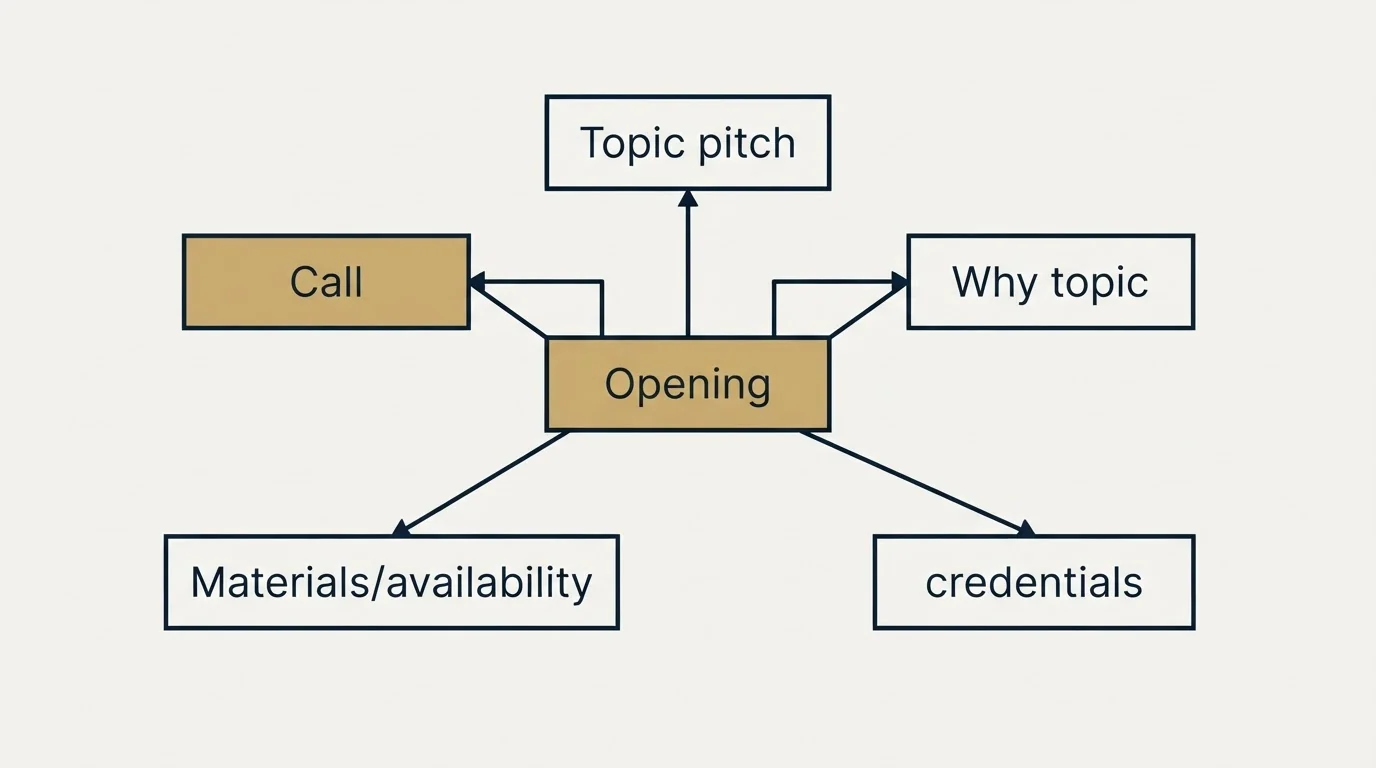
Pitch Structure
Opening (1-2 sentences): Connect with the specific event. Reference the conference theme, audience, or past sessions.
Topic pitch (2-3 sentences): Present your session idea clearly. Include a working title and brief description of what attendees will learn.
Why this topic (2-3 sentences): Explain why this subject matters to their specific audience right now.
Your credentials (2-3 sentences): Briefly establish your expertise and speaking experience.
Materials/availability (1-2 sentences): Mention supporting materials you can provide and your availability for their dates.
Call to action (1 sentence): Request next steps.
Total length: 200-300 words.
Tone Guidance
- Confident without arrogance: You have value to offer
- Professional and respectful: Treat organizers as partners
- Specific rather than generic: Details demonstrate genuine interest
- Focused on attendee value: Lead with what the audience gains
Conference Speaking Pitch Templates
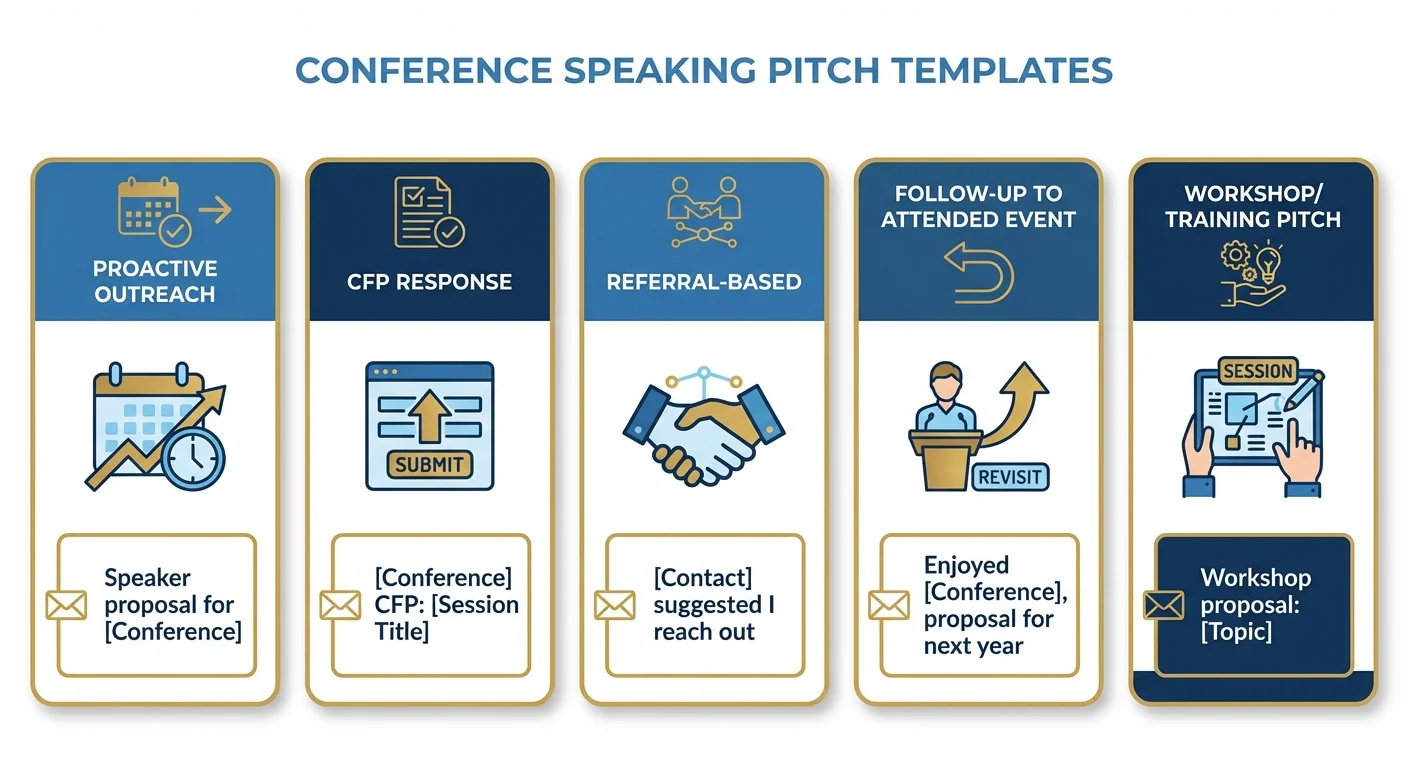
Template 1: Proactive Outreach
Subject: Speaker proposal for [Conference Name]
Hi [Name],
I'm reaching out about a speaking opportunity at [Conference Name]. Your event's focus on [theme/topic] aligns closely with work I've been doing on [specific area].
I'd like to propose a session titled "[Working Title]." In this talk, attendees would learn:
- [Key takeaway 1]
- [Key takeaway 2]
- [Key takeaway 3]
This topic is particularly relevant for your audience because [specific reason tied to their attendees or current industry trends].
Background: I'm [Title] at [Company], where I [relevant experience]. I've spoken at [notable events] and have [other relevant credentials]. I've attached my speaker bio and can share video from previous talks.
I'm available for [dates if known]. Would this topic interest you for [Conference Name]?
[Your Name] [Contact info]
Template 2: CFP Response
Subject: [Conference Name] CFP: [Session Title]
Hi [Name],
I'm submitting a proposal for [Conference Name]'s call for speakers.
Session Title: [Title]
Description: [2-3 sentence description of what the session covers and what attendees will learn]
Why this matters now: [1-2 sentences connecting the topic to current industry trends or challenges]
About me: [1-2 sentences on relevant expertise and speaking experience]
Format flexibility: I can deliver this as a [keynote/breakout/workshop/panel] and adjust length based on your needs.
I've attached my full bio and session outline. Video from my talk at [Previous Event] is available at [link].
Let me know if you need additional information.
[Your Name]
Template 3: Referral-Based Outreach
Subject: [Mutual Contact] suggested I reach out about [Conference Name]
Hi [Name],
[Mutual Contact] recommended I contact you about speaking at [Conference Name]. They mentioned you're looking for sessions on [topic area], and thought my work on [specific expertise] might be a good fit.
I'd like to propose: "[Session Title]"
This session would cover [brief description]. Attendees would leave with [specific actionable takeaways].
I recently delivered a similar session at [Previous Event] with positive response. [Mutual Contact] can speak to my presentation style and content quality.
Would this topic work for your program? I'm happy to discuss adjustments based on your audience's specific needs.
[Your Name]
Template 4: Follow-Up to Attended Event
Subject: Enjoyed [Conference Name], speaker proposal for next year
Hi [Name],
I attended [Conference Name] [timeframe] and was impressed by the quality of sessions, particularly [specific session or theme]. It's clear you understand what this audience needs.
For [upcoming year], I'd like to propose a session on [topic]. Specifically:
Title: "[Session Title]"
Topic: [Brief description]
Why it matters: At [Conference], I noticed several questions during sessions about [topic area]. This talk would directly address those needs with [specific approach].
I'm [Title] at [Company] with experience in [relevant area]. I've spoken at [events] on related topics.
I know planning is likely underway. Would this topic fit your program?
[Your Name]
Template 5: Workshop or Training Pitch
Subject: Workshop proposal: [Topic] for [Conference Name]
Hi [Name],
I'm proposing a hands-on workshop for [Conference Name] that would give attendees practical skills they can apply immediately.
Workshop Title: [Title]
Duration: [Time] (flexible based on your format)
What attendees will do:
- [Hands-on activity 1]
- [Practical exercise 2]
- [Takeaway deliverable 3]
What they'll leave with: [Specific tangible outcome]
Workshops like this work because [reason: participants learn by doing, immediate application, etc.]. I've delivered similar sessions at [events] with [outcome/feedback].
I can accommodate [group size] participants and will handle [materials/setup needs].
Is there space for an interactive workshop in your program?
[Your Name]
When A Pitch Goes Unanswered
Conference organizers are busy, and speaker selection often follows extended timelines. Most unanswered pitches are not rejections. The program was already full, the theme moved, or your email arrived in the week the organizer was running last year's event.
That is a timing signal, not a verdict on you or your topic, and the answer to it is not to chase. A second email on the same thread reads as a bump, and it spends the relationship you are trying to build. Send one message per pitch, then put the effort into the next genuine reason to write.
What To Do Instead
Treat every approach as its own pitch, with its own reason to exist.
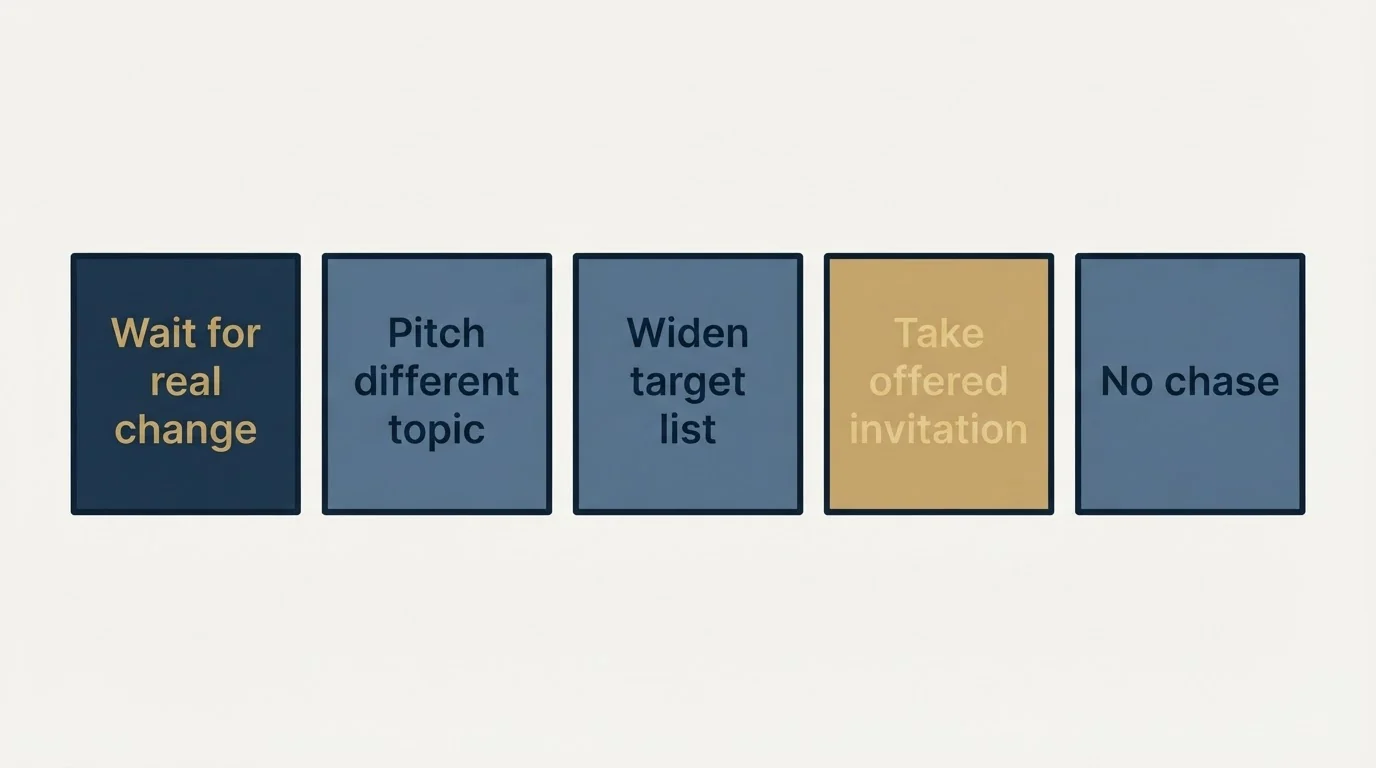
Wait for a real change, then write about that. A new call for proposals, a new track, a published shift in the event's theme, or new work of your own worth talking about. Each of those is a premise that stands on its own to an organizer who does not remember your earlier email.
Pitch a different topic rather than the same one again. Organizers turn down topics far more often than they turn down people. A second attempt that repeats the first idea gives them nothing new to say yes to.
Widen the target list instead of deepening the chase. Three organizers approached once each will beat one organizer approached three times, for the same effort and none of the goodwill cost.
Take an invitation when it is offered. If an organizer replies asking you to check back in June, or the event's CFP page names a decision date and a contact for status questions, that is their own process and a two-way conversation. Answering it is not a bump.
Re-Approach Examples
Each of these is a new first message with its own subject line. None refers back to an earlier email or continues an old thread.
New cycle, new topic:
Subject: [Topic] session for [Conference Name] [Year]
Hi [Name],
[Conference Name] [previous year] ran several sessions on [theme], and the questions from the room kept landing on [specific gap]. For [year] I'd like to propose "[Session Title]," which covers [brief description] and sends attendees home with [specific takeaway].
I'm [Title] at [Company], where I [relevant experience]. I've spoken at [notable events] and can share video on request.
Is that a fit for the [year] program?
[Your Name]
New evidence, same expertise:
Subject: [Conference Name]: session on [new finding]
Hi [Name],
We spent last quarter on [research or project] and the result surprised us: [specific finding]. It cuts against [common assumption] in a way your audience would want to argue with, which usually makes for a good room.
I'd like to propose "[Session Title]" for [Conference Name], covering [one-line description]. Video from my talk at [Previous Event] is at [link].
Is there space in the program for it?
[Your Name]
After Your Pitch Gets Accepted
Securing a speaking slot is the beginning, not the end.
Delivering on Your Commitment
Meet all deadlines. Submit materials (bio, headshot, slides, description) on time.
Communicate proactively. Keep organizers informed of any issues or needs.
Prepare thoroughly. Deliver content that exceeds expectations.
Engage professionally. Arrive early, stay for the event, participate in networking.
Promote your session. Share your upcoming talk through your channels.
After the Event
Thank the organizers. Express genuine appreciation for the opportunity.
Share feedback. If you have constructive observations about the event, share them diplomatically.
Stay connected. Maintain the relationship for future opportunities.
Request testimonials. Ask for feedback you can use in future speaker pitches.
Repurpose content. Turn your talk into blog posts, videos, and other content.
Common Mistakes to Avoid
Pitching Generic Topics
Vague proposals like "Leadership in the Digital Age" don't stand out. Specific, actionable topics with clear takeaways win.
Making It About You
Organizers care about attendee value, not your promotional goals. Lead with what the audience gains.
Ignoring Event Theme
Pitches disconnected from the event's focus signal lack of research and reduce acceptance chances.
Underselling Your Credentials
Don't be overly modest about relevant experience. Organizers need confidence you'll deliver.
Overcomplicating Logistics
Complex requirements around scheduling, AV needs, or formats create friction. Be flexible and easy to work with.
Chasing One Silent Pitch
One email rarely secures speaking slots, which is an argument for pitching more events with more ideas, not for raising the same proposal with the same organizer twice. Persistence belongs in the number of genuine pitches you make.
Neglecting Preparation After Acceptance
Failing to deliver after being selected damages your reputation for future opportunities.
Your Conference Speaking Outreach Checklist
Preparation
- Identified target conferences by tier
- Researched event themes, audiences, and past speakers
- Found appropriate contacts (program directors, organizers)
- Prepared speaker assets (bio, headshot, reel, testimonials)
- Developed session topics with clear titles and takeaways
Pitch Quality
- Subject line is clear and professional
- Opening connects to specific event
- Topic is specific with clear attendee value
- Credentials establish expertise
- Call to action is clear
- Total length is under 300 words
Process
- CFP deadlines tracked
- Materials ready to send on request
- Relationship notes documented
Post-Acceptance
- Deadlines calendared and met
- Promotion plan executed
- Content thoroughly prepared
- Thank-you note and testimonial request planned
Building Your Speaking Career
Conference speaking delivers compounding returns. Each successful talk builds credentials that make future opportunities easier to secure. Cold email accelerates this process by proactively creating opportunities rather than waiting for invitations.
Start with events where you have realistic chances of acceptance, deliver exceptional value, and use that foundation to pursue increasingly prestigious opportunities.
If you're looking to systematize your conference speaking outreach while maintaining personalization, RevenueFlow can help. Our done-for-you cold email campaigns apply these principles to build your speaking portfolio.
Get Your Free Campaign and see how targeted cold email can help you secure conference speaking opportunities.
Frequently asked questions.
Frequently asked questions- Why should I pursue conference speaking for my business?
- Conference speaking establishes thought leadership while delivering multiple business benefits. A single talk validates your expertise through organizer selection, provides direct access to concentrated target audiences, and generates repurposable content for months. Speaking slots also create networking opportunities with other speakers and organizers, generate inbound leads from interested attendees, and increase brand visibility through conference marketing before and after the event.
- What do conference organizers look for in speaker submissions?
- Conference organizers prioritize speakers who deliver actionable, valuable content that serves attendees rather than promotional pitches. They seek speakers with audience draw, professional delivery experience, and fresh perspectives that differ from previous years. Organizers need reliable speakers who handle logistics smoothly, promote their sessions, and present low-risk options. Topics covered recently at the event or vague proposals signal potential problems and typically get rejected.
- How do I find conference speaking opportunities in my industry?
- Use systematic research methods including industry event calendars on association websites, conference aggregator platforms like Lanyrd and Eventbrite, and LinkedIn events. Research where competitors and industry peers have spoken, monitor social media for call-for-proposals announcements, and search for previous speakers in your space. Google searches using terms like '[your industry] conference [year]' or '[topic] speaking opportunities' surface additional options you can evaluate for audience alignment and reputation.
- Should I target the biggest conferences first when starting out?
- No, use a tiered targeting approach instead. Create three tiers: Tier 1 for dream events with large audiences and high prestige, Tier 2 for strong events with relevant audiences, and Tier 3 for smaller events. Start with Tier 2 and 3 conferences to build your speaking track record and credentials before pursuing Tier 1 opportunities. This approach increases acceptance rates because organizers prefer speakers with proven delivery experience over unproven speakers who represent higher risk.
- What assets do I need before reaching out to conference organizers?
- Prepare a speaker bio in multiple lengths (50, 100, and 200 words) highlighting your expertise and speaking experience, a professional headshot, and clear session descriptions. A speaking reel demonstrating your presentation skills, testimonials from previous engagements, and a topics list showing your range significantly strengthen your credibility. Conference organizers evaluate speakers alongside topics, so having these assets ready before outreach demonstrates professionalism and reduces organizer risk.
About the author.

Ben Carden is CRO at RevenueFlow, which builds and operates outbound revenue engines for B2B companies. Previously at Gartner Enterprise. Studied at London School of Economics.
Ben Carden · CRO
Connect on LinkedIn →Explore more.
Ready to scale your outreach?
We build GTM engines that book real meetings. See the receipts.
Related articles.
Cold Email for Awards Nominations: Complete Strategy Guide
Learn how to use cold email to secure industry awards and recognitions. Includes proven templates, submission strategies, and best practices for awards outreach that gets results.
Cold Email for Mentorship: Complete Strategy Guide
Learn how to use cold email to find and connect with mentors who can accelerate your career or business. Includes proven templates, personalization strategies, and best practices for building meaningful mentor relationships.
Cold Email for Webinar Guest Recruitment: Strategy Guide
Learn how to use cold email to recruit expert guests for your webinars. Includes proven templates, personalization strategies, and best practices for building a roster of compelling webinar speakers.
Cold Email for Guest Blogging: Complete Strategy Guide
Learn how to use cold email to secure guest blogging opportunities on high-authority publications. Includes proven templates, pitch strategies, and best practices for building your content portfolio.
Cold Email for Interview Requests: Complete Strategy Guide
Learn how to use cold email to secure interviews with industry experts, thought leaders, and key stakeholders. Includes proven templates, timing strategies, and follow-up frameworks.
Cold Email for Influencer Outreach: Partner with Creators
Learn how to use cold email to build authentic influencer partnerships that drive real results for your brand, with proven templates and strategies.