Cold Email for Guest Blogging: Complete Strategy Guide
Learn how to use cold email to secure guest blogging opportunities on high-authority publications. Includes proven templates, pitch strategies, and best practices for building your content portfolio.
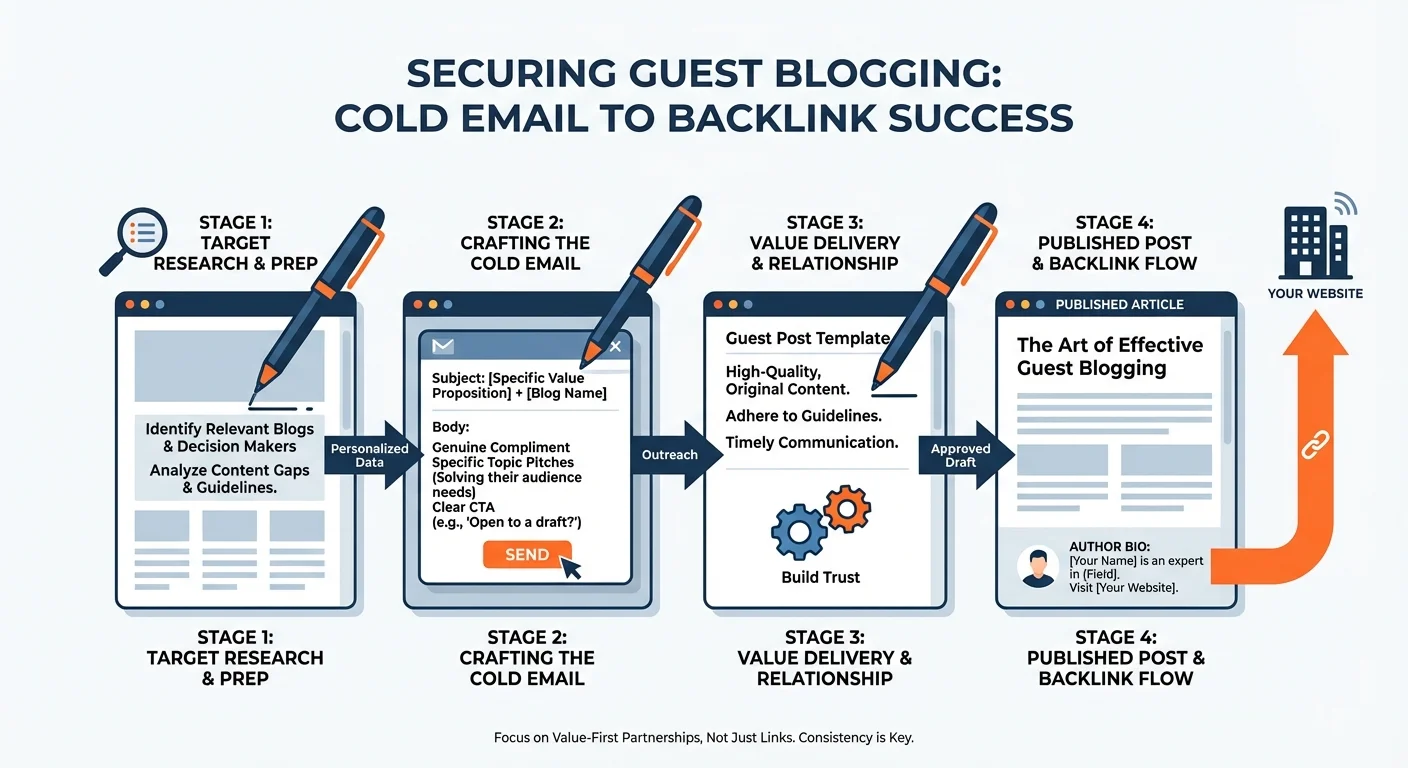
Cold email works for guest blogging because it provides direct access to editors, allows personalization beyond generic submission forms, and typically generates faster responses. To succeed, research 10-15 recent articles from your target publication, identify the right editor (Managing Editor, Content Editor, or Contributions Editor), and craft a pitch that demonstrates understanding of their content gaps and audience needs rather than focusing on your desire for exposure.
Key takeaways
- High-quality publications receive hundreds of pitch emails weekly, making strategic differentiation through personalized cold email essential for standing out.
- Create a tiered target list with Tier 1 (dream publications), Tier 2 (strong publications), and Tier 3 (growing publications), starting with Tiers 2 and 3 to build credibility before pitching top-tier targets.
- Research each publication by reading at least 10-15 recent articles to understand tone, style, content gaps, and audience demographics before pitching.
- Find the right contact by searching for titles like Managing Editor, Content Editor, or Contributions Editor on the publication's team page, LinkedIn, or using tools like Hunter.io.
- Editors prioritize content that fills gaps in existing coverage, provides fresh perspectives, drives engagement, requires minimal editing, and arrives on time.
Reviewed and updated September 15, 2026
Cold Email for Guest Blogging: Complete Strategy Guide
Guest blogging remains one of the most effective strategies for building authority, driving referral traffic, and expanding your professional reach. The challenge is that high-quality publications receive hundreds of pitch emails weekly, and most get ignored. Cold email, when executed strategically, provides a direct channel to editors and content managers who can open doors to valuable publishing opportunities.
Cold email strategy for finding mentors shows how that same direct channel can expand your professional reach beyond editors and into personal guidance.
Cold email strategy for recruiting webinar guests applies that same direct outreach approach to inviting busy experts onto live sessions.
This guide covers everything you need to know about using cold email to secure guest blogging placements, from identifying the right publications to crafting pitches that get accepted.
Each guest post email template below is a single complete pitch, written to be the only message you send to that editor.
Why Guest Blogging Still Matters
In an era of social media and video content, written content on established publications continues to deliver unique value.
Credibility building. Being published on respected industry publications signals expertise to your audience, potential clients, and partners.
SEO benefits. Quality backlinks from authoritative sites improve your search rankings and domain authority.
Targeted reach. Publications with established audiences put your content in front of readers who care about your topic.
Content portfolio. Guest posts create a body of work that demonstrates your expertise and writing ability.
Relationship development. Successful guest posts often lead to ongoing contributor relationships and additional opportunities.
Why Cold Email Works for Guest Post Pitching
While many publications have formal submission processes, cold email offers advantages that submission forms often lack.
Direct access to decision makers. Emails reach editors directly, bypassing general submission queues that may have significant backlogs.
Personalization opportunity. Cold email allows you to tailor your pitch to the specific editor and demonstrate understanding of their publication.
Cold Email for Mentorship: Complete Strategy Guide explains how that same personalization principle applies when reaching out to potential mentors rather than editors.
Relationship initiation. Email creates a direct line of communication that can develop into an ongoing relationship.
Stand out from the crowd. A well-crafted personal email differentiates you from mass submissions through generic forms.
Faster response times. Direct outreach often generates faster responses than formal submission processes.
Finding Guest Blogging Opportunities
The quality of publications you target significantly impacts the value you receive from guest blogging.
Evaluating Potential Publications
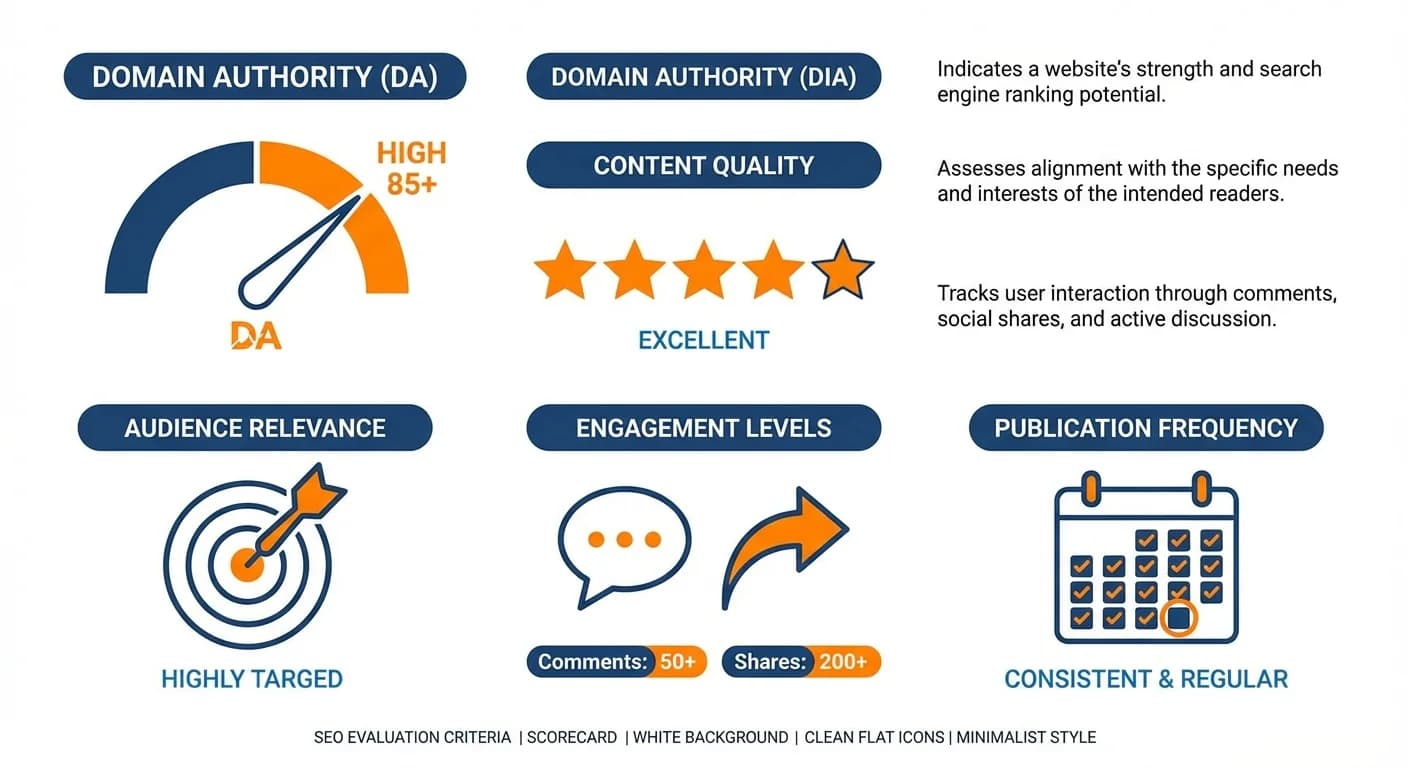
Consider these factors when identifying target publications:
Domain authority. Higher domain authority generally means more SEO value from backlinks. Tools like Moz, Ahrefs, or SEMrush provide these metrics.
Audience relevance. Publications should reach your target audience, not just have high traffic numbers.
Content quality. The quality of existing content reflects on you as a contributor.
Engagement levels. Look for publications where readers comment, share, and engage with content.
Contributor guidelines. Publications that have clear guidelines indicate an established guest posting program.
Publication frequency. Sites that publish regularly need more content and may be more receptive to pitches.
Research Methods
Google search operators. Use queries like:
- "[your topic] + write for us"
- "[your topic] + guest post"
- "[your topic] + contributor guidelines"
- "[your topic] + submit an article"
Competitor analysis. Identify where industry peers and competitors have published guest content.
Content aggregators. Platforms like Medium, LinkedIn, and industry-specific aggregators often lead to publication opportunities.
Twitter and LinkedIn. Follow editors and content managers who share when they're seeking contributors.
Existing guest posts. Authors who have published guest posts often do so on multiple publications. Follow their trail.
Building Your Target List
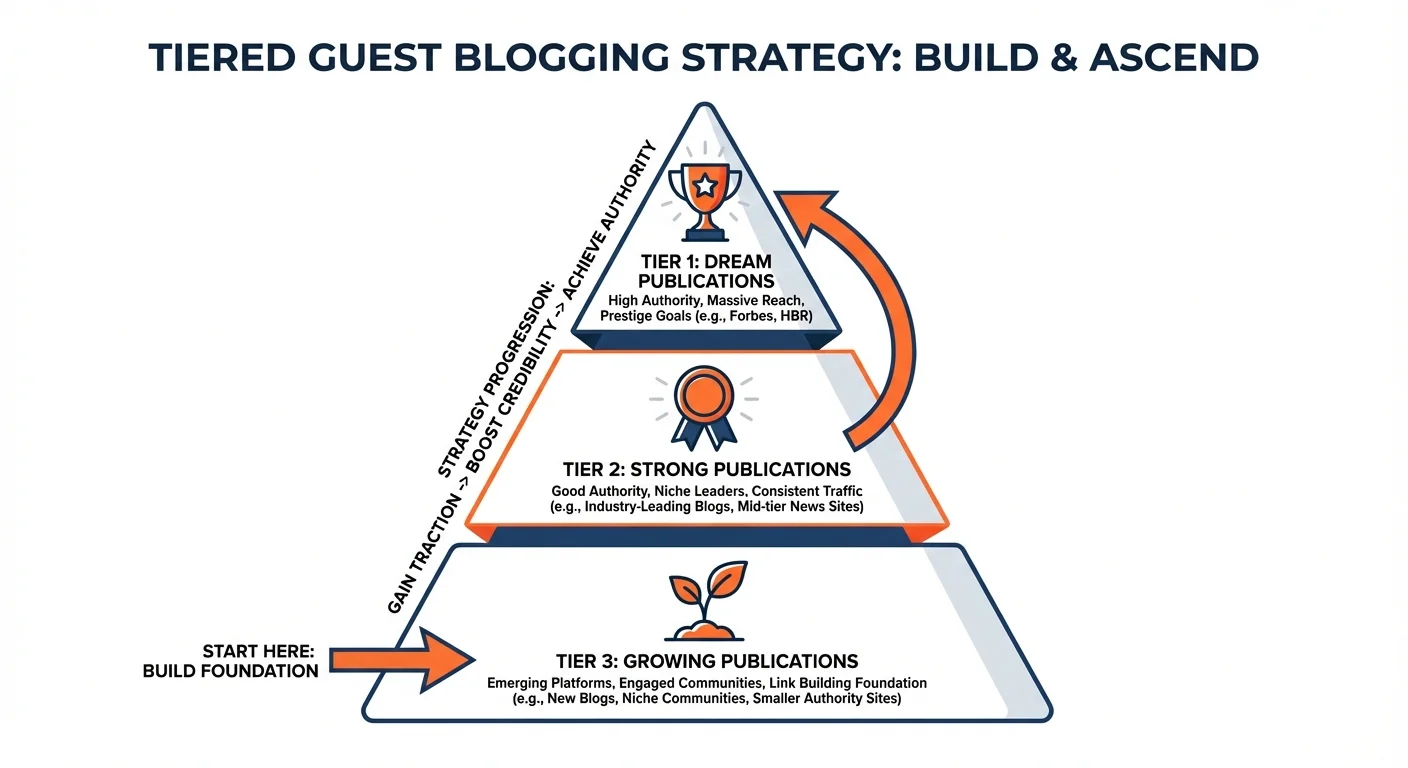
Create a tiered list of publications:
- Tier 1: Dream publications with highest authority and reach
- Tier 2: Strong publications with good metrics and relevant audiences
- Tier 3: Growing publications where you can build your portfolio
Start with Tier 2 and 3 publications to build credibility before pitching Tier 1 targets.
Research Before Pitching
Thorough research separates successful pitches from the rejection pile.
Understanding the Publication
Before pitching any publication:
- Read at least 10-15 recent articles to understand tone and style
- Identify topics they cover and gaps in their content
- Note article length, formatting preferences, and structure
- Understand their audience demographics and interests
- Review their contributor guidelines thoroughly
- Check their social media engagement on articles
Finding the Right Contact
Identify the person who handles guest content:
Editor titles to look for:
- Managing Editor
- Content Editor
- Contributions Editor
- Editorial Manager
- Content Manager
Where to find contacts:
- Publication's "About" or "Team" page
- LinkedIn searches for "[Publication] + editor"
- Twitter bios of publication staff
- Author bylines on recent guest posts
- Tools like Hunter.io or Clearbit
Understanding Editor Needs
Editors want content that:
- Fills gaps in their existing coverage
- Provides fresh perspectives on evergreen topics
- Drives engagement and shares
- Meets their quality standards without heavy editing
- Arrives on time and as promised
Position your pitch around these needs, not your desire for exposure.
Crafting Guest Post Pitch Emails
Your pitch email determines whether your ideas get considered or ignored.
Subject Lines for Guest Post Pitches
Effective subject lines are:
- Clear about the purpose (guest post pitch)
- Specific about the topic
- Brief and professional
Examples:
- "Guest post pitch: [Topic]"
- "[Specific Topic] article idea for [Publication]"
- "Contributor inquiry: [Topic angle]"
- "Article pitch for [Publication]"
Avoid clickbait, excessive punctuation, or vague subject lines.
Email Structure
Opening (1-2 sentences): Demonstrate familiarity with the publication. Reference a recent article or specific aspect of their content.
Your pitch (3-4 sentences): Present your article idea clearly. Include the working title, main angle, and key points you'll cover.
Credentials (2-3 sentences): Explain why you're qualified to write this piece. Include relevant experience and previous publications.
Logistics (1-2 sentences): Note your timeline, proposed word count, and flexibility on the idea.
Call to action (1 sentence): Ask if they'd like to see a draft or discuss the idea further.
Total length: 150-250 words.
Pitch Content Elements
The topic angle. Specificity matters. "Content marketing tips" is too broad. "How B2B SaaS companies can reduce content production costs by 40% using AI tools" is specific and compelling.
The value proposition. What will readers learn or gain? Why should the publication's audience care?
Your unique perspective. What experience or data do you bring that others lack?
Supporting evidence. Do you have original data, case studies, or examples that strengthen the piece?
Guest Post Pitch Templates
Template 1: Standard Pitch
Subject: Guest post pitch: [Specific Topic]
Hi [Editor Name],
I've been reading [Publication] for [timeframe] and particularly enjoyed your recent piece on [specific article]. The point about [specific insight] resonated with my experience.
I'd like to pitch a guest post titled "[Working Title]." The piece would cover:
- [Key point 1]
- [Key point 2]
- [Key point 3]
I'll include [specific evidence: original data, case studies, expert quotes] to support the insights.
I'm a [your role] with [relevant experience]. My writing has appeared in [notable publications if applicable]. I can deliver a polished [word count] piece within [timeframe].
Would this topic interest your readers? I'm happy to adjust the angle based on your feedback or share a draft for your review.
Best, [Your Name] [Website/LinkedIn]
Template 2: Data-Driven Pitch
Subject: [Publication] article: Original research on [Topic]
Hi [Editor Name],
I have original data that [Publication] readers might find valuable. We recently [conducted research/analyzed data/completed a study] on [topic], and the findings challenge conventional wisdom about [specific point].
Proposed article: "[Working Title]"
Key findings I'd highlight:
- [Data point 1 with specific number]
- [Data point 2 with specific number]
- [Counterintuitive insight]
The piece would be approximately [word count] words and include [number] original charts and graphs.
I'm [your role] at [company], where we [brief relevant context]. I've contributed to [notable publications].
Would exclusive access to this data interest you? I can provide more details on methodology and findings.
[Your Name]
Template 3: Trending Topic Pitch
Subject: Timely piece: [Trending Topic]
Hi [Editor Name],
Given the recent [industry development/news event/trend], I wanted to pitch a timely piece for [Publication] on [specific angle].
Your readers are likely asking [question related to trend]. I can address this with practical guidance based on [your relevant experience].
Proposed title: "[Working Title]"
The article would cover:
- [Timely point 1]
- [Practical takeaway 2]
- [Forward-looking insight 3]
I can turn this around quickly given the time-sensitive nature. I'm available to discuss or submit a draft by [specific date].
Background: I'm [your role] and have [specific relevant experience with this topic].
Is this timing and topic a fit?
[Your Name]
Template 4: Response to Contributor Call
Subject: RE: Call for contributors on [Topic]
Hi [Editor Name],
I saw your recent [tweet/LinkedIn post/call for contributors] about needing pieces on [topic]. I'd like to submit an idea.
Proposed article: "[Working Title]"
This piece would address [specific problem readers face] by providing [specific solution or framework]. I'd include [case study/examples/data] from my experience [relevant background].
Key sections:
- [Section 1]
- [Section 2]
- [Section 3]
I've written for [notable publications] and currently [your role and relevant context].
Would you like to see a draft or outline first?
[Your Name]
Template 5: Following Up on Previous Publication
Subject: Another piece for [Publication]?
Hi [Editor Name],
Thank you again for publishing my recent piece on [previous article topic]. I was pleased to see the engagement, particularly the comments about [specific aspect].
I'd like to pitch a follow-up piece that addresses questions readers raised: "[Working Title]"
This would build on the original article by:
- [Extension point 1]
- [Extension point 2]
- [New angle that addresses reader questions]
Same approach as before: [word count] words, delivered within [timeframe].
Would this complement the original piece well?
[Your Name]
When A Pitch Goes Unanswered
Editors are busy and pitches get buried, so silence is common and it is rarely a judgment on your idea. The usual causes are an editorial calendar that is already full, an angle that overlaps something they have commissioned, or a week where the publication was shipping something else entirely.
None of those change if you email again on the same thread. A chase adds nothing the editor did not already have, and to the one person whose goodwill you need most it reads as a bump. Send one pitch per email, and put the next effort into the next idea.
- None of those change if you email again on the same thread.
- A chase adds nothing the editor did not already have, and to the one person whose goodwill you need most it reads as a bump.
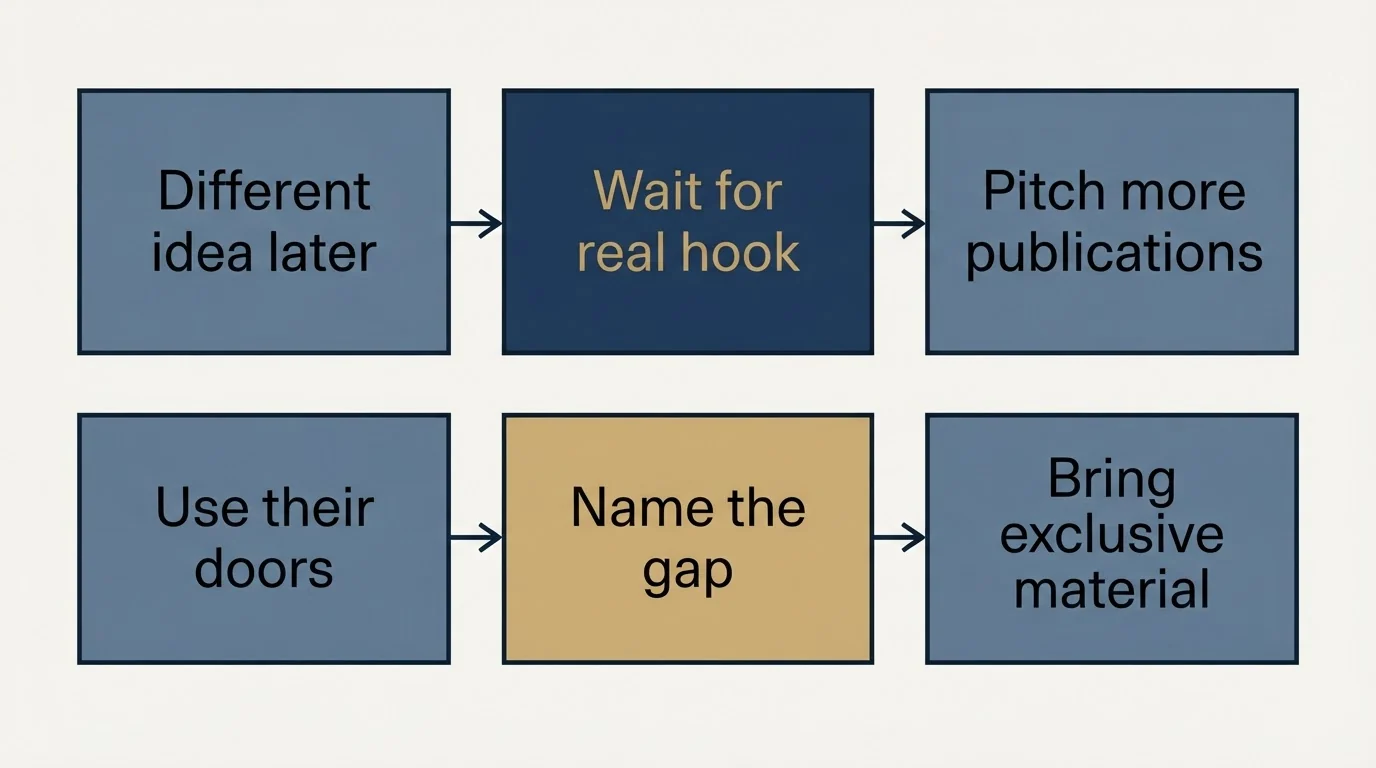
- Pitch a genuinely different idea later.
- Wait for a real hook.
- Pitch more publications rather than the same one repeatedly.
- Use the doors they open themselves.
What To Do Instead
Pitch a genuinely different idea later. Not the same title with a new subject line. Editors reject topics far more often than they reject writers, and a second idea gives them something new to say yes to.
Wait for a real hook. A news event in their coverage area, original data you have just finished, a gap that opens when a staff writer leaves a beat. A pitch built on something that happened is a first message, not a reminder.
Pitch more publications rather than the same one repeatedly. Ten editors approached once will place more articles than one editor approached ten times, and the tier-2 and tier-3 targets you are building credibility on reply fastest.
Use the doors they open themselves. A contributor call, a published editorial calendar, a "pitch me" post on social, or an editor who replies asking you to come back in the spring. Those are invitations and answering them is a conversation, not a chase.
Strengthening The One Pitch You Send
If you only get one message, spend the effort there rather than on the messages that would have come after it:
Name the gap, with the evidence. "You have covered [topic] four times this year, all from the buyer's side. Nobody has written the operator's version." That takes ten minutes of reading and it is the single strongest opener in this format.
Bring something they cannot get elsewhere. Original data, a named case study, a customer willing to be quoted. Exclusivity is the one thing that reliably moves a pitch to the top of an editor's queue.
Reduce the work to almost nothing. A working title, a three-line outline, a word count, and a delivery date. Editors commission the pitch that is closest to being an article.
Re-Approach Example
A later approach is a new first message. It carries its own subject line, its own idea, and no reference to the pitch that went unanswered.
Subject: [Publication] piece: [new specific angle]
Hi [Editor Name],
[Publication] ran [recent article] last month, and the comments kept circling back to [specific unresolved question]. I'd like to write the piece that answers it: "[Working Title]."
It would cover [key point 1], [key point 2], and [key point 3], with [original data or named case study] behind each one. [Word count] words, delivered by [date].
I'm [your role] at [company], and my writing has appeared in [notable publications].
Want me to send an outline?
[Your Name]
After Your Pitch Gets Accepted
Securing a placement is just the beginning. How you deliver determines future opportunities.
Delivering Quality Content
Follow guidelines exactly. Word count, formatting, link policies, and image requirements exist for reasons. Follow them precisely.
Meet deadlines. Late delivery damages relationships. If you can't meet a deadline, communicate early.
Submit polished work. Proofread thoroughly. Check formatting. Review every link. Editors remember writers who require minimal editing.
Be responsive to feedback. Accept editorial changes gracefully. Revise quickly when requested.
Promotion After Publication
Support your guest post by:
- Sharing on your social channels
- Including in your newsletter
- Responding to comments on the article
- Linking to it from relevant content on your own site
Editors notice when contributors actively promote their pieces.
Building Ongoing Relationships
After successful publication:
- Send a thank-you note with engagement metrics
- Wait an appropriate interval, then pitch again
- Stay engaged with the publication's content
- Offer to contribute to special features or projects
One successful guest post can lead to ongoing contributor status.
Common Mistakes to Avoid
Pitching Without Research
Sending pitches that could apply to any publication signals laziness. Editors recognize generic outreach immediately.
Ignoring Guidelines
If a publication has contributor guidelines, follow them exactly. Ignoring requirements gets your pitch rejected.
Proposing Topics Already Covered
Before pitching, search the publication for existing coverage of your topic. Pitch fresh angles, not duplicates.
Making It About You
Your pitch should focus on value for readers, not your desire for exposure or backlinks.
Overselling Yourself
Credentials matter, but excessive self-promotion signals insecurity. Let your idea and relevant experience speak for themselves.
Submitting First Drafts
Some pitches include complete articles. If you do this, ensure the quality is exceptional. A mediocre attached draft closes doors.
Your Guest Blogging Outreach Checklist
Preparation
- Identified target publications with relevant audiences
- Evaluated domain authority and engagement metrics
- Read recent content from each target
- Identified specific contacts (editors, content managers)
- Reviewed contributor guidelines for each target
Pitch Development
- Topic has specific angle (not generic)
- Pitch demonstrates publication familiarity
- Key points/outline are included
- Credentials are relevant and brief
- Call to action is clear
Email Quality
- Subject line is clear and professional
- Total length is under 250 words
- Proofread for errors
- Links and signatures work correctly
Re-Approach Plan
- One pitch per email, with no chase planned for an unanswered one
- Next idea for this publication drafted, on a genuinely different angle
- Timing tied to their editorial calendar or to a real news hook
Building Your Guest Blogging Pipeline
Guest blogging through cold email outreach requires patience, persistence, and genuine value creation. The publications worth appearing in receive numerous pitches, so yours must stand out through specificity, relevance, and demonstrated understanding of their audience.
Start with publications where you have realistic chances of acceptance, then use those credentials to pitch higher-tier targets. Each successful placement builds momentum for the next.
Once you have built momentum through guest placements, the same outreach discipline applies to pursuing recognition, as explained in this guide to pitching industry awards nominations.
If you're looking to scale your guest blogging outreach while maintaining pitch quality, RevenueFlow can help. Our done-for-you cold email campaigns apply these principles to identify opportunities and pitch editors effectively.
Get Your Free Campaign and see how targeted cold email can expand your guest blogging portfolio.
Frequently asked questions.
Frequently asked questions- Why is cold email better than submission forms for guest blogging?
- Cold email provides direct access to decision-making editors, bypassing general submission queues that often have significant backlogs. It allows you to personalize your pitch to the specific editor and publication, creating a direct line of communication that can develop into an ongoing relationship. Well-crafted personal emails differentiate you from mass submissions through generic forms and typically generate faster responses than formal submission processes.
- What should I research before pitching a guest post?
- Read at least 10-15 recent articles from the publication to understand their tone, style, and content gaps. Identify topics they cover and note their preferred article length, formatting, and structure. Understand their audience demographics and interests, review contributor guidelines thoroughly, and check social media engagement on their articles. Find the right editor by looking for titles like Managing Editor, Content Editor, or Contributions Editor on their team page or LinkedIn.
- How do I evaluate which publications to target for guest blogging?
- Consider domain authority using tools like Moz, Ahrefs, or SEMrush for SEO value. Prioritize audience relevance over traffic numbers, ensuring the publication reaches your target readers. Assess content quality, engagement levels through comments and shares, publication frequency, and whether they have clear contributor guidelines. Create a tiered list with dream publications, strong publications, and growing publications, starting with Tier 2 and 3 to build credibility before pitching top-tier targets.
- What do editors look for in guest post pitches?
- Editors want content that fills gaps in their existing coverage, provides fresh perspectives on evergreen topics, drives engagement and shares, meets quality standards without requiring heavy editing, and arrives on time as promised. Position your pitch around these editorial needs rather than your desire for exposure. Demonstrate understanding of the publication's content, audience, and current coverage to show you can deliver value to their readers.
About the author.

Ben Carden is CRO at RevenueFlow, which builds and operates outbound revenue engines for B2B companies. Previously at Gartner Enterprise. Studied at London School of Economics.
Ben Carden · CRO
Connect on LinkedIn →Explore more.
Ready to scale your outreach?
We build GTM engines that book real meetings. See the receipts.
Related articles.
Cold Email for Awards Nominations: Complete Strategy Guide
Learn how to use cold email to secure industry awards and recognitions. Includes proven templates, submission strategies, and best practices for awards outreach that gets results.
Cold Email for Mentorship: Complete Strategy Guide
Learn how to use cold email to find and connect with mentors who can accelerate your career or business. Includes proven templates, personalization strategies, and best practices for building meaningful mentor relationships.
Cold Email for Conference Speaking: Complete Strategy Guide
Learn how to use cold email to secure speaking opportunities at industry conferences and events. Includes proven templates, pitch strategies, and best practices for speaker outreach.
Cold Email for Webinar Guest Recruitment: Strategy Guide
Learn how to use cold email to recruit expert guests for your webinars. Includes proven templates, personalization strategies, and best practices for building a roster of compelling webinar speakers.
Cold Email for Interview Requests: Complete Strategy Guide
Learn how to use cold email to secure interviews with industry experts, thought leaders, and key stakeholders. Includes proven templates, timing strategies, and follow-up frameworks.
Cold Email for Influencer Outreach: Partner with Creators
Learn how to use cold email to build authentic influencer partnerships that drive real results for your brand, with proven templates and strategies.