ContactOut vs Salesforce: Cross-Category Comparison
Compare ContactOut (data enrichment tool) and Salesforce (crm platform) side by side. Understand how these tools fit different stages of your sales workflow.
ContactOut and Salesforce do different jobs and are usually bought together. ContactOut finds and verifies contacts, Salesforce tracks what happens after they answer. Salesforce starts at $25 per seat per month on its Starter Suite tier, and ContactOut sells exports per seat, from $49 a month for 300 exports.
Key takeaways
- Salesforce publishes Starter Suite at $25 per seat per month, the same rate monthly or annually.
- ContactOut's pricing page publishes a free tier of 5 emails a day, an Email seat at $49 a month for 300 exports, and Email plus Phone at $99 a month for 600 exports.
- The two feature lists here genuinely sit in different categories. A list difference shows that one vendor lists something and the other does not, and never that only one of them can do it.
- For an illustrative team of five wanting roughly 500 new contacts a month, the Salesforce line is $1,500 a year and the ContactOut line is $1,176.
Reviewed and updated August 29, 2026
ContactOut vs Salesforce: Cross-Category Comparison
This is the one pair in the set where the two feature lists genuinely stay in their own categories. Nothing on Salesforce's list finds a contact who is not already in the system, and nothing on ContactOut's list is a pipeline. That makes the decision cleaner than most, and it moves the whole question onto which gap is costing money first.
The Short Answer
Buy whichever one closes the gap that is costing you money this quarter, and in a genuine tie buy Salesforce first. A pipeline with thin data still shows you what is happening; a good list with nowhere to record what happened to it decays into a spreadsheet inside a month.
ContactOut and Salesforce do not compete. ContactOut finds and verifies the people, Salesforce keeps track of what happens after they answer, and a team running outbound at volume usually ends up with both.
Why Compare These Two Tools?
Data enrichment tools find and verify contact information, while CRMs organize and track those contacts through the sales process. Teams evaluate whether their CRM's built-in data features are sufficient or if a dedicated enrichment tool delivers better data quality.
ContactOut is a data enrichment tool focused on B2B lead data and contact enrichment. Email and phone finder with 300M+ professional profiles, LinkedIn-focused browser extension, and AI-powered email campaigns.
Salesforce is a CRM platform focused on customer relationship management. The world's leading CRM platform offering a comprehensive suite of sales, service, marketing, and commerce tools. Known for extensive customization, AI-powered insights via Einstein, and a vast ecosystem of third-party integrations through AppExchange.
ContactOut vs Groove by Clari examines a similar complementary pairing, contrasting a data enrichment tool with a Salesforce native engagement platform for outreach.
Where Each Tool Fits in Your Workflow
- Step 1Lead sourcing and data
ContactOut covers B2B lead data and contact enrichment, on a free entry plan.
- Step 2Pipeline and deal tracking
Salesforce covers customer relationship management, from $25/mo.
| Aspect | ContactOut | Salesforce |
|---|---|---|
| Category | Data Enrichment Tool | CRM Platform |
| Workflow Stage | Lead sourcing and data | Pipeline and deal tracking |
| Primary Focus | B2B lead data and contact enrichment | Customer relationship management |
| Starting Price | Free | $25/mo |
| Features Listed | 9 | 8 |
| Integrations | 8 | 8 |
The table above is a category summary rather than a verdict. The two workflow-stage rows are the only ones where these tools differ in kind; the rest, feature counts included, compares two marketing surfaces of different lengths. The starting-price row is the one most often misread: a per-seat CRM price scales with headcount, so five people cost five times one. ContactOut is metered on credits or exports instead, so its cost scales with how many contacts get touched rather than with how many people are logged in.
What Each Side Does in a Cold Outbound Run
Neither of these tools sends cold volume, and that decides what each is for. ContactOut produces a list, Salesforce keeps the history of what happened to it, and the sending sits in a third place.
The house rule is one message per campaign: no bumps, no thread replies, and no second LinkedIn message landing under the one somebody already ignored. That is why list quality carries so much weight here. With a single message per prospect there is no follow up to rescue a bad address, so an unusable row is a lost prospect rather than a delayed one.
The deliverability consequence is harder. A wrong address produces a hard bounce, and enough of those damage the sender reputation of the sending domain. Where sending inventory is shared across campaigns that damage reaches every campaign on it, so list hygiene before a send costs less than repairing a domain after one.
Salesforce covers the other half. Replies have to land where a human will see them, and a meeting counts only when it meets criteria agreed in writing before launch: a qualified appointment nobody logged is indistinguishable from one that never happened.
Pricing Comparison
ContactOut Pricing
| Plan | Price | Contacts | Emails |
|---|---|---|---|
| Free | Free | 5 emails and 5 phones per day | 5 emails / day |
| $49/mo | 300 exports / month | Unlimited emails | |
| Email + Phone | $99/mo | 600 exports / month | Unlimited emails |
Both paid tiers on ContactOut's pricing page are priced per seat.
Source: ContactOut Pricing
Salesforce Pricing
| Plan | Price |
|---|---|
| Starter Suite | $25/mo |
| Pro Suite | $100/mo |
| Enterprise | $175/mo |
| Unlimited | $350/mo |
| Agentforce 1 Sales | $550/mo |
Starter Suite is billed monthly or annually at the same rate; every tier above it is the per user per month price billed annually, as published mid-2026.
Source: Salesforce Sales Pricing
Pricing Context
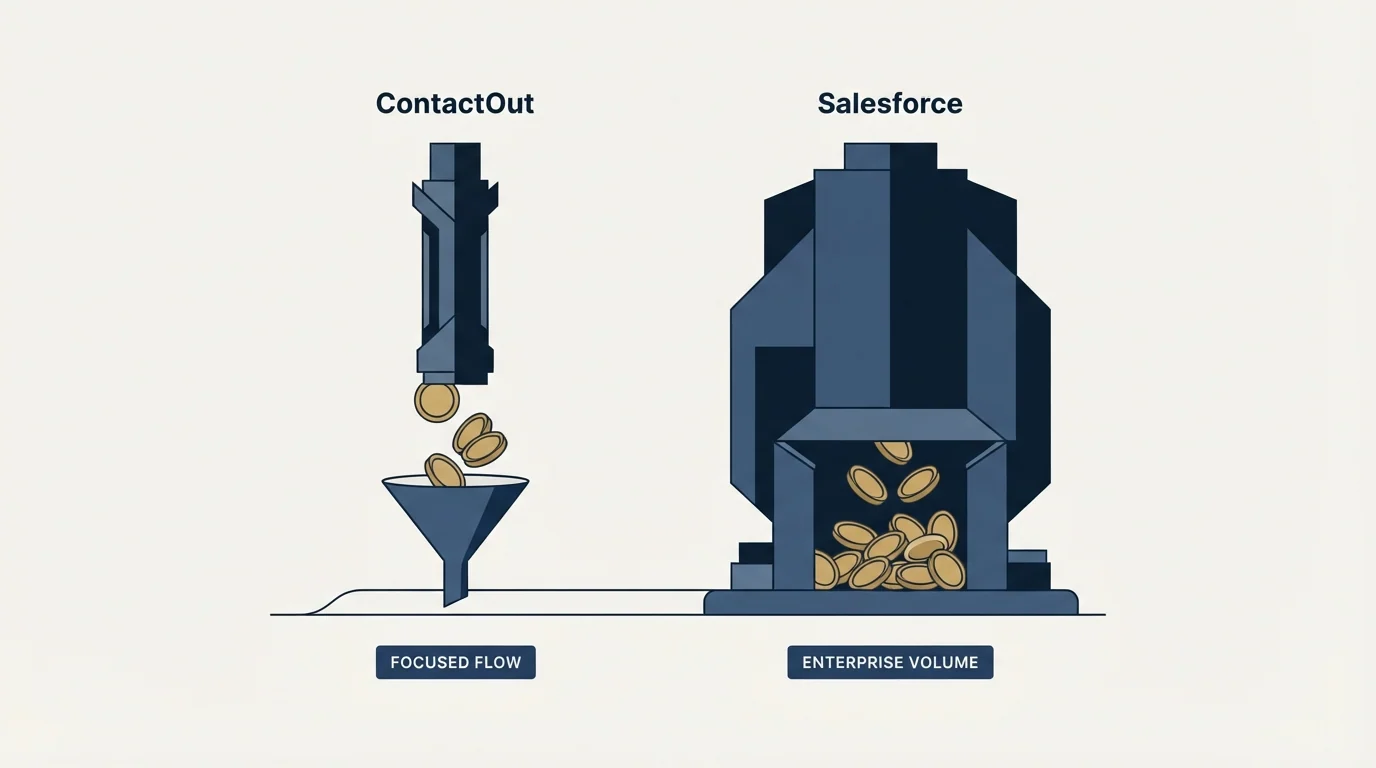
These two prices are not measuring the same thing. Salesforce charges per seat, so its cost follows headcount, while ContactOut charges for volume, so its cost follows how many contacts get touched. A team can double its ContactOut bill without hiring anybody.
On the CRM side the entry tier is Salesforce's Starter Suite at $25 per seat per month, and that rate is the same whether it is paid monthly or annually.
What the Pair Costs at a Realistic Team Size
Vendor tables price a seat or a credit. A budget prices a team, so here is the same decision worked end to end. Both inputs are invented for the arithmetic: a team of five that wants roughly 500 new verified contacts a month.
On the CRM side, and on the rate Salesforce's pricing page shows, five seats on Starter Suite at $25 per seat per month comes to $1,500 for the year, and Starter Suite carries the same rate monthly or annually. Those totals are illustrative.
ContactOut sells exports per seat, and the Email plan includes 300 exports a month against the illustrative 500 the team wants, so the honest sizing is two seats at $49 a month, which is $1,176 for the year and 600 exports a month. One Email plus Phone seat at $99 a month reaches the same 600 for $1,188 and adds phone numbers.
| Line, year one, illustrative | Amount |
|---|---|
| Salesforce, five seats | $1,500 |
| ContactOut, 500 contacts a month | $1,176 |
| Pair, cheaper billing of each | about $2,676 |
Two things fall out of that, and neither is about the tools. The billing basis moves more money than the tier choice on most of these ladders, so check whether a published monthly figure is the monthly rate or the annual rate divided by twelve. And the enrichment line moves with volume, so model it at the volume you intend to send. Against a realistic cost of a booked meeting both lines are small, which is why the order of purchase matters more than the total.
Feature Highlights
ContactOut Key Capabilities (Data Enrichment Tool)
- 300M+ professional profiles
- Browser extension for LinkedIn
- Email campaigns
- AI email writer
- Data enrichment
- List builder
- Search portal
- Bulk license (700M+ profiles on Team)
- CSV export
Salesforce Key Capabilities (CRM Platform)
- Lead, account, and contact management
- Opportunity and pipeline tracking
- Einstein AI-powered analytics and predictions
- Sales forecasting and territory management
- Workflow automation and approval processes
- Customizable dashboards and reports
- AppExchange marketplace
- Mobile CRM app for iOS and Android
Feature Overlap
On this page the two feature lists genuinely do sit in different categories: nothing on Salesforce's list finds a contact who is not already in the system, and nothing on ContactOut's list is a pipeline. State that carefully, because a list difference supports the claim that one vendor lists something and the other does not, and never the claim that only one of them can do it. Feature lists are marketing surfaces kept at different lengths.
Integration Ecosystem
ContactOut Integrations
ContactOut connects with: Salesforce, HubSpot, Greenhouse, Lever, Bullhorn, Zapier, Gmail, Outlook.
Salesforce Integrations
Salesforce connects with: Slack, Google Workspace, Microsoft Outlook, Mailchimp, DocuSign, Zapier, Tableau, MuleSoft.
Shared Integrations
Both tools integrate with: Zapier. This shared ecosystem means they can work together in your tech stack.
Read a shared-integration list as a plumbing note rather than a recommendation. Two tools in one directory means a connector exists; it says nothing about which fields that connector writes, or what happens when the two disagree about a value. The rollout section below settles that.
When to Choose ContactOut

Choose ContactOut when the list is the part that is failing: a large share of rows with no usable contact, employers that are out of date, or a campaign that cannot start because nobody can reach the people on it.
When to Choose Salesforce
- Your biggest gap is in lead sourcing and data
- You already have a solid crm platform and need specialized B2B lead data and contact enrichment capabilities
- You want an affordable entry point ($0/mo)
- Your team's primary bottleneck is B2B lead data and contact enrichment
- Your biggest gap is in pipeline and deal tracking
- You already have a data enrichment tool and need better customer relationship management
- You want an affordable entry point ($25/mo)
- Your team's primary bottleneck is customer relationship management
Choose Salesforce when the pipeline is the part that is failing: replies with nowhere to be logged, next steps depending on somebody remembering, or a manager who cannot tell you what happened to last month's list.
Do You Need Both, and in Which Order?
Two questions decide the order, and both are answerable in an afternoon.
The first is where the work is stopping. Pull fifty rows out of whatever stores your prospects today and count how many carry a usable direct email, a current employer and a title that matches what the person does now. If a large share fail, the data is the bottleneck and ContactOut goes first. If most pass and nobody knows who followed up, Salesforce goes first.
The second is who else has to see it. A CRM is a shared system that survives a rep leaving; enrichment output can sit in a spreadsheet for a while without anybody being hurt. That asymmetry is the honest reason to lean toward Salesforce when the two look equally urgent. There is also a case for buying neither yet: a team sending its first few hundred messages a month learns more from the replies than from either tool, and the purchase becomes obvious once doing it by hand costs a day a week, which is roughly where the credit arithmetic above starts paying for itself.
- Depends: Fifty sample rows checked by hand for a usable email, a current employer and a matching title
- Depends: More than a third of that sample unusable, which puts ContactOut first
- Depends: Replies and meetings currently tracked somewhere shared, which is what Salesforce provides
- No: Field ownership written down before the two systems are connected
- No: Meeting criteria agreed in writing before any campaign launches
Rolling the Second Tool In Without Breaking the First
Adding the second tool is where the pair usually goes wrong, and the failure has one shape: two systems writing the same field with different ideas about what is true.
Decide field ownership before anything is connected. Write down which system owns the email address, the job title, the company name and the phone number, and make the other read-only on those fields. The rule that survives contact with a sales team is that anything a human typed after speaking to somebody outranks anything a vendor fetched.
Set the record matching key before the first sync. Matching on a company name creates duplicates the moment somebody writes Ltd instead of Limited; matching on a domain or an existing record id does not, and CRM enrichment writing into a wrongly matched record is harder to unpick than one that wrote nothing.
Then run one segment and read fifty finished records by hand before opening it up. Check coverage as well as accuracy, because the match rate is not something a pricing page will tell you, and agree the refresh cadence while you are there, since data decay makes a one-off pass a snapshot with a short life.
- Week 1Write down who owns which field
Decide whether ContactOut or Salesforce is authoritative for email, title, company and phone, and make the other read-only on those fields.
- Week 1Pick the matching key
Match on domain or an existing record id rather than on company name, which duplicates on Ltd against Limited.
- Week 2Run one segment
Push a single campaign's worth of accounts through the new tool and read fifty finished records by hand before widening it.
- Week 3Measure coverage, not just accuracy
Record how many of the target accounts got a usable contact at all, which no pricing page will tell you in advance.
- Week 4Set the refresh cadence
Contact data goes stale as people move, so agree how often records are re-enriched while the ownership rules are still fresh.
Using Both Together
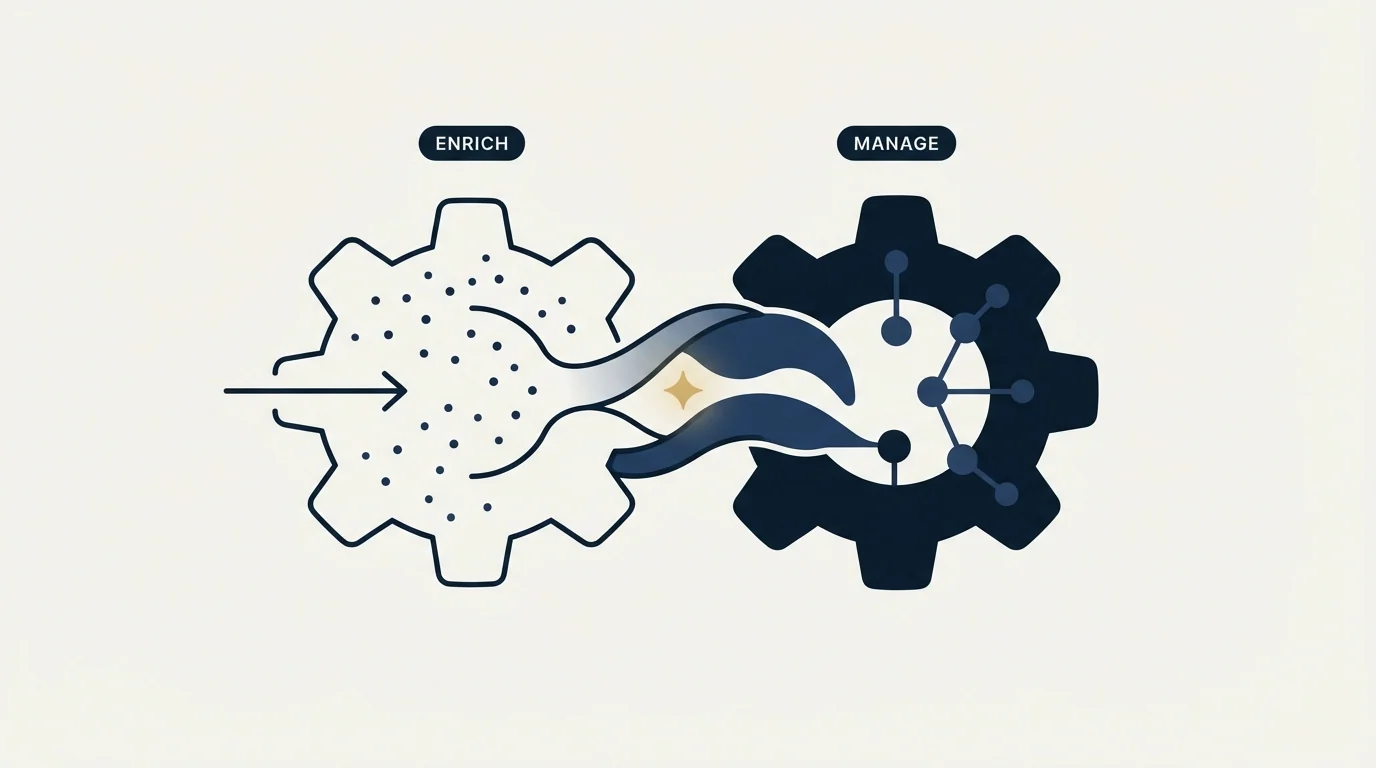
Many sales teams use both a data enrichment tool and a CRM platform as part of their complete workflow. ContactOut handles lead sourcing and data while Salesforce covers pipeline and deal tracking.
InboxAlly vs Klenty explores a similar complementary pairing, where a deliverability tool and a campaign execution platform support distinct workflow stages.
Since both tools integrate with Zapier, connecting them in your workflow is straightforward.
The practical version is narrower than it sounds. ContactOut runs before the campaign and produces rows; Salesforce runs after it and keeps what came back. The only place they have to meet is the moment a row becomes a record, and getting that handoff right is most of the value of the pair. Agree what counts as a meeting at the same time, because meetings are qualified against criteria written down before launch rather than judged afterwards.
The Decision Shortcut
If the whole decision has to fit in a sentence: buy the one that closes the gap you can measure, and if both are measurable, buy Salesforce first and add ContactOut at the volume where hand-sourcing starts costing a day a week.
- A pipeline exists and it is full of dead contacts. Buy ContactOut. A second CRM will not fix a data problem.
- A list exists and nobody can tell you what happened to it. Buy Salesforce.
- Neither exists and the budget covers one. Buy Salesforce and source by hand for a quarter.
Whichever order you land on, the money question is smaller than the ordering question. The expensive mistake is paying for a tool whose output has nowhere to go.
How These Figures Were Checked
Every figure on this page comes from the vendor's own pricing page, checked against a dated copy of that page rather than from memory, and attributed to the surface it appeared on.
Both vendors' pages were readable, so both ladders reflect what those pages published when they were last read.
The illustrative budget above is arithmetic on those published rates, and the team size and contact volume behind it are invented.
Related Reading
- Best ContactOut Alternatives in 2026
- Best Salesforce Alternatives in 2026
- Apollo.io vs ContactOut: Data Enrichment Tool Comparison
- ContactOut vs ZoomInfo: Data Enrichment Tool Comparison
- HubSpot CRM vs Salesforce: CRM Platform Comparison
If you would rather have this run for you, RevenueFlow books qualified meetings on a pay-per-meeting basis and publishes client results.
Pricing and features are taken from the vendors' own pages. Verify current terms with the vendor before relying on them.
Frequently asked questions.
Frequently asked questions- Should I buy ContactOut or Salesforce first?
- Take fifty rows from your current list and count how many carry a usable email, a current employer and a matching title. If a large share fail, buy ContactOut first. If most pass and nobody can say who followed up, buy Salesforce first. In a genuine tie buy Salesforce, because it is the shared system that survives somebody leaving.
- What do ContactOut and Salesforce cost together?
- On an illustrative five-person team wanting roughly 500 new verified contacts a month, the Salesforce side is $1,500 for the year and the ContactOut side is about $1,176 on its cheaper billing. Both the team size and the contact volume are invented for the arithmetic.
- Do ContactOut and Salesforce do the same thing?
- No. ContactOut works before a campaign and produces rows; Salesforce works after it and keeps what came back. The only place they have to meet is the moment a row becomes a record. Feature lists of different lengths are marketing surfaces and do not show that either tool is alone in being able to do something.
- How many contacts does a ContactOut seat actually cover?
- The Email plan carries 300 exports a month per seat and Email plus Phone carries 600, according to its pricing page. A team wanting roughly 500 new contacts a month therefore needs either two Email seats at $49 each or one Email plus Phone seat at $99, which is worth working out before buying a single seat and running short.
About the author.

Tim Carden is CMO / CTO at RevenueFlow, which builds and operates outbound revenue engines for B2B companies. Studied at McGill University.
Tim Carden · CMO / CTO
Connect on LinkedIn →Explore more.
Ready to scale your outreach?
We build GTM engines that book real meetings. See the receipts.
Related articles.
AroundDeal vs Salesflare: Data Enrichment Tool vs CRM Platform Comparison
Compare AroundDeal (data enrichment tool) and Salesflare (CRM platform) side by side. See pricing, features, and integrations to decide which one, or both, your stack needs.
Evaboot vs Microsoft Dynamics 365 Sales: Data Enrichment Tool vs CRM Platform Comparison
Compare Evaboot (data enrichment tool) and Microsoft Dynamics 365 Sales (CRM platform) side by side. See pricing, features, and integrations to decide which one, or both, your stack needs.
Agile CRM vs LeadIQ: CRM Platform vs Data Enrichment Tool Comparison
Compare Agile CRM (CRM platform) and LeadIQ (data enrichment tool) side by side. See pricing, features, and integrations to decide which one, or both, your stack needs.
Anymail Finder vs Pipeline CRM: Data Enrichment Tool vs CRM Platform Comparison
Compare Anymail Finder (data enrichment tool) and Pipeline CRM (CRM platform) side by side. See pricing, features, and integrations to decide which one, or both, your stack needs.
AroundDeal vs Maximizer: Data Enrichment Tool vs CRM Platform Comparison
Compare AroundDeal (data enrichment tool) and Maximizer (CRM platform) side by side. See pricing, features, and integrations to decide which one, or both, your stack needs.
Breakcold vs Bulk Email Checker: CRM Platform vs Data Enrichment Tool Comparison
Compare Breakcold (CRM platform) and Bulk Email Checker (data enrichment tool) side by side. See pricing, features, and integrations to decide which one, or both, your stack needs.