Closing Ratio: The Denominator That Starts Earlier
Closing ratio is deals won divided by attempts made, expressed as a percentage, and close rate is the same number. Its denominator characteristically starts before an opportunity exists, at a quote sent, a prospect worked or a person contacted, which is what separates it from win rate and why an unqualified figure carries no information.
Key takeaways
- Closing ratio and close rate are one metric under two names, and no practical distinction between the words survives contact with how teams actually use them.
- Its three circulating denominators are quotes sent, prospects worked and prospects contacted, and the same quarter can read as one percent or twenty five percent depending on which is chosen.
- The reciprocal of the ratio is a work order, so planning against one denominator and executing against another sizes the top of the funnel wrong by an order of magnitude.
- A published closing ratio benchmark whose base is not stated cannot be compared to yours, because the conventions differ by more than any team's performance does.
A sales manager reports a closing ratio of thirty five percent in a Monday review. The revenue model two floors up was built on eighteen. Nobody lied and nobody made an arithmetic error. The two numbers were counted from different starting points, and the distance between those starting points is the entire subject of this entry.
Closing ratio is the share of sales attempts that end in a closed deal, expressed as a percentage. It is the same number as close rate, and the two phrases are used interchangeably by the people who publish definitions of either one.
The arithmetic is one division. What makes the metric slippery is that the thing sitting underneath the line begins earlier in the process than most people assume, and earlier than the metric it is most often confused with.
The denominator that starts before an opportunity exists
The live entry on win rate sets out four denominators that circulate for that metric: opportunities created in a period, opportunities that reached a named stage, opportunities that reached a decision, and deals closed inside the period. All four begin at an opportunity. Something already had to be qualified, accepted and recorded before it could appear in any of them.
Closing ratio is used with denominators that begin further back, and that is the distinction worth holding.
Quotes or proposals sent. This is the most commonly published version, and it is the one used in businesses where a formal quote is a discrete, countable event: fabrication, construction, insurance, professional services. The attempt is the quote. A team that sends twenty quotes and closes five is running a twenty five percent closing ratio under this definition.
Qualified prospects worked. Wins divided by everything a seller genuinely engaged, whether or not it ever became a formal opportunity. This sits between the two conventions and is the version most likely to be meant when a manager quotes the number without qualifying it.
Prospects contacted. Wins divided by everyone the team reached out to. This is the widest base of all, it produces a small percentage, and it is the only version that prices an entire outbound motion rather than the closing skill inside one.
None of the three is wrong. They answer different questions, and the answers are far apart. Take an invented quarter, chosen only to show the spread: a team contacts four hundred people, has substantive conversations with sixty, sends twenty quotes and wins five. The contacted-based closing ratio is a little over one percent. The conversation-based ratio is one in twelve. The quote-based ratio is twenty five percent. Every one of those figures describes the same quarter and the same five deals.
- Counts formal proposals only
- Reads highest of the three
- Measures the close, not the funnel
- Only countable where quoting is a discrete event
- Five wins from twenty quotes reads as twenty five percent
- Counts everyone a seller genuinely engaged
- Includes conversations that never became opportunities
- Usually what a manager means when the number is unqualified
- Depends on a judgement about what counts as worked
- Five wins from sixty conversations reads as roughly eight percent
- Counts everyone the team reached out to
- Reads lowest of the three by a wide margin
- The only version that prices a whole outbound motion
- Requires the contacted count to be recorded honestly
- Five wins from four hundred contacts reads as roughly one percent
The practical rule is short. A closing ratio quoted without its denominator carries no information, and two people comparing closing ratios are usually comparing conventions rather than performance.
Why it matters: the number that sizes everything upstream
The reason to care about which denominator you are using is that the reciprocal of a closing ratio is a work order.
If the ratio is one in twenty and the plan needs ten deals, the plan needs two hundred attempts of whatever kind the denominator counts. Change the denominator and the required volume changes with it, without a single thing changing about how the team sells. A team that plans against a quote-based ratio and then executes against a contacted base will build a top of funnel an order of magnitude too small and discover it a quarter later.
That is the same reasoning pipeline coverage applies one stage further down, and it fails in the same direction: a coverage multiple derived from one denominator and applied to a pipeline built on another produces a requirement that is confidently wrong.
The second reason the metric matters is diagnostic. A closing ratio that falls while absolute wins hold steady is usually a report about the denominator rather than about the closers. Somebody loosened what counts as a quote, or a new campaign widened the contacted base, or a bulk import added rows nobody worked. Reading the ratio beside the raw counts is what separates those cases, and it is the habit SDR metrics argues for across the whole scorecard.
Where the published definition misleads
The benchmark numbers are unusable. Published closing ratio benchmarks are quoted almost universally without their denominator, and a benchmark whose base is unknown cannot be compared to yours. A figure computed over quotes sent will sit ten or twenty times higher than one computed over contacts made, so a team measuring itself against the wrong one will conclude it is failing or thriving on the strength of an accounting difference.
Ratio and rate are the same thing here, and the distinction people try to draw is invented. Some sources present the closing ratio as a proportion and the close rate as a percentage, or attach one to individual sellers and the other to teams. Nothing in practice honours that split. Treat the two phrases as one metric under two names, and state the denominator instead of relying on the word.
A small denominator makes the number noise. A seller who sent four quotes and won one has a twenty five percent closing ratio, and so does the seller who sent forty and won ten. The second number is information about a sales motion. The first is information about one deal. Any use of the metric to compare sellers needs a minimum count underneath it, agreed before anybody looks at the results.
It rewards the wrong behaviour when it is managed directly. Making the ratio a target creates an incentive to quote less, to work fewer conversations, and to leave attempts unrecorded. All three raise the number and shrink the business. The metric is a description, and it degrades when it is used as a goal.
It says nothing about deal size. A ratio counts events. A team closing a high share of small deals and losing the large ones reads well on this metric and badly in the revenue plan, which is the same failure the count-based version of conversion rate has, and the reason the value-weighted view has to be read beside it.
How it is used in outbound

In a cold outbound programme the useful denominator is the widest one, because the attempt being measured is the send.
The chain runs contacted, replied, meeting held, opportunity, closed won. A closing ratio measured over the last two of those describes an account executive. A closing ratio measured from contacted to closed won describes the whole machine, and it is the only version that can be compared against what the programme costs. Cost per closed deal is that ratio and the cost per contact multiplied together, which is why teams that only track the narrow version cannot say what an outbound channel is worth.
Our own sending doctrine makes the wide denominator unusually clean to compute. We send one message per campaign, built on one premise, and any later approach is a separate campaign with its own reason to exist. There are no bump sequences and no thread replies inflating the attempt count, so contacted means one person received one message, and the denominator is a number rather than a judgement. Programmes running multi step cadences have to decide whether an attempt is a person or a touch, and the two answers differ by a factor of four or five before anything else is considered.
Three practical consequences follow for a team running outbound.
Measure the ratio by campaign and by segment before measuring it in aggregate. A blended closing ratio across referral, inbound and cold-sourced deals describes none of the three populations, and the cold-sourced number is the only one that tells you whether the outbound spend is working. Market segmentation is the cut that makes those splits possible in the first place.
Read it beside the qualification bar. A rising closing ratio on cold-sourced deals is very often a report that the meeting standard tightened, which is a genuine improvement and should be described as one. The written criteria in the qualified appointment entry are what make that readable rather than arguable.
Wait for the sales cycle before judging it. A ratio computed over a period shorter than the sales cycle is measuring attempts against wins that came from earlier attempts, and it will be wrong in whichever direction volume moved. The trap and the fix are the same ones meetings land and nothing closes works through for the whole post-meeting stretch.
- Yes: Name the denominator in words, every time it is reported
- Yes: Say whether an attempt is a person or a touch
- Yes: Split it by lead source before comparing anything
- Yes: Set a minimum denominator below which the number is not reported per seller
- Yes: Check the measurement window is longer than the sales cycle
- No: Compare it against a published benchmark whose base is unknown
- Depends: Read it beside absolute wins and beside average deal size
Related terms
Closing ratio sits alongside win rate, which asks the same question from an opportunity base rather than an attempt base, and conversion rate, which is the general form of the division with both ends named. Pipeline coverage is what the reciprocal of the ratio turns into when it is applied to a target, and sales velocity carries it as one of four terms. Quota attainment is the seller-level number a closing ratio feeds. Where the denominator is an appointment rather than a quote, the standard that appointment has to meet is in qualified appointment, and the definition work upstream of all of it is in the lead generation KPIs guide.
The short version
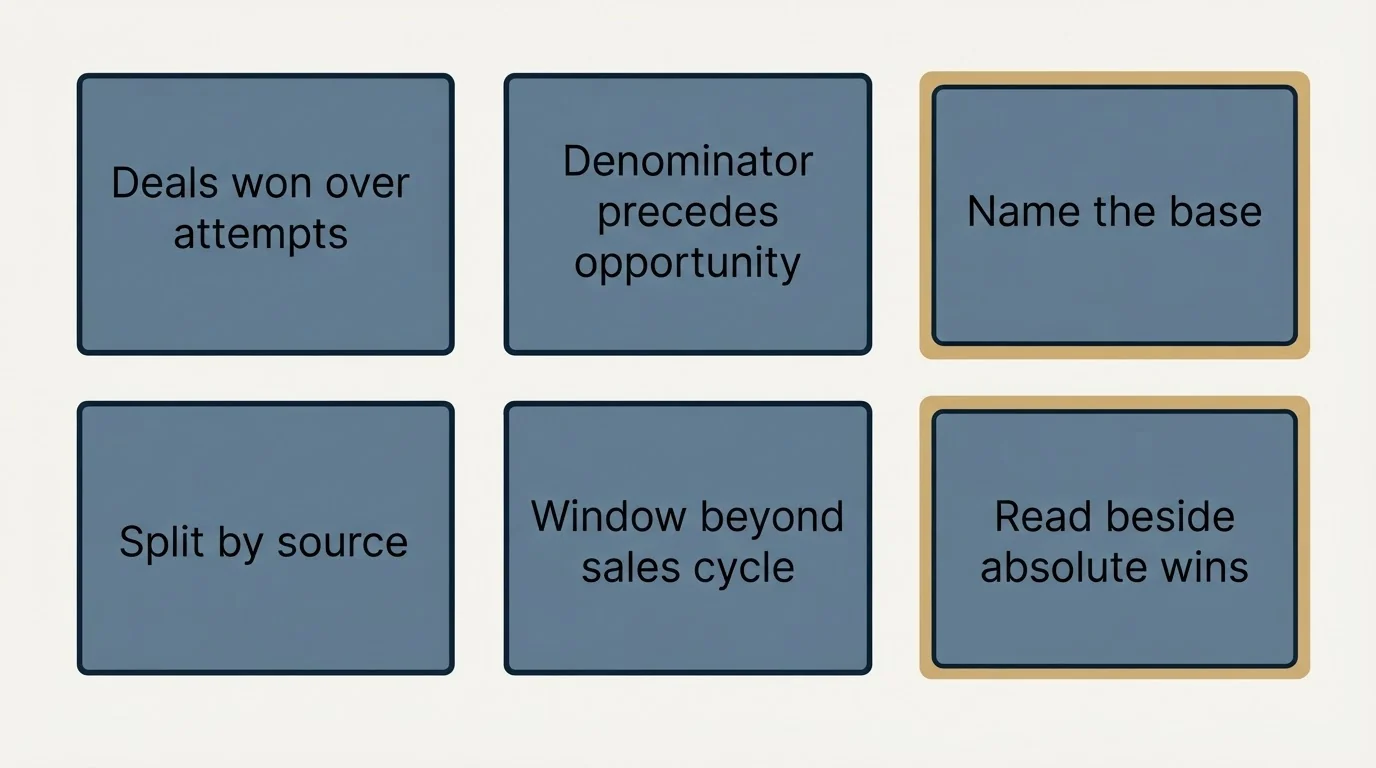
Closing ratio is deals won divided by attempts made, and close rate is the same number under a different name. Its denominator characteristically starts earlier than an opportunity, at a quote sent, a prospect worked or a person contacted, which is what separates it from win rate and what makes an unqualified figure meaningless. Name the base, split it by source, give it a window longer than the sales cycle and a floor under the count, and read it beside absolute wins so that a ratio which improved because the team quoted less is not mistaken for one that improved because the team sold better.
RevenueFlow runs cold email and LinkedIn outreach for B2B teams, one message per campaign, and reports the contacted-to-closed chain rather than the flattering slice of it. If you would rather that motion were somebody else's job, see how the campaigns work.
Frequently asked questions.
Frequently asked questions- What is the difference between closing ratio and win rate?
- Win rate is normally counted from an opportunity base, so something had to be qualified and recorded before it could appear in the denominator. Closing ratio is usually counted from an attempt base that starts earlier: a quote sent, a prospect worked or a person contacted. The two can describe identical selling and still be far apart, because they are dividing by different populations.
- Is closing ratio the same thing as close rate?
- Yes. The two phrases are used interchangeably by the sources that define either one. Some publishers try to split them, attaching one to individuals and the other to teams, or one to a proportion and the other to a percentage. Nothing in practice honours that split, so treat them as one metric and state the denominator rather than relying on which word was used.
- What is a good closing ratio?
- The question cannot be answered from a benchmark, because published benchmarks almost never state their denominator and the conventions differ by a factor of ten or more. A figure computed over quotes sent will always dwarf one computed over contacts made. Your own ratio, measured the same way for several consecutive quarters and split by lead source, is the only comparison that carries meaning.
- How should an outbound team measure closing ratio?
- From the widest base, because the attempt being measured is the send. Count contacted to closed won, split by campaign and by segment, and read it beside cost per contact so the ratio prices the channel rather than the closer. Give it a window longer than the sales cycle, or it measures this period's attempts against wins produced by earlier ones.