Return-Path: What It Means and Why the Textbook Definition Misleads
Return-Path is the header a receiving mail server adds at final delivery, recording the envelope sender the sending system declared. It is where bounces go and it names the domain SPF authenticated. You never set it directly; you set the envelope sender and the receiver stamps the result.
Key takeaways
- It is a record written by the receiver, so setting the header yourself achieves nothing.
- Bounces return here rather than to the visible From: address.
- A platform-owned return path costs you SPF alignment, leaving DKIM as your only aligned identifier.
- Delegating a subdomain by CNAME brings SPF back into alignment for the cost of one DNS record.
Return-Path is the header a receiving mail server writes into a message at final delivery, recording the envelope sender address the sending server declared during the SMTP exchange. It is the address that bounces and delivery notifications go back to. RFC 5321 specifies that the final delivery system adds it from the reverse-path it was given.
That sentence contains the detail everybody gets wrong. Return-Path is not something you write. You supply an envelope sender when your server sends the message, and the receiver stamps it into the delivered copy. Reading a Return-Path header therefore tells you what the receiving end actually saw, which makes it the most reliable single line in a delivered message for debugging authentication.
What it is for, and how it is configured in practice
Bounces have to go somewhere, and the somewhere cannot be the address the reader sees. If a mailing list forwards your message to two hundred people, the failures from those two hundred deliveries belong to the list operator, not to you. Rewriting the return path is how that separation happens, and the same machinery is what lets a sending platform collect bounces on your behalf.
Configuring it looks like this in practice. Your sending platform sets an envelope sender it controls, on a domain it controls, so that failures return to infrastructure that can process them automatically. That is why so many delivered messages carry a Return-Path on a domain the reader has never heard of, full of identifiers, while the From: header shows a normal company address.
Most platforms also offer a custom return path: you delegate a subdomain of your own domain, usually with a CNAME record pointing at the platform, and the envelope sender becomes something like bounces.yourdomain.com. Bounces still flow to the platform, and the domain in the envelope now belongs to you. That single change is what brings SPF into DMARC alignment, since under relaxed alignment a subdomain aligns with its organisational domain.
- Step 1Declared
The sending server names an envelope sender in the SMTP MAIL FROM command.
- Step 2Checked
SPF is evaluated against that envelope domain, not against the visible From: domain.
- Step 3Stamped
The final delivery server writes the address into a Return-Path header on the delivered copy.
- Step 4Used
Any bounce or delivery notification is sent to that address, wherever it points.
Where the textbook definition misleads
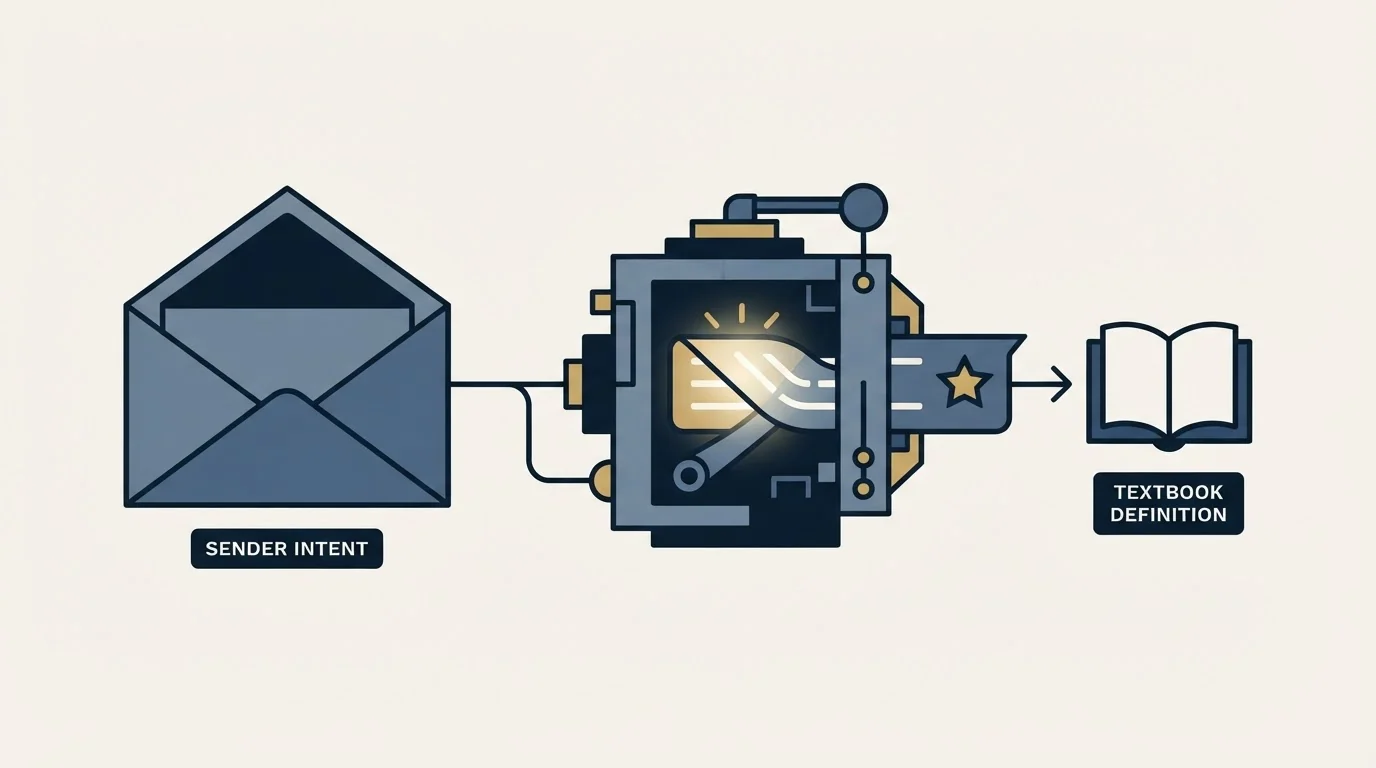
It is a record, not a control. Setting a Return-Path header in a message you compose does nothing useful; the receiver overwrites it from the envelope. The lever is the envelope sender your server declares. Tools that expose a "Return-Path" field are usually setting the envelope sender and naming the field after its visible result.
Bounces do not go to your From: address. This surprises people every time. Failures return to the return path, and if that points at your sending platform, the platform sees them and your mailbox never will. That is usually the correct design, because automated bounce processing is more reliable than a person reading a mailbox. It stops being correct the moment nobody has checked that the processing is happening.
A third-party return path costs you SPF alignment. If the envelope domain belongs to your platform and the visible From: belongs to you, SPF may pass while failing DMARC alignment, leaving DKIM as the only aligned identifier. Mail survives on one leg instead of two. Since forwarding routinely breaks DKIM, a forwarded copy of that message has no aligned identifier left, which is precisely when a strict DMARC policy bites.
"Return-Path" is also a company name, and the results will mix. Return Path was a well-known email intelligence business, later part of Validity, and searches for the term still surface it alongside the header. When a colleague says Return Path, it is worth a moment to establish which of the two they mean.
Variable return paths are a feature, and they look like noise. Many platforms encode a per-message or per-recipient identifier into the local part, so a bounce can be matched back to exactly which send failed without parsing the notification. That is why the address often looks like a random string. It is also why the return path is a poor thing to whitelist by exact address and a reasonable thing to reason about by domain.
An empty return path is normal. A null reverse-path, written <>, marks a message as a bounce notification and exists so bounces cannot themselves bounce. Encountering it in logs is expected behaviour, not a defect.
- Envelope domain belongs to the sending tool
- Bounces are processed automatically by the platform
- SPF authenticates the platform's domain
- DMARC alignment rests on DKIM alone
- Envelope domain is a subdomain of yours
- Bounces still flow to the platform for processing
- SPF authenticates a domain that aligns with your From:
- DMARC has two independent paths to a pass
What this means when you are running outbound
Read a delivered message before you theorise. The header is written by the receiver, so it is the one place in this chain where the evidence does not come from the system you are trying to check. Send to a mailbox you control, open the full headers, and find the Return-Path line. It tells you the envelope domain the receiver recorded, and the Authentication-Results line beside it tells you which checks passed and for which domain. Two lines, thirty seconds, and most authentication puzzles resolve.
Confirm somebody, or something, is processing the bounces. Follow the return path to whatever collects them, and check that hard bounces reach a suppression list that every future campaign consults. This is the single highest-value item in the topic, because unprocessed bounces are how a list quietly decays into dead addresses and eventually into trap hits, and nothing in the sending dashboard makes that visible while it is happening.
Delegate the subdomain if your platform supports it. The cost is one DNS record. The benefit is that SPF starts aligning, so DMARC has two independent ways to pass and a forwarding hop no longer removes your only identifier. Use a subdomain dedicated to the purpose rather than the organisational domain itself, so that the delegation cannot interfere with anything else the domain does.
The failure mode that hides for months
The expensive version of getting this wrong is not a misconfiguration; it is a mailbox nobody opens.
A team delegates a subdomain, points it at their own infrastructure rather than the platform's, and quietly becomes responsible for bounce processing without anybody deciding to be. Bounces arrive at an address that exists, so nothing errors. They accumulate. Dead addresses stay in the list, get mailed again next campaign, bounce again, and the bounce rate creeps upward over months in a way that reads as gradual list decay rather than as a broken pipeline.
The check is one question with a verifiable answer: name the process that reads that mailbox, and show a suppression entry it created this month. If nobody can, the pipeline is not running, whatever the configuration says. That is the same discipline that applies everywhere in this area, which is to verify from the receiving end rather than from the settings screen that claims the sending end is fine.
Why this shows up when a domain gets stricter
The reason this becomes urgent is usually a policy change somewhere else. An organisation moves its DMARC policy from monitoring to quarantine or reject, and mail that had been passing SPF for a platform domain and failing alignment starts being treated according to the new policy. Nothing about the sending setup changed. The tolerance for the misalignment did.
The same thing happens when a receiving organisation tightens its own rules, or when a forwarding path is introduced that breaks DKIM on a stream that had been relying on it. In every case the fix is the same and is cheap: get both identifiers aligned so that losing one is survivable. The aggregate reports will show you, per source, which of the two is carrying you today, and the answer is often not what the sending platform's documentation implies.
- Yes: The Return-Path in a delivered message has been read and identified
- Yes: You know which domain SPF is authenticating, and whether it aligns
- Yes: Bounces reach something that processes them automatically
- Yes: Hard bounces are written to a suppression list every campaign checks
- Depends: A delegated subdomain is used where the platform supports one
- No: Writing a Return-Path header into the message and expecting it to survive
The short version

Return-Path is the receiver's record of where a message said its failures should go. You do not set it directly; you set the envelope sender, and the receiver stamps the result into the delivered copy. That indirection is why the header is trustworthy as evidence: it was written by the other side, from what actually arrived, rather than by the system whose configuration you are trying to check.
Two things follow that are worth acting on. Bounces go there rather than to your visible address, so confirm something is reading and acting on them. And the domain in it is the domain SPF authenticates, so aligning it with your own domain gives DMARC a second independent path to a pass, which is what keeps mail surviving a forwarding hop or a policy change. Both are small pieces of configuration with a long tail of consequences, and both are visible in the headers of any message you send yourself. If the wider authentication picture is unclear, the setup guide covers the records in order and why DMARC fails covers what usually goes wrong.
RevenueFlow runs cold email and LinkedIn outreach for B2B teams on infrastructure we configure and monitor ourselves, including the unglamorous parts. See how the campaigns work.
Specification behaviour verified as of mid-2026 against RFC 5321. Verify current specifications with the source before relying on them.
Frequently asked questions.
Frequently asked questions- How do I set the Return-Path on my emails?
- You do not set the header. You set the envelope sender your server declares in the SMTP exchange, and the receiving server writes it into the delivered copy. Tools that expose a Return-Path field are setting the envelope sender and naming the field after its visible result, which is where the confusion comes from.
- Why is my Return-Path a domain I do not recognise?
- Because your sending platform set an envelope sender on a domain it controls, so failures return to infrastructure that can process them automatically. That is usually the right design. The cost is that SPF now authenticates their domain rather than yours, so DMARC alignment rests entirely on DKIM.
- What is a custom return path and is it worth setting up?
- It means delegating a subdomain of your own domain, usually by CNAME, so the envelope sender becomes something like bounces.yourdomain.com while bounces still flow to the platform. It is worth it: SPF starts aligning, so DMARC has two independent paths to a pass and a forwarding hop no longer removes your only identifier.
- Why is the Return-Path address full of random characters?
- Many platforms encode a per-message or per-recipient identifier into the local part so a bounce can be matched back to the exact send without parsing the notification. That is a feature rather than noise. It does mean the return path is a poor thing to allowlist by exact address and a reasonable one to reason about by domain.