Envelope Sender: A Working Definition for People Who Have to Ship It
The envelope sender is the address a sending server declares in the SMTP MAIL FROM command, which RFC 5321 calls the reverse-path. The recipient never sees it, SPF checks its domain rather than the visible From: header, and every bounce returns to it. DMARC exists because those two addresses are allowed to differ.
Key takeaways
- SPF checks the envelope domain, so it authenticates a domain the reader never sees.
- Bounces follow the envelope, which is often a platform domain rather than yours.
- A null reverse-path, written as MAIL FROM with empty angle brackets, marks a message as a bounce notification.
- Forwarding breaks SPF and message edits break DKIM, so alignment on both survives more events than alignment on one.
The envelope sender is the address a sending server declares in the SMTP MAIL FROM command when it hands a message over, and it is the address that receives any bounce. It is separate from the From: header the recipient reads in their mail client, it is not shown to them, and the two are allowed to be different. RFC 5321, which defines SMTP, calls it the reverse-path.
Every email therefore carries two senders. The envelope sender belongs to the delivery machinery, in the same way the address on a courier's manifest belongs to the courier. The From: header belongs to the message itself, defined by RFC 5322 as the originator field, and it is the one a human being sees. Almost every confusing thing about email authentication traces back to that split.
Envelope sender vs the From: header: why there are two
The envelope sender and the From: header are two addresses with two jobs. The envelope sender, set by MAIL FROM, tells the receiving server where problems go back to, and it is the domain SPF checks. The From: header is what the reader sees, and RFC 5322 says it "specifies the author(s) of the message".
Between a mail sender and a mail receiver, the envelope is the part only the two servers read. RFC 5321 describes the reverse-path as the source mailbox, "which can be used to report errors". The separation is what makes forwarding, mailing lists and bounce handling possible at all.
When a mailing list forwards your message to two hundred subscribers, the message the subscribers read should still say it came from you, so the From: header stays as you wrote it. The bounces from two hundred subscriber addresses should go to the list operator, not to you, so the list rewrites the envelope sender to its own bounce-handling address. Both statements are true at once, and only two separate fields allow it.
The envelope sender is also the address used for the SPF check: RFC 7208 has verifiers check the "MAIL FROM" identity. SPF asks whether the connecting server was authorised to send for the envelope domain, which means the standard authenticates a domain the reader never sees. This is the single most common source of surprise in email authentication, and the reason DMARC exists: DMARC requires an authenticated result to be aligned with the visible From: domain before it counts for anything.
One more detail matters for anyone reading bounce logs. The envelope sender may legitimately be empty, written as <>. A null reverse-path marks a message as itself a bounce notification, and it exists so that bounces cannot bounce and produce an infinite loop. RFC 5321 writes it as MAIL FROM:<>. Seeing MAIL FROM:<> in a log is normal.
SMTP conversation, then the message it carries
MAIL FROM:<bounces@send.example.com> 1
RCPT TO:<buyer@prospect.example>
DATA
From: Your Name <you@example.com> 2
- 1The envelope sender, which RFC 5321 calls the reverse-path. SPF checks this domain, bounces return to it, and the reader never sees it.
- 2The From: header, inside the message data. The mail client displays it, and DMARC wants an authenticated domain aligned with it.
Where the textbook definition misleads
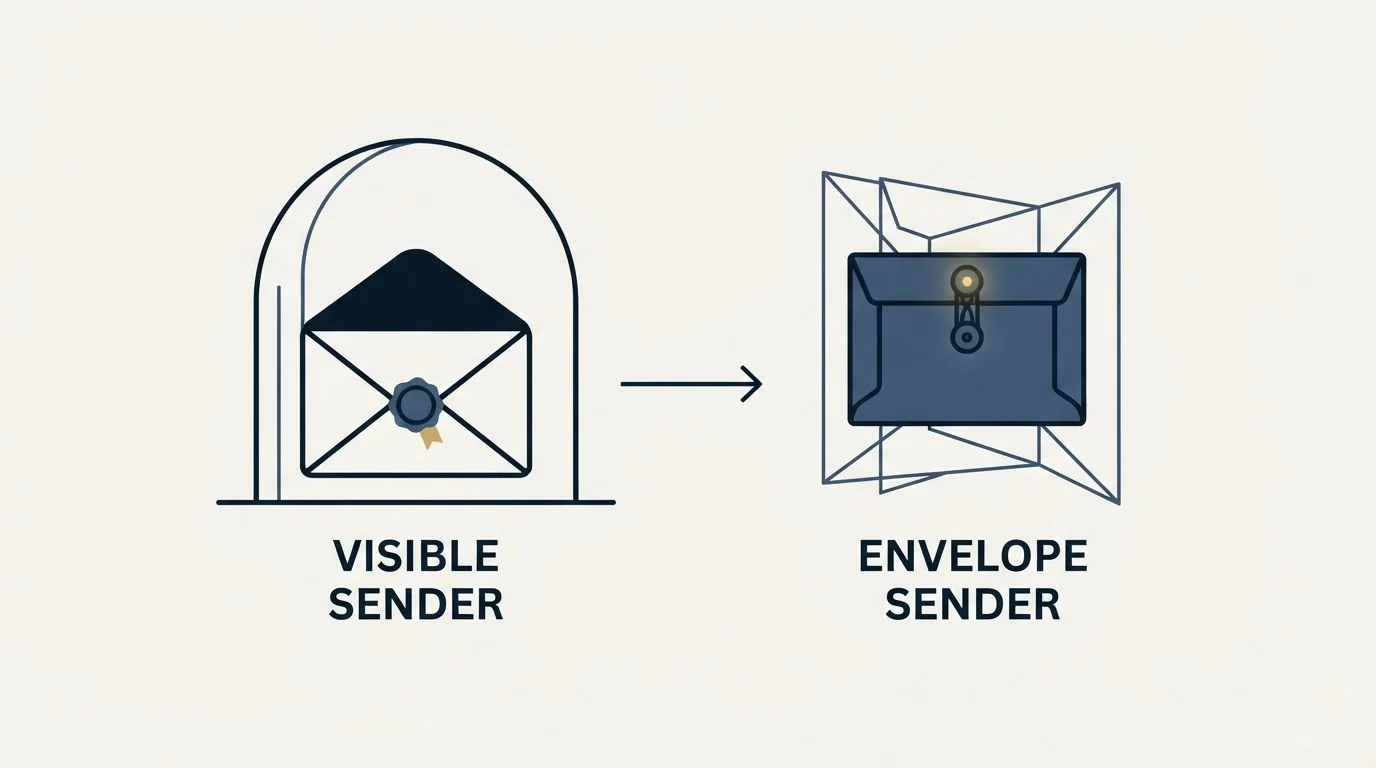
"The From address" is ambiguous, and the ambiguity is expensive. When a platform, a vendor, or a colleague says "the from address", they may mean either field. Configuration screens rarely distinguish them, support articles use the terms loosely, and two people can debug the same problem for an hour while meaning different things. Asking which one is meant is the fastest route to the answer.
Aligning them takes a deliberate setting. Many sending platforms use their own domain as the envelope sender by default, so your mail passes SPF for the platform's domain while displaying yours. That combination fails DMARC alignment on the SPF side. It is survivable if DKIM signs and aligns with your domain, which is exactly why DMARC accepts either path, and it is worth knowing which of the two is actually carrying you.
A mismatch is not a fault by itself. Forwarders and lists rewrite the envelope sender legitimately, every day. Treating any divergence as spoofing generates false alarms and, worse, teaches people to ignore the reports where genuine spoofing would appear.
Bounces follow the envelope, so bounce handling lives wherever it points. If the envelope sender belongs to your sending platform, the platform receives the bounces and you see them through its reporting. If it belongs to you, you receive them and something of yours has to process them. Neither is wrong. What causes damage is assuming the first while the second is configured, because bounces then arrive in a mailbox nobody reads, and unprocessed bounces are how a list rots into spam traps.
Some receivers surface the mismatch, which changes what "invisible" means. Gmail's help centre says it shows "via" and a website name next to the sender's name when "The domain it was sent from doesn't match the domain in the "From:" address." The recipient is then reading a technical mismatch as a signal about the sender, which is a presentation consequence of a configuration decision most senders make without noticing.
What this means when you are running outbound
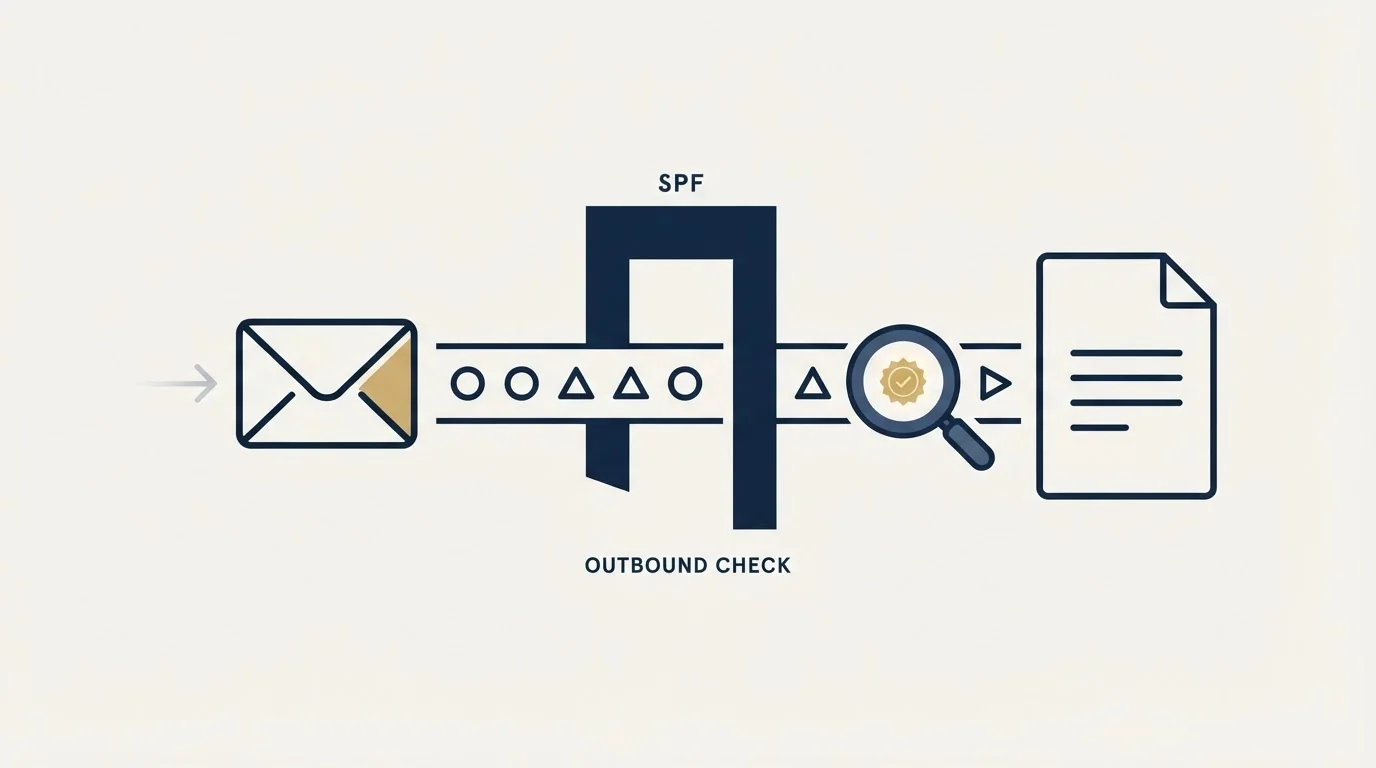
Three practical items, in order of how often they bite.
Find out what your platform puts in the envelope. Send a message to a mailbox you control and read the full headers. The Return-Path recorded there is the envelope sender the receiving server saw. If it is a domain belonging to your sending tool, your SPF pass belongs to that tool's domain and your DMARC pass depends entirely on DKIM. That is fine as a design, and it is not fine as a surprise, because a DKIM problem then removes your only aligned identifier at once.
Know where bounces are actually landing. Follow the envelope address and confirm something is reading that mailbox and writing the results to a suppression list every campaign checks. An outbound programme that does not process bounces accumulates dead addresses, and dead addresses are the mechanism by which reputation degrades quietly over months.
Keep the envelope domain aligned where you reasonably can. Alignment on both SPF and DKIM is more robust than alignment on one, because they break under different events. SPF fails when mail is forwarded, which RFC 7208 treats as a known cause of unintended SPF failures, or when it leaves from an IP the record does not list. DKIM survives relays that make no substantive change to the message, in RFC 6376's words, and fails when something in transit alters the signed content. A sender relying on a single path loses its verdict whenever that path is disturbed. Most platforms support delegating a subdomain for this purpose, and under relaxed alignment a subdomain of your organisational domain aligns with it.
Why this gets urgent without anything changing
The awkward property of a setup relying on one aligned identifier is that it works perfectly until something outside your control moves, and then it fails everywhere at once.
Two events do it. A receiving organisation tightens how it treats DMARC failures, so mail that was passing on a technicality starts being quarantined. Or a forwarding path is introduced: an alias, a distribution list, a personal redirect. Forwarding takes SPF away, because the forwarder's server is not the one your record authorises, so a sender aligned only through SPF loses its only identifier at that step. DKIM travels inside the message and survives a plain redirect, while a list that edits the message can break it too, which RFC 7489 describes as transiting a mediator: it "often causes either the authentication to fail or Identifier Alignment to be lost."
Neither event is announced, and neither shows up as a change in your own configuration. That is the argument for fixing alignment while nothing is wrong: the work is one DNS record and an afternoon, and the alternative is doing the same work under pressure, during a campaign, with no clear signal about what changed.
| Event | SPF | DKIM |
|---|---|---|
| Mail is forwarded by an alias or redirect | Fails | Survives if unaltered |
| A mailing list edits the message | Fails or loses alignment | Can break |
| Mail leaves from an IP the record does not list | Fails | Unaffected |
| Something in transit alters the signed content | Depends on the path | Fails |
The debugging habit worth having
When an authentication result does not make sense, read the received headers of an actual message rather than any dashboard. They record, at the receiving end, what the receiver saw: the Return-Path it recorded, the Authentication-Results line with SPF, DKIM and DMARC verdicts, and the domain each verdict applied to.
RFC 5321 has the final delivering server insert that return-path line, and RFC 8601 defines the verdict line, where SPF names the domain it checked as smtp.mailfrom and DKIM names the signing domain as header.d.
That single view usually settles the question in a minute, and it is a different method from asking the sending tool what it thinks it did. The sending tool reports its own configuration; the received headers report what arrived. When those disagree, and they sometimes do, the headers are right. For a broader picture across every source sending as your domain, DMARC aggregate reports do the same job at inventory scale.
Headers of a delivered message
Return-Path: <bounces@send.example.com> 1
Authentication-Results: mx.example.net; spf=pass smtp.mailfrom=send.example.com; dkim=pass header.d=example.com 2
From: Your Name <you@example.com> 3
- 1Written at final delivery from the MAIL FROM address: the envelope sender the receiver saw.
- 2SPF names the domain it checked, the envelope domain; DKIM names the signing domain. Under relaxed alignment a subdomain of your organisational domain aligns with it.
- 3The From: domain every verdict is aligned against. Bounces go to the envelope address instead.
The short version
There is a naming footnote worth carrying, because the same field appears under four labels depending on who is writing. The specification calls it the reverse-path. Server operators call it the envelope sender or the envelope from. Delivered messages record it as Return-Path. Some documentation writes it as MAIL FROM or 5321.From, against 5322.From for the header. All five refer to the same address, and recognising that is often the whole of the difficulty when reading two vendors' documentation side by side.
Every message carries a sender for the machinery and a sender for the reader. The envelope sender is the first of those: declared at SMTP time, invisible to the recipient, checked by SPF, and the destination for every bounce.
The two exist because forwarding, mailing lists and bounce handling all require the delivery machinery to be addressable independently of the person who wrote the message, and once you see that, the rest of the design stops looking arbitrary.
Knowing which of the two a tool or a colleague means removes a large share of the confusion in this area, and knowing where your bounces land removes a slow, silent source of reputation damage. Beyond that, the useful work is the ordinary work: correct authentication on every sending domain, alignment you can explain, and reports somebody reads. If DMARC is failing and the reason is unclear, the six most likely causes are the place to start.
RevenueFlow runs cold email and LinkedIn outreach for B2B teams on infrastructure we configure and monitor ourselves. See how the campaigns work.
Specification behaviour is taken from RFC 5321 (SMTP), RFC 5322 (message format), RFC 7208 (SPF), RFC 6376 (DKIM), RFC 7489 (DMARC) and RFC 8601 (Authentication-Results), and Gmail's "via" behaviour from its help centre. Verify current specifications with the source before relying on them.
Frequently asked questions.
Frequently asked questions- What is the difference between the envelope sender and the From address?
- The envelope sender belongs to the delivery machinery: declared at SMTP time, never displayed, checked by SPF, and the address bounces return to. The From: header belongs to the message and is what the mail client shows. They are allowed to differ, which is what makes forwarding, mailing lists and bounce handling possible.
- Why does my mail pass SPF but fail DMARC?
- Because SPF passed for a domain that is not the one in your From: header. Many platforms use their own domain as the envelope sender by default, so SPF authenticates them while you are displayed. DMARC requires alignment, so that pass does not count, and you are relying entirely on DKIM to carry you.
- Where do my bounces actually go?
- To the envelope sender, not to your visible address. If that belongs to your sending platform, the platform receives them and surfaces them in its reporting. Follow the address in a delivered message's Return-Path header and confirm something reads it and writes hard bounces into a suppression list every campaign checks.
- Should the envelope domain match my From: domain?
- Aligning both SPF and DKIM is more robust than relying on one, because they break under different events: forwarding breaks SPF, and a list that edits the message can break DKIM. Most platforms support delegating a subdomain for the envelope, and under relaxed alignment a subdomain of your organisational domain aligns with it. The cost is one DNS record.