How to Book Sales Meetings with Banking
A tactical playbook for booking meetings with bank decision makers: asset-tier targeting, FDIC list building, a seven-touch cadence, and four templates.
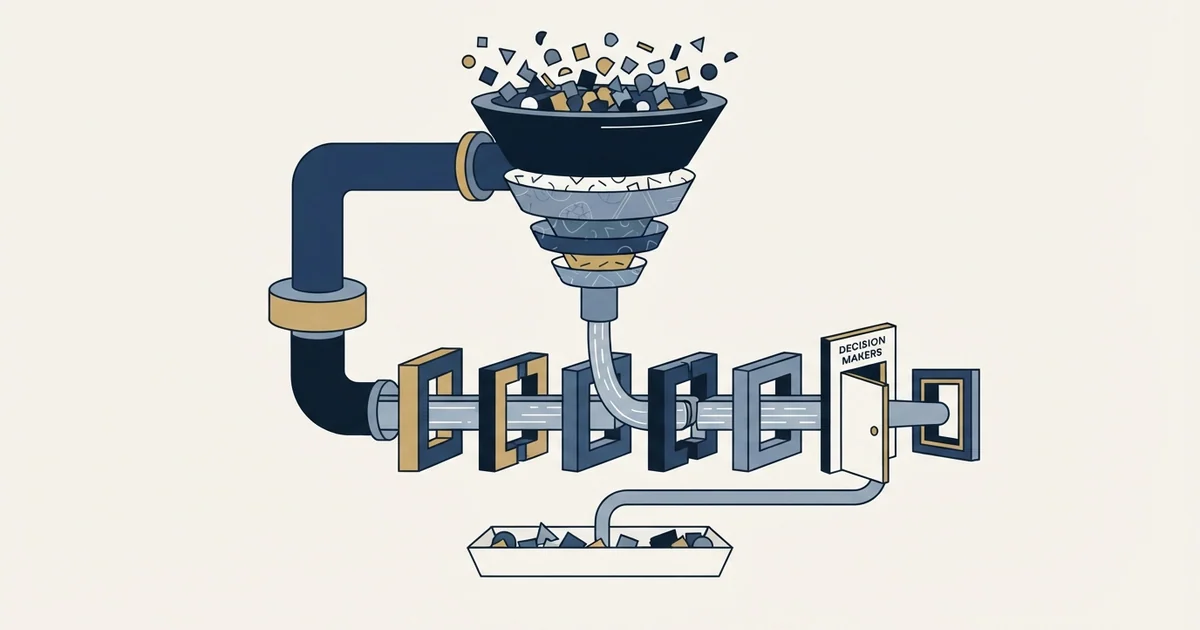
To book meetings with banks, segment prospects by asset size first, then target the executive who owns the metric your product moves. Build the list from FDIC BankFind and call report data, layer on a trigger like a job posting or core renewal, and ask for fifteen minutes rather than a demo.
Key takeaways
- There were 4,336 FDIC-insured commercial banks and savings institutions in the US as of Q4 2025, making banking a finite and fully mappable target list.
- Segment by asset size before choosing titles: sub-$1B banks are CEO and CFO decisions, while $10B to $100B regionals run formal RFP and third-party risk processes lasting 6 to 12 months.
- FDIC BankFind and quarterly call report line items are better list sources than generic B2B databases, which mix in credit unions and fintechs and get asset size wrong.
- Bank buying runs on committee and audit time, so the patience belongs in trigger timing and list precision rather than in a compressed SaaS-style push.
- Replacing the demo ask with a 15-minute call or a document offer lifts reply rates, because bank executives equate demos with six months of procurement.
- Plan on roughly 1 to 3 booked meetings per 100 well-targeted, verified bank prospects as a published planning figure, then replace it with your own measured numbers.
Reviewed and updated September 1, 2026
How to Book Sales Meetings with Banking: A Step-by-Step Playbook
A $2.8 billion community bank in the Midwest gets dozens of vendor emails a week. Most of them open with some version of "I help banks improve efficiency and reduce costs." The few that get replies name the bank's core processor, reference a specific line item from its call report, or mention the exact regulatory deadline the recipient is already losing sleep over.
That gap is the whole game. Banking is one of the most reachable verticals in B2B because the target list is finite, public, and unusually well documented. There were 4,336 FDIC-insured commercial banks and savings institutions in the United States as of the fourth quarter of 2025. Source: FDIC Quarterly Banking Profile. You can build a verified list of every one of them in an afternoon, complete with asset size, deposit mix, branch count, and named executives.
Converting that list into calendar invites is the hard part. This playbook covers who to target, how to segment, what the campaigns look like, the CTA that works with people trained to be suspicious, and how many meetings to expect.
Step 1: Segment by Asset Size Before You Touch a Title
Every decision downstream depends on this. A $400 million bank and a $40 billion bank share an industry and nothing else about how they buy.
| Tier | Asset size | Who decides | Buying reality |
|---|---|---|---|
| Community | Under $1B | President, CEO, CFO, COO | One or two people decide. Fast if the CEO is sold. Budget is tight and personal. |
| Lower midsize | $1B to $10B | CFO, COO, department SVPs | A named department head owns the problem. Committee approval required. |
| Regional | $10B to $100B | VP and SVP line owners, procurement, vendor management | Formal RFP culture, third-party risk review, 6 to 12 month cycles. |
| Large | Over $100B | Innovation groups, program managers, category sourcing | Enterprise procurement. Cold email books discovery, never a deal. |
If you sell a $15,000 annual product, community and lower-midsize banks are your market and the CEO or CFO is your buyer. If you sell a $400,000 platform, you are working the regional tier and your first meeting is with a line owner who has to build an internal case. Sending the same email to both is the most common reason banking campaigns produce nothing. Pick one tier, build the campaign for it, and run the next tier later with different copy.
Step 2: Target Titles That Own a Number
Banks are functionally siloed, and the person whose title sits closest to your product often has no budget. Aim at the executive who owns a metric your product moves.
Deposits and retail: Chief Retail Officer, EVP Retail Banking, SVP Deposit Operations. They own deposit growth, cost of funds, and branch productivity.
Lending: Chief Lending Officer, Chief Credit Officer, SVP Commercial Lending, Director of Loan Operations. They own loan volume, pull-through rate, and time to close.
Risk and compliance: Chief Risk Officer, BSA/AML Officer, Chief Compliance Officer, Fraud Manager. They own exam findings, false positive rates, and SAR throughput.
Technology and operations: CIO, CTO, COO, Director of Digital Banking, Core Conversion Project Manager. They own uptime, integration debt, and the core contract.
Finance: CFO, Controller, Treasurer, Director of Asset Liability Management. At banks under $2 billion the CFO often doubles as the de facto technology decision maker.
Two title notes. "Vice President" is a mid-level rank at most banks, so aim for EVP, SVP, Chief, President, or Director. And a large share of community bank decision makers hold President and CEO simultaneously, and they read their own email.
Step 3: Build the List From Regulatory Data
Standard B2B databases are mediocre on banks. Firmographic filters hand you credit unions, mortgage brokers, and fintechs mixed in with chartered institutions, and asset size is usually wrong. Better sources:
FDIC BankFind Suite. Every insured institution with charter class, asset size, branch count, holding company, and quarterly call report financials. This is your free universe file.
Call report line items. Filter on the thing you actually sell against. Treasury management software maps to noninterest income relative to assets. Loan automation maps to commercial and industrial loan growth quarter over quarter. Fraud tooling maps to operating loss trends.
Core processor mapping. Which core a bank runs (Fiserv, FIS, Jack Henry, or a smaller provider) determines what integrates. Core contracts typically run five to seven years, and a bank inside its renewal window is dramatically more buyable. Press releases, user conference attendee lists, and job postings reveal this.
Trigger events. A bank hiring a Digital Banking Manager or a second BSA analyst is telling you where the pain is. Every acquisition announcement creates a consolidation project, duplicate vendor contracts, and a twelve to eighteen month window of active buying. Association conference speakers have self-identified as people who care about a specific topic.
Verify every address before sending. A bounce rate above two percent on a financial services list will get your sending domain flagged fast.
Step 4: One Message Per Campaign, Paced for a Slow, Skeptical Buyer
Banking outreach fails when it uses SaaS-speed cadences. Bank executives travel to board meetings, sit in exam prep, and check email in batches, so five emails stacked under one subject line inside ten days reads as pressure. Instead of a sequence, each campaign carries exactly one message, and the ideas are spread across separate campaigns paced to how these buyers actually work.
| Campaign | Window | Channel | Content |
|---|---|---|---|
| 1 | Now | Email, one message | Specific trigger or peer reference, one clear question |
| Alongside 1 | Same week | Connection request, no pitch, no note beyond one line | |
| Alongside 1 | Week three | Phone, one call | Direct dial mid-morning, carrying its own reason to ring |
| 2 | Four to six weeks on | Email, one message | One concrete data point or peer example, its own subject line |
| 3 | Next quarter | Email, one message | New angle, different pain, shorter than the first |
| 4 | Next planning window | Email, one message | Resource offer, no meeting ask |
| 5 | Budget season | Email, one message | The routing and timing ask, tied to the planning cycle |
Anyone who does not answer is written to again later in a new single-message campaign, with a new subject line and a new premise, never as a reply added to the earlier exchange. We stopped running that second touch because a bump sits under a message the reader has already passed over, in front of exactly the people most likely to report it, and in a vertical where Proofpoint and Mimecast are watching, that reputation cost is charged to the sending domain across every other bank you write to. A fresh email also earns a fresh open. The reasoning, with the numbers from our own campaigns, is in why we stopped using follow-ups.
Timing details that matter here. Tuesday through Thursday, 7:00 to 8:30 AM local time, lands well because bank executives start early. Avoid the last week of any quarter (call report preparation) and the two weeks around year-end audit. If a bank is mid core conversion, hold until the conversion date passes and reach out with a post-conversion angle.
Keep send volume low. A well-targeted banking campaign might have a total addressable list of 900 institutions in a given asset tier and geography, which is not a list you burn through in a week. Fifty to eighty new prospects per day per mailbox, personalized in the first line, beats a thousand-a-day blast.
Step 5: Use a CTA That Does Not Ask for a Demo

The single biggest lift in banking outreach comes from changing the ask. Bank executives associate "demo" with a 45 minute vendor presentation followed by six months of procurement, so they decline by default. Asks that convert better:
- "Worth 15 minutes to see whether this even applies to a bank your size?"
- "Would the two-page summary of how [Peer Bank] handled this be useful?"
- "Are you the right person, or should I be talking to someone in operations?"
- "If this is a next-year conversation, say so and I will follow up in the fall."
That last one matches the real budget rhythm. Most banks build the following year's technology budget between August and November, and an email acknowledging that cycle reads as informed rather than pushy. Interest-based asks also pull replies from people who are not ready to meet, and those replies are how you learn about a core conversion happening next spring.
Templates That Book Banking Meetings
Template 1: Community Bank CEO, Peer Benchmark Angle
Subject: {{bank_name}} vs. peer banks on {{metric}}

Hi {{first_name}},

Pulled {{bank_name}}'s latest call report while looking at {{state}} banks
in the ${{asset_range}} range. Your {{metric}} sits at {{value}}, against a
peer median closer to {{peer_value}}.

That gap usually traces back to {{root_cause}}, which is what we work on
with banks your size. {{peer_bank_type}} in {{nearby_state}} closed most
of it in about {{timeframe}}.

Worth 15 minutes to see whether the same applies, or is this handled?

{{sender_name}}
{{title}} | {{company}}
Why this works: It opens with public regulatory data the recipient recognizes as real, which separates you from vendors who clearly did no work. Community bank CEOs are intensely peer-aware, so the comparison lands. The closing question offers an easy honest out, which raises reply rate even when the reply is a no.
Template 2: Department Head, Trigger-Based
Subject: {{trigger_event}}

{{first_name}},

Saw {{bank_name}} posted for a {{job_title}} last month. In most banks
that role opens up when {{underlying_problem}} has been eating the
existing team's hours.

We handle the {{specific_workflow}} piece of that, which is usually where
the volume sits. Two banks in the {{asset_range}} range cut {{workflow}}
handling time meaningfully after implementation.

Not asking for a demo. If it's useful I'll send the one-pager and you can
decide from there.

{{sender_name}}
{{phone}}
Why this works: The job posting proves timing instead of guessing at it. Saying "not asking for a demo" defuses the reflex that kills most banking outreach, and asking permission to send a document costs the recipient nothing while starting a thread you can build on.
Template 3: Risk and Compliance Officer
Subject: {{regulation_or_deadline}} timeline question

Hi {{first_name}},

Quick question rather than a pitch. With {{regulation_or_deadline}} landing
{{timeframe}}, are you handling {{specific_requirement}} inside the current
{{system_name}} setup, or building something alongside it?

Asking because most {{asset_range}} banks we talk to are doing it manually,
and the volume gets ugly at {{threshold}}.

Happy to share what we're seeing across other institutions. No agenda
beyond that.

{{sender_name}}
{{company}}
Why this works: Risk and compliance officers respond to peer intelligence more than to product claims, because their job is anticipating what examiners expect. Leading with a genuine question fits how they communicate, and cross-institution observations hold value whether or not they ever buy.
Template 4: The Budget Cycle Routing Ask
Subject: {{topic}} at {{bank_name}}: wrong person, wrong time, or handled?

{{first_name}},

When {{topic}} has not come up at a bank your size, it is usually one of
three things: wrong person, wrong time, or wrong problem.

If it's timing, most banks lock next year's vendor budget between August
and November, so I'm happy to come back in {{month}}.

If it's the wrong person, who owns {{function}} at {{bank_name}}?

Otherwise I'll leave it here.

{{sender_name}}
Why this works: It offers three easy responses instead of a meeting ask, and the budget-timing option matches a real constraint. It runs as its own campaign weeks after an earlier one, so the routing question is the whole point of the message rather than a line bolted onto a pitch, and nothing in it depends on the reader remembering a previous email.
Handling the Objections You Will Actually Get
- No: "We're locked into our core provider."
- No: "You'd have to go through vendor management."
- No: "Budget is set for the year."
- No: "We're too small for this."
"We're locked into our core provider." Ask which contract year they are in and whether the core covers the specific workflow or merely sits adjacent to it. Banks routinely buy point solutions around a core they cannot leave.
"You'd have to go through vendor management." Agree immediately and treat it as a green light. The interagency guidance on third-party relationships issued by the Federal Reserve, FDIC, and OCC in June 2023 formalized due diligence across the vendor lifecycle. Source: OCC Bulletin 2023-17. Having your SOC 2 report, financials, business continuity plan, and cyber insurance certificate packaged and ready is a real advantage, and saying so on a first call builds more credibility than any feature list.
"Budget is set for the year." Ask when the planning cycle opens, take a calendar hold for that month, and show up with something new.
"We're too small for this." Usually a pricing fear. Give a real number range on the call, because bank buyers dislike vendors who dodge it.
What Realistic Output Looks Like
Treat the following as planning arithmetic rather than a benchmark, and replace it with your own numbers after 500 sends.
Per 100 verified prospects in a single asset tier, with genuine first-line personalization and the full set of campaigns above, a reasonable model is 3 to 8 total replies, roughly half of them positive or curious, and 1 to 3 booked meetings. Expect 20 to 40 percent of those meetings to surface the wrong person and produce a referral instead. Applied to a 900-institution list, that lands around 9 to 27 meetings across a full cycle of roughly two months. Banking sales cycles then run three to nine months from first meeting to signature, longer if a core integration is involved.
Two variables move these numbers most: list precision (one asset tier, one clearly owned problem) and trigger quality (outreach timed to a job posting, an acquisition, a core renewal, or a regulatory deadline). Trigger-based campaigns win because the timing objection disappears before it gets raised.
Deliverability Notes Specific to Bank Domains

Banks run aggressive email security. Proofpoint, Mimecast, and Microsoft Defender inspect links, attachments, and sender reputation harder than the average corporate gateway.
Practical rules: no attachments, no tracking pixels on first touch, no link shorteners ever, and one plain link at most after the first reply. Send plain text. Warm each sending domain for at least three weeks, and authenticate with SPF, DKIM, and DMARC set to at least quarantine.
Avoid anything resembling a phishing pattern. Urgency language, "action required," account references, or requests to click and verify get flagged by the filter and the human. Bank employees sit through phishing simulation training constantly, and an email that pattern-matches to a simulation gets reported rather than answered.
Pull It Together
Build one asset-tier list from FDIC data, target the executive who owns the metric you move, layer on a real trigger, run a patient set of single-message campaigns over six weeks, and ask for fifteen minutes or a document instead of a demo. That beats volume in a vertical where the entire universe is smaller than most companies' monthly send quota.
If you would rather have this built and run for you, RevenueFlow does done-for-you cold email for B2B teams selling into regulated industries, including list construction, deliverability infrastructure, and campaign management. Book a strategy call and we will map the addressable bank list for your product first.
Related Reading
- Cold Email for Banking and Financial Services: The Complete Guide
- Banking Cold Email Benchmarks: 2026 Performance Data
- Cold Email for Partnerships: Building Strategic Business Relationships
If you would rather have this run for you, RevenueFlow books qualified meetings on a pay-per-meeting basis and publishes client results.
Frequently asked questions.
Frequently asked questions- Who should I target at a bank for cold outreach?
- Target the executive who owns the metric your product moves, not the title closest to your product. At banks under $1 billion in assets that is usually the President and CEO or the CFO. Above $1 billion, aim at department heads such as Chief Lending Officer, Chief Risk Officer, BSA Officer, or Director of Digital Banking. Note that Vice President is a mid-level rank at most banks.
- Where do I get an accurate list of banks to email?
- Start with the FDIC BankFind Suite, which lists every insured institution with charter class, asset size, branch count, holding company, and quarterly call report financials for free. Layer in call report line items to filter on the problem you solve, plus job postings, acquisition announcements, and core processor renewal timing as trigger data.
- How many emails does it take to book one bank meeting?
- As a planning model rather than a published benchmark, expect 3 to 8 replies and 1 to 3 booked meetings per 100 well-targeted, verified prospects across a multi-message programme. We send one message per campaign and get there with a larger verified list, because in this vertical list precision and trigger timing move the number far more than message count does. Measure your own rate after the first 500 sends and adjust.
- What should the call to action be in a cold email to a bank?
- Avoid asking for a demo. Bank executives associate demos with long vendor presentations and procurement cycles. Higher-converting asks include a 15-minute call to check whether the problem applies at their asset size, an offer to send a two-page peer summary, a question about who owns the function, or a reconnect during their August to November budget cycle.
- Do cold emails to banks get blocked by security filters?
- Often, yes. Banks commonly run Proofpoint, Mimecast, or Microsoft Defender, which inspect links, attachments, and sender reputation aggressively. Send plain text with no attachments, no link shorteners, and no tracking pixels on first touch. Authenticate with SPF, DKIM, and DMARC, warm domains for at least three weeks, and keep bounce rate under two percent.
About the author.

Ben Carden is CRO at RevenueFlow, which builds and operates outbound revenue engines for B2B companies. Previously at Gartner Enterprise. Studied at London School of Economics.
Ben Carden · CRO
Connect on LinkedIn →Explore more.
Ready to scale your outreach?
We build GTM engines that book real meetings. See the receipts.
Related articles.
Cold Email for Influencer Outreach: Partner with Creators
Learn how to use cold email to build authentic influencer partnerships that drive real results for your brand, with proven templates and strategies.
Cold Email for Product Feedback: Complete Strategy Guide
Learn how to use cold email to gather valuable product feedback from users and prospects. Includes proven templates, feedback frameworks, and response optimization techniques.
Cold Email for PR: How to Pitch Journalists and Get Coverage
Learn how to craft cold emails that get journalists to open, read, and respond to your pitches. Includes real templates, timing strategies, and a complete PR outreach checklist.
Cold Email for Reviews: Complete Strategy Guide
Learn how to use cold email to generate authentic product reviews on G2, Capterra, and other platforms. Includes proven templates, compliance guidelines, and review generation frameworks.
Cold Email for Link Building: How to Get Quality Backlinks
Learn how to use cold email outreach to build high-quality backlinks that improve your SEO rankings, with proven templates and strategies that get responses.
Cold Email for Focus Groups: Complete Strategy Guide
Learn how to use cold email to recruit qualified participants for focus groups. Includes proven templates, screening strategies, and group composition frameworks.