How to Book Sales Meetings with Construction
A tactical playbook for booking meetings with construction decision makers: titles, list sources, sequence timing, CTAs, objections, and real funnel math.
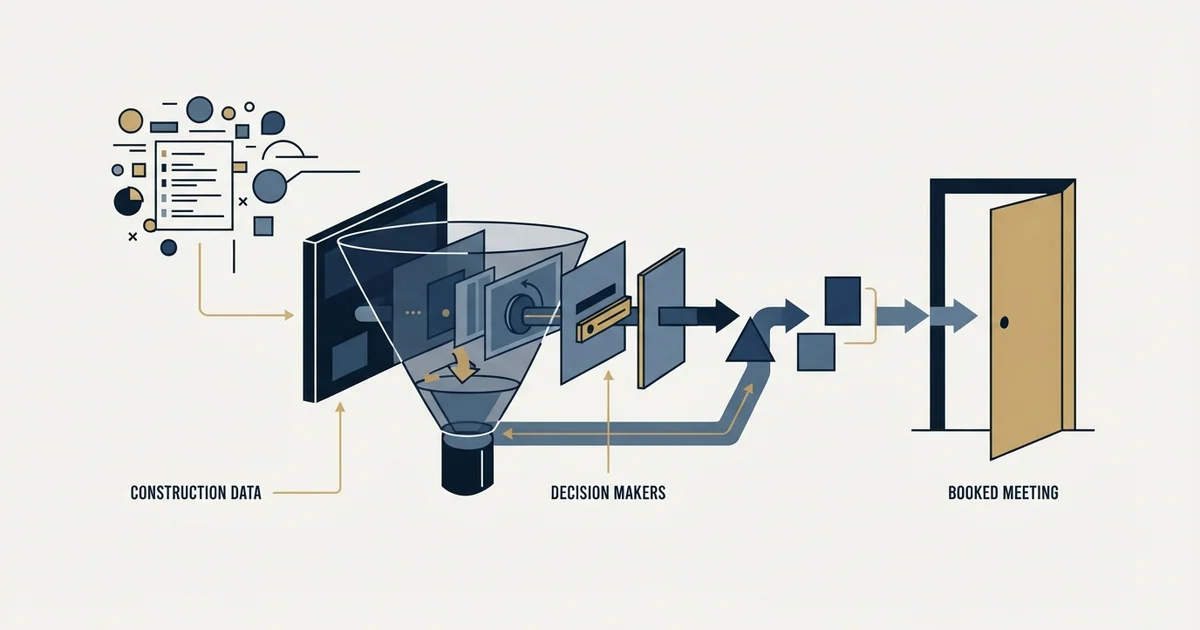
To book meetings with construction decision makers, pick one segment (trade contractors, GCs, civil, homebuilders, or owners), target owners and VPs of Operations, Controllers, and Safety Directors, build the list from license boards and permit data, and send plain-text emails under 90 words at 5 to 7am local time with a single-question CTA.
Key takeaways
- Segment before you build a list: general contractors, specialty trades, heavy civil, homebuilders, and owners/developers buy in completely different ways.
- In contractors under 250 employees, three or four people (Owner, VP of Operations, Controller, Safety Director) make every purchasing decision that matters.
- Build lists from construction-native sources like state license boards, building permit records, and AGC/ABC chapter directories rather than generic B2B databases.
- Send between 5 and 7am recipient local time, Tuesday through Thursday, in plain text under 90 words, because these emails are read on a phone before the first coordination meeting.
- Run five single-message email campaigns across the year with one cold call beside each, then a quarterly re-approach campaign, since construction demand is project-triggered.
- Plan on roughly 400 to 1,000 verified contacts per month to hold about 10 construction meetings, and back-solve your volume from that ratio before launching.
Reviewed and updated September 1, 2026
How to Book Sales Meetings with Construction: A Step-by-Step Playbook
At 5:40 on a Tuesday morning, the VP of Operations at a $70M mechanical contractor is sitting in his truck in a Home Depot parking lot clearing email before the 6:30 pre-task meeting. He reads maybe fifteen messages. He replies to two, both one line long.
That is the window you are competing for. Construction decision makers are operationally busy in a way most B2B buyers are not, and outreach that books meetings with them looks structurally different from outreach aimed at a SaaS VP of Marketing.
This playbook covers the mechanics: which titles to target, how to build a list when standard databases are thin, how to structure the campaigns, which CTA converts, how to handle the four objections you will hear constantly, and what a realistic meetings-per-100-prospects number looks like.
Step 1: Decide Which Slice of Construction You Are Selling To
"Construction" is five markets with five buying behaviors. Picking one before you build a list is the highest-leverage decision in the campaign.
| Segment | Who they are | Buying behavior |
|---|---|---|
| General contractors | Manage the build, subcontract the trades | Committee-driven, focused on schedule risk and margin fade |
| Specialty trade contractors | Electrical, mechanical, plumbing, concrete, roofing | Owner or VP decides fast, cares about labor productivity and getting paid |
| Heavy civil and infrastructure | Roads, bridges, utilities, earthwork | Bid-driven, public procurement rules, fleet heavy |
| Homebuilders and remodelers | Production and custom builders | Volume-sensitive, seasonal, buy sales and marketing tooling |
| Owners, developers, CM firms | Fund and oversee projects | Long cycles, formal procurement, high contract value |
A campaign targeting specialty trade contractors between 50 and 300 employees behaves nothing like one targeting top-400 general contractors. The first can close in two calls with an owner. The second needs a champion, a jobsite pilot, and a regional rollout. Write your campaigns for one, never both.
Step 2: Target the Titles That Can Actually Say Yes
Construction org charts are flatter than software org charts, and authority sits with fewer people. In most contractors under about 250 employees, three or four people make every purchasing decision that matters.
Best-converting titles by company size:
- Under 50 employees: Owner, President, General Manager. No committee. The owner signs.
- 50 to 300 employees: VP or Director of Operations, VP of Construction, CFO/Controller (anything touching billing, payroll, job costing), Safety Director (anything touching EMR or OSHA exposure).
- 300+ employees: Add Director of VDC, Director of Preconstruction, Chief Estimator, Equipment Manager, Director of Field Operations. Here the operations lead is your champion and the CFO is the approver.
Two titles are overrated as entry points. Project Managers get pitched constantly and hold almost no budget. IT Directors at contractors are usually infrastructure people who route your email to a business owner anyway.
Two are underrated. Safety Directors have real budget and a clear, quantified pain (recordables, EMR, insurance premiums). Controllers own more software decisions than their title implies, because job costing, AIA billing, lien waivers, and certified payroll all sit under them.
Step 3: Build the List From Construction-Native Sources
Standard B2B data providers underperform here. Contractors churn email domains, lean on generic info@ addresses, and often have no LinkedIn presence for the person who actually signs. Pull "Construction, 50-500 employees, VP title" out of a general database and you will hit a wall of bounces and irrelevant contacts.
Sources that produce better lists:
- State contractor license boards. Public, current, and they list license class, active status, and often the qualifying individual's name. Excellent for trade-specific targeting.
- Building permit data. County and municipal permits name the contractor of record on active projects, giving you a filter (currently building) and a personalization hook (the project).
- Association member directories. AGC and ABC chapters, NECA, MCAA, SMACNA, NRCA, and state trade associations publish member lists skewed toward better-capitalized contractors.
- Plan rooms and bid boards. Companies actively bidding have pipeline and pressure.
- Contractor rankings. ENR regional lists and local business journal top-contractor lists are pre-qualified by revenue.
Then verify. Run every address through a verification tool, drop catch-all domains into a lower-priority segment, and manually confirm the top 10 percent. A 400-contact verified list will out-book a 4,000-contact unverified one and protects your sending domains.
Step 4: Build the Campaigns Around Field Hours

The structural rules that matter in this vertical:
Send early. Construction leadership starts the day between 5 and 7am local time. Landing at the top of the inbox before the first coordination meeting beats landing at 10am under 40 other messages. Segment sends by recipient time zone.
Tuesday through Thursday. Mondays go to scheduling, Fridays to closeout and payroll.
Keep it under 90 words. These emails get read on a phone, one-handed, outdoors. No images, no logos, no HTML, no attachments on a first touch.
One message per campaign, five campaigns across the year. Campaign 1 opens with the operations angle. Campaign 2, four to six weeks on, goes to the people who did not answer, carrying a different pain and its own subject line. Campaign 3 carries the proof, campaign 4 lands on the next project trigger, and campaign 5 is the routing ask in the planning window. Nobody gets a second email underneath the first. We stopped sending that bump because it arrives beneath a message the reader has already skipped, in front of exactly the people most likely to mark it as spam, and the reputation cost is charged to the sending domain across every other campaign it carries. A fresh email gets a fresh open, and buying here follows project cycles anyway, so the next campaign has a real reason to exist. The reasoning, with the numbers from our own campaigns, is in why we stopped using follow-ups.
Phone is a real channel here. Construction is one of the few B2B verticals where cold calling still connects at a meaningful rate, especially early morning and late afternoon. Pair each campaign with a single call in the same week, carrying its own reason to ring rather than a question about whether they saw the email. LinkedIn is the weakest channel for trade contractors and gets stronger as you move toward large GCs, owners, and developers.
Watch the season. In cold-weather markets, Q1 and late Q4 are evaluation windows. Mid-summer is peak field chaos in most of the country.
Step 5: The CTA That Actually Converts
The default SaaS CTA ("Do you have 15 minutes this week for a quick demo?") underperforms badly here, because it asks a busy operator to spend time evaluating something abstract.
Three CTA patterns that book meetings here:
- The single-question interest check. "Is {{specific_problem}} something you're dealing with on the {{project_type}} side, or is it handled?" This gets a one-word reply, which is the point. A reply starts a thread, and the thread books the meeting.
- The bounded call. "Worth 12 minutes to walk through how {{peer_company_type}} handles this? I'll show you the actual workflow, not slides." Naming the duration and what happens inside the meeting removes the fear of a pitch.
- The artifact offer. "Want me to send the one-page breakdown of how {{peer_company}} cut {{metric}}?" Lower friction than a call, and a good share of takers accept a call when you send it.
Whichever you use, quantify in field terms: hours per week of foreman time, days of schedule slip, rework percentage, recordable incidents, days sales outstanding. Abstract percentage improvements read as vendor noise.
Step 6: Templates You Can Send Today

Template 1: The Operations Cold Open
Subject: {{company_name}} crews on the {{project_name}} job

{{first_name}},

Saw {{company_name}} pulled the permit on {{project_name}}.

Most {{trade}} contractors your size tell me the same thing when
they're running 4+ active jobs: foremen burn 5-6 hours a week
rebuilding schedules by hand after a delivery or manpower change.

{{peer_company_type}} contractors we work with got that down to
under an hour.

Is that a real problem on your jobs right now, or handled?

{{sender_name}}
{{phone}}
Why this works: The permit reference proves you looked at their business, not a job title filter. The pain is stated in foreman hours, a unit they think in. The CTA is a yes/no question that costs nothing to answer, and "or handled" gives a graceful exit, which raises reply rate.
Template 2: The CFO/Controller Angle
Subject: DSO on your commercial work

{{first_name}},

Quick one. On the commercial side, how long is it taking
{{company_name}} to get paid after a pay app goes in?

The contractors I talk to in {{market}} are sitting at 60-75 days
and eating the float on their line of credit, mostly because
lien waivers and backup docs bounce back from the GC two or
three times.

We cut that cycle for {{peer_company_type}} contractors by
{{specific_number}} days.

If that's worth 12 minutes, I'll show you the actual billing
workflow. If your DSO is already under 45, ignore me.

{{sender_name}}
{{phone}}
Why this works: It opens with a question the controller knows the answer to and probably hates. The vocabulary (pay app, lien waivers, backup, float) signals you have sold into construction before. The disqualifier at the end buys credibility and filters out bad-fit replies.
Template 3: The Safety Director Angle
Subject: EMR question

{{first_name}},

Straight question: is {{company_name}}'s EMR costing you work
right now? A few GCs in {{market}} moved their prequal threshold
to 0.90 this year and it's knocking good subs off bid lists.

We work with {{trade}} contractors on the leading-indicator side
(pre-task planning, near-miss capture, corrective action closeout)
so the number moves before the renewal, not after.

Want the one-pager on how {{peer_company}} moved theirs, or is
this the wrong quarter for it?

{{sender_name}}
{{phone}}
Why this works: EMR ties directly to bid eligibility and insurance cost, so safety is framed as a commercial problem. The artifact CTA is low friction, and "or is this the wrong quarter" invites a timing reply you can convert into a calendar hold.
Template 4: The Standing Offer
Subject: {{next_season}} planning at {{company_name}}

{{first_name}},

Assuming {{problem}} isn't a priority right now, which is a
fine answer.

If it comes back up when you're planning {{next_season}} work,
reply to this and I'll pick it up then.

One thing that might be useful either way: {{specific_resource}}.

{{sender_name}}
Why this works: A message that assumes nothing and asks for nothing often produces the highest reply rate of any campaign in construction, because the recipient's default state is genuinely "busy." It goes out as its own campaign to people an earlier one did not reach, with its own subject line, and a specific future trigger ({{next_season}} planning) makes it easy for them to come back months later.
Step 7: Handling the Four Replies You Will Get Most
- No: "We already use {{competitor}}."
- No: "Send me some info."
- No: "Talk to my PM / my IT guy."
- No: "We're too busy right now."
"We already use {{competitor}}." Do not attack the incumbent. Ask a narrow diagnostic question about its weakest area: "Makes sense, a lot of guys are on it. Curious how it handles {{specific_edge_case}}, that's where most switches start." Look for a crack, not a debate.
"Send me some info." A soft brush-off most of the time, a real request the rest. Treat it as real, but attach a hook: send one page, then ask a question that requires thought. "Sent. One thing I couldn't tell from outside: are your foremen filling out daily reports in the field or at the end of the day in the truck?"
"Talk to my PM / my IT guy." Take the referral and ask for a warm handoff in the same breath: "Happy to. Would you mind forwarding this with a line so it doesn't land cold?"
"We're too busy right now." In construction this is almost always literally true. Do not push. Book the future: "Totally get it. When does the schedule loosen, October? I'll put a note in for then." Then actually follow up in October. That single behavior converts a meaningful share of a construction list over a 6 to 12 month horizon.
Step 8: What 100 Prospects Realistically Produces
Run the math before you build the campaign so you know how many contacts you need. The model below is a planning framework, not a published benchmark. Replace each rate with your own once you have a few hundred sends of real data.
| Stage | Conservative | Solid | Strong |
|---|---|---|---|
| Contacts loaded | 100 | 100 | 100 |
| Deliverable after verification and bounces | 88 | 92 | 95 |
| Total replies across the campaigns | 3 | 6 | 10 |
| Positive or curious replies | 1 | 3 | 5 |
| Meetings booked | 1 | 2 | 3 |
| Meetings actually held | 0.6 | 1.5 | 2.4 |
The implication: to hold 10 meetings a month, plan on roughly 400 to 1,000 verified, well-segmented contacts entering campaigns per month, plus calls. If someone promises 30 construction meetings a month off 500 contacts, either the meetings are worthless or the list is scraped.
Two ratios matter more than reply rate. Held rate: construction no-show rates run higher than software because jobsite emergencies are real, so confirm the morning of, offer phone instead of video, and keep meetings to 15 or 20 minutes. Positive reply share: if replies are coming in but almost none are positive, the targeting is off rather than the copy.
At RevenueFlow we treat these campaigns as a segment-first exercise, because in construction the list decides the outcome long before the copy does.
Step 9: The Five Things That Kill Construction Campaigns
- Generic "construction" targeting. An electrical sub and a paving contractor share an NAICS prefix and nothing else.
- Sending to info@ and office@ addresses. These reach a receptionist or a dead box. Named contacts only.
- Video-call-first CTAs. Offer phone. Many of these buyers take calls from a truck and never open Zoom.
- Corporate polish. Logos, HTML templates, and three-paragraph value props read as vendor spam. Plain text, short sentences, trade vocabulary.
- Quitting after one campaign. Demand here is project-triggered. The contact who ignored a spring campaign may reply in the fall, to a fresh one, after a job goes sideways.
Your Pre-Launch Checklist

- One segment chosen (trade, revenue band, geography)
- Titles mapped to company size, operations and finance leads prioritized
- List sourced from license boards, permits, associations, or rankings
- Every address verified, catch-alls segmented separately
- Sends scheduled 5 to 7am recipient local time, Tuesday through Thursday
- Five single-message campaigns across the year, with one call beside each
- Every email under 90 words, plain text, no attachments
- CTA is a single question or a bounded 12-minute call
- Objection responses written in advance
- Quarterly re-approach campaign scheduled for every non-responder
If you would rather have this built and run for you, including segment selection, the construction-native list build, sending infrastructure, and the follow-up that turns "we're slammed right now" into a booked call six months later, book a strategy call with RevenueFlow.
Related Reading
- Cold Email for Partnerships: Building Strategic Business Relationships
- Cold Email for Product Feedback: Complete Strategy Guide
- Construction Cold Email Benchmarks: 2026 Performance Data
If you would rather have this run for you, RevenueFlow books qualified meetings on a pay-per-meeting basis and publishes client results.
Frequently asked questions.
Frequently asked questions- What job titles should I target to book meetings with construction companies?
- Under 50 employees, go straight to the Owner, President, or General Manager. Between 50 and 300 employees, target the VP or Director of Operations, the CFO or Controller for anything touching billing and job costing, and the Safety Director for anything touching EMR. Above 300 employees, add Preconstruction, VDC, and Field Operations leaders. Project Managers rarely hold budget.
- When is the best time to send cold emails to contractors?
- Between 5 and 7am in the recipient's local time zone, Tuesday through Thursday. Construction leadership clears email before the first pre-task or coordination meeting of the day, so arriving at the top of that inbox matters more than any subject line trick. Mondays go to scheduling and Fridays go to closeout and payroll.
- How many meetings can I expect per 100 construction prospects?
- As a planning model rather than a published benchmark, a tight, verified list of 100 contacts run through five single-message campaigns typically produces a small handful of replies, of which one to three convert into booked meetings and slightly fewer are actually held. Track your own rates after a few hundred sends and replace the assumptions.
- Why do standard B2B databases work poorly for construction lists?
- Contractors churn email domains, route inbound to generic info@ addresses, run shared corporate email for field staff, and frequently have no LinkedIn presence for the person who actually signs. Filtering a general database by NAICS code and VP title produces heavy bounce rates and irrelevant contacts. License boards, permit records, and association directories are more accurate.
- What CTA converts best when emailing construction decision makers?
- A single yes-or-no question about a specific operational problem outperforms a demo request, because it costs the recipient one word to answer and opens a thread. If you want a call, bound it tightly (twelve minutes, offered by phone rather than video) and say exactly what will happen inside it.
About the author.

Ben Carden is CRO at RevenueFlow, which builds and operates outbound revenue engines for B2B companies. Previously at Gartner Enterprise. Studied at London School of Economics.
Ben Carden · CRO
Connect on LinkedIn →Explore more.
Ready to scale your outreach?
We build GTM engines that book real meetings. See the receipts.
Related articles.
Cold Email for Influencer Outreach: Partner with Creators
Learn how to use cold email to build authentic influencer partnerships that drive real results for your brand, with proven templates and strategies.
Cold Email for Product Feedback: Complete Strategy Guide
Learn how to use cold email to gather valuable product feedback from users and prospects. Includes proven templates, feedback frameworks, and response optimization techniques.
Cold Email for PR: How to Pitch Journalists and Get Coverage
Learn how to craft cold emails that get journalists to open, read, and respond to your pitches. Includes real templates, timing strategies, and a complete PR outreach checklist.
Cold Email for Reviews: Complete Strategy Guide
Learn how to use cold email to generate authentic product reviews on G2, Capterra, and other platforms. Includes proven templates, compliance guidelines, and review generation frameworks.
Cold Email for Link Building: How to Get Quality Backlinks
Learn how to use cold email outreach to build high-quality backlinks that improve your SEO rankings, with proven templates and strategies that get responses.
Cold Email for Focus Groups: Complete Strategy Guide
Learn how to use cold email to recruit qualified participants for focus groups. Includes proven templates, screening strategies, and group composition frameworks.