How to Book Sales Meetings with Media Companies
A playbook for booking calls with media decision makers: which titles to target, how to build the list, sequence timing, templates, and realistic meeting math.
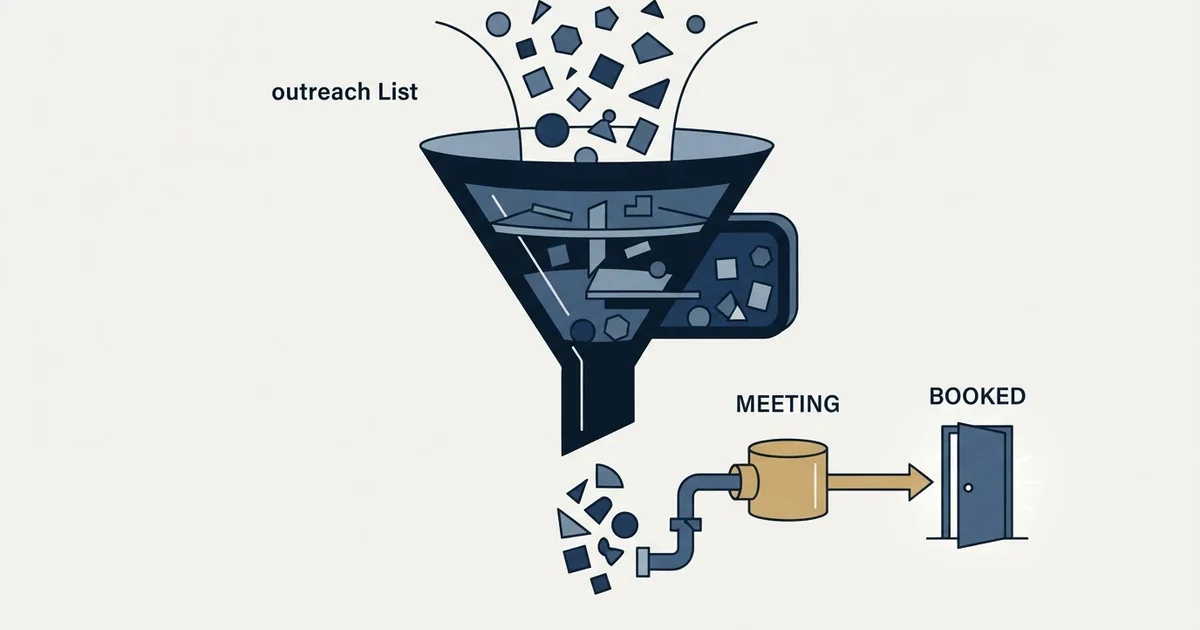
To book meetings with media companies, pick one segment (digital publisher, broadcast group, subscription publisher), target the executive who owns the metric your product moves such as fill rate or churn, build a 200 to 400 contact list from mastheads and job postings, and run four single-message campaigns across the year outside Q4 and upfronts.
Key takeaways
- Segment before you send: digital publishers, broadcast groups, subscription publishers, streaming, podcast networks, and production houses have different revenue models and different vocabulary.
- Target whoever owns the metric your product moves (fill rate, sell-through, churn, ARPU, utilization) rather than the closest-sounding title.
- Woodpecker's campaign data shows sends to fewer than 50 contacts averaged roughly 5.8% reply rates, with rates declining as list size grows.
- The majority of replies arrive after the first email, so a second contact matters, but we send it as a new campaign weeks later rather than as a reply in the same thread.
- Avoid October through mid-December (revenue peak), April and May (upfronts and NewFronts), and political season in even years; January to March and mid-June to September are the reliable windows.
- Plan on roughly 1 to 2 meetings per 100 well-targeted contacts, meaning 500 to 800 researched contacts per month to book eight to ten meetings.
Reviewed and updated September 1, 2026
How to Book Sales Meetings with Media Companies: A Step-by-Step Playbook
A digital publisher doing 15 million monthly uniques might employ 300 people, but the number who can approve a new vendor contract is usually under ten. In broadcast it is often under five per station group. Most outbound teams selling into media burn their list on content editors, marketing managers, and social leads, none of whom control a budget, then conclude that "media companies don't respond to cold email."
Media companies do respond. They are commercial organizations under visible revenue pressure, they measure everything in CPMs and churn, and they will take a 20-minute call with someone who understands how their P&L works. What they ignore is outreach written for generic B2B SaaS buyers.
This playbook covers the mechanics of turning cold outreach into booked calls: who to target, how to build the list, campaign structure, the CTA that converts here, the objections you will get, and what a realistic meetings-per-100-prospects number looks like before you commit budget.
Step 1: Narrow to a Single Media Segment
"Media companies" spans organizations with almost nothing in common operationally. A local TV station group, a subscription trade publisher, a podcast network, and a streaming service run different revenue models and use different words for the same problem. One campaign written for all of them reads as generic to every one of them. Pick a lane:
| Segment | Primary revenue model | What keeps them up at night |
|---|---|---|
| Digital publishers | Advertising, affiliate, events | Search and social referral decline, direct-sold share, RPM |
| Subscription and trade publishers | Recurring subscriptions, memberships | Churn, renewal rate, ARPU, paywall conversion |
| Local broadcast and radio groups | Spot advertising, retrans, political | Sell-through, local direct vs national, traffic and billing ops |
| Streaming and CTV | Subscriptions plus ad tiers | Ad load, fill rate, subscriber acquisition cost |
| Podcast and audio networks | Host-read and programmatic ads | Attribution, dynamic ad insertion, inventory forecasting |
| Production and post houses | Project fees | Utilization, delivery deadlines, storage cost |
Segment choice determines your list, titles, metric vocabulary, and timing. Get it wrong and nothing downstream works.
Step 2: Target Titles That Own a Number

The buyer you want is whoever owns the metric your product moves. Map your offer to the metric first, then to the title.
| If you sell | Target titles | Metric they own |
|---|---|---|
| Ad revenue tooling, yield, direct-sold workflow | Chief Revenue Officer, VP Ad Sales, VP Revenue Operations, Director of Ad Operations, Head of Programmatic | Fill rate, sell-through, CPM, revenue per session |
| Audience and subscription growth | Chief Digital Officer, VP Audience Development, Head of Consumer Revenue, Director of Retention | Churn, paywall conversion, ARPU |
| Content production and workflow | VP Production Technology, Head of Post Production, Director of Content Operations, VP Editorial Operations | Time to publish, utilization, storage cost |
| Data, identity, measurement | VP Data, Head of Insights, Director of Analytics | Match rate, addressable inventory, attribution |
| Broadcast operations | General Manager, Director of Sales, VP Traffic and Billing, Director of Engineering | Sell-through, makegoods, discrepancy rates |
Two rules specific to media. Skip anyone with "Editorial" in the title unless you sell editorial tooling, since church-and-state separation means they will not route you to the commercial side. And at station groups and mid-size publishers, the GM or Publisher is often a genuine buyer with signing authority.
Step 3: Build the List From Sources Your Competitors Skip
Standard database exports return stale titles here, because media companies restructure constantly. Layer these sources instead:
Mastheads and about pages. Publishers list commercial leadership publicly in a way most industries do not. Ten minutes on a masthead beats a database filter.
Trade press quotes. Digiday, AdExchanger, Press Gazette, TVNewsCheck, and Adweek quote the exact people who make buying decisions, stating their current priority. That quote is your opening line.
Conference speaker lists. Digiday events, the IAB's programmatic and podcast upfronts, NAB Show, and INMA publish rosters months ahead. A speaker who just presented on retention is telling you what they are measured on.
Job postings. A publisher hiring three programmatic yield analysts has a yield problem and a budget. A station group posting for a traffic system administrator is mid-migration. Postings are the cleanest free intent signal in this vertical.
Tech stack detection. Knowing whether a publisher runs Google Ad Manager, Piano, Zephr, WideOrbit, Operative, or Boostr gives you an opening line no generic sender can write.
Cap each segment at 200 to 400 contacts. Woodpecker's analysis of campaigns across its user base found that sends to fewer than 50 contacts averaged roughly 5.8% reply rates, with rates falling as list size grew. Source: Woodpecker. Small lists force real research, and real research is what media buyers respond to.
Step 4: Build the Offer Around Revenue Timing
Media companies buy against two motions: things that add revenue before the next quarter closes, and things that cut cost without cutting headcount they have already cut. Anything positioned as abstract "efficiency" lands in the same pile as the twelve other vendor emails they got that morning. Three frames consistently earn calls:
The yield frame. Tie your product to unsold or underpriced inventory. Every commercial leader in media knows their sell-through rate and knows it is not 100%. Referencing a specific slice of that gap beats any feature list.
The retention frame. For subscription publishers, a single point of monthly churn is a number the Head of Consumer Revenue can compute in their head. Lead with that arithmetic and you have their attention in one sentence.
The headcount-neutral frame. Media has spent several years cutting operational staff. An offer that lets a four-person ad ops team handle the workload of seven beats one that promises growth requiring new hires.
The CTA matters as much as the frame. The ask that converts here is time-bound and small: "worth 15 minutes before you lock Q4 planning?" beats "let me know if you'd like to chat," because it attaches your meeting to a deadline already on the prospect's calendar. Naming their actual calendar event (upfronts, NewFronts, budget season, political season) is the highest-leverage personalization in this vertical.
Step 5: One Message Per Campaign, and the Timing Around It

Media decision makers sit in meetings all day during selling season and go dark during their revenue peak. Four single-message campaigns spread across the year, each with its own premise, fit how they work better than a compressed three-week sequence.
| Campaign | Window | Channel | Job of this message |
|---|---|---|---|
| 1 | Week 0 | Email, one message | Specific observation about their business plus one-line offer |
| 1 | Week 0 | Connection request or profile view, no pitch | |
| 2 | About five weeks on | Email, new subject line | A proof point (peer publisher, benchmark, teardown) |
| 3 | About ten weeks on | Email, new subject line | The offer reframed around a different metric they own |
| 4 | The next open window | Email, new subject line | Short note with a referral ask |
Woodpecker's data shows the majority of replies to cold campaigns arrive after the first message rather than on it. Source: Woodpecker. We read that as evidence that a second contact matters, not that it has to sit inside the same thread. So the later contact goes out as its own campaign weeks on, with a new subject line and a new premise, to the people who did not answer the first. A reply threaded under an ignored message is delivered to the readers most likely to mark it as spam, and the reputation cost is charged to the sending domain across every other campaign it carries. The full argument, with the numbers from our own campaigns, is in why we stopped using follow-ups. What does throw away pipeline is stopping after one campaign.
Calendar awareness matters just as much. October through mid-December is the revenue peak for ad-supported media, and almost nothing new gets evaluated then. April and May go to upfronts and NewFronts. In even-numbered years, local broadcast is absorbed by political advertising from late summer on. The reliable windows are January through March and mid-June through September.
Step 6: Templates That Book Calls
Template 1: Digital publisher, ad revenue
Subject: {{company}} fill rate

Hi {{first_name}},

Saw {{company}} posted for two programmatic yield analysts last month.
Usually that means direct-sold is holding up and the open-market side is
leaking margin.

We work with publishers in the {{vertical}} space on exactly that gap.
The pattern is almost always the same: inventory that clears at floor
because the demand path is set once and never revisited.

Worth 15 minutes to walk through what your unsold looks like? If your
sell-through is already where you want it, I'll go away happily.

{{sender_name}}
Why this works: The job posting is a public, verifiable signal that this person has a problem and a budget, and citing it proves you did work no bulk sender did. Naming a mechanism (inventory clearing at floor) rather than a benefit reads as practitioner. The exit ramp lowers the cost of replying.
Template 2: Subscription publisher, retention
Subject: churn math for {{company}}

{{first_name}},

Quick arithmetic. At {{estimated_subscribers}} subscribers and
{{estimated_arpu}} ARPU, every point of monthly churn is roughly
{{annual_impact}} a year. Most of the publishers we talk to are losing
the bulk of it in the first 90 days after the promo price expires.

We help teams catch those accounts before the renewal charge fails,
without adding anyone to your retention team.

If first-90-day churn is on your list this year, is there 20 minutes
in the next couple weeks?

{{sender_name}}
Why this works: It does the prospect's math in the first three lines, the fastest way to prove you understand their business model. It names a specific failure point (post-promo expiry) instead of churn generally, and the headcount-neutral promise addresses the constraint media operators live under.
Template 3: Local broadcast, General Manager or Director of Sales
Subject: {{market}} local direct

Hi {{first_name}},

Most station groups we talk to in markets like {{market}} say the same
thing: national is fine, local direct is where the upside is, and the
sales team doesn't have hours to prospect it.

We handle the top of that funnel so your AEs walk into meetings that
are already booked, in categories you actually want (auto, legal,
home services).

Open to a short call in the next week or two, before political
inventory takes over the calendar?

{{sender_name}}
Why this works: It uses broadcast vocabulary correctly (national versus local direct, AEs, political inventory), which separates you from generic senders immediately. The category examples show you know which advertisers actually spend in local markets, and the timing reference supplies a reason to act now from their calendar rather than yours.
Template 4: The referral ask, as a later campaign
Best for: a later campaign to people who did not answer an earlier one. Its own subject line, sent as a new email rather than a reply into the old thread.
Subject: who owns {{topic}} at {{company}}?

{{first_name}}, one question and I will get out of your way.

If {{topic}} isn't a priority right now, no problem at all. Is there
someone on the {{department}} side who owns it, or should I check back
after {{next_quarter}}?

Either way, appreciate the time.

{{sender_name}}
Why this works: It offers two low-effort ways to respond, and the referral question surfaces the real owner in organizations where titles do not map cleanly to responsibility. Media orgs restructure often enough that "wrong person" is a common cause of silence, which is exactly why the question is worth its own campaign rather than a line at the bottom of an unanswered thread.
Step 7: The Four Objections You Will Actually Get
- No: "We handle that in house."
- No: "Budget is locked until the new fiscal year."
- No: "Send me a deck."
- No: "We already use {{competitor}}."

"We handle that in house." Usually true and usually partial. Ask which part. Ad ops teams build internal tooling for their top ten advertisers and leave the long tail manual. That long tail is your opening.
"Budget is locked until the new fiscal year." Ask when planning starts, not when the year starts, since the decision gets made two to three months earlier. Book the meeting for planning season and hold it. This objection is a scheduling instruction disguised as a rejection.
"Send me a deck." In media this often means "I am busy and want to end this politely." Send a one-pager instead, with a specific question attached that takes one word to answer. A question restarts the conversation; a deck ends it.
"We already use {{competitor}}." Do not attack the incumbent. Ask what it does not cover. Media stacks are assembled in layers over years, and there is nearly always a gap between the ad server, the CRM, and billing where work is still manual.
Step 8: What a Realistic Outcome Looks Like
Treat this as a planning model rather than a promise. Published benchmarks put average B2B cold email reply rates in the low single digits, with tightly targeted campaigns outperforming large generic sends by several multiples. Source: Belkins.
Bar widths are equal here because these stage values are not a single comparable measure.
| Stage | Conservative | Well-executed |
|---|---|---|
| Contacts emailed | 100 | 100 |
| Total replies | 3 to 4 | 6 to 8 |
| Positive replies | 1 | 2 to 3 |
| Meetings booked | 0 to 1 | 1 to 2 |
| Meetings held (after no-shows) | 0 to 1 | 1 to 2 |
The practical implication: eight to ten meetings a month with media companies means running working campaigns against roughly 500 to 800 well-researched contacts, on infrastructure that keeps you out of spam. Teams that plan for 3,000 contacts and one campaign get volume without meetings. Teams that plan for 600 contacts across three tight segments get meetings. That is the operating model agencies like RevenueFlow build for clients, and it is reproducible in house if you staff the research.
Pre-Send Checklist

- One media segment per campaign, never "media" as a whole
- Every contact owns a metric your offer moves
- Opening line cites something publicly verifiable (posting, quote, launch, hire)
- Email under 120 words with one ask
- CTA tied to a deadline already on their calendar
- At least four campaigns across the year, one message each
- Send window avoids Q4 peak, upfronts, and political season
- Referral ask carried by its own later campaign
- Sending domains warmed and separate from your primary domain
Media companies are among the easier B2B verticals to book once you speak in the units they manage: fill rate, churn, sell-through, utilization. Research burden per contact runs high, and so does reply quality, since the people you reach are operators who will tell you fast whether the problem is real.
If you would rather have this built and run for you, from segment selection and list research through campaign writing, deliverability, and booked calls, book a strategy call and we will map the media segment worth going after first.
Related Reading
- Cold Email for PR: How to Pitch Journalists and Get Coverage
- Cold Email for Partnerships: Building Strategic Business Relationships
- Cold Email for Product Feedback: Complete Strategy Guide
If you would rather have this run for you, RevenueFlow books qualified meetings on a pay-per-meeting basis and publishes client results.
Frequently asked questions.
Frequently asked questions- Who should I target at a media company for a first meeting?
- Target whoever owns the metric your product moves. For ad revenue tooling that is the CRO, VP Ad Sales, or Director of Ad Operations. For subscription growth it is the Head of Consumer Revenue or VP Audience Development. For broadcast, the General Manager or Director of Sales usually has real signing authority. Skip editorial titles unless you sell editorial tooling.
- When is the worst time to cold email media companies?
- October through mid-December is the revenue peak for ad-supported media and almost nothing new gets evaluated then. April and May are consumed by upfronts and NewFronts. In even-numbered years, local broadcast is absorbed by political advertising from late summer onward. January through March and mid-June through September are the reliable windows.
- How many meetings can I expect per 100 media prospects?
- As a planning model, a well-executed campaign against a tightly researched list produces roughly 6 to 8 total replies, 2 to 3 positive replies, and 1 to 2 booked meetings per 100 contacts. Conservative campaigns land closer to 0 to 1. Booking eight to ten meetings a month typically requires 500 to 800 researched contacts.
- Should I follow up when a media buyer does not reply?
- Four single-message campaigns across the year work better than five touches in three weeks: an email and a LinkedIn connect now, a proof point about five weeks on, a reframe around a different metric around ten weeks, and a referral ask in the next open window. Each one is a new email with its own subject, never a reply into an earlier thread.
- What CTA converts best when emailing media executives?
- A small, time-bound ask tied to a deadline already on their calendar. Something like "worth 15 minutes before you lock Q4 planning?" outperforms an open-ended request to chat. Naming their real calendar event (upfronts, NewFronts, budget season, political season) is the highest-leverage personalization available in this vertical.
About the author.

Ben Carden is CRO at RevenueFlow, which builds and operates outbound revenue engines for B2B companies. Previously at Gartner Enterprise. Studied at London School of Economics.
Ben Carden · CRO
Connect on LinkedIn →Explore more.
Ready to scale your outreach?
We build GTM engines that book real meetings. See the receipts.
Related articles.
Cold Email for Influencer Outreach: Partner with Creators
Learn how to use cold email to build authentic influencer partnerships that drive real results for your brand, with proven templates and strategies.
Cold Email for Product Feedback: Complete Strategy Guide
Learn how to use cold email to gather valuable product feedback from users and prospects. Includes proven templates, feedback frameworks, and response optimization techniques.
Cold Email for PR: How to Pitch Journalists and Get Coverage
Learn how to craft cold emails that get journalists to open, read, and respond to your pitches. Includes real templates, timing strategies, and a complete PR outreach checklist.
Cold Email for Reviews: Complete Strategy Guide
Learn how to use cold email to generate authentic product reviews on G2, Capterra, and other platforms. Includes proven templates, compliance guidelines, and review generation frameworks.
Cold Email for Link Building: How to Get Quality Backlinks
Learn how to use cold email outreach to build high-quality backlinks that improve your SEO rankings, with proven templates and strategies that get responses.
Cold Email for Focus Groups: Complete Strategy Guide
Learn how to use cold email to recruit qualified participants for focus groups. Includes proven templates, screening strategies, and group composition frameworks.