Manufacturing Cold Email Reply Rate Benchmarks (2026)
No one has published a manufacturing-only cold email reply rate study. Here are the real cross-industry baselines and how to read your numbers.
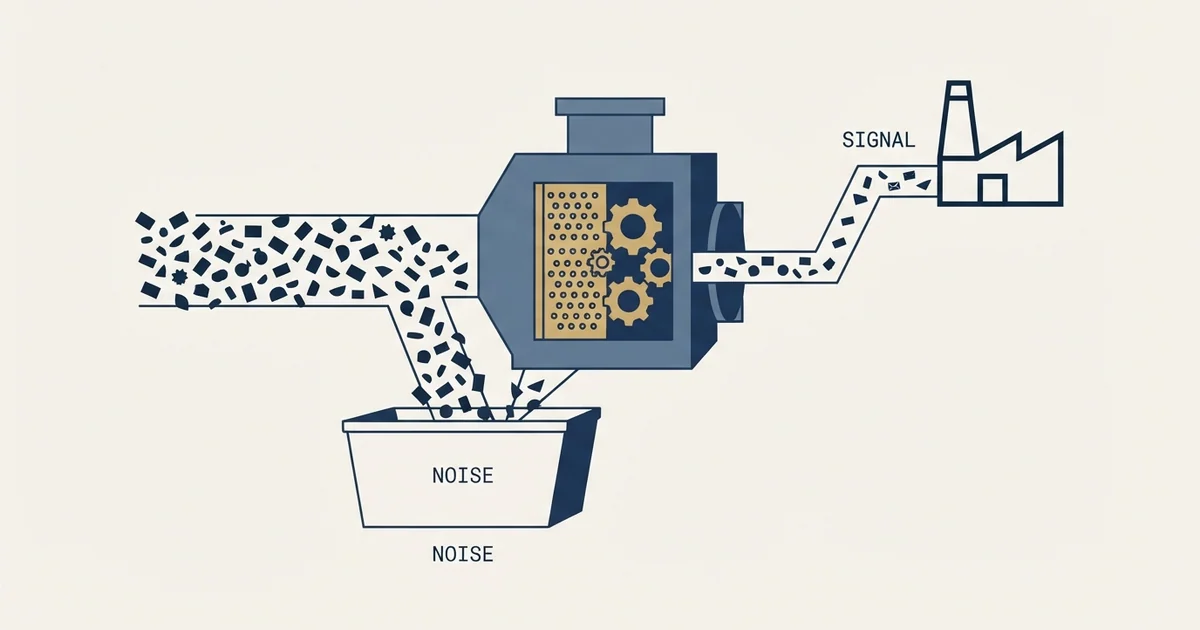
No published study measures cold email reply rates for manufacturing alone. The best public baseline is 8.5%, from Backlinko and Pitchbox's analysis of 12 million outreach emails. Treat 6 to 9% total replies as baseline, 10 to 15% as good, and above 15% as excellent, while tracking positive replies rather than total replies.
Key takeaways
- The strongest public baseline for cold outreach reply rate is 8.5%, from Backlinko and Pitchbox's analysis of 12 million outreach emails.
- No vendor has published a large-sample cold email reply rate dataset segmented specifically to manufacturing, so any manufacturing-only benchmark you see quoted is derived rather than measured.
- Adding a single follow-up raises replies by 65.8%, and three or more messages roughly doubles responses (Backlinko/Pitchbox).
- Contacting several people at one account produces 93% higher response rates than single-contact outreach, which matters in manufacturing where buying groups span plant, finance, and ownership.
- Woodpecker's analysis of 26,000+ campaigns found personalized campaigns get almost twice the reply rate of non-personalized ones, with two to three follow-ups performing best.
- Total reply rate overstates performance in manufacturing because role inboxes (info@, purchasing@) generate autoresponders and deflections, so positive reply rate should be the primary metric.
Reviewed and updated September 1, 2026
Manufacturing Cold Email Reply Rate Benchmarks (2026): What Good Looks Like
Search for a manufacturing-specific cold email reply rate benchmark and you will find a lot of confidently stated numbers with no study behind them. The honest position in 2026 is that no vendor has published a large-sample, methodologically transparent reply-rate dataset segmented to manufacturing. What does exist is a small set of real cross-industry studies, plus a set of structural facts about manufacturing inboxes that reliably push results above or below those cross-industry figures.
The most-cited real baseline comes from Backlinko's analysis with Pitchbox of 12 million outreach emails, which found that 8.5% of outreach emails receive a response. Source: Backlinko. The second is Woodpecker's analysis of over 26,000 cold email campaigns, which found that personalized campaigns achieve almost twice the reply rate of non-personalized ones, and that campaigns with two to three follow-ups produce the highest open and reply rates. Source: Woodpecker.
Everything useful about manufacturing benchmarks is built on top of those figures plus an understanding of who is actually receiving your email at a fabrication shop, an injection molder, or a tier-two automotive supplier.
The Only Defensible Way to Set a Manufacturing Benchmark
Treat 8.5% as your gravitational center rather than your target. That figure covers outreach email broadly across a very large sample, so it is the closest thing to a published population mean that anyone has released. Then adjust for what manufacturing does to that number.
The table below is a set of operating bands, derived from the public baselines above rather than measured in a manufacturing-only dataset. Use them to classify a campaign, not to quote a statistic.
| Band | Total reply rate | What it almost always means |
|---|---|---|
| Broken | Under 2% | Deliverability failure, dead contact data, or a list with no relationship to your offer |
| Underperforming | 2 to 5% | Generic message, or you are hitting the wrong role in the plant |
| Baseline | 6 to 9% | Roughly the published cross-industry figure. Functional, unremarkable |
| Good | 10 to 15% | Personalization and multi-touch sequencing are both working |
| Excellent | Above 15% | Narrow, well-defined segment with a specific, verifiable trigger |
Two cautions before you use those bands.
First, total reply rate is a vanity number in manufacturing more than in most verticals. Shared mailboxes generate autoresponders, out-of-office replies during shutdown weeks, and "please contact purchasing at this address" deflections from front-desk staff. Most sequencing platforms count all of those as replies. A campaign showing 14% total replies can easily contain a majority of non-human or non-decision responses. Track positive reply rate as your primary metric and total reply rate as a diagnostic. In most B2B programs positive replies are a minority of total replies, and in manufacturing that gap widens.
Second, open rate is close to useless as a benchmark now. Mailchimp notes that Apple's Mail Privacy Protection inflates open reporting, and its own published industry benchmark data carries that caveat. Source: Mailchimp. Manufacturing IT environments compound the problem, since conservative security gateways pre-fetch images and register phantom opens. Judge campaigns on replies and meetings booked.
What Drags Reply Rates Down in Manufacturing
Role inboxes instead of individual inboxes
A meaningful share of the contact records you buy for small and mid-sized manufacturers resolve to info@, sales@, or purchasing@. Those addresses are monitored by an office manager whose job is routing customer orders, not evaluating vendors. Sending to them produces polite deflections that register as replies and convert at close to zero. Filter role addresses out of your list before you count anything, or you will benchmark against noise.
Your buyer is not at a desk
Plant managers, production supervisors, quality managers, and maintenance leads spend most of the shift on the floor. Email gets checked in bursts: early morning before the first handoff, during lunch, and at end of day. This does not lower the ceiling on reply rate, but it stretches the response window. A campaign you evaluate at day four looks far worse than the same campaign evaluated at day fourteen. Give manufacturing sequences longer measurement windows than you would give a SaaS campaign.
Contact data decays faster than the databases admit
Manufacturing carries high turnover in supervisory roles, steady acquisition activity among mid-market shops, and a long tail of companies whose web presence has not been updated in years. Bounce rates on manufacturing lists tend to run higher than on technology lists, and every bounce is both a lost send and a deliverability tax. If your hard bounce rate is above 3%, fix that before you look at any reply number, because sender reputation is degrading in the background and suppressing the replies you would otherwise get.
Capex cycles are annual, not quarterly
Equipment, automation, ERP, and MES purchases move on capital budget calendars set months in advance. A message that lands in March against a budget locked the previous October earns a genuinely interested "not now" that never converts in-quarter. This depresses positive reply rate on any single campaign and rewards programs that run continuously rather than in bursts.
Filtering is more aggressive than you expect
Industrial firms serving defense, aerospace, or automotive customers often run strict inbound filtering driven by supply chain security requirements. Link-heavy, image-heavy, and tracking-pixel-heavy emails get quarantined. Plain-text messages with no links in the first touch consistently fare better into these environments.
- No: Role inboxes instead of individual inboxes
- No: Your buyer is not at a desk
- No: Contact data decays faster than the databases admit
- No: Capex cycles are annual, not quarterly
- No: Filtering is more aggressive than you expect
The Levers That Actually Move the Number
Each effect below comes from a published study, cited inline. These are the interventions with real evidence behind them.
| Lever | Published effect | Source |
|---|---|---|
| Add one follow-up | Replies increase by 65.8% | Backlinko |
| Send three or more messages | Roughly doubles responses versus a single send | Backlinko |
| Personalize the subject line | Response rate up 30.5% | Backlinko |
| Personalize the email body | Response rate up 32.7% | Backlinko |
| Subject line of 36 to 50 characters | Outperforms shorter lines by 32.7% | Backlinko |
| Contact several people at one account | 93% higher response rate than single-contact outreach | Backlinko |
| Multi-touch plus multi-contact combined | 160% higher response rate than a one-off single-contact email | Backlinko |
| Personalized campaigns overall | Almost twice the reply rate of non-personalized campaigns | Woodpecker |
| Two to three follow-ups | Highest open and reply rates across 26,000+ campaigns | Woodpecker |
The multi-contact finding matters disproportionately in manufacturing. Buying groups at a mid-sized plant routinely include a plant manager, a controller, an engineering lead, and an owner or general manager who signs. Reaching three of those four raises the odds that at least one forwards your message internally, which is how most manufacturing deals actually start.
What a benchmark-beating manufacturing email looks like
Subject: {{company}} second shift scrap rate

Hi {{first_name}},

Your {{plant_city}} plant runs {{shift_count}} shifts on
{{process_type}}. Shops your size usually find second and third shift
scrap runs measurably higher than first, and nobody sees it until the
monthly quality report closes.

We put inline vision checks on {{similar_operation_type}} lines so the
variance shows up in-shift instead of four weeks later.

Worth ten minutes to see whether your numbers show the same pattern?
If second shift is already clean, ignore this and I will stop.

{{sender_name}}
{{sender_title}} | {{sender_phone}}
Why this works: the subject line sits inside the 36 to 50 character range the Backlinko data favors, it names a specific operational symptom rather than a product category, it uses variables verifiable from public sources and site photos rather than guessed firmographics, it carries no links or images to trip industrial mail filters, and the close gives an explicit exit that reduces defensive non-replies.
How to Read Your Own Results Against the Benchmark

Run this sequence in order. Jumping to reply rate before checking the steps above it is the most common way teams misdiagnose a campaign.
- Step 1Check whether you have a sample
Below roughly 250 to 300 sends per variant you are reading noise.
- Step 2Check deliverability before copy
If bounces exceed 3%, your list is the issue.
- Step 3Separate total replies from positive replies
Manually classify a sample of 50 replies into positive, referral, not-now, and hard no.
- Step 4Segment before you conclude
Break results down by employee-count band, by role, and by sub-vertical.
- Step 5Compare against your own prior campaign, not the internet
Your own trailing three campaigns tell you whether you are improving.
Step one: check whether you have a sample. At 300 sends and a 7% reply rate you have 21 replies. Four replies either direction moves your rate by more than a full point. Below roughly 250 to 300 sends per variant you are reading noise. Do not rewrite copy off a 60-send test.
Step two: check deliverability before copy. Look at hard bounce rate, spam complaint rate, and whether your sending domains were properly warmed. A campaign landing in spam produces a reply rate that looks like a copy problem and is not one. If bounces exceed 3%, your list is the issue.
Step three: separate total replies from positive replies. Manually classify a sample of 50 replies into positive, referral, not-now, and hard no. A campaign with 12% total replies where nine tenths are auto-responses is performing worse than one at 5% where every reply is human.
Step four: segment before you conclude. Break results down by employee-count band, by role, and by sub-vertical (machining, plastics, food processing, metal fabrication). An aggregate reply rate hides the fact that one segment is producing 15% and three are producing 2%. The fix is usually cutting the losing segments rather than rewriting the email.
Step five: compare against your own prior campaign, not the internet. Your addressable market, offer, and sender reputation differ from every published dataset. The 8.5% public figure tells you whether you sit in a normal range. Your own trailing three campaigns tell you whether you are improving.
Minimum reporting cadence
Report weekly on sends, bounce rate, total replies, and positive replies. Report monthly on positive reply rate by segment and on meetings booked per thousand sends. That last metric is the one a manufacturing sales leader should be managed against, because it is immune to autoresponder inflation and it maps directly to pipeline.
When a Low Reply Rate Is Actually Fine
A 3% positive reply rate into a list of 200 tier-one automotive suppliers, where average contract value runs into six or seven figures, is a strong program. A 12% reply rate into 10,000 unqualified job shops that will never buy is a busy failure. Benchmark reply rate alongside deal size and total addressable market, and let the smaller, richer segment carry a lower percentage without alarm.
The corollary holds too. If your addressable market is large and your reply rate is stuck under 5% after you have fixed deliverability, added follow-ups, and personalized properly, the problem is almost always positioning rather than execution. Manufacturing buyers respond to specific operational symptoms (scrap, downtime, changeover time, lead time, labor coverage) and ignore capability statements. Rewriting the offer beats rewriting the email.
Getting Your Numbers Above Baseline
If you would rather have this built and run for you, RevenueFlow handles done-for-you cold email for B2B companies selling into manufacturing and industrial markets, covering list building, domain infrastructure, copy, and reply handling. Book a strategy call and we will read your current numbers against these bands and tell you which of the five diagnostic steps is costing you the most.
Related Reading
- Legal Services Cold Email Reply Rate Benchmarks (2026): What Good Looks Like
- Real Estate Cold Email Reply Rate Benchmarks (2026): What Good Looks Like
- Manufacturing Cold Email Benchmarks: 2026 Performance Data
If you would rather have this run for you, RevenueFlow books qualified meetings on a pay-per-meeting basis and publishes client results.
Benchmark figures cited above are drawn from published third-party studies as of July 2026. The operating bands are derived from those studies for interpretation purposes and are not themselves measured data.
Frequently asked questions.
Frequently asked questions- What is a good cold email reply rate for manufacturing?
- There is no published manufacturing-only benchmark. Anchored on the 8.5% cross-industry figure from Backlinko and Pitchbox's 12-million-email study, treat 6 to 9% total replies as baseline, 10 to 15% as good, and above 15% as excellent. Judge positive replies separately, since role inboxes at manufacturers inflate total reply counts with autoresponders and front-desk deflections.
- Why are my cold emails to manufacturers getting no replies?
- Check deliverability before copy. Manufacturing lists carry higher bounce rates because supervisory turnover and acquisitions decay contact data quickly, and hard bounces above 3% degrade sender reputation. Industrial mail gateways also quarantine link-heavy and image-heavy messages. After that, confirm you are reaching individuals rather than info@ or purchasing@ addresses, which convert at close to zero.
- How many follow-ups should a manufacturing cold email sequence have?
- Two to three follow-ups is the evidence-backed range. Woodpecker's analysis of over 26,000 campaigns found campaigns with two to three follow-ups produced the highest open and reply rates, and Backlinko's data shows one additional follow-up lifts replies by 65.8%. Space them wider than a SaaS sequence, since plant-floor buyers check email in short bursts.
- Should I measure open rate on manufacturing cold email campaigns?
- Use it as a rough deliverability signal only. Apple's Mail Privacy Protection inflates open reporting, a caveat Mailchimp attaches to its own benchmark data, and conservative industrial security gateways pre-fetch images and register phantom opens. Report positive replies and meetings booked per thousand sends instead, since neither can be inflated by automated systems.
- How many emails do I need to send before the reply rate means anything?
- Roughly 250 to 300 sends per variant. At 300 sends and a 7% reply rate you have only 21 replies, so a swing of four replies moves the rate by more than a full point. Below that volume you are reading noise, and rewriting copy off a 60-send test usually makes campaigns worse rather than better.
About the author.

Hosun Chung is COO at RevenueFlow, which builds and operates outbound revenue engines for B2B companies. Previously at Gleacher Shacklock LLP. Studied at London School of Economics.
Hosun Chung · COO
Connect on LinkedIn →Explore more.
Ready to scale your outreach?
We build GTM engines that book real meetings. See the receipts.
Related articles.
Real Estate Cold Email Reply Rate Benchmarks (2026)
No vendor publishes a real estate cold email benchmark. Here are the published reply-rate tiers that do apply, and how to read your own results.
Legal Services Cold Email Reply Rate Benchmarks (2026)
Cross-industry cold email reply rates average 3.43%. Here is what good looks like when your list is law firms, plus the levers with real data behind them.
Manufacturing Cold Email Benchmarks: 2026 Performance Data
Industry benchmark data for manufacturing cold email campaigns, including open rates, reply rates, and conversion metrics for companies targeting manufacturers, industrial operations, and supply chain leaders.
Cold Email Conversion Benchmarks: 2026 Performance Data
Complete benchmark data for cold email conversion rates from reply to meeting to opportunity. Learn what drives conversions and how to optimize your full funnel.
Education Cold Email Benchmarks: 2026 Performance Data
Industry benchmark data for education cold email campaigns, including open rates, reply rates, and conversion metrics for companies targeting K-12 schools, higher education, and corporate training organizations.
Automotive Cold Email Benchmarks: 2026 Performance Data
Industry benchmark data for automotive sector cold email campaigns, covering OEMs, suppliers, dealerships, and automotive technology with performance metrics by segment and buyer role.