Legal Services Cold Email Reply Rate Benchmarks (2026)
Cross-industry cold email reply rates average 3.43%. Here is what good looks like when your list is law firms, plus the levers with real data behind them.

No vendor publishes a legal-services-specific cold email reply rate benchmark. Using cross-industry platform data, the average reply rate is 3.43%, 5 to 10% counts as good, and above 10% is excellent. For law firm outreach, plan for 3 to 5% on median campaigns and 6 to 9% on tightly segmented, well-researched ones.
Key takeaways
- Cold email reply rates average 3.43% across industries, with 5 to 10% counted as good and 10%+ as excellent (Woodpecker platform data).
- No vendor publishes a legal-services-specific reply rate benchmark, so legal targets must be derived from cross-industry data plus known vertical friction.
- List size is the biggest published lever: campaigns under 50 contacts reply at 5.8% versus 2.1% for lists of 500 or more.
- Published benchmark data reports 8.3% replies for campaigns with three to five follow-ups versus 4.1% for single-email campaigns, with 42% of replies arriving after the first email.
- Personalized campaigns achieve almost twice the reply rate of non-personalized ones across 26,000+ analyzed campaigns.
- Keep bounce rate under 2%; law firm rosters churn constantly through lateral moves and directory data goes stale fast.
Reviewed and updated September 1, 2026
Legal Services Cold Email Reply Rate Benchmarks (2026): What Good Looks Like
Woodpecker's platform data puts the average cold email reply rate at 3.43%, treats 5 to 10% as good, and reserves "excellent" for anything above 10%. Source: Woodpecker. Those are cross-industry figures pulled from tens of thousands of campaigns across recruitment, agencies, software, and lead generation.
Now point that same machine at law firms. You are emailing people whose entire compensation model punishes unbilled minutes, whose inboxes are guarded by practice managers and legal assistants, and whose IT stack is frequently more locked down than the average enterprise. For a lazy campaign into legal, the cross-industry median functions as a ceiling rather than a starting point.
This article lays out what a realistic reply rate looks like when your target list is law firms and in-house legal departments, which structural factors drag the number down, which levers have published evidence behind them, and how to judge your own dashboard against all of it.
If you are reading this as one of the professional-services firms it is written for, the persona-specific version of this playbook lives in our guide to outbound for professional-services firms.
The Honest Caveat: No Vendor Publishes a "Legal" Reply Rate
Belkins, Woodpecker, Instantly, Smartlead, and Lavender all publish aggregate cold email data. None of them publish a reply-rate benchmark segmented specifically to legal services buyers. Any article that hands you a precise "law firms reply at 4.7%" figure is either quoting a private dataset it will not name or making it up.
What you can do honestly is build a legal benchmark from three published variables that are known to move reply rate, then adjust for the vertical's structural friction. That is the approach below. Every number carries its source, and every projection is labeled as a projection.
Headline Benchmark Ranges

Start with the cross-industry baseline, because it is the only measured ground truth available.
| Metric | Platform average | Good | Excellent |
|---|---|---|---|
| Reply rate | 3.43% | 5 to 10% | 10%+ |
| Open rate | 27.7 to 44% | 40 to 60% | 65%+ |
| Bounce rate | 5.1% | Below 2% | Below 1.5% |
Source: Woodpecker
For a broader outreach population, Backlinko and Pitchbox analyzed 12 million outreach emails and found that only 8.5% received a response, counting the full sequence rather than a single send. Source: Backlinko.
Here is how I would set expectations for a legal-services campaign, framed as planning targets derived from that data rather than measured vertical benchmarks:
| Campaign quality | Total reply rate (projected) | Positive reply rate (projected) |
|---|---|---|
| Blast: bought list, no research, one send | Below 2% | Under 0.5% |
| Median: light personalization, generic angle | 3 to 5% | 1 to 1.5% |
| Good: tight segment, role-specific angle | 6 to 9% | 2 to 3% |
| Great: sub-100 lists, researched openers, verified contacts | 10%+ | 3 to 5% |
The positive-reply column matters more than the total. In legal, a large share of replies are "please remove me," "send this to our procurement portal," or a paralegal confirming that the partner does not evaluate vendors by email. A 9% total reply rate that produces zero booked calls is a worse campaign than a 5% rate that produces four.
What Drags Reply Rates Down in Legal Services
Six structural factors show up repeatedly when outreach into law firms underperforms.
The billable hour taxes every reply. A partner billing at $600 an hour is being asked to spend a non-billable unit reading your email. Every other B2B buyer has slack time. Many lawyers, structurally, do not. Copy that requires interpretation gets deleted rather than parsed.
Firm-level inboxes swallow volume. Legal directories, firm websites, and most scraped data sources are heavy on info@, contact@, and newbusiness@ addresses. These are role accounts, and they behave badly in two ways: they rarely produce a decision-maker reply, and mailbox providers treat sustained cold volume to role accounts as a spam signal. A list that is 30% role accounts will depress reply rate and deliverability simultaneously.
Decision authority is genuinely diffuse. Depending on firm size, the person who can say yes may be the managing partner, the firm administrator, the COO, the director of legal operations, the IT director, or a practice group chair. Small firms concentrate all of this in one overloaded person. Mid-size and large firms distribute it across people who each hold a veto and none of whom hold a budget alone. Sending the same email to all of them earns polite silence.
Security posture is above average. Law firms handle privileged material and are a known target for business email compromise. Many run aggressive filtering, external-sender banners, link rewriting, and attachment stripping. A cold email with two tracked links and an embedded image is materially more likely to be quarantined here than at a 30-person SaaS company.
Vendor fatigue is real and specific. Practice management, e-discovery, document automation, billing, intake, CRM, AI drafting, and now AI agent tooling have all pitched the same 200,000-ish US firms repeatedly. Legal buyers have heard "save your associates 10 hours a week" enough times that the phrase itself now reads as noise.
Calendars are adversarial. Trial dates, filing deadlines, discovery cutoffs, and fiscal-year-end all create dead zones you cannot see from the outside. A sequence that runs three touches in eight days across a trial week is simply wasted.
The Levers With Published Evidence Behind Them
These are the four changes with actual data attached, ranked by the size of the published effect.
1. Shrink the list
Woodpecker's data on list size is the single most actionable finding for legal outreach:
| Contacts per campaign | Reply rate |
|---|---|
| Under 50 | 5.8% |
| 50 to 200 | 4 to 5% |
| 200 to 500 | ~3% |
| 500 to 1,000+ | 2.1% |
Source: Woodpecker
The reply rate at sub-50 lists is roughly 2.8x the rate at 500+ lists. In legal this effect should be even stronger, because the segments are so distinct. "Personal injury firms, 5 to 20 attorneys, running paid intake" and "Am Law 200 litigation practice groups" are different products, different pain, different words. Bundling them into one 800-contact campaign guarantees mediocre copy for both.
2. Personalize the opener and the subject
Woodpecker's analysis of 26,000+ campaigns found personalized campaigns achieved almost twice the reply rate of non-personalized ones, with advanced personalization (custom snippets rather than merge tags) outperforming basic personalization. Source: Woodpecker.
Backlinko's 12-million-email study found personalized subject lines lifted response rate by 30.5% and personalized message bodies by 32.7%. Source: Backlinko.
For legal, the personalization that works is professional rather than personal. Reference a practice area expansion, a lateral hire announcement, a recent verdict or settlement in a public docket, a state bar CLE the person presented, or a specific line from the firm's own site describing how it handles intake. Referencing someone's alma mater or marathon time reads as scraped, because it was.
Where we differ from standard practice
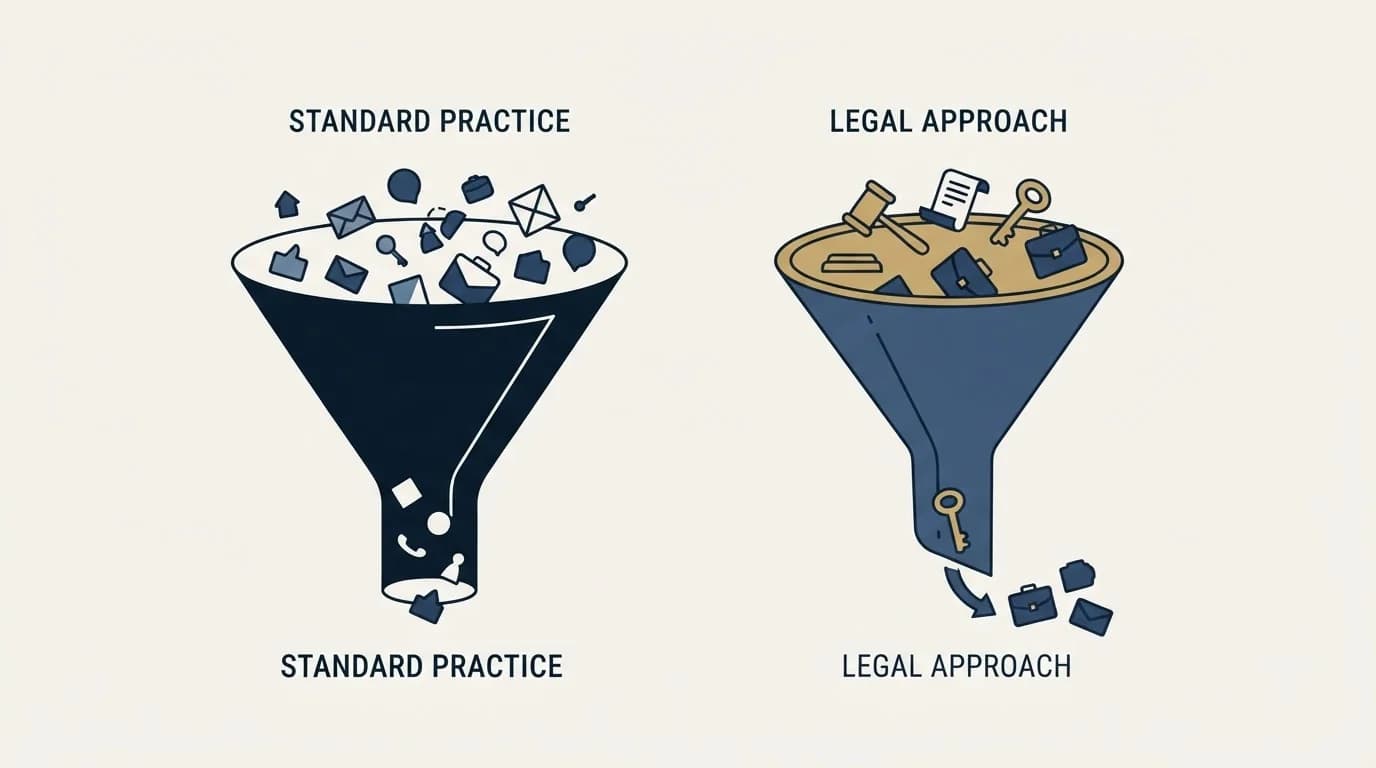
Much of the advice on this page reflects how outbound is commonly run. We run it differently, and since this page sits on our site it is worth saying where the difference is and what it costs us.
- A sequence of messages to each prospect over several weeks
- Later messages often land in the same email thread
- Every contact is reached more than once, so a distracted reader gets another chance
- The later messages go only to people who did not answer the first
- Reputation cost accrues on the sending domain across everything else it sends
- One message, then that campaign is finished for that contact
- No thread replies and no bumps
- A non-responding audience becomes a new campaign with a genuinely different premise, not a reminder
- More of the work moves into targeting and into the one message
- We reach each contact less often, and that is the cost we accept
The reasoning is mechanical rather than moral. A follow-up arrives underneath a message the recipient has already seen and chosen not to answer, so it is delivered to the population most likely to mark it as spam, and the reputation cost of that lands on the sending domain across every campaign running on it. We set that cost against the replies a sequence recovers and decided the trade was not worth it. The full argument, with the numbers from our own campaigns, is in why we stopped using follow-ups.
3. Read the follow-up research before you copy it
Woodpecker reports first-email-only campaigns at 4.1% reply rate versus 8.3% for campaigns with three to five follow-ups, with 58% of replies coming from the initial email and 42% from follow-ups. Source: Woodpecker. Backlinko found a single follow-up boosts replies by 65.8%, and that multi-attempt sequences across multiple contacts at the same account lift response rates by 160%. Source: Backlinko.
Woodpecker's campaign analysis found two to three follow-ups delivered optimal open and reply rates. Source: Woodpecker. Four to seven total touchpoints is the practical range; past that, unsubscribe and complaint risk climbs.
For legal specifically, the interval matters more than the count. A message that lands during a trial week is lost whatever else you send, which is an argument for timing the next campaign around the docket rather than for compressing more into ten days.
4. Fix the deliverability floor before touching copy
Average bounce rate on the Woodpecker platform is 5.1%, with good performance under 2% and excellent under 1.5%. Source: Woodpecker. If you are bouncing above 3% into a legal list, you have a data problem that no amount of copy work will fix. Law firm rosters churn constantly through lateral moves, and directory data goes stale fast.
Note also that open rate has become a weak signal. Apple Mail Privacy Protection inflates it, so treat the 27.7 to 44% average as directional only. Source: Woodpecker. Judge campaigns on replies and booked calls.
A Reference Email That Respects the Constraints
Subject: {{firm_name}} intake after hours

Hi {{first_name}},

Saw {{firm_name}} added two associates to the {{practice_area}} group
this quarter, which usually means intake volume is already ahead of
capacity.

Most {{practice_area}} firms your size lose signed cases on callback
speed rather than on quality of representation. We handle the after-hours
and overflow intake for {{peer_firm_type}} firms so the callback happens
inside 10 minutes instead of the next business morning.

Worth 12 minutes to see whether your current intake gap is costing you
anything? If your callback times are already tight, say so and I will
close the file.

{{sender_name}}
{{sender_title}} | {{phone}}
Why this works: the trigger (associate hires) is public, professional, and implies a real operational condition. The value claim is framed as lost matters rather than saved hours, which maps to how firms actually think about revenue. The ask is a specific short duration, and the explicit exit ("say so and I will close the file") gives a busy lawyer a five-second reply option, which raises total replies and gives you a clean disqualification.
How to Read Your Own Numbers Against the Benchmark
Reply rate is a composite metric. When it is low, the fix depends entirely on which upstream number is broken. Use this diagnostic order.
| Symptom | Likely cause | Fix |
|---|---|---|
| Bounce above 3% | Stale or unverified list, heavy role accounts | Re-verify, strip info@ and contact@, rebuild source |
| Bounce fine, replies under 1% | Landing in spam or promotions | Check domain auth, warmup age, link count, sending volume per mailbox |
| Replies 1 to 3%, mostly negative | Wrong segment or wrong role | Narrow the segment, re-map the buying committee |
| Replies 3 to 5%, few positive | Generic value proposition | Rewrite around one specific, expensive problem |
| Replies 6%+, few meetings | Weak call to action or wrong ask | Reduce commitment size, offer async alternative |
| Good replies, no pipeline | Fit problem upstream of email | Revisit ICP before adding volume |
Two measurement disciplines separate teams that improve from teams that guess.
Track positive reply rate separately. Tag every reply as interested, referral, not now, or no. Total reply rate is a vanity number in a vertical where "remove me" is a common response. Interested plus referral is the number that predicts revenue.
Give each segment enough volume to read. At a 5% reply rate, a 100-contact campaign produces about five replies. That is not enough to distinguish a 4% campaign from a 7% campaign. Run each segment to at least 300 to 400 contacts before drawing conclusions, while keeping individual campaign sends under the 200-contact threshold where Woodpecker's data shows reply rates start sliding. Run multiple small campaigns per segment and aggregate the results.
Work backward from meetings. If you need eight qualified legal-services conversations a month, and you are running a good campaign at 7% total reply with roughly a third positive, that is about 2.3% positive replies, of which perhaps half convert to a booked call. Eight meetings implies roughly 700 well-researched contacts touched per month. Teams that skip this arithmetic either under-build the list or over-promise the pipeline.
What Actually Separates the 3% Campaigns From the 10% Campaigns
Across the published data, the pattern is consistent. Smaller lists beat larger ones. Researched openers beat merge tags. Four to six patient touches beat one send. Clean data beats clever copy. None of these are legal-specific insights, but legal punishes their absence harder than most verticals, because the audience has less time, more filtering, and more vendor fatigue than almost any other B2B buyer.
If your legal outreach is sitting at 2% and you want it at 7%, the order of operations is: verify and de-role the list, cut it into segments small enough that one email fits all of them, rewrite the opener around a public trigger, extend the sequence to five touches over six weeks, and only then start testing subject lines.
RevenueFlow builds and runs these campaigns end to end, including the list construction and inbox infrastructure that determine most of the outcome before a single word gets written. If you would rather have this done for you than rebuild the whole stack in-house, book a strategy call and we will map the segment and the math for your offer.
Related Reading
- Real Estate Cold Email Reply Rate Benchmarks (2026): What Good Looks Like
- Legal Cold Email Benchmarks: 2026 Performance Data
If you would rather have this run for you, RevenueFlow books qualified meetings on a pay-per-meeting basis and publishes client results.
Benchmark figures verified as of July 2026. Reply rate ranges labeled "projected" are planning estimates derived from the cited cross-industry data, not measured legal-vertical benchmarks.
Frequently asked questions.
Frequently asked questions- What is a good cold email reply rate when selling to law firms?
- Plan for 3 to 5% on a median campaign and 6 to 9% on a tightly segmented one with researched openers. Above 10% is excellent. These targets derive from cross-industry benchmarks where the platform average is 3.43% and 5 to 10% is considered good, adjusted for the extra friction legal buyers create.
- Why are reply rates lower when emailing lawyers?
- Billable-hour economics make every non-billable minute expensive, so lawyers delete anything requiring interpretation. Firm lists are heavy on info@ and contact@ role accounts that rarely reach decision-makers. Law firms also run aggressive email security because they handle privileged material, and buying authority is split across managing partners, administrators, and IT directors.
- Do follow-ups improve reply rates when emailing law firms?
- Published benchmark data reports 8.3% replies for campaigns with three to five follow-ups versus 4.1% for single-email campaigns, and 65.8% more replies from a single follow-up. Those figures measure common market practice, not ours: we send one message per campaign and no bumps. What legal outreach actually needs is patience with the calendar, since a message arriving during a trial or filing week is gone regardless of how many follow it.
- Should I measure open rate on cold emails to law firms?
- Treat it as directional only. Apple Mail Privacy Protection inflates opens, and the reported average range of 27.7 to 44% is too noisy to act on. Judge legal campaigns on bounce rate first, then total reply rate, then positive reply rate, then booked calls. Positive replies are the only number that reliably predicts pipeline.
- How many contacts do I need to book eight meetings a month with legal buyers?
- Roughly 700 well-researched contacts per month. At a good 7% total reply rate with about a third of replies positive, that is 2.3% positive replies, and roughly half of those convert to a booked call. Under-building the list is the most common reason legal outreach targets get missed.
About the author.

Hosun Chung is COO at RevenueFlow, which builds and operates outbound revenue engines for B2B companies. Previously at Gleacher Shacklock LLP. Studied at London School of Economics.
Hosun Chung · COO
Connect on LinkedIn →Explore more.
Ready to scale your outreach?
We build GTM engines that book real meetings. See the receipts.
Related articles.
Real Estate Cold Email Reply Rate Benchmarks (2026)
No vendor publishes a real estate cold email benchmark. Here are the published reply-rate tiers that do apply, and how to read your own results.
Cold Email Conversion Benchmarks: 2026 Performance Data
Complete benchmark data for cold email conversion rates from reply to meeting to opportunity. Learn what drives conversions and how to optimize your full funnel.
Education Cold Email Benchmarks: 2026 Performance Data
Industry benchmark data for education cold email campaigns, including open rates, reply rates, and conversion metrics for companies targeting K-12 schools, higher education, and corporate training organizations.
Automotive Cold Email Benchmarks: 2026 Performance Data
Industry benchmark data for automotive sector cold email campaigns, covering OEMs, suppliers, dealerships, and automotive technology with performance metrics by segment and buyer role.
Real Estate Cold Email Benchmarks: 2026 Performance Data
Comprehensive benchmark data for real estate cold email campaigns, including open rates, reply rates, and conversion metrics for companies targeting brokerages, property managers, developers, and real estate investors.
Fintech Cold Email Benchmarks: 2026 Performance Data
Comprehensive benchmark data for fintech cold email campaigns, including open rates, reply rates, and conversion metrics specific to financial technology companies targeting banks, financial institutions, and businesses.