Monday CRM vs RocketReach: Cross-Category Comparison
Compare Monday CRM (crm platform) and RocketReach (data enrichment tool) side by side. Understand how these tools fit different stages of your sales workflow.
Monday CRM and RocketReach sit at different points of one outbound run, so most teams end up with both and the real question is which to buy first. Monday CRM tracks what happens after somebody answers, at from $12/mo per seat. RocketReach produces the row in the first place, from $69/mo. Buy whichever gap you can name today.
Key takeaways
- Monday CRM is priced per seat and follows headcount, while RocketReach is priced on consumption and follows how much data the team uses.
- Buy RocketReach first when the pipeline is empty and Monday CRM first when the pipeline is full and leaking, because those are different bills.
- The two feature lists sit in genuinely different categories here, and the one place they meet is RocketReach writing into Monday CRM, which is plumbing rather than competition.
- Monday CRM's pricing page serves this connection in pounds across four captures and carries no dollar figure at all, so its dollar ladder is carried forward unchanged.
Reviewed and updated August 29, 2026
Monday CRM vs RocketReach: Cross-Category Comparison
A rep works through a conference attendee list on a Tuesday afternoon, pulls ninety addresses, and hits the lookup ceiling at sixty two. The board that was supposed to catch what happened next has one column called Contacted, and everything anybody replied to is sitting in it. Two failures, two separate bills, and the Monday CRM against RocketReach decision is really about which of them is costing more this quarter.
The Short Answer
Buy the side that is losing you money this month. If conversations are dying because nobody can see what stage a deal reached or who owns it, Monday CRM is the purchase, from a carried-forward $12/mo per seat on an annual commitment. If the list runs out, the addresses bounce, or the right person at the account was never found, RocketReach is the purchase, from $69/mo on its monthly tab, after five free lookups on a free account.
Teams running outbound at volume end up with both, so the order matters more than the choice.
Why Compare These Two Tools?
Data enrichment tools find and verify contact information, while CRMs organize and track those contacts through the sales process. Teams evaluate whether their CRM's built-in data features are sufficient or if a dedicated enrichment tool delivers better data quality.
Monday CRM is a CRM platform focused on customer relationship management. A flexible CRM built on the monday.com Work OS platform, offering highly customizable pipelines, automations, and dashboards. Ideal for teams that want a CRM tightly integrated with project management and collaboration workflows, with a visual and intuitive interface.
RocketReach is a data enrichment tool focused on B2B lead data and contact enrichment. Global contact and company search platform with 700M+ profiles, verified emails, direct dials, and org chart intelligence.
Where Each Tool Fits in Your Workflow
- Step 1Lead sourcing and data
RocketReach covers B2B lead data and contact enrichment, from $69/mo after 5 free lookups on a free account.
- Step 2Pipeline and deal tracking
Monday CRM covers customer relationship management, from $12/mo per seat on an annual commitment.
| Aspect | Monday CRM | RocketReach |
|---|---|---|
| Category | CRM Platform | Data Enrichment Tool |
| Workflow Stage | Pipeline and deal tracking | Lead sourcing and data |
| Primary Focus | Customer relationship management | B2B lead data and contact enrichment |
| Starting Price | $12/mo | $69/mo |
| Features Listed | 8 | 10 |
| Integrations | 8 | 6 |
What Each Side Does in a Cold Outbound Run
Neither of these two tools sends the cold volume, which puts both upstream of the only part a prospect ever sees.
RevenueFlow sends one message per campaign. There are no bump messages and no thread replies, so the first email is the only email that campaign will send. Everything rides on the row: whether the person is the right person, whether the address is real, and whether the company was worth writing to. That is the work RocketReach is bought for.
A wrong address is not a wasted send. It is a hard bounce on shared sending inventory, and the sender reputation damage lands on every client mailing from those domains rather than on the campaign that caused it. That is why list hygiene is the lever worth paying for: a data tool earns its price in bounces avoided before it earns anything in replies.
Monday CRM picks the run up at the other end. Somebody answers, and from there the question is what stage the conversation reached, who owns it and what was agreed. A meeting counts once it is held and meets the qualification criteria agreed in writing before launch, and that record is what a spreadsheet stops being able to hold once there are more live deals than one person can carry in their head.
Pricing Comparison

Monday CRM Pricing
| Plan | Price |
|---|---|
| Basic | $12/mo |
| Standard | $17/mo |
| Pro | $28/mo |
| Enterprise | Contact Sales |
Source: Monday CRM Pricing
Those dollar figures are carried forward from the live page and were not re-checked. The page itself renders in pounds on this connection, with a yearly column that saves 18 percent against the monthly one, so read every figure above as the annual-commitment rate per seat.
RocketReach Pricing
| Plan | Price | Lookups | Billing column |
|---|---|---|---|
| Free account | Free | 5 free lookups | No card required |
| Essentials | $69/mo | 100 Lookups Per Month | billed monthly |
| Pro | $119/mo | 250 Lookups Per Month | billed monthly |
| Ultimate | $209/mo | 1,000 Lookups Per Month | billed monthly |
| Essentials | $33/mo | 1,200 exports per year | $399 billed annually |
| Pro | $75/mo | 3,600 exports per year | $899 billed annually |
| Ultimate | $142/mo | 20,000 exports per year | $1,699 billed annually |
RocketReach serves its monthly and annual ladders as two separate documents, and the allowance changes with the tab rather than only the rate. Reading one tab's price against the other tab's allowance produces a combination no visitor ever sees. The free row is the page's own answer to whether RocketReach is free: free accounts get 5 free lookups with no card.
Source: RocketReach Pricing
Pricing Context
A straight price comparison between these two is close to meaningless, because they are billed on different axes. Monday CRM opens at $12/mo per seat on Basic, and that line follows headcount. RocketReach opens at $69/mo on its monthly tab and $33/mo on its annual one, which is a different plan rather than the same plan discounted. That line follows consumption instead, so a five-person team doubling its sending volume pays the same for the CRM and materially more for the data. The next section works that through on an invented team.
What the Pair Costs at a Realistic Team Size
The numbers below are invented: five people who want 500 verified contacts a month, which is 6,000 a year. The arithmetic is the point rather than the total.
Monday CRM publishes no free tier on the page that was read, so all five seats are paid. Five Monday CRM seats at $12 a month is $720 a year.
| Illustrative line item | Cost | Basis |
|---|---|---|
| Monday CRM Basic, five seats | $720/yr | $12/mo per seat, the annual-commitment rate carried forward from the live page |
| RocketReach Ultimate, monthly tab | $2,508/yr | 1,000 Lookups Per Month covers 500 with room |
| RocketReach Ultimate, annual tab | $1,699/yr | 20,000 exports per year covers 6,000 with room |
| Illustrative pair total | $2,419/yr | the two cheapest rows that actually cover the volume |
RocketReach's monthly tab lists Ultimate at $209/mo, and 500 lookups a month sits inside its "1,000 Lookups Per Month" allowance while the tier below it, at "250 Lookups Per Month", does not. Twelve months of that RocketReach rate is $2,508.
RocketReach's annual tab lists the same tier at $142/mo, "$1,699 billed annually", against "20,000 exports per year". The illustrative 6,000 fits inside that and Pro's "3,600 exports per year" does not, so the same volume costs $1,699 rather than $2,508. That $809 gap comes entirely from which tab the plan was bought on.
The two lines scale on different axes, which is the thing worth taking from an invented number. Doubling the team doubles the CRM line and leaves the data line alone. Doubling the sending volume does the reverse.
Feature Highlights
Monday CRM Key Capabilities (CRM Platform)
- Customizable deal pipeline boards
- Lead and contact management
- Sales automations and workflows
- Email tracking and templates
- Activity management and logging
- Customizable dashboards and reporting
- Document management
- Integrated project management capabilities
RocketReach Key Capabilities (Data Enrichment Tool)
- 700M+ professional profiles
- Verified email addresses and phone numbers
- Advanced people and company search
- Chrome and Edge browser extensions
- Built-in email verification
- Autopilot automated list building
- Bulk lookups and enrichment
- Technographics and firmographics
- Org charts and company news
- Intent data
Feature Overlap
A caution about reading any feature comparison. Two lists differing supports the claim that one vendor lists something and the other does not. It never supports a claim that only one of them can do it, because a feature list is a marketing document and absence from one is not evidence of absence from the product.
On this pair the two lists genuinely do sit in different categories, and the boilerplate claim of minimal overlap holds. Monday CRM's list carries no contact enrichment entry at all, and RocketReach's carries nothing that writes or sends the outbound message, so there is no job here that both of them are bought to do.
The one place they meet is an integration rather than an overlap: RocketReach writes into Monday CRM, which is CRM enrichment and is the whole point of owning both. Read that as plumbing, not as competition.
Integration Ecosystem
Monday CRM Integrations
Monday CRM connects with: Gmail, Microsoft Outlook, Slack, Zoom, Zapier, Google Workspace, Microsoft Teams, DocuSign.
RocketReach Integrations
RocketReach connects with: Salesforce, HubSpot, Outreach, SalesLoft, Bullhorn, Zapier.
Shared Integrations
Both tools integrate with: Zapier. This shared ecosystem means they can work together in your tech stack.
Do You Need Both, and in Which Order?
A team asking this usually owns one of them already, so it is an ordering question rather than a choice.
Buy RocketReach first when the pipeline is empty. A CRM with nothing in it is an expensive filing cabinet, and stage discipline cannot create a conversation nobody started. Buy Monday CRM first when the pipeline is full and leaking: two people writing to the same account in a fortnight, or a live deal count that depends on who you ask.
The checklist is about symptoms rather than features, because a feature list cannot tell you which of these two bills to pay first.
- Depends: Reps run out of people to write to before they run out of hours
- Depends: Sends come back as hard bounces often enough that somebody has noticed
- Depends: The right contact at a target account is missing and nobody can find them
- Depends: Two reps have written to the same company inside a fortnight
- Depends: Nobody can say what stage a named deal is at without asking its owner
- Depends: What was agreed on a call lives in one person's inbox
- Depends: The live deal count depends on who you ask
The first three point at the data side and the last four at the pipeline side. A team marking most of both should still buy one first and let the second be the purchase the first made unavoidable.
When to Choose Monday CRM
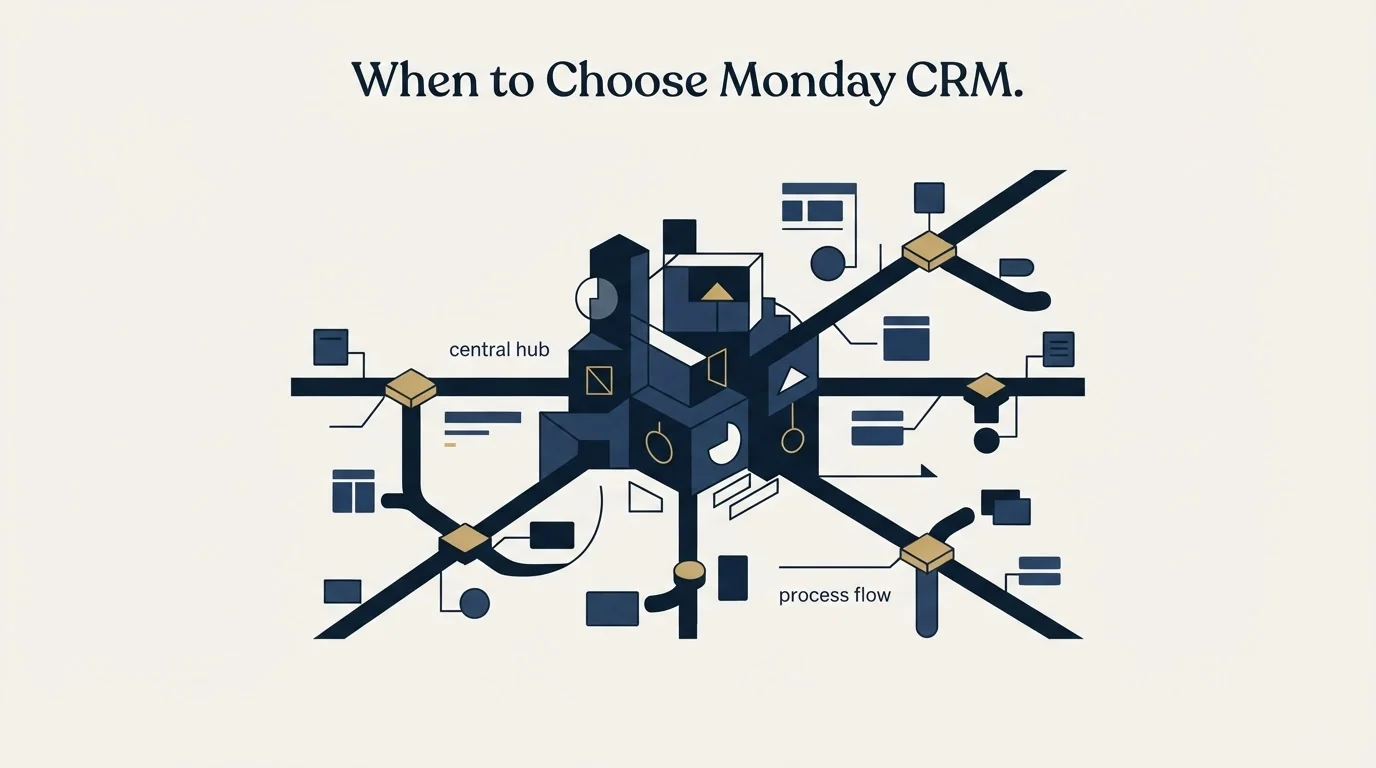
Choose Monday CRM when the bottleneck is what happens after somebody answers: stage visibility, ownership, and a record of what was agreed that survives one person being away.
When to Choose RocketReach
Choose RocketReach when the bottleneck is upstream of any of that: not enough of the right people to write to, or addresses that do not survive contact with a mail server.
- Your biggest gap is in pipeline and deal tracking
- You already have a solid data enrichment tool and need specialized customer relationship management capabilities
- You want an affordable entry point ($12/mo)
- Your team's primary bottleneck is customer relationship management
- Your biggest gap is in lead sourcing and data
- You already have a CRM platform and need better B2B lead data and contact enrichment
- You need enterprise-grade B2B lead data and contact enrichment features
- Your team's primary bottleneck is B2B lead data and contact enrichment
Rolling the Second Tool In Without Breaking the First
The expensive version goes: buy RocketReach, push everything it finds into Monday CRM on day one, then spend a month working out which system owns a phone number when the two disagree. The cheap version takes a fortnight and starts away from both tools.
Write down which system owns which field before a single record moves. Company name, job title and phone number are the three that go wrong, because both sides write all three happily. A field with two owners is a field with no owner.
Then settle the matching key. Email address is the honest default: it is unique and a person carries it between jobs. Company name looks obvious and quietly creates duplicates, since one company is written six ways across a database of any size. Push fifty records through first and read them by hand, which is enough to see the match rate and cheap enough to fix.
Last, decide how often the data gets refreshed and who notices when it has not. Data decay is the quiet one: a list bought a year ago is materially worse than one bought last month, and nothing in either tool says so unprompted.
- Day 1Agree field ownership
Write down which system owns company name, job title and phone number, before any record moves.
- Day 2Pick the matching key
Email address by default. Company name creates duplicates at any real database size.
- Day 3Move one segment
Fifty records, one segment, nothing else.
- Day 5Read all fifty by hand
Count how many carry a usable direct email and how many matched the wrong record.
- Day 10Fix the mapping, then widen
Repair what the read found before the rest of the data moves.
- Day 14Set the refresh schedule
Decide how often records are re-checked and who owns noticing when they are not.
Using Both Together

Many sales teams use both a CRM platform and a data enrichment tool as part of their complete workflow. Monday CRM handles pipeline and deal tracking while RocketReach covers lead sourcing and data.
Since both tools integrate with Zapier, connecting them in your workflow is straightforward.
The Decision Shortcut
Count the last ten deals that went quiet and sort them into two piles: wrong person written to, or right person answered and nothing happened next.
If the first pile is bigger, RocketReach is the purchase and the CRM question can wait a quarter. If the second is bigger, Monday CRM is the purchase and a bigger database will not touch the problem. If the ten split evenly, start with the cheaper of the two and count again a quarter later. Ninety days of one tool argues for the second better than any comparison page can.
How These Figures Were Checked
Every figure here was searched for, character for character, in a dated copy of the vendor's own page, or it is carried forward from the live page and labelled that way. None of it came from a review site or a third-party summary.
Monday CRM's pricing page serves this connection in pounds. Four captures carry twelve GBP figures each and no dollar figure at all, so its dollar ladder is carried forward from the live page unchanged. The tier names are not carried forward: Basic, Standard, Pro and Enterprise are all on the page that was read.
RocketReach's figures were re-read against its own pricing page and every one of them is on it.
Where a page could not be re-read, the existing figures are kept as they were rather than replaced with a guess, and the sentence around them says so. A price nobody can check is worth less than a price anybody can.
Related Reading
- Best Monday CRM Alternatives in 2026
- Best RocketReach Alternatives in 2026
- Monday CRM vs Salesforce: CRM Platform Comparison
- HubSpot CRM vs Monday CRM: CRM Platform Comparison
- Apollo.io vs RocketReach: Data Enrichment Tool Comparison
If you would rather have this run for you, RevenueFlow books qualified meetings on a pay-per-meeting basis and publishes client results.
Pricing and features are taken from the vendors' own pages. Verify current terms with the vendor before relying on them.
Frequently asked questions.
Frequently asked questions- Can I use Monday CRM and RocketReach together?
- Yes, and most teams running outbound at volume do. RocketReach produces and verifies the row before anything is sent, and Monday CRM holds what happens after somebody answers. Agree which system owns company name, job title and phone number before any record moves, then push fifty records through first and read them by hand.
- Which one should I buy first, Monday CRM or RocketReach?
- Count the last ten deals that went quiet. If most died because the wrong person was written to, buy RocketReach and let the CRM question wait a quarter. If most died because the right person answered and nothing happened next, buy Monday CRM, because a bigger database will not touch that problem.
- What do Monday CRM and RocketReach cost for a five-person team?
- On an invented team of five wanting 500 verified contacts a month, Monday CRM Basic is five seats at $12 a month, or $720 a year. RocketReach Ultimate covers it at $209/mo on the monthly tab or $1,699 billed annually, and the annual tab is the cheaper route by $809. Those two lines scale on different axes, so doubling the team moves one and doubling the sending volume moves the other.
- Are these Monday CRM prices current?
- Monday CRM's pricing page serves this connection in pounds across four captures and carries no dollar figure at all, so its dollar ladder is carried forward unchanged. Its tier names are confirmed: Basic, Standard, Pro and Enterprise are all on the page that was read.
About the author.

Tim Carden is CMO / CTO at RevenueFlow, which builds and operates outbound revenue engines for B2B companies. Studied at McGill University.
Tim Carden · CMO / CTO
Connect on LinkedIn →Explore more.
Ready to scale your outreach?
We build GTM engines that book real meetings. See the receipts.
Related articles.
AroundDeal vs Salesflare: Data Enrichment Tool vs CRM Platform Comparison
Compare AroundDeal (data enrichment tool) and Salesflare (CRM platform) side by side. See pricing, features, and integrations to decide which one, or both, your stack needs.
Evaboot vs Microsoft Dynamics 365 Sales: Data Enrichment Tool vs CRM Platform Comparison
Compare Evaboot (data enrichment tool) and Microsoft Dynamics 365 Sales (CRM platform) side by side. See pricing, features, and integrations to decide which one, or both, your stack needs.
Agile CRM vs LeadIQ: CRM Platform vs Data Enrichment Tool Comparison
Compare Agile CRM (CRM platform) and LeadIQ (data enrichment tool) side by side. See pricing, features, and integrations to decide which one, or both, your stack needs.
Anymail Finder vs Pipeline CRM: Data Enrichment Tool vs CRM Platform Comparison
Compare Anymail Finder (data enrichment tool) and Pipeline CRM (CRM platform) side by side. See pricing, features, and integrations to decide which one, or both, your stack needs.
AroundDeal vs Maximizer: Data Enrichment Tool vs CRM Platform Comparison
Compare AroundDeal (data enrichment tool) and Maximizer (CRM platform) side by side. See pricing, features, and integrations to decide which one, or both, your stack needs.
Breakcold vs Bulk Email Checker: CRM Platform vs Data Enrichment Tool Comparison
Compare Breakcold (CRM platform) and Bulk Email Checker (data enrichment tool) side by side. See pricing, features, and integrations to decide which one, or both, your stack needs.