Salesloft vs Woodpecker: Cross-Category Comparison
Compare Salesloft (sales engagement platform) and Woodpecker (cold email platform) side by side. Understand how these tools fit different stages of your sales workflow.
Salesloft publishes no price at all, while Woodpecker publishes $7.00 per 100 contacted prospects at its entry volume. For a cold outbound run the order is usually Woodpecker first, because it owns the mailboxes and the send, then Salesloft once reply volume across several reps makes orchestration the real bottleneck rather than delivery.
Key takeaways
- Salesloft's pricing page names two packages, Advanced and Elite, puts a Request a Demo button on both, and publishes no figure against either.
- Woodpecker prices contacted prospects at $7.00 per 100 at its entry volume and derives the monthly email ceiling by multiplying that figure by 16.
- As a calculator. The published entry rate is $7.00 per 100 contacted prospects, and the page derives the rest from the volume chosen: monthly emails are that number multiplied by 16 and storage is that number multiplied by 4.
- Woodpecker's pricing page publishes warmup, rotation or a send ceiling and Salesloft's publishes none of them, so the sending gap in a cold run is closed by Woodpecker.
Reviewed and updated August 29, 2026
Salesloft vs Woodpecker: Cross-Category Comparison
Woodpecker's pricing page is a calculator. Pick a contacted-prospect volume and it multiplies by 16 to set the monthly email ceiling and by 4 to set storage, starting at $7.00 per 100 contacted prospects. Salesloft's pricing page is a pair of package names with a Request a Demo button under each.
That contrast is the comparison in miniature. One tool is bought by the volume of mail a team intends to send, and the other by the shape of the revenue workflow a team intends to run, and very few teams need both on day one.
Why Compare These Two Tools
Email sending platforms are bought to get cold mail delivered at volume, while sales engagement platforms are bought to run the whole multi-channel workflow around a rep: email, phone and social, plus the pipeline work behind it. The comparison comes down to which of those two gaps is currently costing the team more, and whether closing one makes the other cheaper or more expensive.
Salesloft is an AI-powered revenue workflow platform offering cadence automation, conversation intelligence, deal management and forecasting for sales teams.
Woodpecker is a cold email automation platform with prospect-based pricing, unlimited email accounts and built-in email warmup.
Where Each Tool Fits In Your Workflow
- Step 1Sending
Woodpecker owns the mailboxes and the send. Its page meters contacted prospects a month, with everything else derived from that number.
- Step 2Replies
A reply arrives in a real inbox and has to be read, answered and routed to a person.
- Step 3Orchestration
Salesloft owns what happens next: tasks, calls, pipeline and forecasting. Its page publishes a quoted package, with no published unit at all.
| Aspect | Salesloft | Woodpecker |
|---|---|---|
| Category | Sales Engagement Platform | Cold Email Platform |
| Workflow Stage | Outreach orchestration | Campaign execution |
| Primary Focus | Multi-channel sales outreach | Cold email outreach |
| Starting Price | Request a Demo | $7.00 per 100 contacted prospects at the entry volume |
| What it meters | A quoted package, with no published unit at all | Contacted prospects a month, with everything else derived from that number |
| Warmup or rotation | Not on its pricing page | Published on its pricing page |
What Each Side Does In A Cold Outbound Run
A cold outbound run splits cleanly into two jobs, and these two products are built for different ones.
The sending job is domains, mailboxes, reputation and the send itself. Woodpecker includes 4 email warm-ups free at the entry volume and sells more as an add-on, verifies catch-all addresses free through Bouncer, and lets you invite as many team members as you like for free. Its email ceiling is not a separate purchase; it is your prospect number multiplied by 16.
The orchestration job starts at the reply. Somebody has to read it, answer it, book the call, log the outcome and decide what the next action is, across however many reps are working the account. Salesloft's pricing page publishes its two packages as capability sets, and the words mailbox, warmup, rotation and sending appear on none of the four Salesloft surfaces fetched for this comparison. There is nothing on that page to size a sending wave against.
There is a pricing consequence worth naming. Woodpecker counts a person once however many of the sixteen possible campaign steps they receive. That allowance is built for a multi-step sequence, and RevenueFlow does not run one: house doctrine is one message per campaign, with no thread replies and no bump step behind it. So the free follow-ups are worth nothing on a RevenueFlow wave, and the meter behaves as a straight per-person charge. That is simpler to plan with, and it means the headline volume on the plan card overstates what a single-message wave will actually use.
The last piece is measurement, and it belongs to neither tool. Meetings are qualified against criteria agreed in writing before launch, which is what stops a stack discussion turning into an argument about whose dashboard is right.
Pricing Comparison

Salesloft Pricing
| Package | Price |
|---|---|
| Advanced | Request a Demo |
| Elite | Request a Demo |
Salesloft names two packages and puts a Request a Demo button on both, with no figure beside either. What the page does itemise is the capability set the packages are built from: pipeline generation, seller coaching, full customer lifecycle workflows, conversation intelligence, opportunity management, sandbox environments, multi-team administration and no-code custom object signals. A Salesloft line in a budget is a quote until sales returns one.
Source: Salesloft Pricing
Woodpecker Pricing
| What the page prices | Published rate |
|---|---|
| Contacted prospects | $7.00 per 100 |
| Emails monthly at 500 contacted prospects | 16 000 |
| Stored prospects at 500 contacted prospects | 4 000 |
| Email warm-ups included free | 4 |
| Lead Finder credits included free | 100 |
| Team members | Invite as many team members as you like for free |
Woodpecker's pricing page is a calculator rather than a plan ladder. You choose a contacted-prospect volume and it derives the rest: monthly emails are that number multiplied by 16, which the page names as the maximum number of campaign steps, and stored prospects are that number multiplied by 4. Contacting one person several times inside a single campaign counts once; contacting them from two campaigns counts twice. Catch-all verification is free through Bouncer, and the rate falls as volume rises, which the page labels Save 25%.
Source: Woodpecker Pricing
How The Two Meters Differ
The two bills move on different units, which is the part a feature comparison hides. Salesloft is priced on a quoted package, with no published unit at all. Woodpecker is priced on contacted prospects a month, with everything else derived from that number.
The practical test is what happens when the team grows by one person and when the wave grows by one domain. Those two changes cost different amounts on each page, and a stack that is cheap at two seats and one domain is not automatically cheap at six and four.
What A Two-Tool Stack Costs
Here is illustrative arithmetic, invented as a worked example rather than taken from any client. Two people share the work, the wave is about 2,000 prospects a month, and house doctrine puts one message in front of each of them, so it is about 2,000 sends a month.
| Line | What the page publishes |
|---|---|
| Woodpecker tier that fits | 2 000 contacted prospects on the calculator |
| Woodpecker cost | not published in the state fetched, not published in the state fetched |
| Salesloft cost | No published figure |
The published rate is $7.00 per 100 contacted prospects at the 500-prospect entry step, and the page states that the rate falls as the volume rises. The snapshot renders the volume ladder without a price beside each step, so the figure for 2 000 prospects has to come from the calculator itself rather than from this comparison.
What is published at the entry volume is 4 free warm-ups, 100 free Lead Finder credits, free catch-all verification through Bouncer, and free team members, so the second person costs nothing.
Salesloft's column stays empty on purpose. Advanced and Elite both carry a Request a Demo button and no figure, so there is nothing on the page to compute with. Ask for the per-seat rate and the minimum seat count in the first call, because those two numbers are what make a quote comparable to the column beside it.
Feature Highlights
Salesloft Key Capabilities (Sales Engagement Platform)
- Cadence automation
- Conversation intelligence with AI call summaries
- Deal pipeline tracking and management
- AI-driven revenue forecasting
- CRM sync with bi-directional updates
- Analytics and team performance reporting
- Coaching and rep scorecards
- Mobile app for on-the-go selling
- Calendaring and meeting scheduling
- Workflow automation and rules engine
Woodpecker Key Capabilities (Cold Email Platform)
- Unlimited team members
- Unlimited email accounts
- Email warmup included
- Catch-all email verification
- A/B testing
- Condition-based campaigns
- Adaptive sending
- LinkedIn automation (add-on)
- API and integrations (add-on)
- Agency panel (add-on)
Where The Two Actually Overlap
A cross-category comparison usually assumes the two tools barely overlap, and that is worth checking rather than assuming. On these two pages it mostly holds. Woodpecker lists the sending side: a contacted-prospect meter, free warm-ups and free catch-all verification. Salesloft lists the layer above it: cadence automation, seller coaching, conversation intelligence, opportunity management and forecasting.
The one place they genuinely meet is sequencing, because both products can put a series of steps in front of a person. That matters less than it looks for cold outbound, since RevenueFlow sends one message per campaign with no bump step behind it. Read every line above as what each page lists, not as a claim that the other vendor could not do it.
Integration Ecosystem
Salesloft Integrations
Salesloft connects with: Salesforce, HubSpot, Microsoft Dynamics 365, Gmail, Microsoft Outlook, LinkedIn Sales Navigator, Drift, Vidyard, Zoom, Slack, Highspot, Seismic.
Woodpecker Integrations
Woodpecker connects with: HubSpot, Salesforce, Pipedrive, Zapier, Make, n8n, Google Sheets, Calendly, Slack.
Shared Integrations
Both tools integrate with: Salesforce, HubSpot, Slack. This shared ecosystem means they can work together in your tech stack. Neither page describes an exchange of sending reputation, so the shared list is a convenience rather than a deliverability benefit.
When To Choose Salesloft

- Your biggest gap is in outreach orchestration
- You already have a solid cold email platform and need specialized multi-channel sales outreach capabilities
- You need enterprise-grade multi-channel sales outreach features
- Your team's primary bottleneck is multi-channel sales outreach
When To Choose Woodpecker
- Your biggest gap is in campaign execution
- You already have a sales engagement platform and need better cold email outreach
- You need enterprise-grade cold email outreach features
- Your team's primary bottleneck is cold email outreach
Do You Need Both, And In Which Order
Woodpecker first. Its pricing is built on the one number a cold wave is planned with, the count of people to contact, and it bundles 4 warm-ups and free catch-all verification at the entry volume. The Salesloft page fetched for this comparison cannot answer whether a given wave fits, because it publishes no volume figure.
These two overlap less than any other pair in this family. Woodpecker is a sending tool with a calculator; Salesloft is a revenue workflow with a quote. Running both is a normal end state for a team with real reply volume, and the sequence is always sending first, because orchestration with nothing to orchestrate is an expensive way to buy dashboards.
- Two packages: Advanced and Elite
- A capability set: pipeline generation, seller coaching, conversation intelligence
- Opportunity management, sandbox and multi-team administration
- A Request a Demo button on both packages
- No price, no send ceiling, no warmup or rotation row
- A calculator, opening at $7.00 per 100 contacted prospects
- Emails monthly derived as contacted prospects multiplied by 16
- Stored prospects derived as contacted prospects multiplied by 4
- 4 warm-ups and 100 Lead Finder credits free at the entry volume
- Free catch-all verification through Bouncer, and free team members
Using Both Together
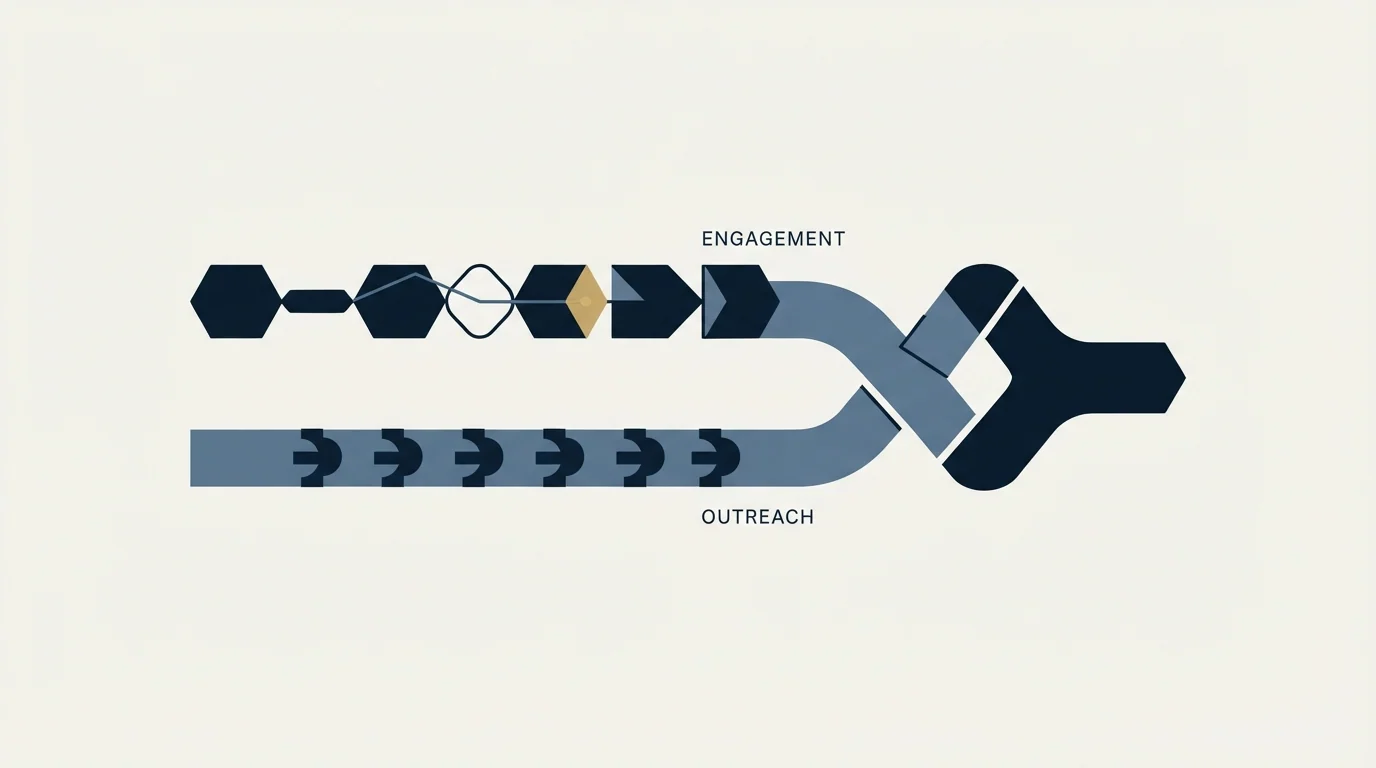
Plenty of teams end up running both, and the join is not complicated: Woodpecker owns the list, the mailboxes and the send, and Salesloft owns everything that happens after a reply lands. The overlapping integrations listed above are the plumbing that makes that split workable, since both sides can read and write to the same CRM record.
The join to get right is the handover. A reply is the moment the run stops being a sending problem and starts being a people problem, so whatever routes replies to a human has to be fast and has to be the same every time. That is a process decision rather than a licence decision, and it is worth settling before either tool is configured.
Rolling Out Without Breaking Deliverability
Sequencing the rollout is what keeps the avoidable costs down. Buying the orchestration layer before there is a reply flow to orchestrate produces seats nobody logs into, and switching the sending layer mid-wave costs inbox placement that took weeks to build.
- Yes: Buy the sending side first and prove inbox placement on a small wave
- Yes: Confirm what the tier includes for warmup, before the first send rather than after it
- Yes: Write the qualified-meeting criteria down and agree them before launch
- Yes: Send one message per campaign, with no bump step behind it
- Depends: Point Salesloft at replies only once there are replies to route
- No: Run two sequencers against the same list
The last row is the one teams get wrong. Two sequencers pointed at the same list will double-contact people, and on shared sending infrastructure that damage is not confined to one campaign. Pick one system to own the send, and let the other one read.
The Decision In One Line
Woodpecker if a wave needs to go out. Salesloft if replies are already arriving faster than the team can work them. These two overlap less than any other pair in this comparison set, so running both eventually is the expected end state rather than a compromise.
Related Reading
- Best Salesloft Alternatives in 2026
- Best Woodpecker Alternatives in 2026
- Outreach vs Salesloft: Sales Engagement Platform Comparison
- Gong vs Salesloft: Sales Engagement Platform Comparison
- Instantly vs Woodpecker: Cold Email Platform Comparison
If you would rather have this run for you, RevenueFlow books qualified meetings on a pay-per-meeting basis and publishes client results.
Pricing and features are taken from the vendors' own pages. Verify current terms with the vendor before relying on them.
Frequently asked questions.
Frequently asked questions- Does a team need both Salesloft and Woodpecker?
- Sending first. Woodpecker owns the mailboxes and the send, and Salesloft's pricing page publishes nothing about warmup, rotation or send volume. Add Salesloft once several reps are working replies and the cost of disorganised follow-up exceeds the seat cost. Buying the orchestration layer before there is a reply flow buys dashboards nobody opens.
- How does Salesloft pricing actually work?
- It does not publish prices. The page names two packages, Advanced and Elite, and puts a Request a Demo button on each. What it does itemise is the capability set behind them: pipeline generation, seller coaching, conversation intelligence, opportunity management and multi-team administration. Ask for the per-seat rate and the seat minimum in the first call.
- How does Woodpecker pricing actually work?
- As a calculator. The published entry rate is $7.00 per 100 contacted prospects, and the page derives the rest from the volume chosen: monthly emails are that number multiplied by 16 and storage is that number multiplied by 4. At 500 prospects it includes 4 warm-ups, 100 Lead Finder credits and free team members.
- Which one should a new outbound programme buy first?
- A new programme starts with Woodpecker, because its price is published and it owns the part of the run that decides whether mail arrives. Salesloft is the later purchase, made when a revenue team is large enough that cadence, coaching and pipeline workflow are the constraint. Ask for its per-seat rate and seat minimum early, since a quote takes time.
About the author.

Tim Carden is CMO / CTO at RevenueFlow, which builds and operates outbound revenue engines for B2B companies. Studied at McGill University.
Tim Carden · CMO / CTO
Connect on LinkedIn →Explore more.
Ready to scale your outreach?
We build GTM engines that book real meetings. See the receipts.
Related articles.
GetSales.io vs Yet Another Mail Merge: Sales Engagement Platform vs Cold Email Platform Comparison
Compare GetSales.io (sales engagement platform) and Yet Another Mail Merge (cold email platform) side by side. See pricing, features, and integrations to decide which one, or both, your stack needs.
Enginy vs Success.ai: Sales Engagement Platform vs Cold Email Platform Comparison
Compare Enginy (sales engagement platform) and Success.ai (cold email platform) side by side. See pricing, features, and integrations to decide which one, or both, your stack needs.
Artisan vs Yet Another Mail Merge: Sales Engagement Platform vs Cold Email Platform Comparison
Compare Artisan (sales engagement platform) and Yet Another Mail Merge (cold email platform) side by side. See pricing, features, and integrations to decide which one, or both, your stack needs.
Hexospark vs JustCall: Cold Email Platform vs Sales Engagement Platform Comparison
Compare Hexospark (cold email platform) and JustCall (sales engagement platform). See pricing, features, and integrations to decide which one, or both, your stack needs.
EmailBison vs Luru: Cold Email Platform vs Sales Engagement Platform Comparison
Compare EmailBison (cold email platform) and Luru (sales engagement platform) side by side. See pricing, features, and integrations to decide which one, or both, your stack needs.
11x vs Salesloft: Sales Engagement Platform Comparison
Compare 11x and Salesloft side by side. See pricing, features, and integrations to choose the right sales engagement platform for your needs.