Lead Management: Five Jobs and the Two Seams That Leak
Lead management is the process carrying a lead from creation to an opportunity or a recorded no, bundling capture, qualification, prioritisation, routing and nurturing. Each job has its own owner and tooling, so the losses concentrate at two seams: the elapsed time between qualification and routing, and the missing destination for good-fit accounts that are not ready.
Key takeaways
- The term is an umbrella over five jobs, and each one has its own owner, vocabulary and dashboard.
- Leads are lost at two handoffs rather than inside any single job: the clock before routing, and the absent destination for good fit with no current trigger.
- Software encodes routing, scoring and qualification policies but decides none of them, so buying the category before writing the policies installs the defaults.
- Outbound inverts capture, since the record exists because a list was built and uploaded, and leaves the other four jobs intact.
Lead management is the process that carries a lead from the moment it is created to the moment it becomes an opportunity or a recorded no. It bundles five jobs that are usually owned by different people: capture, qualification, prioritisation, routing and nurturing.
The term is an umbrella, and that is the whole reason it is worth defining. Each of the five jobs has its own vocabulary, its own tooling and its own dashboard, and the losses happen at the seams between them rather than inside any one of them.
The five jobs, and what each one owns
- Step 1Capture
A record comes into existence, from a form, an import, an integration or a conversation. The output is a row with an identity, a reachable address and a stated origin.
- Step 2Qualification
A decision about whether this lead is worth a salesperson's time, made against fit and against readiness. The output is a yes, a not yet with a date, or a recorded no with a reason.
- Step 3Prioritisation
An ordering of the yes pile, usually by a score, so that finite selling capacity meets the best rows first. The output is a queue, not a verdict.
- Step 4Routing
An assignment to an owner under a stated rule. The output is one named person accountable for the next action, and a timestamp.
- Step 5Nurturing
Contact with the not-yet pile until something changes. The output is a lead that re-enters qualification later rather than one that disappears.
Each of those has its own entry, because each is a real term of art with its own failure modes: lead qualification for the decision, lead scoring for the ordering, lead routing for the assignment and lead nurturing for the contact in between. This page is the parent they belong to, and its job is the sequence rather than any one step.
The sequence is not a pipeline in the deal sense. A lead can loop between qualification and nurturing several times before it either converts or is closed out, and a process drawn as a one-way funnel has no place to put that loop, which is where good-fit accounts quietly go missing.
Where the software definition and the process definition come apart
The phrase names two different things, and a large part of the confusion in the category is that both answers are correct.
Microsoft's own documentation for its sales product, last updated on 13 March 2026, gives the process sense directly: "Lead management is a critical process in sales, enabling organizations to capture, track, and nurture potential customers from initial interest to conversion." The same page then decomposes the configuration an administrator owns into assignment rules, a qualification experience, duplicate detection and scoring rules, which is the same five jobs seen from the settings screen.
That decomposition is the useful part. It shows that the software is a set of enforcement mechanisms for decisions that were made somewhere else. Assignment rules encode a routing policy. Scoring rules encode a prioritisation policy. A qualification experience encodes what a qualified lead converts into. None of those tools decides the policy, and a team that buys the category before writing the policies gets its defaults instead.
The distinction matters commercially too. Lead management software, lead distribution software and a CRM are three overlapping purchases, and the routing half is the one most likely to justify a dedicated tool, for reasons set out in lead routing software.
Why it matters: the two seams that leak
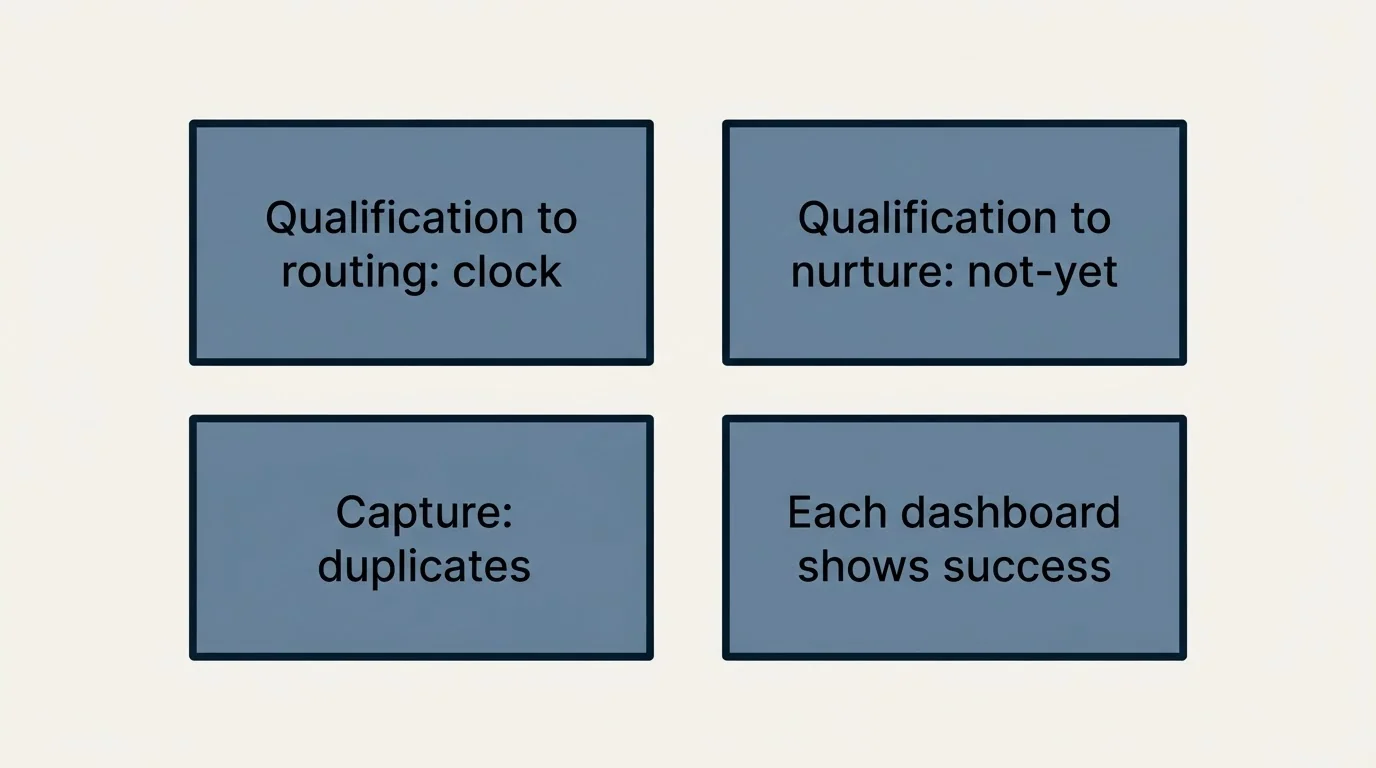
Four of the five jobs are usually done adequately. The losses concentrate in two places, and both are handoffs rather than tasks.
Between qualification and routing, the clock. A lead judged worth a conversation and then assigned some hours later is a different asset from the same lead assigned in minutes, because the buyer was in the middle of something when they raised their hand and is not any more. Nothing on a qualification dashboard shows this, because the lead was qualified correctly and routed correctly. The measurement that exposes it is elapsed time from creation to first human action, held as a distribution rather than an average, since the mean is dominated by the fast majority while the damage sits in the tail.
Between qualification and nurturing, the not-yet pile. The most expensive mistake in the whole process is marking a good-fit company unqualified because nothing is happening this quarter. Fit is stable and readiness is volatile, so that record is a targeting asset filed as a rejection. A process without an explicit destination for good fit and no current trigger will lose those accounts, and it will lose the best ones first, because the best ones are the least likely to be shopping when you happen to arrive.
- Yes: Fit criteria and readiness criteria are written separately, before the leads arrive
- Yes: A rejected lead carries a reason from a short fixed list rather than free text
- Yes: Good fit with no current trigger has a named destination and a revisit date
- Yes: Time from creation to first human action is reported as a distribution
- Yes: Routing rules name one owner and the rule order is written down
- Yes: The rejection reason distribution is reviewed on a schedule and changes the criteria
- No: A score is treated as the qualification decision rather than as an ordering
The last item is worth stating as a failure. A score is a cheap approximation of two judgements, and treating the number as the verdict removes the human read at exactly the point where the record is thinnest.
A third seam is narrower and cheaper to close, and it belongs here because the vendor documentation above names it as configuration rather than as hygiene. Duplicate records arrive at capture, because the same person fills in a form, appears in an imported list and is created by an integration, and each route believes it is meeting them for the first time. Left alone, the duplicates split the history of one account across three rows, so the qualification decision is made on part of the evidence and two owners can be routed the same buyer. Detection at the point of creation is the only version that helps; a periodic merge tidies the database after the damage has been done, and the merge itself frequently loses the origin value on the row it discards.
The reason all three seams survive is that none of them shows up as a failure on any single dashboard. Capture reports records created. Qualification reports a rate. Routing reports assignments made. Each number is accurate, each team is meeting its own standard, and the lead that was qualified, duplicated and answered two days late appears in every one of those reports as a success.
How it is used in outbound

Outbound inverts the first job and leaves the other four intact, which is not how most published descriptions of the process read.
Nothing raises its hand. The record exists because a list was built against a definition and uploaded, so capture is a sourcing decision rather than an inbound event, and the origin of the record has to be recorded deliberately in the source field rather than inferred from a web session. What makes a row usable at that point is the subject of lead list.
Qualification then runs in an unusual order. Most of the fit judgement happens before any contact, at list build, which is both the cheapest gate and the one that gets the least scrutiny. What arrives afterwards is a reply, and the judgement made on it is about readiness and about whether the person is who the list said they were. The internal version of that argument, and why the two teams so often disagree about it, is MQL versus SQL.
Routing changes shape as well, because there is no round robin over a queue of inbound forms. There is a reply, in a thread, that somebody has to answer while the buyer is still reading. Speed is the whole game, and the owner has to be decided before the reply arrives rather than after it.
Our own operating policy narrows the nurturing step deliberately. We send one message per campaign, with no bumps and no thread replies. That is a stricter rule than the standard sequence, and it costs contact volume. It also means the not-yet pile is a targeting input rather than a queue of pending follow-ups, which is the version of that pile that stays useful.
The one artefact all of this rests on is a written definition of what counts as a qualified conversation, agreed before anything sends. Ours is a meeting that was attended and met criteria agreed in writing before launch, with budget, timing and authority deliberately excluded, because those change every quarter and a meeting that happened should not become unqualified afterwards. How that definition gets settled when money depends on it is covered in qualified lead generation services.
Where the term misleads
It sounds like one system and it is five policies. Buying a platform assigns none of the five decisions, and the platform's defaults become the policy by omission.
Conversion is treated as the only good outcome. A fast, clean, recorded no is worth almost as much and costs a fraction of the time. A process measured only on conversion volume keeps marginal leads alive, which inflates the pipeline and makes the forecast worse.
The process is drawn as one-way. Leads loop. A design with no return path from nurturing into qualification will read a returning account as a new lead with no history, which is how the same company gets worked three times by three people.
Qualified is defined by capacity rather than by the buyer. A team that can work forty leads a week sets the bar where forty arrive, so the same lead is qualified this month and unqualified next month without changing at all. That is a defensible operating decision and a poor definition, and it is why qualification rates do not compare across teams or across quarters.
Inbound is assumed. Most published descriptions of the process start at a form fill, which quietly excludes every lead a team created itself. The three jobs an inbound programme actually owns, and the one nobody is assigned, are separated in inbound lead generation. The origin each lead carries into the process, and why that one field cuts every later number, is the subject of lead source.
The short version
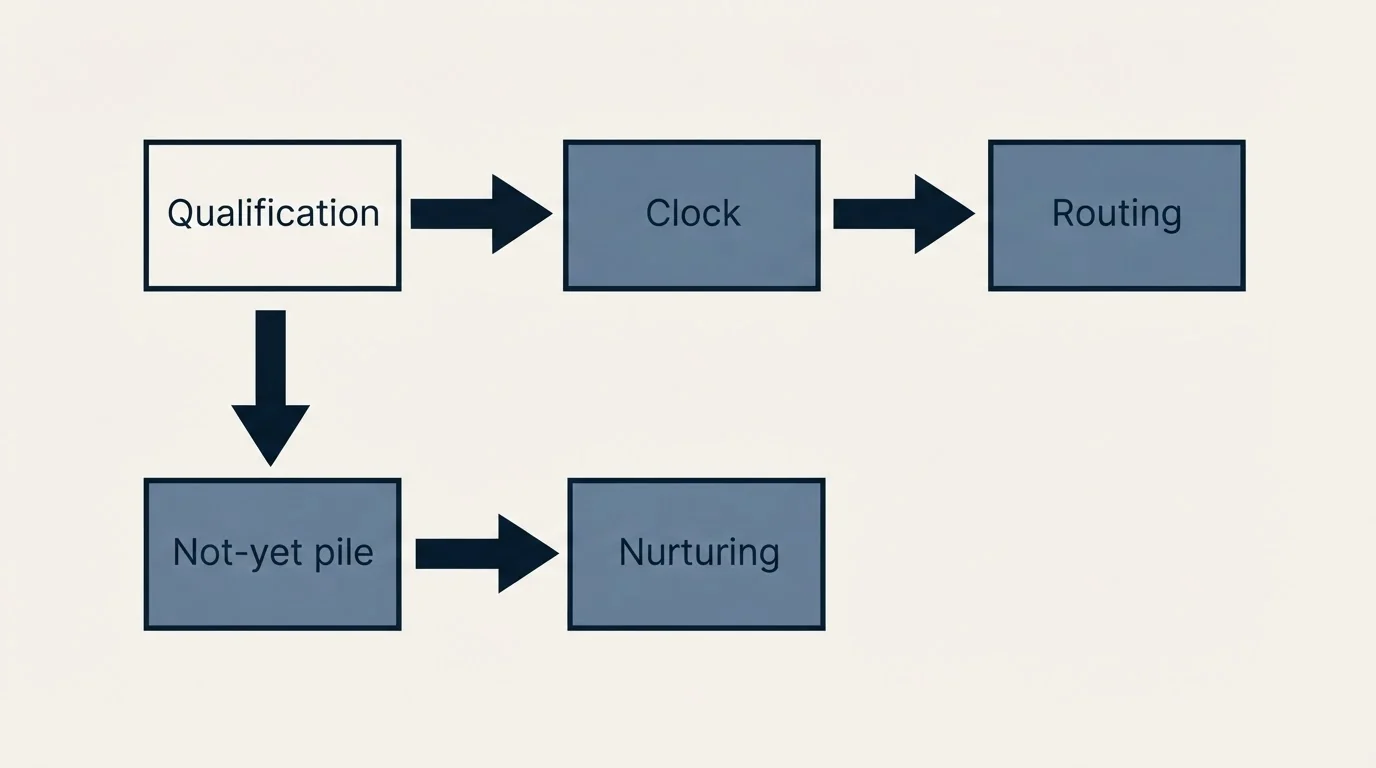
Lead management is the process carrying a lead from creation to an opportunity or a recorded no, and it bundles capture, qualification, prioritisation, routing and nurturing. Each job has an owner and a vocabulary of its own, and the losses happen at the seams: the clock between qualification and routing, and the missing destination for good-fit accounts that are not ready yet.
Write the fit and readiness criteria separately and in advance, give rejections a reason from a fixed list, report time to first action as a distribution, and give the not-yet pile somewhere to go. The related definitions are lead qualification for the decision, lead scoring for the ordering, lead routing for the assignment, lead nurturing for the contact in between, and sales qualified opportunity for the boundary the process is trying to reach.
RevenueFlow runs the outbound half of the first two jobs: attended meetings against criteria agreed in writing before launch, one message per campaign. See what a first campaign produces.
Frequently asked questions.
Frequently asked questions- Is lead management the same thing as a CRM?
- No. A CRM is where the records live and where the rules are configured. Lead management is the set of policies those rules encode: who qualifies, on what evidence, in what order leads are worked, who owns each one and what happens to the ones that are not ready. A team that installs the software without writing the policies inherits the product defaults as its process.
- Where does lead scoring fit in lead management?
- Scoring sits in the prioritisation job, between qualification and routing, and its output is an ordering rather than a verdict. Treating the number as the qualification decision removes the human read at the point where the record carries the least information. A score is a cheap approximation of two separate judgements, fit and readiness, that are more useful kept apart.
- What should happen to a good-fit lead that is not ready to buy?
- It should go to a named destination with a revisit date rather than being marked unqualified. Fit is stable over months and readiness changes week to week, so a company that is right for you and merely early is a targeting asset. Filing it as a rejection loses the best accounts first, because the best ones are the least likely to be shopping when you arrive.
- How is lead management different for outbound teams?
- The capture job inverts, because nothing raises its hand and the record exists only because a list was built against a definition and uploaded. Most of the fit judgement then happens before any contact, at list build. Routing is not a round robin over a queue of forms but a reply in a thread that somebody has to answer while the buyer is still reading it.