Sales Effectiveness: The Conversion Half of Performance
Sales effectiveness is the share of what a sales team is given that converts: the proportion of opportunities, meetings and conversations that reach the intended outcome. It is a ratio, measured with win rate and stage conversion, and it says nothing about cost, which is what its companion measure, sales efficiency, covers.
Key takeaways
- Sales effectiveness is a conversion ratio that asks whether the right outcome happened, while sales efficiency asks what it cost, and the two have opposite fixes.
- Measure effectiveness with win rate and stage conversion, against a stated denominator, read as a distribution across sellers and not as a team average.
- A ratio with a moving denominator is not a measurement: tightening what enters the pipeline raises win rate without anybody selling better.
- In outbound the ratio that tests the list is opportunities against attended meetings, and the meeting definition has to be agreed in writing before launch.
Sales effectiveness is how much of what a sales team is given it converts: the proportion of opportunities, meetings and conversations that reach the outcome they were supposed to reach. It is a quality measure expressed as a ratio, and it says nothing about what the conversion cost.
The companion term is sales efficiency, which is revenue against the resources spent to produce it. Holding the two apart is the entire practical value of the phrase, because a team can be excellent at one and poor at the other, and the two problems have opposite fixes.
What is sales effectiveness?
Sales effectiveness is the share of a sales team's opportunities, meetings and conversations that reach the outcome they were meant to reach. It is measured as a conversion ratio at a named stage, most often win rate and stage-by-stage conversion. It says whether the right thing happened and nothing about what it cost, which is the job of its companion measure, sales efficiency.
The distinction that makes the term useful
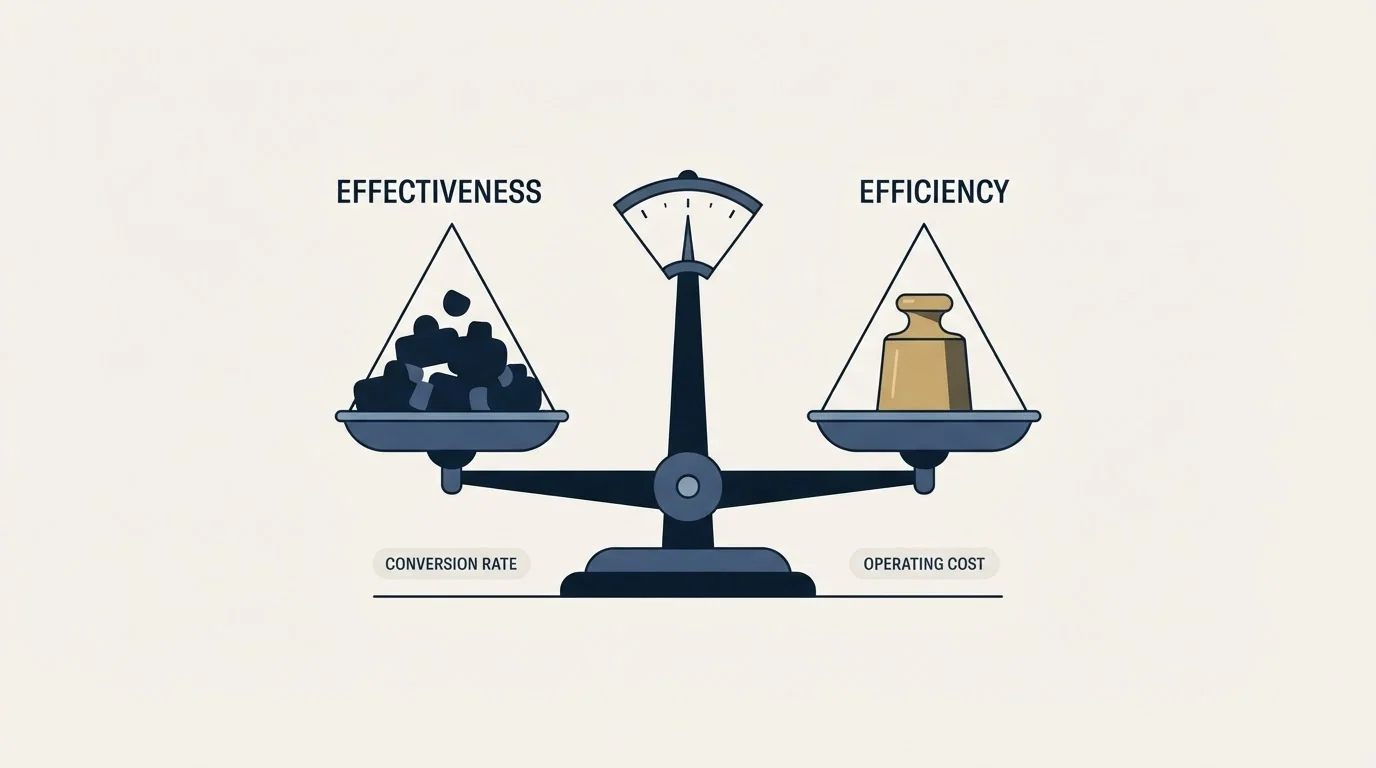
Effectiveness asks whether the right things are happening. Efficiency asks what they cost. Two of the four combinations are worth working through, because the other two need no diagnosis: a team that is strong on both needs nothing and a team that is weak on both knows it.
A team with a high conversion rate and a high cost per deal is effective and inefficient. Its sellers can win, and too much is being spent to put each one in front of a buyer. The work is upstream: targeting, channel mix, the price of a meeting.
A team with a low conversion rate and a low cost per deal is efficient and ineffective. It is cheap to generate conversations and they go nowhere. Adding volume here multiplies the waste, which is the reflex the situation invites and the wrong one.
The reason the distinction gets lost is that both are usually reported as a single word, performance, and performance is measured with quota attainment, which mixes them. A seller can miss quota because the plan was wrong, because the pipeline was thin, or because the selling was poor, and the number reads the same in all three cases. Which of those is happening is what quota attainment is careful to separate.
| Sales effectiveness: does the right outcome happen? | Sales efficiency: what did it cost? | |
|---|---|---|
| Expressed as | A conversion ratio at a named stage | Revenue against spend or time |
| Moves with | Skill, message, targeting and fit | Channel cost, cycle length and headcount |
| Improved by | Changing what happens in the conversation | Changing how conversations are produced |
| Blind to | What the conversation cost | Whether the outcome was any good |
| Measured with | Win rate and stage conversion | Cost per opportunity and revenue per rep |
Which numbers actually measure it
Effectiveness is a family of ratios rather than one figure, and each one is only readable next to its denominator.
Win rate is the headline ratio and the most frequently misread, because the denominator is a choice. Deals won against deals closed, against all opportunities created, against every qualified conversation, are three different numbers with the same name, and the argument is set out in win rate.
Stage conversion is the same idea applied one step at a time, and it is where the loss actually localises. A team with an acceptable win rate and a poor meeting-to-opportunity rate has a problem in the first conversation, not in closing.
Cycle length belongs here even though it looks like an efficiency number. A shorter cycle at the same win rate means the team is establishing fit faster, and where the clock starts decides whether the figure means anything at all, which is what sales cycle is about.
Sales velocity is the expression that holds deal count, value, win rate and cycle length together, so it shows which input a claimed improvement is actually resting on. That is sales velocity, and it is the reason a single ratio is rarely enough.
Two habits stop the numbers being decorative. Read them as a distribution rather than an average, because a team mean is usually one or two sellers and a long tail, and coaching the mean helps nobody. And read them against a cohort, not against last quarter, because the mix of what entered the pipeline changes faster than the selling does. Which numbers a development team actually controls, and which are inherited from decisions made elsewhere, is set out in SDR metrics.
Sales excellence, and why it is the same object
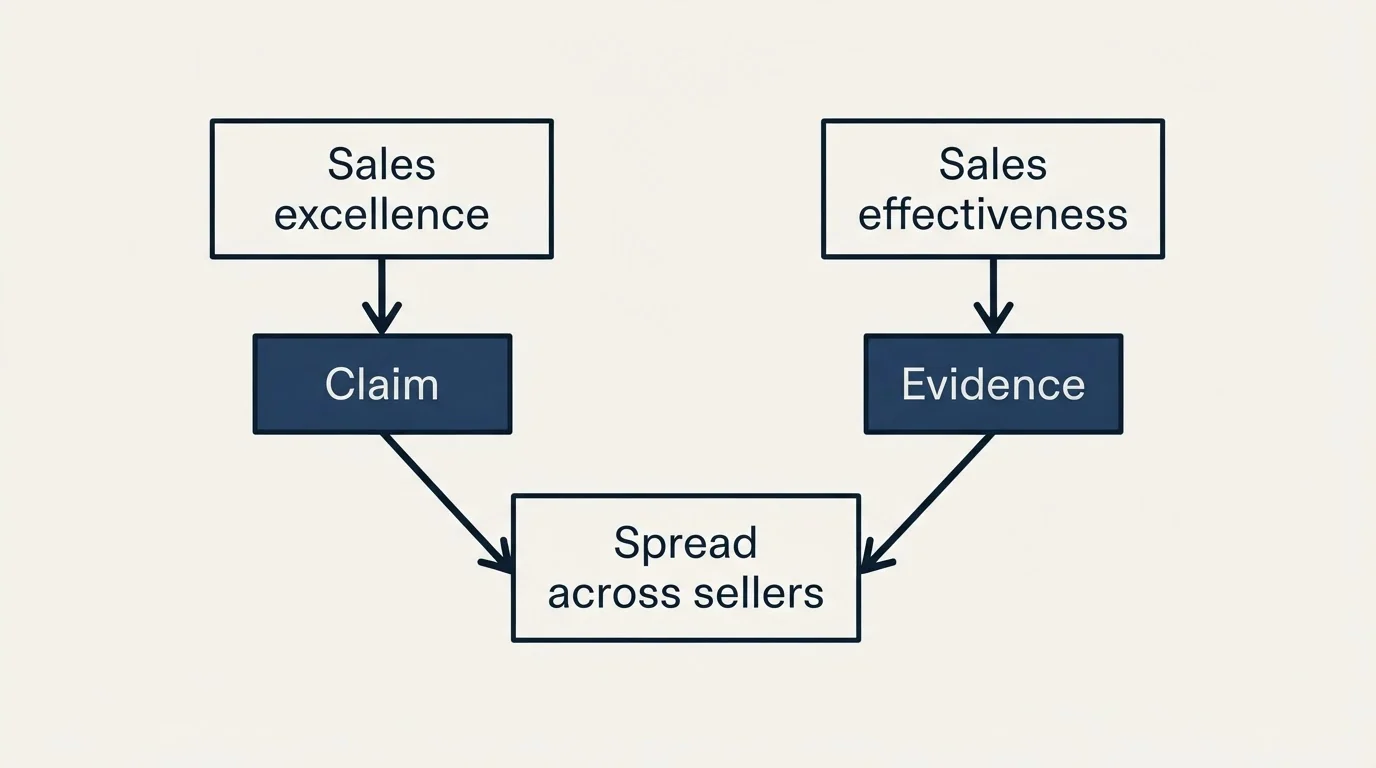
Sales excellence is the same question asked in a different vocabulary. The effectiveness framing reaches for a ratio, and the excellence framing reaches for a maturity model: disciplines, habits, cultural commitment, repeatable behaviour under pressure.
Both are describing a team that converts what it is given. The excellence framing adds one genuinely useful idea, which is consistency: a team where the top seller converts at three times the median is not excellent, whatever the aggregate says, because the result is a property of one person rather than of the organisation. The spread between the best and the median is a better test of the claim than the average is.
The framing also has a specific weakness worth naming. Stated as culture and commitment, it resists falsification. There is no observation that would show a team is not committed to excellence, so the label attaches to whatever a team is already doing and the work of improvement gets described rather than measured. The effectiveness version is narrower and it can be wrong, which is what makes it useful.
The practical reconciliation is to treat sales excellence as the claim and sales effectiveness as the evidence for it. Consistency of conversion across sellers, and the spread rather than the mean, is where those two meet.
Where the term misleads
It gets measured with activity. Calls made, emails sent and meetings booked are inputs. Counting them measures effort, and a team can raise every one of them while converting a smaller share of what it touches. Activity belongs in a capacity conversation, not an effectiveness one.
It is confused with enablement. Enablement is one lever on effectiveness, alongside targeting, message, pricing and product fit. A programme that trains sellers harder while the list stays wrong improves the lever that was not binding, and the numbers do not move.
A ratio with a moving denominator is not a measurement. Tightening what enters the pipeline raises win rate and lowers coverage without anybody selling better. Any effectiveness claim needs the entry definition stated and dated, or the improvement is an edit.
Effectiveness is bounded by what the team is given. A seller converting a badly targeted list at a low rate is producing the correct result. Reading that as a selling problem sends the intervention to the wrong place, and the diagnosis lives in the loss reasons rather than in the ratio, which is what win/loss analysis exists to recover.
Makes the number comparable
- The denominator is stated, and it has not changed inside the comparison period
- The ratio is read as a distribution across sellers, not as a team average
- Conversion is broken out by stage rather than reported only at the close
- Cycle length is held beside the ratio, so a slower win is visible as a cost
Sends work to the wrong place
- Activity counts are used as the effectiveness measure
- A fall in conversion is treated as a selling problem before the list is examined
How it is used in outbound
At the front of the funnel the ratios are shorter and the denominators are harder, which makes outbound the place where effectiveness is easiest to measure honestly and easiest to fake.
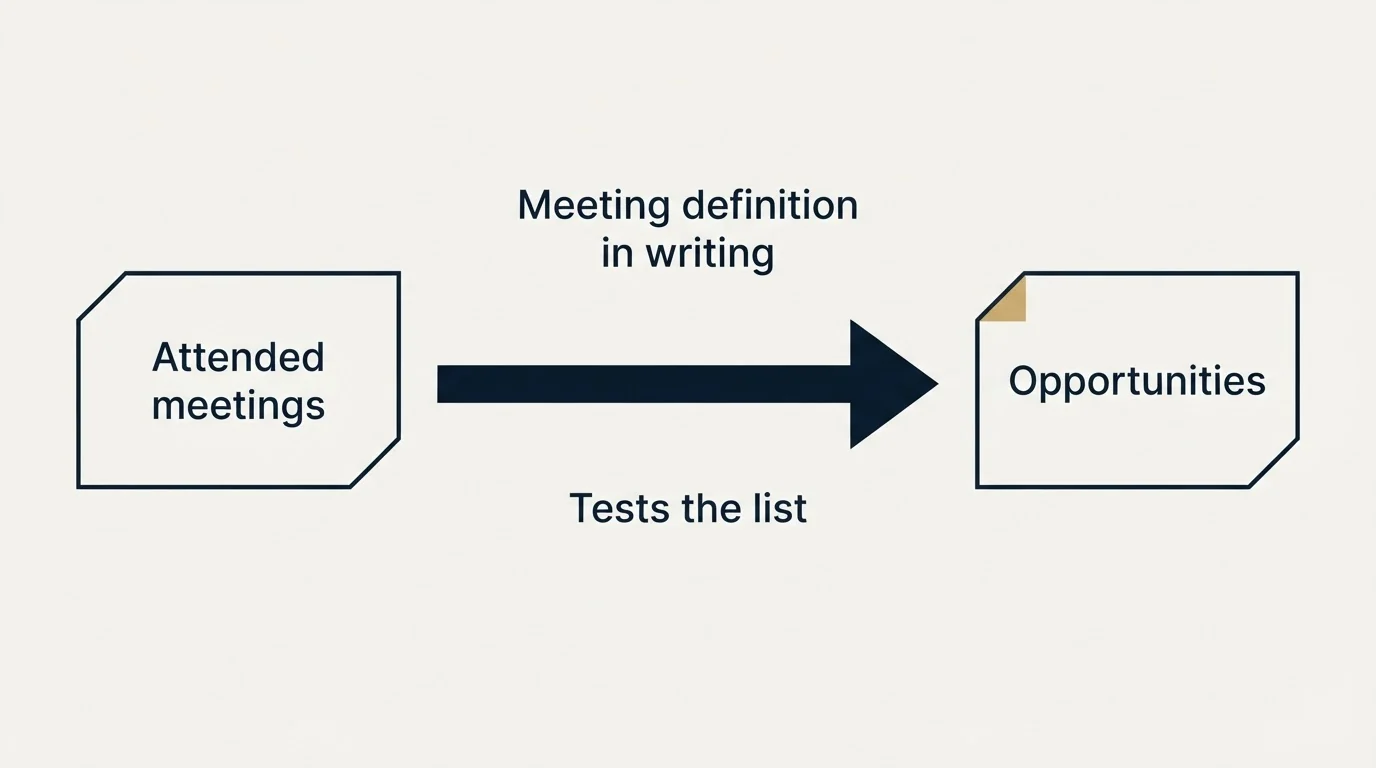
Three ratios carry the reading. Reply rate against messages sent says whether the premise is landing. Meeting rate against positive replies says whether the offer survives contact. Opportunity rate against attended meetings says whether the meetings were worth taking, and it is the only one of the three that tests the targeting rather than the copy.
The third is the one teams skip, and skipping it is how a programme reports improving effectiveness while producing less pipeline. Booking more meetings from the same list raises two ratios and moves nothing, because the constraint was never the booking rate.
Two house practices change what the numbers mean here. We send one message per campaign, with no bumps and no thread replies, so a reply rate is a reply rate to a single message rather than to a sequence of five, and the figure is not comparable to a sequenced programme's. And the opportunity denominator is fixed in advance: a meeting counts when it was attended and met criteria agreed in writing before launch, which is what a qualified appointment means, with budget and timing deliberately excluded because they move every quarter. Agreeing that definition after the results exist turns the effectiveness measure into a negotiation.
The rest of the picture is coverage. A team converting well from too little is short of pipeline rather than short of skill, and the ratio that says how much was needed is pipeline coverage, read against the measured win rate rather than against a borrowed multiple. Turning any of this into a weekly number somebody owns is covered in go-to-market execution, and the methods that convert the same pipeline into a forecast are compared in sales forecasting methods.
The short version
Sales effectiveness is the share of what a team is given that converts. It is a ratio, it is silent about cost, and its companion is sales efficiency, which is silent about quality. Measure it with win rate and stage conversion, held against a stated denominator and read as a distribution rather than an average.
Sales excellence is the same object described as a maturity claim by the training literature. The useful part of that framing is consistency across sellers; the weak part is that a claim about culture cannot be shown to be false.
In outbound, the ratio that matters is opportunities against attended meetings, because it is the only one that tests the list rather than the copy. Fix the meeting definition in writing before the campaign runs, or the measurement becomes an argument held after the results are in.
The neighbouring definitions are win rate, sales velocity, quota attainment and pipeline coverage. What happens inside the conversation the ratios are counting is in discovery call.
RevenueFlow supplies the denominator: attended meetings against criteria agreed in writing before launch. See what a first campaign produces.
Frequently asked questions.
Frequently asked questions- What is sales effectiveness?
- Sales effectiveness is how much of what a sales team is given it converts: the proportion of opportunities, meetings and conversations that reach the outcome they were supposed to reach. It is a quality measure expressed as a ratio, usually win rate and stage conversion, and it says nothing about what the conversion cost.
- What is the difference between sales effectiveness and sales efficiency?
- Effectiveness asks whether the right outcome happens and is expressed as a conversion ratio. Efficiency asks what it cost and is expressed as revenue against spend or time. A team can be strong at one and weak at the other. Effective but inefficient means fixing targeting and channel cost; efficient but ineffective means adding volume multiplies the waste.
- How do you measure sales effectiveness?
- With a family of ratios, each read beside its denominator. Win rate is the headline, stage conversion shows where the loss sits, cycle length shows how fast fit is established, and sales velocity holds the inputs together. State the denominator, keep it fixed inside the comparison period, and read the spread across sellers, not the mean.
- Is sales excellence the same as sales effectiveness?
- It is the same object in a different vocabulary. Effectiveness reaches for a ratio, excellence for a maturity model of disciplines and habits. The useful idea excellence adds is consistency across sellers. Its weakness is that a claim about culture cannot be shown false, so treat excellence as the claim and effectiveness as the evidence.