Sales Qualified Lead (SQL): The Acceptance, and the Criteria Behind It
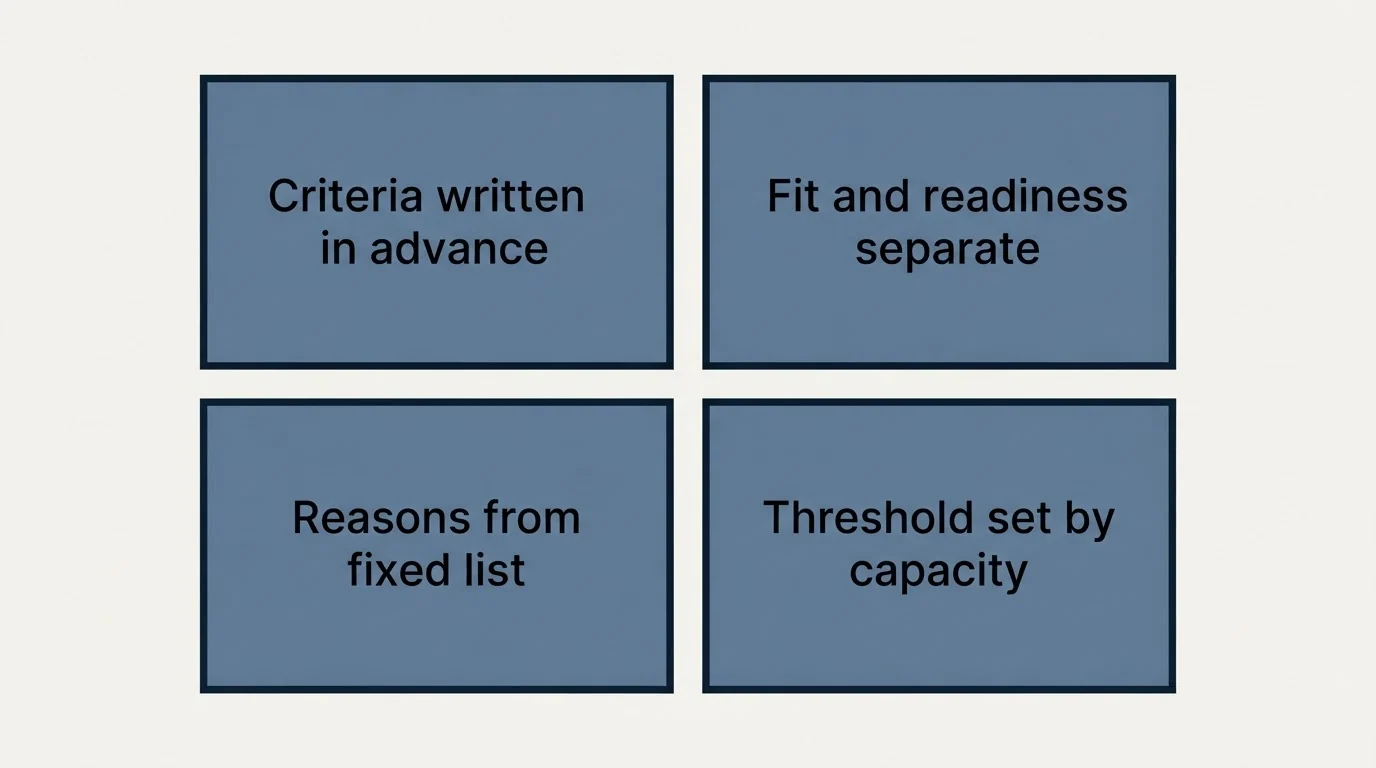
A sales qualified lead is a lead a salesperson has examined and accepted as worth their time, against criteria agreed in advance. The acceptance is the definition rather than a prediction about the deal. The criteria decide whether the label means anything, and the threshold is usually set by team capacity rather than by anything about the buyer.
Key takeaways
- The defining event is a salesperson accepting the record, not a score crossing a threshold or a behaviour being observed.
- Fit and readiness belong in separate lists, because a good-fit company that is not ready today is a targeting asset rather than a rejection.
- The threshold is usually a capacity decision, so SQL counts are not comparable between companies or between quarters.
- Where money depends on the definition, agree it in writing before anything sends and keep budget, timing and authority out of the fit criteria.
A sales qualified lead, usually abbreviated SQL, is a lead that a salesperson has examined and accepted as worth their time, against criteria agreed in advance. The acceptance is the definition: an SQL is not a lead that scored highly or behaved encouragingly, it is one that a person on the sales side has taken responsibility for working.
That is a smaller claim than the term usually carries, and holding it to that size is what stops the vocabulary becoming an argument. The label describes a handover that happened, not a prediction about whether the deal will close.
What separates it from the labels either side of it
SQL sits in the middle of a short sequence, and each step in that sequence is a different party making a different judgment.
A lead is a record: a person at a company, however they arrived. A marketing qualified lead is one that marketing believes meets the agreed bar, usually on a mix of fit attributes and observed behaviour. A sales qualified lead is one that sales has looked at and accepted. A sales qualified opportunity is a deal that has entered the pipeline with a value and a close date attached, which is a further step and a different object entirely.
The important boundary is between the second and the third, because it is the only one where the record changes hands. Marketing proposes and sales disposes, and an SQL is what exists after the disposal went one way rather than the other. Some teams insert a sales accepted lead between the two, to separate the moment a record is received from the moment it is judged worth working, which is a useful split wherever there is a delay between the two events and an unnecessary one where there is not.
- Judged on fit attributes and observed behaviour
- Threshold usually set by a scoring model
- Owned by marketing, counted in marketing's numbers
- Being wrong costs a salesperson's hour
- Judged by a person reading the record
- Accepted against criteria agreed in advance
- Ownership moves to sales at this point
- Being wrong costs a slot in the pipeline
- Has a value and a close date on a record
- Judged against written stage criteria
- Counted in the forecast
- Being wrong costs forecast accuracy
Why it matters, and the part most teams skip
The part that gets skipped is the criteria, and skipping it is what turns the label into a standing argument between two functions.
When sales says the leads are bad and marketing says the leads are fine, both are applying a bar. Neither bar is written down, so neither party can be shown to be wrong, and the conversation repeats monthly with different anecdotes. The unglamorous fix is to agree the criteria in writing, in advance, with examples of accepted and rejected records rather than only rules, and to revisit them on a schedule.
Two properties make such a definition work rather than decorate a wiki.
Fit and readiness are listed separately. Whether a company would make a good customer is knowable in advance, stable for months, and checkable against every company in the market. Whether a purchase is plausible right now is volatile and mostly invisible from outside. Conflating them produces the most expensive error in this area: a good-fit company that is not ready today gets marked unqualified and disappears, when the correct disposition is that they are exactly who you want and the timing is not yet. The full version of that distinction is in lead qualification.
Rejections carry a reason from a fixed list. A rejected lead with free-text notes cannot be counted, so it teaches nobody anything. A month where rejections cluster on wrong seniority is a targeting instruction; a month where they cluster on no budget is a pricing or segment instruction. Reading the distribution is the only routine evidence anyone gets about whether the qualification standard is right.
There is a third property that decides whether the number is comparable at all: the bar is usually set by capacity rather than by the buyer. A team that can work forty leads a week sets the threshold where forty arrive. Grow the team and the threshold drops, and records that were unqualified last month become qualified without changing. That is a defensible operating decision and it means SQL counts are not comparable between companies or between quarters, including your own.
How it is used in outbound
On an inbound programme the SQL boundary is a handover between two internal teams. On an outbound programme it is frequently a commercial term, and that changes what it has to be able to survive.
Where somebody is paid per qualified lead or per qualified meeting, the definition decides what is being bought, and a definition agreed after the fact is argued under pressure by whichever party is losing. Three things follow.
Agree the criteria in writing before anything sends. Not after the first batch, and not as a principle to be worked out later. The list should be precise enough that a target list can be built from it, which is the same test an ideal customer profile has to pass.
Keep budget, timing and authority out of the fit criteria. They are readiness signals that change week to week. Making them billing conditions means a genuine conversation with exactly the right person can be rejected because that person said not this quarter, which is a fact about the calendar rather than about the qualification.
Set a rejection window and name the reviewer. A rejection has to arrive while everyone remembers the conversation, and it has to point at something in the agreed definition. Wrong company, wrong seniority, an agreed exclusion, a failed criterion: those count. The meeting went poorly does not, because it is a judgment about an outcome rather than about the standard. Without that second half the definition is decorative, since any meeting can be declined afterwards on grounds nobody wrote down.
- Step 1Write the criteria
Fit and readiness listed separately, precise enough that a list could be built from them
- Step 2Add examples
Accepted and rejected records, because rules alone are read differently by two people
- Step 3Fix the window
How long the reviewer has, and who that reviewer is, agreed before anything sends
- Step 4Read the rejections
Reasons from a fixed list, reviewed as a distribution rather than one at a time
Our own position is a worked version of exactly this. The criteria that make a meeting qualified are agreed with the client in writing before launch, and budget, timing, decision authority and immediate intent are deliberately absent from them. What remains is a company inside the agreed audience, a person with genuine responsibility for or influence over the relevant area, agreement to a relevant business conversation, attendance and participation, and no prior suppression. We also run one message per campaign, built on one premise and sent once, which puts the whole qualification burden before the send rather than after it, because there is no second attempt to rescue a badly chosen audience.
Where the textbook definition misleads

Buying intent is not part of the definition, despite appearing in the common phrasings. The common phrasing says an SQL has demonstrated budget, authority, need and timeline. Three of those four describe readiness and only one describes fit, so a checklist built from them disqualifies good-fit accounts on the day rather than dating them for the quarter they become reachable. The frameworks people reach for here are aimed at different points on the path, which is why BANT and MEDDIC are not interchangeable with each other or with this label.
A high score is not an SQL. Scoring ranks records so a team can work them in order, and it cannot rank a market, only an audience. The acceptance step is a person reading the record, which is the thing a threshold approximates. Why summing fit and intent into one number destroys the information the acceptance needs is set out in lead scoring.
Published conversion figures for this stage describe somebody else's definition. Uplift percentages circulate widely for what SQLs are worth relative to other leads, and they are computed on bars nobody outside those companies can inspect. Your own rate, measured the same way for several quarters, carries more than any of them.
Disqualification is not failure. A fast, clean no costs a fraction of the time a marginal lead consumes and is worth nearly as much. Teams measured only on qualified volume keep marginal records alive, which inflates the pipeline and makes forecasting worse. The useful counterpart measure is how quickly a record that will not buy gets identified, and almost nobody reports it, because it looks like a count of things that did not happen.
- Yes: Fit criteria and readiness criteria are listed separately
- Yes: Accepted and rejected examples exist, not only rules
- Yes: Budget, timing and authority are not used as fit criteria
- Yes: A rejection window and a named reviewer are agreed in advance
- Yes: Rejection reasons come from a fixed list and get read as a distribution
- Depends: The threshold is documented as a capacity decision, with its current value
- Depends: Good-fit but not-ready records have a defined destination rather than being deleted
Related terms
Lead qualification is the judgment the label records the outcome of. Sales qualified opportunity is the next object down the chain, and a different one. Lead scoring is the automated approximation that proposes candidates. Inbound lead is the population most SQL definitions were written around. And qualified appointment is the outbound-side unit with the same definitional problem.
The short version
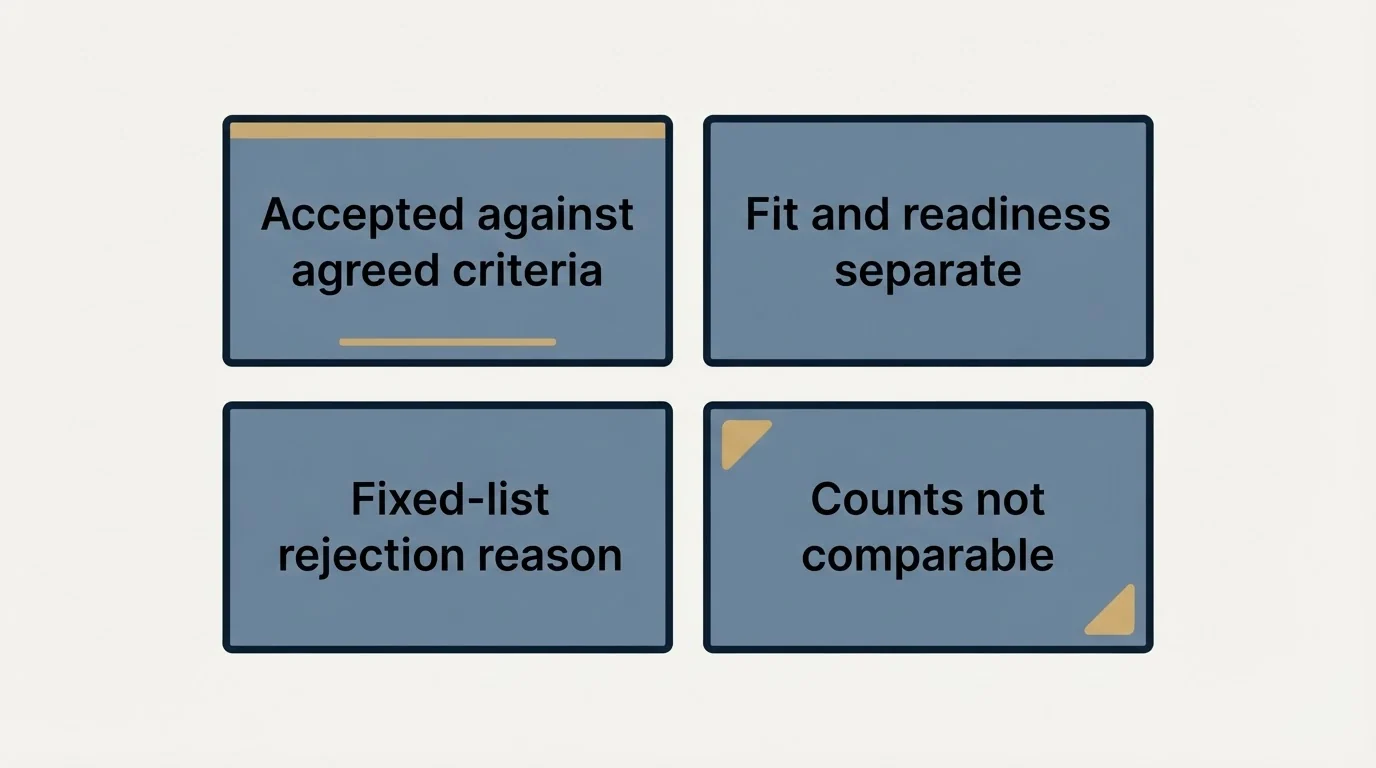
A sales qualified lead is one that sales has examined and accepted against criteria agreed in advance. The acceptance is the whole definition, and the criteria are the part that decides whether the label means anything.
Write fit and readiness separately, add accepted and rejected examples, keep budget and timing out of the fit half, and give rejections a reason from a fixed list so the distribution can be read. Where money depends on the definition, agree it before anything sends and fix a rejection window with a named reviewer.
Expect the threshold to be a capacity decision rather than a statement about buyers, which means SQL counts are not comparable across companies or across quarters. The internal handover this label sits on is worked through in MQL versus SQL, and what a qualified lead has to be when somebody is paying for it is in qualified lead generation services.
Producing conversations that clear a bar agreed in writing before launch is the work we do. See what one campaign produces.
Frequently asked questions.
Frequently asked questions- What is the difference between an MQL and an SQL?
- An MQL is a record marketing believes meets the agreed bar, usually judged on fit attributes and observed behaviour. An SQL is one a salesperson has read and accepted as worth working. The boundary between them is the only point where the record changes owner, which is why disagreements about lead quality almost always turn out to be disagreements about that definition.
- Does a sales qualified lead have to have budget and a timeline?
- It should not. Budget, authority, need and timeline are mostly readiness signals that change week to week, and only one of the four describes fit. A definition built from them disqualifies good-fit companies on the day rather than dating them for the quarter they become reachable, and it lets a genuine conversation with the right person be argued away after the fact.
- What is the difference between a sales qualified lead and a sales qualified opportunity?
- An SQL is a record somebody has accepted as worth working. A sales qualified opportunity is a deal that has entered the pipeline with a value and a close date attached, judged against written stage criteria. The first is a handover, the second is a forecastable object, and a record can be the first for weeks before it becomes the second, or never become it at all.
- Why are SQL counts not comparable between companies?
- Because the qualifying threshold is normally set by how many records the team can work rather than by anything about buyers. Grow the team and the bar drops, so records that were unqualified last month become qualified without changing. That is a reasonable operating decision and a poor definition, and it applies to comparisons across your own quarters as much as across companies.