Apollo.io vs Mixmax: Cross-Category Comparison
Compare Apollo.io (sales engagement platform) and Mixmax (cold email platform) side by side. Understand how these tools fit different stages of your sales workflow.
Mixmax and Apollo.io are not competing for the same budget line. Mixmax meters unique sequence recipients a month, 1,500 on Engagement Copilot at $65 a month, so a 2,000-prospect wave does not fit without an add-on. Apollo lists unlimited sequences on every paid tier from $49 per seat.
Key takeaways
- Apollo.io's pricing page publishes a free tier with 900 credits per seat per year and paid tiers at $49, $79 and $119 per seat per month billed annually, with the top tier carrying a three seat minimum.
- Mixmax meters unique sequence recipients a month rather than emails: 50 on Free, 100 on the Copilot tiers and 1,500 on Engagement Copilot and Suite.
- Mixmax's pricing page lists no warmup, no mailbox rotation and no deliverability suite on any tier, and it sends from the seat's own Gmail mailbox.
- Mixmax sells more sequence recipients as an add-on from $19 a month annual for another 1,500, which is the line to model before assuming a tier can carry a cold wave.
Reviewed and updated August 28, 2026
Apollo.io vs Mixmax: Cross-Category Comparison
Mixmax meters unique sequence recipients a month rather than emails: 50 on the free tier, 100 on Inbox Copilot, 1,500 on Engagement Copilot and Suite. A cold wave of 2,000 prospects does not fit any of them without an add-on, and that is the most useful fact on the page.
Apollo is built the other way round. It grants credits per seat per year and lists unlimited sequences on every paid tier, so the constraint moves from campaign size to research volume. These two tools are not competing for the same budget line.
Why Compare These Two Tools?
Email sending platforms focus specifically on cold email campaigns, while sales engagement platforms offer multi-channel outreach including email, phone and social. The comparison comes down to specialization against breadth of channels.
Apollo.io is an all-in-one sales intelligence and engagement platform combining a 240M+ contact database with automated sequences, email outreach, dialer, and AI-powered workflows for prospecting at scale. It is filed here as a sales engagement platform, and its own pages lead on multi-channel sales outreach.
Mixmax is a sales engagement platform for Gmail with AI-powered sequences, email tracking, meeting scheduling, and conversation intelligence. It is filed here as a cold email platform, and its own pages lead on cold email outreach.
The categories are the least interesting thing on this page. What decides the purchase is which meter each vendor bills on, and what each one already includes that the other would be paid for a second time.
Where Each Tool Fits in Your Workflow
- Step 1Campaign execution
Mixmax covers cold email outreach, from $34/mo.
- Step 2Outreach orchestration
Apollo.io covers multi-channel sales outreach, on a free entry plan.
| Aspect | Apollo.io | Mixmax |
|---|---|---|
| Category | Sales Engagement Platform | Cold Email Platform |
| Workflow Stage | Outreach Orchestration | Campaign Execution |
| Primary Focus | Multi-channel sales outreach | Cold email outreach |
| Starting Price | Free entry plan | $34/mo |
| Capabilities Listed | 10 | 10 |
| Integrations Listed | 12 | 9 |
Apollo's own plan cards list a Deliverability Suite and email warmup from Basic up, unlimited sequences on every paid tier, domain and mailbox purchasing, and unlimited Gmail and Microsoft mailboxes from Professional. So Apollo's own cards already carry the sending side of a cold outbound run, not only the research side.
Mixmax sends from the seat's own Gmail mailbox and its pricing page lists no warmup, no mailbox rotation and no deliverability suite on any tier. What it rations is unique sequence recipients a month.
Pricing Comparison
Apollo.io Pricing
| Plan | Price | Credits | Seats |
|---|---|---|---|
| Free | Free | 900 credits per seat/year, granted monthly | 1 or more |
| Basic | $49/mo | 30,000 credits per seat/year, granted upfront | 1 or more |
| Professional | $79/mo | 48,000 credits per seat/year, granted upfront | 1 or more |
| Organization | $119/mo | 72,000 credits per seat/year, granted upfront | 3 minimum |
Apollo's pricing page renders those three paid figures as the per seat per month rate billed annually, and labels the Organization tier with a three seat minimum. The page carries a monthly billing toggle beside an annual one, so the number a card shows depends on which state the page is in.
Source: Apollo.io Pricing
Mixmax Pricing
| Plan | Paying monthly | Billed annually | Sequence recipients |
|---|---|---|---|
| Free | Free | Free | 50 / month |
| Inbox Copilot | $34/mo | $29/mo | 100 / month |
| Meeting Copilot | $34/mo | $29/mo | 100 / month |
| Engagement Copilot | $65/mo | $49/mo | 1,500 / month |
| Mixmax Suite | $105/mo | $89/mo | 1,500 / month |
Mixmax prices per user and meters unique sequence recipients a month rather than emails, so a campaign's size, not its length, is what consumes the allowance. The page sells more recipients as an add-on, starting at $19 a month annual and $25 a month monthly for another 1,500.
Source: Mixmax Pricing
Pricing Context
These two pages do not price the same unit, so a headline comparison between them says very little. Read the meter first: one of these vendors bills for seats and research, the other for reach and sending identity. A stack that adds a rep and a stack that adds a domain will move in completely different directions on the same two invoices.
What A Two-Tool Stack Costs
Here is illustrative arithmetic, invented as a worked example rather than taken from any client, for a two person team running one wave of about 2,000 prospects a month.
Apollo.io on its Basic tier is $49 per seat per month billed annually, so 2 seats across twelve months comes to $1,176.
Mixmax on its Engagement Copilot tier is $49 per user a month billed annually, so 2 users across twelve months comes to $1,176.
Together that is $2,352 a year before anyone has sent a single email, and the two lines move for different reasons: one grows when the team grows, the other when the volume does.
Feature Highlights
Apollo.io Key Capabilities (Sales Engagement Platform)
- B2B contact and company database (240M+ contacts)
- Multi-channel sequences (email, phone, LinkedIn)
- AI-powered email writing and optimization
- Built-in dialer with call recording
- Automated workflows and engagement rules
- A/B testing for email sequences
- Buying intent signals and job change alerts
- Advanced lead scoring and filtering
- Email deliverability tools and mailbox rotation
- Conversation intelligence (Professional+)
Mixmax Key Capabilities (Cold Email Platform)
- AI-powered email sequences
- Email tracking and analytics
- Meeting scheduling (1-click)
- Conversation intelligence
- Multichannel sequences
- AI email personalization
- Inbox categorization and smart signals
- CRM auto-sync
- Custom branding (add-on)
- Dialer and SMS (add-on)
Where The Two Actually Overlap
Both list sequences, tracking, scheduling and CRM sync, and both live comfortably beside a rep's Gmail. Mixmax's pricing page lists no warmup, no mailbox rotation and no deliverability suite on any tier, and it sends from the seat's own mailbox. Apollo's cards list a Deliverability Suite with email warmup, domain and mailbox purchasing and a 240M+ contact database. What Mixmax lists and Apollo's cards do not is a meeting-focused product line: Meeting Copilot at $34 a month for prep, summaries and follow-ups.
A feature list is a record of what a vendor chose to publish, so the right reading is that one page lists a capability and the other does not. It never supports a claim that only one of them can do the job.
Do You Need Both, And In Which Order
Cold volume is Apollo's side of this. Mixmax earns its place after the meeting is booked, in the inbox of the person who has to run it.
The cheapest way to answer that for a specific programme is to write down what stopped the last wave. A wave that stalled because nobody knew who to contact has a data problem. A wave that stalled because the mail landed in spam has an infrastructure problem. A wave that ran fine and produced replies nobody worked has neither, and buying a third tool will not fix it.
Integration Ecosystem
Apollo.io Integrations
Apollo.io connects with: Salesforce, HubSpot, Pipedrive, Gmail, Microsoft Outlook, LinkedIn, Zapier, Slack, Sendgrid, Outreach, Salesloft, Webhooks API.
Mixmax Integrations
Mixmax connects with: Gmail, Google Workspace, Salesforce, HubSpot, Pipedrive, Slack, Zoom, Calendly, Zapier.
Shared Integrations
Both tools integrate with: Salesforce, HubSpot, Pipedrive, Gmail, Zapier, Slack. This shared ecosystem means they can work together in your tech stack.
When to Choose Apollo.io
- Your biggest gap is in outreach orchestration
- You already have a solid cold email platform and need specialized multi-channel sales outreach capabilities
- You want an entry point that costs nothing to start
- Your team's primary bottleneck is multi-channel sales outreach
When to Choose Mixmax
- Your biggest gap is in outreach orchestration
- You already have a solid cold email platform and need specialized multi-channel sales outreach capabilities
- You want an entry point that costs nothing to start
- Your team's primary bottleneck is multi-channel sales outreach
- Your biggest gap is in campaign execution
- You already have a sales engagement platform and need better cold email outreach
- You want an affordable entry point ($34/mo)
- Your team's primary bottleneck is cold email outreach
- Your biggest gap is in campaign execution
- You already have a sales engagement platform and need better cold email outreach
- You want an affordable entry point ($34/mo)
- Your team's primary bottleneck is cold email outreach
Using Both Together
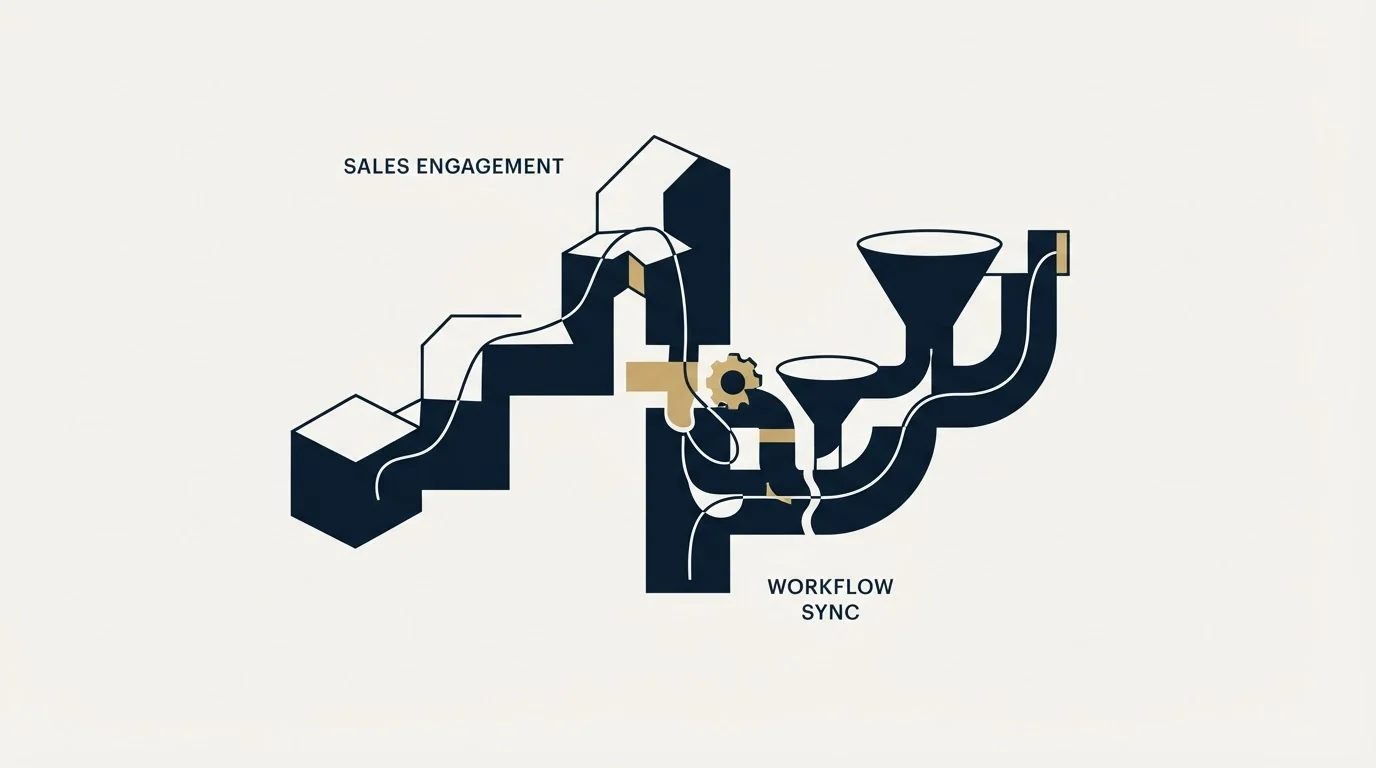
Both together is the natural configuration rather than the extravagant one, because they meter different work. Apollo runs the outbound wave; Mixmax runs the follow-through on the accounts that answered. The recipient allowance is the number to watch when the second system starts touching cold names.
House practice makes that manageable rather than theoretical. RevenueFlow runs one message per campaign, with no thread replies and no bump sequences behind it, so a prospect who appears in two systems receives at most one message from each rather than two escalating threads from both. The suppression list sits above the tools and is loaded into each of them before anything sends.
Salesforce, HubSpot, Pipedrive, Gmail, Zapier, Slack appear on both integration lists above, and those shared connectors are where a duplicate is easiest to catch, because both systems can write to the same CRM record.
Rollout Notes
- Yes: Name the system that owns the contacted-already list
- Yes: Load suppression into both tools before either sends
- Yes: Send one message per campaign, with no bump step behind it
- Yes: Check the sending mailboxes are warmed and authenticated
- Yes: Agree in writing what counts as a qualified meeting
- Depends: Point replies at one inbox a person actually reads
Switching between these two is mostly a data exercise. Export the contacted list from the outgoing tool before the licence lapses, because a suppression list you cannot reconstruct is the expensive part of a migration. Re-authenticate the sending mailboxes in the new system rather than assuming the connection carries over, and give any newly connected mailbox a warming period before it carries real volume. Meetings are qualified against criteria agreed in writing before launch, and that definition should survive the tooling change unchanged.
Decision Shortcut
- Name the binding constraint. List quality, sending capacity, or what happens after a reply. One of the three is costing more than the other two.
- Check what is already paid for. sales engagement platforms and cold email platforms overlap more than their category labels suggest, so read both feature lists before adding a line to the invoice.
- Price a realistic year, not a headline. Include the add-ons each tool needs to reach parity with the other.
- Decide who owns suppression. One system holds the contacted-already list, and both read from it.
- Re-check in a quarter. Whichever tool you bought second should have a measurable job by then, or it is a renewal to cancel.
Related Reading
- Best Apollo.io Alternatives in 2026
- Best Mixmax Alternatives in 2026
- Apollo.io vs Outreach: Sales Engagement Platform Comparison
- Apollo.io vs Salesloft: Sales Engagement Platform Comparison
- Instantly vs Mixmax: Cold Email Platform Comparison
If you would rather have this run for you, RevenueFlow books qualified meetings on a pay-per-meeting basis and publishes client results.
Pricing and features are taken from the vendors' own pages. Verify current terms with the vendor before relying on them.
Frequently asked questions.
Frequently asked questions- Does a team need both Apollo.io and Mixmax?
- Yes, and it is the natural configuration rather than the extravagant one. Apollo runs the outbound wave on a seat and credit meter; Mixmax runs the follow-through in the inbox of the person who owns the meeting. The recipient allowance is the number to watch when Mixmax starts touching cold names.
- How does Apollo.io pricing actually work?
- Per seat, with credits as the second meter. The page lists a free tier granting 900 credits per seat per year, then Basic at $49, Professional at $79 and Organization at $119 per seat per month billed annually, granting 30,000, 48,000 and 72,000 credits per seat per year upfront. Organization carries a three seat minimum, and a monthly billing toggle sits beside the annual one.
- How does Mixmax pricing actually work?
- Per user, metered on unique sequence recipients a month. Inbox Copilot and Meeting Copilot are $34 a month billed monthly or $29 billed annually, Engagement Copilot is $65 or $49, and Mixmax Suite is $105 or $89. The recipient allowance runs 50 on Free, 100 on the Copilot tiers and 1,500 above, with more sold as an add-on from $19 a month.
- Which one should a new outbound programme buy first?
- Apollo, for cold volume. Mixmax's own recipient meter says so: 50 a month on Free and 1,500 on its main paid tiers is a follow-through allowance rather than a campaign allowance. Mixmax earns its place after the meeting is booked, not before the first send.
About the author.

Tim Carden is CMO / CTO at RevenueFlow, which builds and operates outbound revenue engines for B2B companies. Studied at McGill University.
Tim Carden · CMO / CTO
Connect on LinkedIn →Explore more.
Ready to scale your outreach?
We build GTM engines that book real meetings. See the receipts.
Related articles.
GetSales.io vs Yet Another Mail Merge: Sales Engagement Platform vs Cold Email Platform Comparison
Compare GetSales.io (sales engagement platform) and Yet Another Mail Merge (cold email platform) side by side. See pricing, features, and integrations to decide which one, or both, your stack needs.
Enginy vs Success.ai: Sales Engagement Platform vs Cold Email Platform Comparison
Compare Enginy (sales engagement platform) and Success.ai (cold email platform) side by side. See pricing, features, and integrations to decide which one, or both, your stack needs.
Artisan vs Yet Another Mail Merge: Sales Engagement Platform vs Cold Email Platform Comparison
Compare Artisan (sales engagement platform) and Yet Another Mail Merge (cold email platform) side by side. See pricing, features, and integrations to decide which one, or both, your stack needs.
Hexospark vs JustCall: Cold Email Platform vs Sales Engagement Platform Comparison
Compare Hexospark (cold email platform) and JustCall (sales engagement platform). See pricing, features, and integrations to decide which one, or both, your stack needs.
EmailBison vs Luru: Cold Email Platform vs Sales Engagement Platform Comparison
Compare EmailBison (cold email platform) and Luru (sales engagement platform) side by side. See pricing, features, and integrations to decide which one, or both, your stack needs.
AiSDR vs Apollo.io: Sales Engagement Platform Comparison
Compare AiSDR and Apollo.io side by side. See pricing, features, and integrations to choose the right sales engagement platform for your needs.