Apollo.io Sales Engagement vs Pipedrive Compared
Compare Apollo.io (sales engagement platform) and Pipedrive (crm platform) side by side. Understand how these tools fit different stages of your sales workflow.
Pipedrive records the relationship and Apollo.io runs the touches, so these two sit at different points in one outbound run rather than competing. Apollo.io starts free and reaches unlimited sequencing at $49/mo, while Pipedrive enters at $14/mo. Their published capability lists still collide on 2 classes, so decide which system owns the send before connecting them.
Key takeaways
- Pipedrive does not reach this egress today, so its ladder is carried forward from the live page rather than re-checked. Read it on the vendor page before it goes into a budget.
- Apollo.io publishes a per seat ladder, so both halves of this pair can be costed on paper. Its free card lists "2 Sequences" and the paid cards from Basic at $49/mo list "Unlimited Sequences".
- "Minimal feature overlap" does not hold on this pair. The two published lists collide on 2 classes, starting with outbound email, which is a decision about which system owns that job rather than a feature win for either.
- Agree which system owns contact status before connecting them, and match on email address. Two tools both convinced they own that field is how somebody who already replied keeps being mailed.
Reviewed and updated September 1, 2026
Apollo.io Sales Engagement vs Pipedrive: Cross-Category Comparison
The price on the front of Apollo.io's pricing page is not the price of the thing this comparison is about. Unlimited sequencing sits on Basic, at $49/mo, which is not the tier at the top of the page. That gap is the first thing to check when a team is weighing Apollo.io against Pipedrive, because the entry figure in every comparison table on the internet is the one that does not include the capability being compared.
The Short Answer
Buy for the gap you can name. If deals are being worked and nobody can describe the pipeline, Pipedrive is the purchase. If the pipeline is fine and the top of it is empty, Apollo.io is the purchase. If both are true, the pipeline goes first.
Both vendors publish a rate, so the pair can be costed on paper before anyone books a call. Buying one first, running it for a quarter and adding the second only if the first leaves a gap you can point at is still the cheaper way in.
Why Compare These Two Tools?
CRMs track the entire customer lifecycle and deal pipeline, while sales engagement platforms focus on the outreach phase. Many teams debate whether to invest in a CRM with built-in engagement features or use separate best-of-breed tools.
Apollo.io is a sales engagement platform focused on multi-channel sales outreach. All-in-one sales intelligence and engagement platform combining a 240M+ contact database with automated sequences, email outreach, dialer, and AI-powered workflows for prospecting at scale.
Pipedrive is a CRM platform focused on customer relationship management. A sales-focused CRM designed by salespeople for salespeople, built around a visual deal pipeline. Pipedrive emphasizes simplicity and ease of use with powerful automation features, AI-powered sales assistance, and activity-based selling methodology.
Where Each Tool Fits in Your Workflow
- Step 1Outreach orchestration
Apollo.io covers multi-channel sales outreach, on a free entry plan.
- Step 2Pipeline and deal tracking
Pipedrive covers customer relationship management, from $14/mo.
| Aspect | Apollo.io | Pipedrive |
|---|---|---|
| Category | Sales Engagement Platform | CRM Platform |
| Workflow Stage | Outreach orchestration | Pipeline and deal tracking |
| Primary Focus | Multi-channel sales outreach | Customer relationship management |
| Starting Price | Free | $14/mo |
| Features Listed | 10 | 8 |
| Integrations | 12 | 8 |
What Each Side Does in a Cold Outbound Run
Neither of these tools sends cold volume for you. Pipedrive is where a conversation gets recorded once it exists, and Apollo.io is where the touch is orchestrated and measured. Cold sending itself happens on separate, warmed sending inventory, which is a different purchase again.
Worth stating the sending doctrine plainly, because it changes what either tool is worth: one message per campaign, and no follow up under it. A sequence step that lands beneath an ignored email is a bump, so the sequencing engine matters less than the list feeding it.
The cost of a bad list is not the wasted send, it is the sender reputation. Cold outbound runs on shared inventory, so one campaign mailing stale records damages placement for every campaign beside it.
Meetings are the other place the two categories separate. A meeting counts when it matches criteria agreed in writing before launch, and neither tool decides that. Pipedrive is where the agreed definition gets recorded against the account so the same standard survives a rep change.
Both categories are wider than the two names on this page, and sales engagement in particular has several tools doing broadly this job; a roundup of Outreach alternatives is a quick way to see the shape of that shelf before committing a budget to one of them.
Pricing Comparison
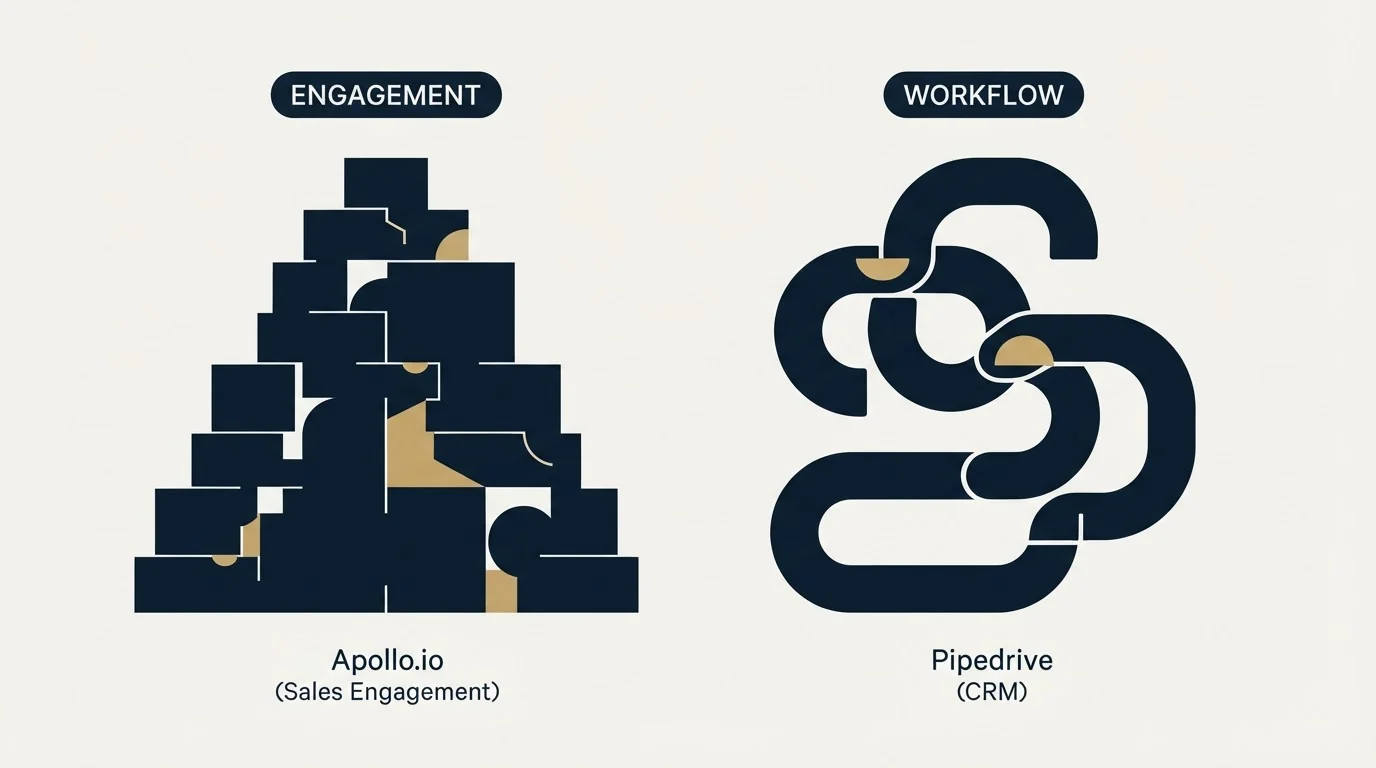
Apollo.io Pricing
| Plan | Price | Credits | Seats |
|---|---|---|---|
| Free | $0/mo | 900 credits per seat/year, granted monthly | 1 or more |
| Basic | $49/mo | 30,000 credits per seat/year, granted upfront | 1 or more |
| Professional | $79/mo | 48,000 credits per seat/year, granted upfront | 1 or more |
| Organization | $119/mo | 72,000 credits per seat/year, granted upfront | 3 minimum |
Every paid price above is the per seat per month rate billed annually, and the Organization tier carries a three seat minimum.
Every paid card carries the line "Per seat per month, billed annually" against a toggle labelled "Annual billing Save 24%", and Organization reads "(min 3 seats)".
Apollo's homepage publishes "240M+ contacts and 30M+ companies", and the paid cards add "Deliverability Suite & Email Warmup".
Source: Apollo.io Pricing
Pipedrive Pricing
| Plan | Price |
|---|---|
| Lite | $14/mo |
| Growth | $39/mo |
| Premium | $59/mo |
| Ultimate | $79/mo |
Every price above is the per seat per month rate billed annually, which Pipedrive also publishes as one payment of $168, $468, $708 and $948 per seat per year.
No route reaches Pipedrive's pricing page from this egress, so the ladder above is carried forward from the live page rather than re-checked. The plan NAMES are confirmed on Pipedrive's own support article, which reads "Pipedrive offers four pricing plans to fit teams of any size: Lite , Growth , Premium and Ultimate".
Source: Pipedrive Pricing
Pricing Context
Apollo.io publishes a per seat ladder that was readable today, every paid card carrying the line "Per seat per month, billed annually". Pipedrive does not reach this egress, so its figures above are the ones already on this page rather than a fresh reading, and any comparison between the two columns is only as current as that carried forward half.
What the Entry Price Does Not Buy
Pipedrive's ladder cannot be re-read from here today, so which tier carries which capability is not something this page can state. The figures in the table above are carried forward from the live page.
Apollo, the half of this pair that can be read, splits by tier. Apollo's free card lists "2 Sequences" and its paid cards from Basic upward list "Unlimited Sequences", so the free tier is a place to look at the database rather than a place to run outbound from.
The practical consequence is the same either way. Take the number for the tier that carries the capability being compared, not the number at the top of the page, before either tool goes into a budget.
What the Pair Costs at a Realistic Team Size
The team below is invented, not a client. Five sellers, all needing a seat in both systems, no add-ons, no onboarding fee.
| Line item (illustrative team of five) | Per month | Twelve months |
|---|---|---|
| Pipedrive Lite, 5 seats at $14 | $70 | $840 |
| Apollo.io Basic, 5 seats at $49 | $245 | $2,940 |
| Illustrative total | $315 | $3,780 |
The Pipedrive rate above is carried forward from the live page rather than re-checked, because its pricing page is not readable from here today. Seat count is the variable that moves this most, and it moves it linearly, so the arithmetic scales cleanly in both directions.
Only the Apollo.io half of that total comes from a page checked today. The Pipedrive line is carried forward from the live article, so treat $3,780 as an order of magnitude rather than a quote, and re-read Pipedrive's own ladder before it goes into a budget.
Feature Highlights
Apollo.io Key Capabilities (Sales Engagement Platform)
- B2B contact and company database (240M+ contacts and 30M+ companies)
- Multi-channel sequences (email, phone, LinkedIn)
- AI-powered email writing and optimization
- Built-in dialer with call recording
- Automated workflows and engagement rules
- A/B testing for email sequences
- Buying intent signals and job change alerts
- Advanced lead scoring and filtering
- Email deliverability tools and mailbox rotation
- Conversation intelligence (Professional+)
Pipedrive Key Capabilities (CRM Platform)
- Visual deal pipeline management
- Activity-based selling methodology
- Email sync with templates and tracking
- Workflow automation builder
- AI-powered sales assistant
- Revenue forecasting and reporting
- Customizable web forms and chatbot
- Mobile app with caller ID and call logging
Feature Overlap
The published lists collide on 2 classes, so the two sit closer together than a category label suggests:
- Outbound email. Apollo.io lists "Multi-channel sequences (email, phone, LinkedIn)", and Pipedrive lists "Email sync with templates and tracking".
- Workflow automation. Apollo.io lists "Automated workflows and engagement rules", and Pipedrive lists "Workflow automation builder".
Read that as a decision rather than a feature win. On a house that sends one message per campaign, two systems able to mail the same list is something to settle once, by picking which one owns the send and turning the other one off for that job. The caveat is the important half: this compares the exact wording of two vendor lists, so it says what each vendor chose to publish, not what either product can be made to do.
Integration Ecosystem
Apollo.io Integrations
Apollo.io connects with: Salesforce, HubSpot, Pipedrive, Gmail, Microsoft Outlook, LinkedIn, Zapier, Slack, Sendgrid, Outreach, Salesloft, Webhooks API.
Pipedrive Integrations
Pipedrive connects with: Google Workspace, Microsoft Outlook, Slack, Zoom, Zapier, Mailchimp, Trello, Asana.
Shared Integrations
Both tools integrate with: Microsoft Outlook, Zapier, Slack. This shared ecosystem means they can work together in your tech stack.
Do You Need Both, and in Which Order?
Both on day one is rarely the right shape, and the order matters more than the answer either way. Buy the side that closes the gap you can name, run it for a quarter, then decide whether the second one is still worth its seat cost.
Both halves of this pair publish a rate, which is unusual on this shelf and makes the order easy to test on paper before anyone signs anything.
The failure to avoid is buying the second tool to fix a problem the first one was never going to solve. A pipeline nobody updates does not get fixed by better sequencing, and a list that bounces does not get fixed by a tidier deal board.
- Yes: Deals are progressing but nobody can say what is in the pipeline
- No: The pipeline is clean and the top of it is empty
- Depends: Two systems are already mailing the same people
- Depends: Nobody agrees what counts as a qualified meeting
A yes on the first line points at Pipedrive. A yes on the second points at Apollo.io. A yes on the third means the next purchase is a decision about ownership rather than a tool at all.
When to Choose Apollo.io

- Your biggest gap is in outreach orchestration
- You already have a solid crm platform and need specialized multi-channel sales outreach capabilities
- You want an affordable entry point ($0/mo)
- Your team's primary bottleneck is multi-channel sales outreach
When to Choose Pipedrive
- Your biggest gap is in outreach orchestration
- You already have a solid crm platform and need specialized multi-channel sales outreach capabilities
- You want an affordable entry point ($0/mo)
- Your team's primary bottleneck is multi-channel sales outreach
- Your biggest gap is in pipeline and deal tracking
- You already have a sales engagement platform and need better customer relationship management
- You want an affordable entry point ($14/mo)
- Your team's primary bottleneck is customer relationship management
- Your biggest gap is in pipeline and deal tracking
- You already have a sales engagement platform and need better customer relationship management
- You want an affordable entry point ($14/mo)
- Your team's primary bottleneck is customer relationship management
Rolling the Second Tool In Without Breaking the First
Write down which system owns each field before anything is connected. The common mess is two tools both claiming to own contact status, so a rep marks somebody as replied in one place and the other keeps mailing them.
Pick a matching key and stick to it. Email address is the only key that survives a job change badly but joins reliably; company name does not join at all across two systems that normalise it differently.
Run one segment through the connected pair before the whole list goes near it. Fifty records is enough to read by hand, and reading them by hand is what catches a mapping that looks right in a settings screen and is wrong in the data.
- Days 1 to 3Agree field ownership
One system owns contact status, one owns activity history. Write it down.
- Days 4 to 7Connect on one segment
Fifty records, matched on email address, read by hand.
- Days 8 to 10Read the coverage
Count the records that matched, the ones that duplicated, and the ones that silently did neither.
- Days 11 to 14Widen or stop
Widen only after the fifty read clean. A bad mapping at fifty records is a bad mapping at fifty thousand.
Set a refresh cadence for whichever side holds the contact data, and put a date on it. Records decay whether or not anybody is looking.
Using Both Together
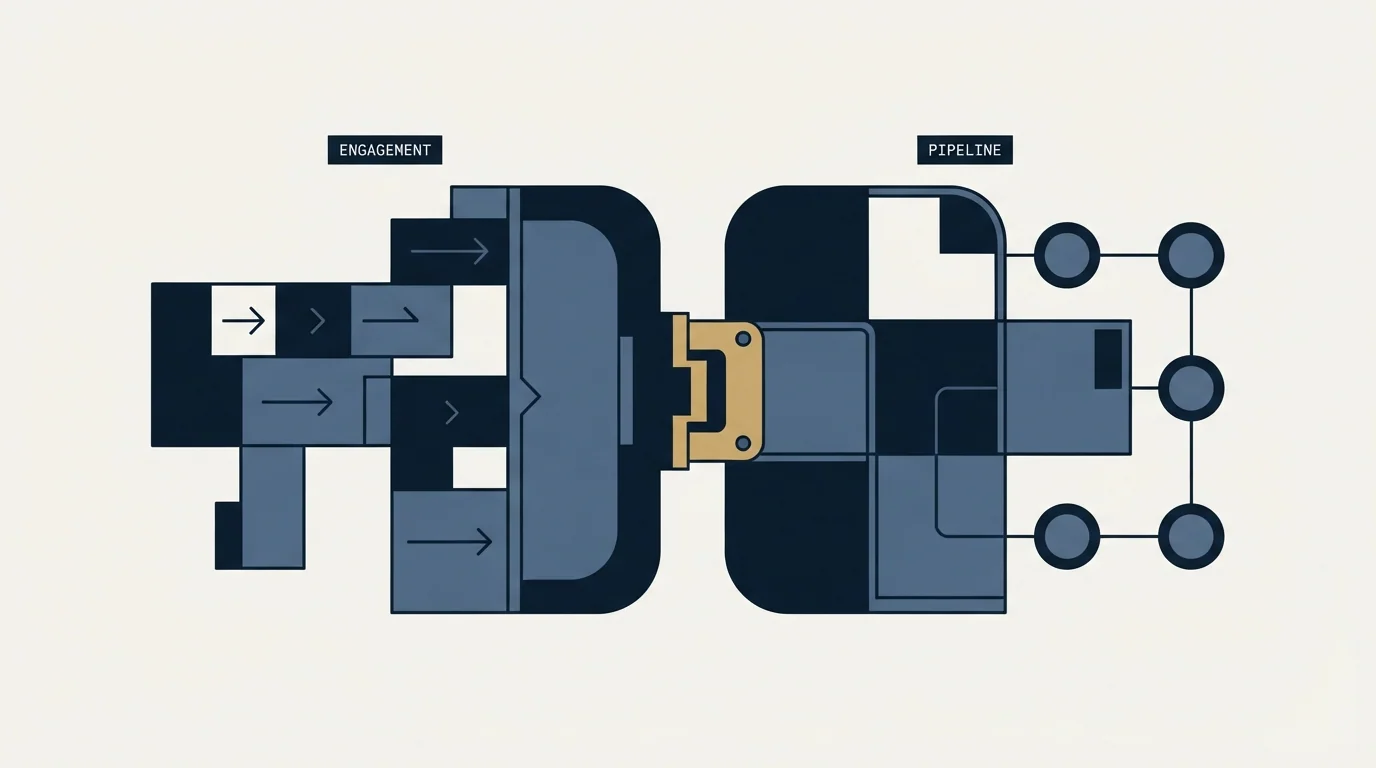
Many sales teams use both a sales engagement platform and a CRM platform as part of their complete workflow. Apollo.io handles outreach orchestration while Pipedrive covers pipeline and deal tracking.
Since both tools integrate with Microsoft Outlook, Zapier and Slack, connecting them in your workflow is straightforward.
The part worth deciding before they are connected is which system owns contact status. Two tools both convinced they own it is how somebody who replied keeps getting mailed.
The Decision Shortcut
If the pipeline is the thing nobody can describe, buy Pipedrive. If the top of the pipeline is empty, buy Apollo.io. If both are true, the pipeline goes first, because an outbound push into a system nobody maintains produces conversations that get lost rather than deals that close.
If neither is clearly true, buy neither this quarter and fix the list instead. That is the cheapest of the three options and it is the one most likely to move the number.
How These Figures Were Checked
Vendor figures on this page are attributed to the page they appear on, because vendors contradict themselves across their own surfaces.
- Pipedrive. No route reaches Pipedrive's pricing page from this egress, so the ladder above is carried forward from the live page rather than re-checked. The plan NAMES are confirmed on Pipedrive's own support article, which reads "Pipedrive offers four pricing plans to fit teams of any size: Lite , Growth , Premium and Ultimate".
- Apollo.io. Every figure on this page was matched against Apollo.io's pricing page as it renders today.
Any arithmetic above is this page's own, done on those inputs and labelled illustrative where it appears.
Related Reading
- Best Apollo.io Alternatives in 2026
- Best Pipedrive Alternatives in 2026
- Apollo.io vs Outreach: Sales Engagement Platform Comparison
- Apollo.io vs Salesloft: Sales Engagement Platform Comparison
- Pipedrive vs Salesforce: CRM Platform Comparison
If you would rather have this run for you, RevenueFlow books qualified meetings on a pay-per-meeting basis and publishes client results.
Pricing and features are taken from the vendors' own pages. Verify current terms with the vendor before relying on them.
Frequently asked questions.
Frequently asked questions- Do I actually need both Apollo.io and Pipedrive?
- Not on day one. Buy the side that closes the gap you can name, run it for a quarter, then decide whether the second one is still worth its seat cost. Teams running continuous outbound usually end up with both, joined on email address, rather than choosing between them once and never revisiting it.
- Which one should I buy first?
- Start from the gap you can name. If deals are being worked and nobody can describe the pipeline, Pipedrive is the purchase. If the pipeline is fine and the top of it is empty, Apollo.io is. If both are true the pipeline goes first, because outbound into a system nobody maintains produces conversations that get lost.
- What does the pair cost for a small team?
- On an invented five person team, Pipedrive at its entry tier and Apollo.io Basic at $49 a seat come to a figure you can work out before any call, because both ladders are published. The article shows that arithmetic line by line and labels it illustrative, since seat count is what moves it.
- How much do these two overlap in practice?
- More than the category labels suggest. The two published lists collide on 2 classes, including outbound email. That is a comparison of what each vendor chose to publish rather than of what either product can do, and the useful response is to pick one owner for the overlapping job.
About the author.

Tim Carden is CMO / CTO at RevenueFlow, which builds and operates outbound revenue engines for B2B companies. Studied at McGill University.
Tim Carden · CMO / CTO
Connect on LinkedIn →Explore more.
Ready to scale your outreach?
We build GTM engines that book real meetings. See the receipts.
Related articles.
Kommo vs Luru: CRM Platform vs Sales Engagement Platform Comparison
Compare Kommo (CRM platform) and Luru (sales engagement platform) side by side. See pricing, features, and integrations to decide which one, or both, your stack needs.
Dripify vs Membrain: Sales Engagement Platform vs CRM Platform Comparison
Compare Dripify (sales engagement platform) and Membrain (CRM platform). See pricing, features, and integrations to decide which one, or both, your stack needs.
AiSDR vs Apollo.io: Sales Engagement Platform Comparison
Compare AiSDR and Apollo.io side by side. See pricing, features, and integrations to choose the right sales engagement platform for your needs.
Best Kixie Alternatives in 2026
Looking for alternatives to Kixie? Compare the top sales engagement platforms by pricing, features, and integrations.
Mailshake vs Pipedrive: A Sender and a CRM, Side by Side
Mailshake sells per-user sending with a two-way Pipedrive sync from its middle tier; Pipedrive is a per-seat CRM with sequences from Growth. Both read 18 September 2026.
AroundDeal vs Leadspicker: Data Enrichment Tool vs Sales Engagement Platform Comparison
Compare AroundDeal (data enrichment tool) and Leadspicker (sales engagement platform) side by side. See pricing, features, and integrations to decide which one, or both, your stack needs.