Cold Email for Expert Quotes: Complete Strategy Guide
Learn how to use cold email to secure expert quotes for your articles, reports, and marketing content. Includes proven templates, targeting strategies, and response optimization techniques.

Cold email succeeds for expert quotes because it enables targeted outreach to specific individuals with relevant expertise, delivers efficient results within days, and allows precise question framing for better responses. It provides direct access to diverse perspectives beyond your existing network while offering experts valuable exposure to new audiences. This approach generates higher-quality quotes than social media requests or forum posts, which typically get lost or yield inconsistent results.
Key takeaways
- Cold email enables targeted outreach to experts with specific knowledge relevant to your content, rather than accepting whatever perspectives are readily available.
- A systematic expert quote program can substantially improve engagement metrics, with quoted experts often sharing content with their own audiences and multiplying reach without additional promotion costs.
- Successful expert outreach requires building comprehensive lists with more experts than needed, as response rates vary and having alternatives prevents deadline-driven quality compromises.
- Ideal expert profiles should include subject matter authority, credibility markers your audience will recognize, demonstrated communication ability, and complementary perspectives to existing content voices.
- Expert sources can be identified through industry publications, research institutions, conference speaker rosters, podcasts, LinkedIn thought leaders, book authors, and company leadership roles.
Reviewed and updated September 15, 2026
Cold Email for Expert Quotes: Complete Strategy Guide
Expert quotes transform ordinary content into authoritative resources. A single compelling quote from a recognized industry voice can elevate an article from forgettable to shareable, adding credibility that raw statistics and generic insights cannot match. Cold email provides the most reliable path to securing these valuable endorsements, even from experts who seem completely inaccessible.
A content marketing manager at a B2B software company struggled to differentiate her blog posts from competitors publishing similar topics. After implementing a systematic expert quote outreach program, her articles began featuring insights from industry leaders, analysts, and practitioners. Engagement metrics improved substantially, and several quoted experts shared the content with their own audiences, multiplying reach without additional promotion costs.
Why Cold Email Works for Expert Quotes
Gathering expert quotes through traditional channels presents significant challenges. Social media requests get lost in notification overload. Waiting for responses in community forums yields inconsistent results. Relying on your existing network limits the range of perspectives you can include. Cold email solves these problems by enabling targeted outreach to specific individuals whose expertise matches your content needs.
The Strategic Advantage of Direct Expert Outreach
Cold email for expert quotes offers several unique benefits:
Targeted expertise: You can identify and contact individuals with specific knowledge relevant to your content. Rather than accepting whatever perspectives are available, you pursue exactly the voices that would strengthen your piece.
Efficient time investment: A single email to the right expert can yield a quote within days. This efficiency allows you to enhance multiple pieces of content with authoritative voices without extensive networking or relationship building.
Quality control: Direct outreach lets you frame your question precisely, increasing the likelihood of receiving quotes that directly address your content angle.
Diversity of perspective: Cold email enables you to reach experts from different backgrounds, industries, and viewpoints, creating richer, more balanced content.
Reciprocal value: Experts often appreciate opportunities to share their perspectives with new audiences. Your outreach provides exposure that benefits both parties.
Finding the Right Experts to Quote
The value of an expert quote depends entirely on the expert's relevance, credibility, and ability to provide insight that enriches your content. Systematic targeting ensures you reach individuals whose contributions will genuinely enhance your work.
Defining Your Ideal Expert Profile
Before initiating outreach, establish clear criteria for the experts you want to quote:
Subject matter authority: Does the person possess genuine expertise on your specific topic? Look for evidence of deep knowledge through published work, professional experience, or recognized credentials.
Credibility markers: Would your audience recognize and respect this person as an authority? Consider their titles, affiliations, publications, and industry reputation.
Communication ability: Can they articulate insights in quotable, accessible language? Review their existing content to assess their communication style.
Complementary perspective: Does this expert offer a viewpoint that complements or constructively contrasts with other voices in your content?
Accessibility likelihood: Some experts field constant quote requests while others rarely receive them. Balance ambition with pragmatism when building your outreach list.
Where to Find Expert Sources
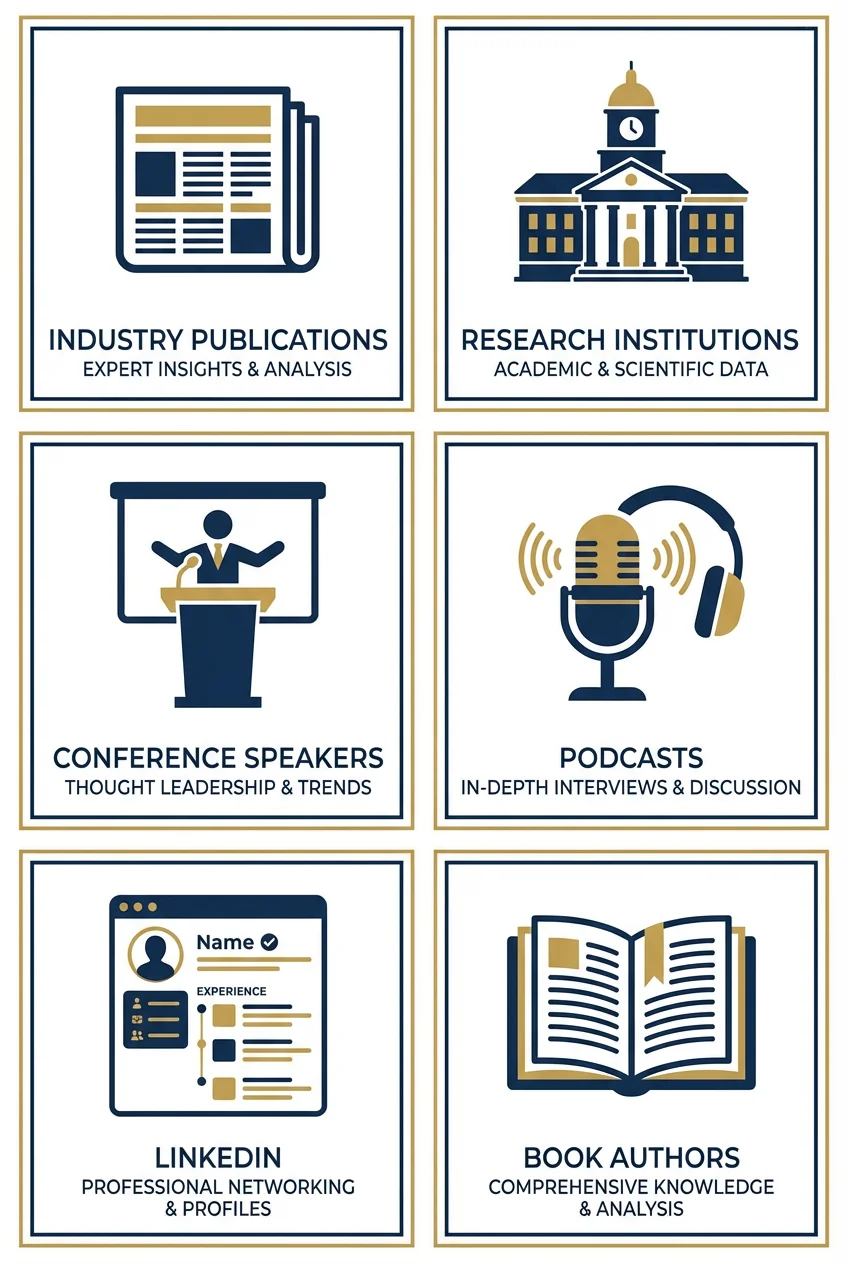
Identifying ideal experts requires research across multiple channels:
Industry publications: Authors who write for respected industry publications have demonstrated both expertise and willingness to share knowledge publicly.
Research institutions: Academics and researchers offer rigorous, evidence-based perspectives with strong credibility signals.
Professional associations: Association leaders and committee members often welcome opportunities to represent their fields.
Conference speaker rosters: Individuals who present at industry events have both expertise and experience communicating complex topics.
Podcasts and webinars: Experts who appear on podcasts have demonstrated media-friendliness and communication ability. Their existing interviews reveal their style.
LinkedIn thought leaders: Active LinkedIn contributors with engaged followings have established expertise and comfort with public discourse.
Book authors: Published authors in your topic area have invested significant effort in developing and articulating their expertise.
Company leadership: Executives and practitioners at relevant companies offer applied perspectives that complement academic viewpoints.
Building Your Expert Outreach List
Compile comprehensive information for each potential expert:
- Full name, title, and organization
- Email address and alternative contact methods
- Specific expertise relevant to your content
- Recent work, publications, or public statements
- Potential question angles that match their knowledge
- Personalization opportunities from their content
- Estimated response likelihood
Build lists with more experts than you need. Response rates vary, and having alternatives prevents deadline pressure from forcing compromises on quote quality.
What to Offer Expert Sources
Requesting a quote asks for something valuable: the expert's time, intellectual property, and professional endorsement. Successful outreach demonstrates clear value exchange that makes participation worthwhile.
Value Propositions That Motivate Experts

Different experts respond to different incentives:
Audience exposure: Your publication reaches readers who may not know this expert. Quantify your audience when impressive.
Thought leadership reinforcement: Being quoted as an authority strengthens the expert's professional positioning.
Content repurposing opportunity: Experts can reference and reshare content featuring their quotes, extending the value of their contribution.
Network expansion: Being featured alongside other quoted experts creates potential connection opportunities.
Cause advancement: Experts passionate about specific topics welcome opportunities to spread their message.
Simple satisfaction: Many experts genuinely enjoy sharing knowledge and having their perspectives valued.
Structuring Your Quote Request
Your outreach should clearly communicate:
- What publication or content will feature the quote
- The specific topic or question you want them to address
- Who will see the finished content (audience description)
- How you will attribute the quote (name, title, links)
- Any deadline constraints
- Approximate response length you need
- Whether you need written response or can work from a brief call
Clarity about expectations reduces friction. Ambiguity triggers hesitation and non-response.
What Works: Expert Quote Email Best Practices
Effective quote request emails balance efficiency with professionalism. Experts receive many such requests, so your message must quickly establish credibility, articulate a clear ask, and make responding easy.
Subject Line Principles
Your subject line determines whether busy experts open your email:
- Reference the specific topic requiring their expertise
- Mention your publication if it has recognition value
- Keep it concise and professional
- Create mild curiosity without appearing spammy
Examples that perform well:
- "Expert quote request: [specific topic]"
- "Quick question on [topic] for [publication]"
- "Your perspective needed: [topic]"
- "[Publication] seeking expert input on [topic]"
Email Body Structure
Structure your quote request emails with these elements:
Quick credibility: Open with brief context about who you are and your publication. One or two sentences establishing legitimacy.
Specific topic context: Explain what you are writing about and why expert perspective matters for this piece.
Precise question: State exactly what you want them to comment on. Specific questions yield better quotes than open-ended requests.
Value proposition: Articulate what they gain from participating. Exposure, positioning, or simple acknowledgment of their expertise.
Logistics clarity: Provide deadline, desired response length, and attribution format.
Easy response path: Make responding as simple as possible. They should be able to reply with their quote directly.
Tone and Voice Guidelines
Quote request emails succeed when they feel efficient and respectful:
- Be direct and concise
- Demonstrate that you have done research
- Respect their time by keeping the email brief
- Express genuine interest in their perspective
- Maintain professional formality
- Avoid excessive flattery
Expert Quote Request Email Templates
The following templates demonstrate effective approaches for securing expert quotes. Customize these frameworks with specific details about your content and target experts.
Template 1: The Straightforward Request
Subject: Expert quote request: [specific topic]
Body:
Hi [First Name],
I am [Your Name], [role] at [Publication]. We are publishing a piece on [topic] for our audience of [audience description].
Given your expertise in [their specific area], I would love to include your perspective on this question:
[Specific, focused question]
A response of 2-3 sentences would work perfectly. I would attribute the quote to [their name, title, organization] and include a link to [their website/profile].
My deadline is [date]. Could you share your thoughts by then?
Thanks for considering, [Your Name]
Template 2: The Context-Rich Request
Subject: Your insights on [topic] for [publication]
Body:
Hi [First Name],
I am working on an article about [broader topic] for [Publication], specifically examining [angle or thesis].
Your [recent article/talk/research] on [related topic] demonstrates exactly the expertise our readers need. The perspective you shared about [specific insight from their work] relates directly to what I am exploring.
Would you be willing to share your thoughts on this question:
[Specific question that builds on their existing work]
I am looking for 2-4 sentences that I can quote with full attribution. The piece is scheduled to publish [timeframe], so I would need your response by [deadline].
Our publication reaches [audience description], and I would include links to your [book/website/profile].
Best, [Your Name] [Publication]
Template 3: The Multiple Expert Request
Subject: Joining [other experts] in [publication] feature
Body:
Hi [First Name],
I am [Your Name] from [Publication]. I am compiling expert perspectives on [topic] and have already received contributions from [notable expert 1] and [notable expert 2].
Your background in [their expertise area] would add valuable dimension to the piece. Specifically, I would love your take on:
[Specific question]
The format is simple: 2-3 sentences responding to the question above. I will attribute the quote to you with your title and organization, plus any link you prefer.
Can you contribute by [deadline]?
[Your Name]
Template 4: The News Hook Request
Subject: Expert comment on [news event/trend]
Body:
Hi [First Name],
Following [recent news event or announcement], [Publication] is preparing a response piece examining implications for [relevant industry or topic].
Given your expertise in [their specific area], would you share your analysis of [specific angle]?
The question I am exploring:
[Focused question related to the news]
I am working on a quick turnaround with publication planned for [date]. Even 2-3 sentences would be valuable.
Full attribution as [their name, title] with links to your work.
Thanks, [Your Name] [Publication]
Template 5: The Research-Based Request
Subject: Quote for [report/whitepaper] on [topic]
Body:
Hi [First Name],
I am producing a [research report/whitepaper/guide] on [topic] for [organization/publication]. The piece will be distributed to [audience description] and aims to provide [value proposition].
Your expertise in [specific area] would strengthen the section on [particular topic]. I am specifically interested in your perspective on:
[Detailed question with context]
I am looking for a substantive response (3-5 sentences) that I can quote with full attribution. The quote would appear in the section covering [topic area] alongside data and analysis.
Would you be willing to contribute? I can share the completed report with you before publication and will send a final copy when released.
Deadline: [date]
Thank you, [Your Name] [Title/Organization]
Where we differ from standard practice
Much of the advice on this page reflects how outbound is commonly run. We run it differently, and since this page sits on our site it is worth saying where the difference is and what it costs us.
- A sequence of messages to each prospect over several weeks
- Later messages often land in the same email thread
- Every contact is reached more than once, so a distracted reader gets another chance
- The later messages go only to people who did not answer the first
- Reputation cost accrues on the sending domain across everything else it sends
- One message, then that campaign is finished for that contact
- No thread replies and no bumps
- A non-responding audience becomes a new campaign with a genuinely different premise, not a reminder
- More of the work moves into targeting and into the one message
- We reach each contact less often, and that is the cost we accept
The reasoning is mechanical rather than moral. A follow-up arrives underneath a message the recipient has already seen and chosen not to answer, so it is delivered to the population most likely to mark it as spam, and the reputation cost of that lands on the sending domain across every campaign running on it. We set that cost against the replies a sequence recovers and decided the trade was not worth it. The full argument, with the numbers from our own campaigns, is in why we stopped using follow-ups.
Follow-Up Strategy for Quote Requests

Many expert quotes result from follow-up messages rather than initial outreach. Experts often intend to respond but deprioritize non-urgent requests. Strategic follow-up significantly improves success rates.
Follow-Up Timing and Approach
Plan your follow-up sequence before initiating outreach:
First follow-up: 3-5 days after initial email. Brief, friendly reminder that references your original request and restates the specific question.
Second follow-up: 5-7 days after first follow-up. Offer flexibility (extended deadline, shorter response, phone call option) while maintaining interest.
After two follow-ups without response, move on to alternative experts. Quote requests warrant persistence but not aggression.
Follow-Up Message Examples
First follow-up:
Hi [First Name],
Following up on my quote request about [topic]. I know expert inboxes get crowded.
Quick reminder of the question:
[Restate specific question]
Even a brief response (2-3 sentences) would be valuable. Deadline is [date].
Thanks, [Your Name]
Second follow-up:
Hi [First Name],
One more note on the expert quote request for [publication].
If time is tight, I can work with even a single sentence response. Alternatively, happy to do a 5-minute phone call and write up the quote for your approval.
If this timing simply does not work, no problem at all.
[Your Name]
Common Mistakes to Avoid
Expert quote outreach fails for predictable reasons. Avoiding these errors dramatically improves success rates.
Asking Questions That Are Too Broad
"What are your thoughts on digital marketing?" will not yield a usable quote. Specific questions generate specific, quotable responses. Frame questions narrowly enough to answer in 2-4 sentences.
Failing to Research the Expert
Contacting someone about a topic outside their expertise wastes everyone's time and damages your credibility. Verify that each expert's background aligns with your question.
Omitting Deadline Information
Experts need to know when you need their response. Without deadlines, your request goes to the bottom of their priority list indefinitely.
Making Response Too Difficult
If responding requires significant effort (writing multiple paragraphs, answering several questions, joining a call), response rates plummet. Make contributing as easy as possible.
Neglecting Attribution Details
Experts want to know how they will be credited. Unclear attribution reduces motivation to participate.
Ignoring Response Quality
Not every quote you receive will be usable. Have backup experts ready and be prepared to follow up for clarification when responses miss the mark.
Missing the Window
Quote requests work best when timed appropriately. Asking about yesterday's news or ancient trends reduces relevance and expert interest.
Your Expert Quote Request Checklist
Before launching your expert quote campaign, confirm completion of these steps:
Research and Planning
- Identified specific question(s) requiring expert perspective
- Defined ideal expert criteria for your content
- Built list of potential experts (more than you need)
- Researched each expert's background and recent work
Outreach Preparation
- Written customized emails with specific questions
- Established clear deadlines
- Defined attribution format
Response Management
- Created system for tracking outreach and responses
- Prepared templates for thanking contributors
- Planned process for sharing published content with quoted experts
- Identified backup experts if first choices do not respond
Build Your Expert Quote Pipeline
Securing expert quotes through cold email requires systematic outreach, clear communication, and persistent follow-up. The strategies, templates, and frameworks in this guide provide everything needed to enhance your content with authoritative voices.
Each expert relationship you build extends beyond a single quote. Contributors who have positive experiences become ongoing sources, refer you to colleagues, and share your content with their audiences.
Ready to enhance your content with expert credibility? Our team specializes in outreach campaigns that connect you with industry authorities. Get your free expert outreach campaign and start adding authoritative voices to your content.
Related Reading
Frequently asked questions.
Frequently asked questions- Why is cold email more effective than social media for getting expert quotes?
- Cold email solves the problems inherent in other channels by enabling direct, targeted communication. Social media requests get lost in notification overload, and waiting for responses in community forums yields inconsistent results. Cold email allows you to reach specific individuals whose expertise matches your content needs, frame questions precisely, and typically receive responses within days rather than weeks or not at all.
- What credentials should I look for when choosing experts to quote?
- Focus on five key criteria: subject matter authority demonstrated through published work or professional experience, credibility markers your audience will recognize like titles and affiliations, communication ability to articulate insights in quotable language, complementary perspectives that add value to your content, and accessibility likelihood based on their public profile. Balance reaching for high-profile experts with pragmatic choices who are more likely to respond.
- Where can I find experts to request quotes from?
- The most productive sources include industry publications where authors have demonstrated expertise and public engagement, research institutions for evidence-based perspectives, conference speaker rosters for practiced communicators, podcasts and webinars where guests show media-friendliness, LinkedIn thought leaders with engaged followings, book authors who have invested in developing their expertise, and company leadership offering applied practitioner perspectives.
- How does getting expert quotes improve content performance?
- Expert quotes transform ordinary content into authoritative resources that differentiate your work from competitors. A single compelling quote from a recognized industry voice adds credibility that statistics and generic insights cannot match. Beyond engagement improvements, quoted experts often share the content with their own audiences, multiplying reach without additional promotion costs and creating reciprocal value for both parties.
About the author.

Ben Carden is CRO at RevenueFlow, which builds and operates outbound revenue engines for B2B companies. Previously at Gartner Enterprise. Studied at London School of Economics.
Ben Carden · CRO
Connect on LinkedIn →Explore more.
Ready to scale your outreach?
We build GTM engines that book real meetings. See the receipts.
Related articles.
Cold Email for Guest Blogging: Complete Strategy Guide
Learn how to use cold email to secure guest blogging opportunities on high-authority publications. Includes proven templates, pitch strategies, and best practices for building your content portfolio.
Cold Email for Awards Nominations: Complete Strategy Guide
Learn how to use cold email to secure industry awards and recognitions. Includes proven templates, submission strategies, and best practices for awards outreach that gets results.
Cold Email for Mentorship: Complete Strategy Guide
Learn how to use cold email to find and connect with mentors who can accelerate your career or business. Includes proven templates, personalization strategies, and best practices for building meaningful mentor relationships.
Cold Email for Conference Speaking: Complete Strategy Guide
Learn how to use cold email to secure speaking opportunities at industry conferences and events. Includes proven templates, pitch strategies, and best practices for speaker outreach.
Cold Email for Webinar Guest Recruitment: Strategy Guide
Learn how to use cold email to recruit expert guests for your webinars. Includes proven templates, personalization strategies, and best practices for building a roster of compelling webinar speakers.
Cold Email for Interview Requests: Complete Strategy Guide
Learn how to use cold email to secure interviews with industry experts, thought leaders, and key stakeholders. Includes proven templates, timing strategies, and follow-up frameworks.