Cold Email for Recruiting: How to Reach Passive Candidates
Learn how to use cold email to recruit passive candidates who aren't actively job hunting. Includes proven templates, personalization strategies, and best practices for talent acquisition outreach.
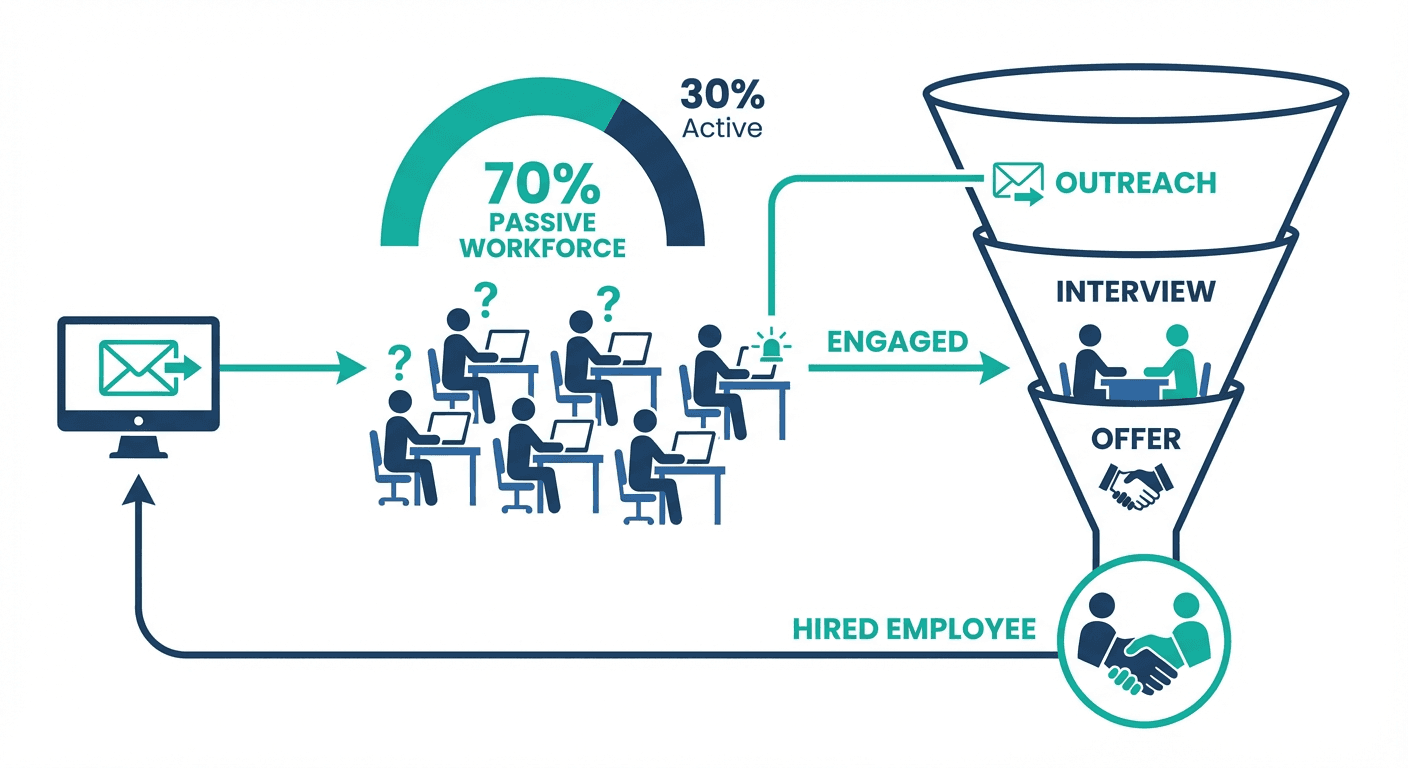
Cold email reaches candidates who are employed and not job hunting, which a job ad cannot. The motion is one researched message per search rather than a timed follow-up sequence, because every touch after the first reaches only people who already declined. Non-repliers move to a talent pool and are approached again when a real event changes their situation.
Key takeaways
- Passive candidates are already employed, so a job posting reaches only the minority who are actively looking.
- One researched message per search carries the whole approach, because every touch after the first is delivered only to people who saw the first and chose not to answer.
- Non-repliers belong in a talent pool with their research attached, rather than in a follow-up queue.
- A later approach needs a real trigger, such as a reorganization, an internal move or a better-fitting role, and its own subject line rather than a reference to the ignored message.
Reviewed and updated October 1, 2026
A senior engineer opens a recruiter email on Tuesday, reads two lines, and archives it. Friday brings a follow-up hanging off the first one. Ten days later, a third. By the fourth, that engineer has a filter routing the domain to a folder they never open, and the company behind it has spent its one shot at somebody it will still want to hire in three years.
The best candidates for most open roles are already employed. A job ad reaches only the minority who are looking; cold email reaches everyone else, and it works when the message respects that the person never asked for it. This guide covers building the list, writing the message, and handling silence, which is the part most recruiting advice gets backwards.
Why cold email reaches candidates a job ad cannot
A job posting is a filter set to catch active seekers. Employee referrals produce excellent hires and stop scaling at the edge of your team's network. A LinkedIn message arrives on the one surface a candidate most associates with recruiter volume, queued behind everybody else who found the same profile that week.
Email has three things going for it in candidate outreach.
It lands in the tool they work in. A professional's inbox is where their actual job happens, so a message there gets read in a working frame of mind rather than a browsing one.
It carries real personalization. A job ad says the same thing to everybody. An email can name the specific system this person built and why it maps to the problem your team has, which is what earns a reply from somebody who is not looking.
It costs less and it is measurable. Contingency search fees are charged as a share of first-year salary and a job board subscription costs the same whether or not it produces a hire. Sourcing directly costs research time and sending infrastructure. Reply rate by segment, role level and message angle then tells you which pitch moves people and which one you have simply been fond of.
What email does not buy you is permission to keep going. That constraint shapes everything below.
One message per campaign, and what replaces the follow-up
We run one message per campaign for cold outbound. No thread replies, no bumps, ever. The full argument is in sales cadence, and the structure of it is this: because a cadence exits on a reply, every touch after the first is delivered exclusively to people who saw your message and chose not to answer. The reply lift from those touches is measured inside the campaign. The deliverability cost is paid by the sending domain across everything else it sends, and no per-campaign report shows you the trade. That side of it is set out in email sequence software.
Three things make the argument stronger in recruiting than in sales.
Silence carries more information here. In B2B sales, a fair reading of non-response is that a busy buyer meant to reply and lost the thread. A passive candidate who did not answer is usually somebody content where they are, which was your premise for calling them passive. Another message does not change that. It demonstrates that the first one was not really addressed to them.
The cost lands on the employer brand and stays there. A candidate who finds your outreach tiresome mentions it, and the people they tell are the professional network you will be sourcing from for years. The reply lift books against one requisition. The damage is charged to every search after it.
What changes a passive candidate's answer is an event, and events are not schedulable. A cadence times the next message off your calendar. Readiness moves on theirs: a reorganization, a new manager, a project that finally shipped, a promotion that did not arrive. Events decide when, if ever, the same email goes out again, never what it says. A role that fits them better than the one you first pitched is a different search, and it gets its own first message.
- Later messages hang off the first one, in view
- Spacing is fixed in advance, before you know anything new
- Every touch reaches only people who already declined
- Nothing in it is new, so it reads as a nudge
- Ends with a breakup email nobody asked for
- One message per search, written to stand alone
- Non-repliers go to a talent pool, not a queue
- A re-send waits for a real change, and only when no fresh candidates remain
- The same email goes out unchanged, so nothing reads as a nudge
- Still reachable in a year, because you did not burn it
Building a list worth one good message
When the message is the only one you get to send, list quality stops being a volume question. Somebody who was never a plausible hire cannot be rescued by better copy.
Define the profile before you source
Write down the skills and level, the companies whose culture actually produces the people you want, the geography and remote policy, and the markers that signal readiness for the step you are offering. Promotions, project ownership and public work say more than tenure alone.
Where the names come from
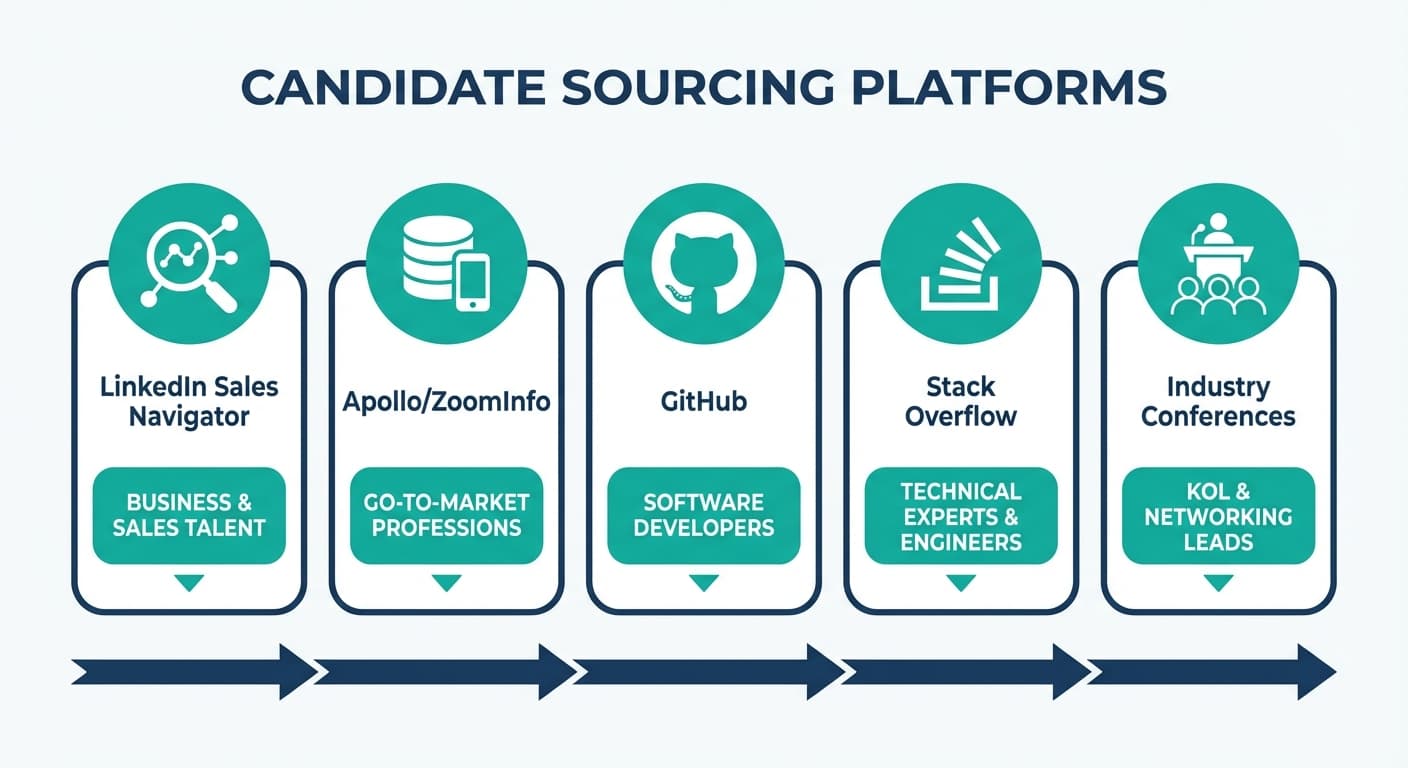
LinkedIn Sales Navigator is the general-purpose seat for identifying people by title, employer and seniority, though you will find addresses elsewhere. Contact databases such as Apollo and ZoomInfo carry business addresses and shorten list building considerably. For technical roles, GitHub and Stack Overflow identify people by what they have built rather than by how they describe themselves. Conference programs and award lists surface senior people who rarely show up in a title search.
Verify the addresses before you send
Invalid addresses damage sender reputation and pull down deliverability for every other message on the domain, including the ones going to candidates you care about most. Verify the list, drop the high-risk addresses rather than gambling on them, and remove bounces after each send. How the tooling differs is covered in email verification tools.
Segment so the message can be specific
Role level matters most, because what moves a senior individual contributor and what moves a director are different things. Company type matters next: somebody at a fifty-person startup and somebody at a bank are weighing different risks. Tenure is the third cut, since a person several years into the same seat is in a different frame from a recent starter.
Personalization is the whole budget

Because there is no second message, everything you were going to spread over a run of messages has to land in one. That caps volume, and it is also what makes the message work.
Research before you write
A few minutes per candidate is enough if you know what you are after: recent work they were visibly responsible for, anything they published or presented, open source or portfolio output, mutual connections, and the shape of their progression.
What actually earns a reply
Name specific work. A project they led, a talk they gave, a product they shipped. This is the sentence that proves a person wrote the email.
Speak to the trajectory. Show that you understand the step they have been building toward, and be honest about whether your role is that step.
Acknowledge that they are probably happy. Saying so out loud is disarming, and it separates you from outreach written as though the recipient were waiting to be rescued.
Use genuine common ground. A shared employer, a shared discipline, a mutual connection who will vouch for you.
Personalization at scale
Build the message in three parts. The opening paragraph is unique to the candidate and carries the research. The middle is role-specific and reusable across everybody you approach for that requisition. The close is standard.
Writing the one message
Subject lines
Keep it short, specific and free of manufactured urgency. Naming their work, their employer or a mutual connection beats anything clever, because it answers the only question the candidate is asking in the preview pane, which is whether this was written for them.
Shapes that work:
- Your work on [Project]
- [Mutual Connection] suggested I get in touch
- [Company] is hiring for [Discipline], and your name came up
Never fake a reply. A first contact dressed up as RE: is deceptive, and a candidate who notices has learned something about your employer they will not unlearn.
Structure and length
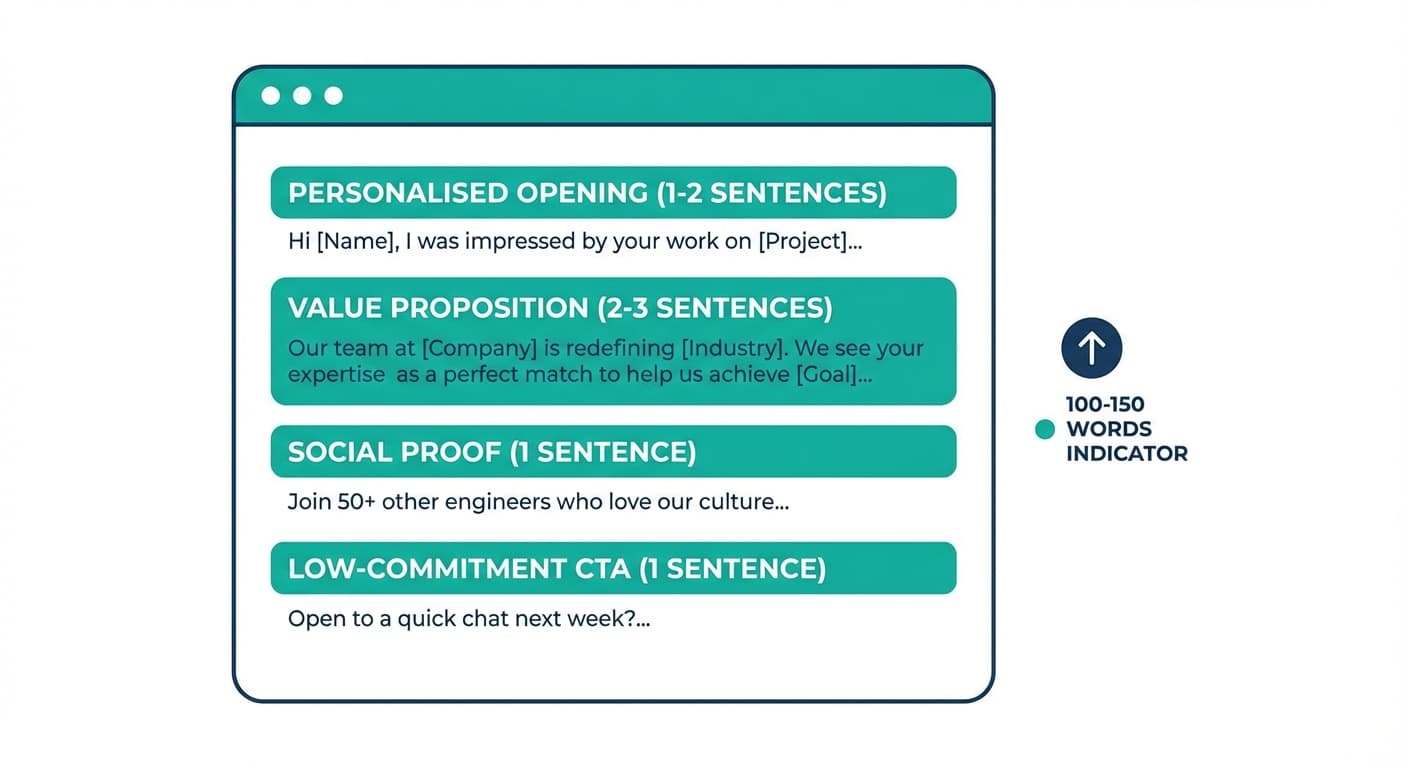
Open with one or two sentences of genuine personalization. Give two or three sentences on why the role is worth their attention, in the terms candidates weigh: scope, the people, the technology, compensation, growth. Add one sentence of credibility. Close with one clear, low-commitment ask. Keep it to roughly 100 to 150 words, because length reads as a demand on their time before a word is processed. Short paragraphs, light formatting, since most of these are read on a phone.
Three recruiting cold email examples
Senior software engineer
Subject: Your distributed systems work
Hi [Name],
I came across your contributions to [Open Source Project] and the way you handled [specific technical problem]. That is an unusual approach to data consistency and it clearly came from running the thing in production.
I am building the infrastructure team at [Company], where we hit the same class of problem at [scale]. The role leads our modernization work and reports to [Title]. Fully remote, base plus equity, real authority over technical direction.
Worth 15 minutes to find out whether it is interesting?
Best, [Your Name]
VP of sales
Subject: [Name], congratulations on the [Region] launch
Hi [Name],
Congratulations on [Company]'s expansion into [Region]. Standing up a new market while holding your existing number does not happen by accident.
[Your Company] is at a similar point: [stage], small commercial team, and a board that wants a sales organization built rather than bought. The role reports to the CEO and carries meaningful equity.
You are very likely doing well where you are. If a confidential conversation is worth 20 minutes, I would welcome it.
[Your Name]
Product designer
Subject: Your Figma Community components
Hi [Name],
Your design system components have been in use on my team for months. The accessibility work in that library is more thorough than most of what ships commercially.
I lead design at [Company] and we need somebody to own our mobile experience end to end. We are [one-line description] serving [user base], and design carries more of the product decision here than at most companies our size.
Happy to tell you more if you are curious.
[Your Name]
When they do not reply
Most candidates will not reply. That is the normal condition of the channel and it is not a signal to send again.
Silence is a result, not a gap
The person is employed and reasonably content. Nothing about that changed between Tuesday and Friday, and a message pointing out that you wrote before adds no information to their decision. Log the non-reply, keep the research, and move on.
Move them to a talent pool
A talent pool is the correct home for a non-replier, and it is worth building deliberately. Keep the research, the profile and the reason you thought they fit, so any future approach starts from what you already know. If a candidate asks to be kept in touch, that is an opt-in and the rules change entirely: they asked, so periodic updates are expected correspondence rather than cold outreach.
Re-send on a trigger, not on a date
If no fresh candidates remain for the search, the same email goes out again unchanged as a new single-message campaign, with no reference to the one they ignored and nothing added. What the events below change is the timing: send it when something has moved on their side, not on a day count. A role that fits them better is a different search, so it gets its own first message.
- Yes: Their employer announced a reorganization, an acquisition or a layoff round
- Yes: They changed roles internally, or the manager they worked for left
- Yes: A product or project they led publicly shipped
- Yes: You opened a different role that fits them better, which is a new search and a new first message
- Yes: Your team changed in a way they would care about, such as a new lead in their discipline
- Yes: They asked to be kept in touch, which makes the next message expected
- No: Some weeks have passed and the requisition is still open
- No: They opened the email and did not answer
Events on the candidate's side are the highest-value class of these. The hiring signal entry covers the same logic read against a company rather than a person.
Do not switch channels to chase
Emailing and then sending a LinkedIn message to the same person about the same role is the same bump wearing a different uniform. It arrives from the same sender, about the same thing, and which tool sent it is invisible to the candidate. If you want more surface area, use other channels for what they are genuinely good at: engaging with the person's public work, showing up where their community does.
Where multi-touch is correct in recruiting
None of the above governs correspondence the candidate is party to. Once they reply, they have initiated, and normal follow-through applies. Recruiting is unusually heavy on this half, and it is where responsiveness earns its reputation.
- Reply arrivesAnswer it the same day
The window in which a passive candidate is curious is short. Speed here does more than any amount of polish in the original message.
- Screening bookedConfirm and set expectations
Who they will speak to, how long, and what the process looks like after it. Removes the most common reason a passive candidate quietly drops out.
- After the callDecision and timeline in writing
Including a no. A clean, fast rejection preserves the relationship for a future search better than silence does.
- Interview loopLogistics, prep and a named contact
One person who owns their experience and answers their questions. Chasing here is expected and welcome.
- Offer stageWritten terms, then check in
They are having conversations at home and possibly with their current employer. Staying reachable is the job.
- If they withdrawClose cleanly and ask to keep in touch
An explicit yes to future contact converts a lost candidate into an opted-in one, which changes what you may send them later.
The same logic covers scheduled commitments. Nobody has ever objected to a note about a call they agreed to.
Mistakes worth avoiding
Leading with your need. An urgent opening is your problem, not the candidate's. What they gain has to arrive before what you want.
Being vague. Exciting opportunity and innovative company are noise. Name the role, the team, the scope and the reason this person specifically.
Re-sending on elapsed time. The same email going out again because a few weeks passed, while fresh candidates are still available, is a nudge with extra steps. Re-send only when no fresh candidates remain, and time it to something that changed for the person.
Sending from an unmonitored address. A candidate who answers into a no-reply mailbox has learned what their time is worth here.
Before you send
List
- Ideal profile written down, sourced from more than one place
- Every address verified, bounces removed after each send
- Segmented by level, company type and tenure
Message
- Subject line short, specific and not disguised as a reply
- Opening names work this person actually did
- Role details specific rather than job description language
- One clear low-commitment ask, under 150 words
Sending setup
- Authenticated sending domain, complete signature
- Reply-to address monitored by a person
- Unsubscribe honored, candidate data stored securely
Non-response plan
- One message per search, with nothing queued behind it
- Non-repliers routed to a talent pool with their research attached
- Any re-send gated on a named trigger and made only when no fresh candidates remain, not on elapsed time
- No channel switch to chase an unanswered email
Start with one message that deserves an answer
Cold email reaches the candidates your job ads never will, and the discipline that makes it work is the discipline of having one shot. Put the research into the first message, be specific about why this person, and accept that most will not answer. Keep the ones who do not, and re-send the same email only once no fresh candidates remain and something has genuinely changed.
Reply rates to expect, and how they move by role and seniority, are in recruiting cold email benchmarks. If you are on the agency side selling placements rather than filling your own roles, that is a different motion with a different buyer, covered in cold email for staffing agencies.
We run cold outbound for B2B clients rather than talent searches, so the above is method rather than a service we sell. What transfers is the discipline: one message per campaign, the angle carrying the work, and any re-send of the same email timed to something that actually changed for the recipient. You can see what a campaign would look like for your market.
Frequently asked questions.
Frequently asked questions- Should you follow up on a recruiting cold email?
- No. A cadence exits on a reply, so every message after the first reaches only people who saw your outreach and chose not to answer, and a passive candidate's silence usually means they are content where they are. Put the effort into one researched message, then wait for something in their situation to change before writing again.
- How do you find email addresses for passive candidates?
- Identify people first through LinkedIn Sales Navigator, contact databases such as Apollo or ZoomInfo, and for technical roles GitHub and Stack Overflow, where you can judge somebody by what they have built. Conference programs and award lists surface senior names that title searches miss. Verify every address before sending, because invalid ones damage the sending domain.
- What should a recruiting cold email say?
- One or two sentences naming specific work this person did, two or three on why the role deserves their attention in the terms candidates weigh, one line of credibility, and one low-commitment ask. Roughly 100 to 150 words. Acknowledging that they are probably happy where they are is disarming and separates you from generic recruiter outreach.
- When is it acceptable to contact a candidate again?
- When something has actually changed. A reorganization or layoff round at their employer, an internal move, a manager leaving, a project shipping, or a role opening on your side that fits them better than the first one. That message needs its own subject line and its own premise, with no reference to the one they ignored.
About the author.

Ben Carden is CRO at RevenueFlow, which builds and operates outbound revenue engines for B2B companies. Previously at Gartner Enterprise. Studied at London School of Economics.
Ben Carden · CRO
Connect on LinkedIn →Explore more.
Ready to scale your outreach?
We build GTM engines that book real meetings. See the receipts.
Related articles.
Cold Email for Influencer Outreach: Partner with Creators
Learn how to use cold email to build authentic influencer partnerships that drive real results for your brand, with proven templates and strategies.
Cold Email for Product Feedback: Complete Strategy Guide
Learn how to use cold email to gather valuable product feedback from users and prospects. Includes proven templates, feedback frameworks, and response optimization techniques.
Cold Email for PR: How to Pitch Journalists and Get Coverage
Learn how to craft cold emails that get journalists to open, read, and respond to your pitches. Includes real templates, timing strategies, and a complete PR outreach checklist.
Cold Email for Reviews: Complete Strategy Guide
Learn how to use cold email to generate authentic product reviews on G2, Capterra, and other platforms. Includes proven templates, compliance guidelines, and review generation frameworks.
Cold Email for Link Building: How to Get Quality Backlinks
Learn how to use cold email outreach to build high-quality backlinks that improve your SEO rankings, with proven templates and strategies that get responses.
Cold Email for Focus Groups: Complete Strategy Guide
Learn how to use cold email to recruit qualified participants for focus groups. Includes proven templates, screening strategies, and group composition frameworks.