Cold Email Templates for Marketing Agencies: 12+ Examples
Thirteen copy-pasteable cold email templates for selling into marketing agencies, grouped by first touch, follow-up, trigger event, referral, and breakup.
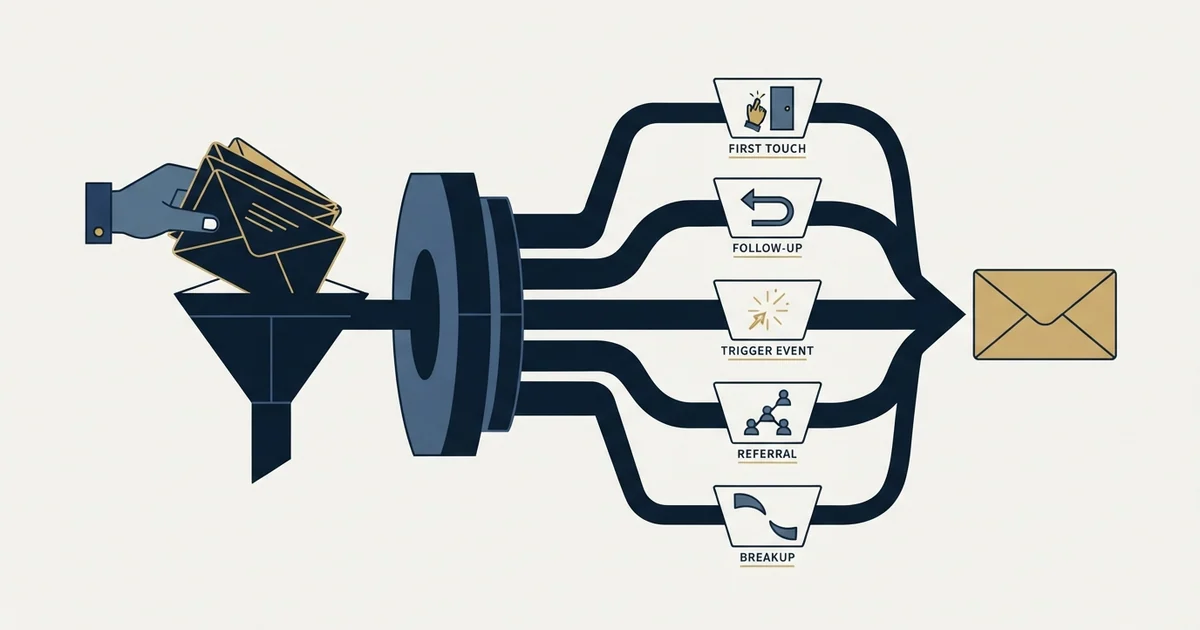
Cold email to marketing agencies works when it speaks to agency economics: gross margin, non-billable hours, delivery capacity, and resellable revenue. Open with a commercial observation, tie the email to a real trigger like a new client win or an open delivery role, keep it under 100 words, and ask permission to send something instead of requesting a meeting.
Key takeaways
- Agency owners are a practitioner audience: many sell or run outbound themselves, so sequence artifacts like broken merge tags and "just circling back" get spotted immediately.
- In an agency, headcount is cost of goods sold, so framing your offer as gross margin or a delayed hire beats generic productivity language.
- The buyer is usually the founder, managing partner, or head of operations, which means one credible five-minute answer often replaces a formal business case.
- Trigger-based outreach outperforms static outreach: new client wins, open delivery roles, service line launches, and account losses all create dated buying windows.
- White-label offers convert better than efficiency tools because agencies live on markup and can resell the capability into retainers they already own.
- Keep every email under 100 words and run five separate campaigns of one message each across several months, ending with a routing ask that sends non-buyers to a dated future window.
Reviewed and updated September 1, 2026
Cold Email Templates for Marketing Agencies: 12+ Examples That Work
Marketing agencies are the hardest cold email audience in B2B, and the reason is structural. The person you are emailing either sells outbound, sits ten feet from someone who does, or has personally written the exact sequence you are running. They know what a merge tag looks like when it fails to render.
Flattery about "loving your work with [Client]" reads as a scrape. Vague promises about "helping agencies scale" read as someone who has never carried a utilization target. What lands is specific commercial reasoning: how your offer affects the agency's margin, its non-billable hours, its retention risk, or its new-business pipeline.
The templates below are grouped by scenario, copy-pasteable, with subject-line options and personalization variables in {{curly_braces}}.
How Marketing Agencies Actually Buy
Headcount is cost of goods sold. In an agency a new hire is a permanent drag on gross margin until that person is billable. Anything that reduces hours per account, or delays a hire, belongs in a margin conversation.
The owner is usually the buyer. The founder, managing partner, or head of operations makes the call, often in one conversation. You rarely need a business case deck. You need a credible five-minute answer.
Buying happens around client events. Agencies purchase when something moves: a logo lands, an account churns, a service line launches, or they win a pitch requiring capability they lack in-house. Trigger-based outreach gets replies. Static outreach gets ignored.
Anything resellable gets attention. Agencies live on markup. An offer they can white-label into a retainer creates revenue, which beats an internal-efficiency tool that only saves cost.
Personalization Variables Worth Collecting
| Variable | Where to source it | Why it matters |
|---|---|---|
{{agency_name}} | Website, LinkedIn | Table stakes |
{{service_line}} | Services page | Determines the pain |
{{client_win}} | Case studies, press | Strongest trigger |
{{open_role}} | Careers page | Signals capacity strain |
{{vertical}} | Client logos | Lets you speak their niche |
{{peer_agency}} | Similar-size agency you served | Social proof that lands |
First Touch Templates
Template 1: The Capacity Strain Opener
Best for: Agencies actively hiring for delivery roles.
Subject options: {{open_role}} search / hiring for {{service_line}}? / question re: the {{open_role}} req
Subject: {{open_role}} search

Hi {{first_name}},

Saw {{agency_name}} is hiring a {{open_role}}. Usually that means
{{service_line}} demand is outrunning the team rather than the team
underperforming.

We handle {{your_service}} for agencies at your headcount, so the work
gets covered without adding a salary to the P&L. {{peer_agency}} used us
to hold off two hires through their busy season.

Worth 10 minutes to see if the math works, or is in-housing the plan
either way?

{{sender_name}}
Why this works for agencies: A job posting is public proof of a bottleneck, and it prices your offer automatically. The owner knows what that role costs fully loaded, so "instead of a salary" is math they run in three seconds. The closing question gives them an easy, honest out.
Template 2: The Margin Math Opener
Best for: Retainer-model agencies where delivery hours squeeze profit.
Subject options: hours per {{service_line}} account / {{agency_name}} retainer margins / non-billable time on {{service_line}}
Subject: hours per {{service_line}} account

{{first_name}},

On {{service_line}} retainers, most of the margin leak we see at agencies
your size isn't the delivery work. It's the reporting, QA, and account
admin wrapped around it.

We take that layer off {{service_line}} accounts so your senior people
stay billable. Usually shows up as a few points of gross margin rather
than a headcount change.

If margin on those accounts is already where you want it, ignore this.
If not, I'll send the one-pager.

{{sender_name}}
Why this works for agencies: It names the problem in the vocabulary owners use with their accountant (gross margin, billable, non-billable). The soft close asks permission to send an asset, which converts better than a calendar link on a first touch.
Template 3: The White-Label Revenue Opener
Best for: Anything an agency can resell into existing accounts.
Subject options: adding {{your_service}} to {{agency_name}} retainers / resell, not rebuild / new line item for existing clients
Subject: adding {{your_service}} to {{agency_name}} retainers

Hi {{first_name}},

Your {{vertical}} clients are almost certainly asking for
{{your_service}} already. Building it in-house is a hiring problem.
Turning the request down is a revenue problem.

We run {{your_service}} white-label under {{agency_name}}'s brand. You
set the markup, we stay invisible, your team keeps the client
relationship.

Want the partner terms and a sample deliverable so you can see what your
clients would receive?

{{sender_name}}
Why this works for agencies: It reframes your offer as a new revenue line inside accounts they already own, the most attractive shape an offer takes for a services business. "We stay invisible" preempts the biggest white-label objection, client-relationship risk.
Re-Approach Templates

These are not second notes under a first one. Each is a separate campaign, sent weeks later to the agencies that did not answer, carrying its own subject line and its own reason to exist.
Template 4: The Value-Add Re-Approach
Best for: agencies that let the first campaign pass without a reply.
Subject options: how {{peer_agency}} scoped {{your_service}} / scope language you can lift / {{your_service}} inside a retainer
Subject: how {{peer_agency}} scoped {{your_service}}

{{first_name}}, something useful either way.

We wrote up how {{peer_agency}} structured {{your_service}} inside their
existing retainers, including the scope language they used with clients.

Want me to send it? No call required.

{{sender_name}}
Why this works for agencies: Owners will trade attention for something they can lift straight into their own scope documents. The offer costs nothing and requires no meeting, which removes the reason to ignore you.
Template 5: The One-Line Question
Subject options: {{service_line}} capacity: this quarter or next? / one question, three words
Subject: {{service_line}} capacity: this quarter or next?

{{first_name}}, is {{service_line}} capacity a this-quarter problem or a
next-quarter one?

{{sender_name}}
Why this works for agencies: Owners context-switch between client fires all day. A question answerable in three words gets more replies than a paragraph restating your value proposition, and "next quarter" is an answer you can schedule against.
Template 6: The Smaller Commitment Reframe
Subject options: one account, 30 days / the smallest version of this
Subject: one account, 30 days

{{first_name}},

A full engagement is usually the wrong level to start at.

Most agencies we work with don't start with one. They start
with one account, usually the one where scope creep is worst, and run it
30 days to see whether the hours actually come down.

If there's an account like that at {{agency_name}}, that's the version
worth talking about.

{{sender_name}}
Why this works for agencies: Agencies are cash-flow sensitive and have been burned by vendors who underdelivered. One account and one month drops perceived risk to near zero, and "the account where scope creep is worst" is a phrase every owner can attach a client name to.
Trigger Event Templates
Template 7: The New Client Win
Subject options: congrats on {{client_win}} / {{client_win}} onboarding / staffing {{client_win}}
Subject: {{client_win}} onboarding

Hi {{first_name}},

Congrats on {{client_win}}. Accounts that size usually get absorbed by
whoever has the least capacity to absorb them.

We plug into {{service_line}} delivery during onboarding so new logos
don't destabilize the accounts you already have. Short engagement, no
long contract.

If the team has room, genuinely ignore me. If not, I can be useful this
month.

{{sender_name}}
Why this works for agencies: A new logo is the highest-intent trigger in this vertical because it creates a dated staffing problem. Naming the real risk (destabilizing existing accounts) shows you understand that agency churn starts when attention shifts to the newest client.
Template 8: The Account Loss or Contraction
Subject options: new business gap / pipeline for Q{{quarter}} / replacing revenue
Subject: pipeline for Q{{quarter}}

{{first_name}},

When an agency loses a retainer, the instinct is to push the existing
team harder on new business. That usually costs delivery quality on the
accounts still paying.

We run outbound for {{vertical}} agencies so pipeline gets rebuilt
without pulling senior people off client work.

Worth a short call, or is pipeline already covered?

{{sender_name}}
Why this works for agencies: Never name the lost client. The template lands because it addresses the second-order problem, delivery quality degrading while everyone chases new business.
Template 9: The New Service Line or Acquisition
Subject options: the {{service_line}} launch / {{agency_name}} + {{acquired_agency}} / new {{service_line}} offering
Subject: the {{service_line}} launch

Hi {{first_name}},

Saw {{agency_name}} announced {{service_line}}. The hard part is the gap
between announcing a capability and having enough delivery depth to sell
it confidently in a pitch.

We backstop that gap. You sell it now, we deliver underneath while your
team ramps.

Want the partner overview?

{{sender_name}}
Why this works for agencies: A launched service line is a public commitment with an unglamorous private reality, which is that the capability is often one person deep. Removing the delivery risk while they sell aggressively fits where they are.
Referral Templates

Template 10: The Mutual Connection
Subject options: {{referrer_name}} suggested I reach out / via {{referrer_name}} / {{referrer_name}} + {{your_service}}
Subject: {{referrer_name}} suggested I reach out

Hi {{first_name}},

{{referrer_name}} at {{referrer_agency}} mentioned you when I asked who
else was dealing with {{specific_problem}}. We handle {{your_service}}
for them, mostly on {{service_line}} accounts.

Happy to show you the setup, or send the scope doc if you'd rather skim
first.

{{sender_name}}
Why this works for agencies: Owners trade vendor recommendations constantly, in Slack groups and peer networks. A named referrer converts a cold email into a semi-warm one. Get the referrer's permission first, because in a small vertical this gets checked.
Template 11: The Referral Ask
Best for: A poor-fit agency that is still a friendly contact.
Subject options: wrong fit, quick ask / who else should I talk to? / not for you, but maybe
Subject: wrong fit, quick ask

{{first_name}},

Looking at {{agency_name}}'s work, {{your_service}} probably isn't a fit
for how you're structured. No pitch.

One ask: we work best with {{vertical}} agencies between {{size_range}}
dealing with {{specific_problem}}. If someone comes to mind, an intro
would be appreciated, and I'll return the favor when I hear of anyone
looking for {{their_service_line}}.

{{sender_name}}
Why this works for agencies: Disqualifying yourself is disarming and costs nothing on a prospect who was never going to buy. The reciprocal offer matters, because agencies always want new business and remember whoever offered it.
Routing Templates
Template 12: The Useful Exit
Subject options: {{resource_name}}, no strings / one thing worth keeping
Subject: {{resource_name}}, no strings

{{first_name}},

Sending this whether or not {{specific_problem}} is anywhere on your
list: {{resource_name}}, useful regardless of whether we ever work
together: {{link}}

If it does become a priority at {{agency_name}}, reply to this one and
I'll pick it up with full context.

{{sender_name}}
Why this works for agencies: It delivers something usable and asks for nothing, which is rare enough to be remembered. Agency buying cycles are triggered by events you cannot see, so being easy to re-engage in six months is worth more than another ask now.
Template 13: The Three-Way Routing Ask
Subject options: yes, later or never on {{your_service}}? / one question, three answers / yes or no on {{your_service}}
Subject: yes, later or never on {{your_service}}?

{{first_name}},

One question, and any of three answers is useful to me: is
{{specific_problem}} not a priority, not a priority right now, or not
something you'd ever outsource?

Whichever it is, I'll route accordingly and stop guessing.

{{sender_name}}
Why this works for agencies: Multiple-choice questions get answers from busy people because replying takes one word. The three options give you clean routing between disqualification, a nurture date, and a genuine never.
Campaign Structure

One message per campaign. An agency that does not answer is never written to again underneath the email it already passed over. It goes into the next campaign weeks later with a fresh subject line and a different premise. A second note under an ignored one reads as pressure, it is delivered to exactly the readers most likely to report it, and the reputation cost is charged to the sending domain across every other campaign it carries. A new email earns a fresh open. The full argument, with the numbers from our own campaigns, is in why we stopped using follow-ups.
| Campaign | Ask | |
|---|---|---|
| 1, on the trigger | Trigger-based first touch (Templates 1, 7, 9) | Permission to send an asset |
| 2, four weeks on | Value-add re-approach (Template 4) | Send the asset |
| 3, eight weeks on | One-line question (Template 5) | Answer one question |
| 4, twelve weeks on | Smaller commitment reframe (Template 6) | One account, 30 days |
| 5, on the next trigger | Useful exit or routing ask (Template 12 or 13) | Keep or route |
Keep every email under 100 words. Agency owners read on their phone between client calls, and anything needing a scroll gets archived.
Customizing These Templates
Replace {{your_service}} with an outcome. "Paid social management" is a category. "Covering paid social so you don't hire a third media buyer" is an outcome with a number attached.
Match social proof to their size. A 12-person agency does not care what you did for a 400-person holding-company shop, and often reads it as a signal they will be your smallest, least-served client. Keep {{peer_agency}} examples within roughly 2x of their headcount.
Delete the compliment. Nearly every agency template opens by praising their portfolio. Cutting that line and starting with the commercial observation makes the email read like a peer wrote it. Teams that run outbound for a living, including ours at RevenueFlow, usually get more lift from removing openers than from adding personalization to them.
Mistakes That Kill Agency Outreach

Do not pitch an agency the thing they sell. If they run outbound and you sell outbound tooling, lead with what your product does for their clients.
Do not leave sequence artifacts. Broken merge tags and "just circling back" are tells a practitioner audience reads instantly.
Do not send to hello@ or info@. Those route to a new-business inbox staffed by someone whose job is filtering you out.
Do not ask for 30 minutes on a first touch. Ask permission to send something, then earn the meeting on the reply.
Do not ignore seasonality. Agencies are least responsive during Q4 campaign crunch and most responsive in January and mid-summer, when they are planning capacity.
- No: pitch an agency the thing they sell
- No: leave sequence artifacts
- No: send to hello@ or info@
- No: ask for 30 minutes on a first touch
- No: ignore seasonality
The Agency Outreach Checklist
- Contact is the owner, managing partner, or head of operations, not a generic inbox
- Email opens with a commercial observation, not a compliment
- Offer is framed as margin, capacity, resellable revenue, or pitch win rate
- Social proof references an agency within 2x of their headcount
- Every merge tag has a verified fallback value
- Body is under 100 words
- First-touch ask is permission to send something, not a meeting
- Every campaign is a single email tied to a real event, with its own subject line
If you would rather have this built and run for you, book a strategy call with RevenueFlow. We build the agency list, write the campaigns against real triggers, run the sending infrastructure, and hand you booked meetings instead of templates.
Related Reading
- Cold Email Templates for Customer Success Managers: 10+ Examples by Scenario
- Best CRM Tools for Marketing Agencies (2026)
- Best Email Sending Tools for Marketing Agencies (2026)
If you would rather have this run for you, RevenueFlow books qualified meetings on a pay-per-meeting basis and publishes client results.
Frequently asked questions.
Frequently asked questions- What should the subject line be when cold emailing a marketing agency?
- Use lowercase, specific, internal-sounding subject lines tied to something real about the agency: "Head of Paid Search search", "hours per SEO account", or "congrats on [Client Name]". Agency owners read hundreds of vendor emails, so anything that sounds like marketing copy ("Partnership opportunity", "Scale your agency") gets archived unopened. Reference a trigger event, an open role, or a service line.
- Who is the right person to email at a marketing agency?
- At most agencies it is the founder, managing partner, or head of operations. Avoid hello@ and info@ addresses, which route to a new-business inbox staffed by someone whose job is to filter vendors out. At larger agencies (roughly 75 people and up), a COO, director of client services, or head of growth may own the decision instead.
- Should I follow up when an agency does not reply?
- None. Send one message per campaign, then re-approach the agencies that did not answer with separate campaigns: a value-add email at four weeks, a one-line question at eight, a smaller-commitment reframe at twelve, and a routing ask at the end. Agency owners are interrupt-driven, so a short email asking one answerable question outperforms a long one that restates your pitch.
- Why do most cold emails to marketing agencies get ignored?
- Three reasons. The email opens with a compliment about their portfolio, which reads as scraped. The offer is framed as generic scale or efficiency rather than margin, capacity, or resellable revenue. And it arrives with no trigger behind it, so nothing about the agency's current situation makes the timing relevant.
- Do white-label offers actually work better with agencies?
- They tend to, because they create revenue rather than only saving cost. An agency can resell a white-label service into existing retainers at their own markup without hiring for the capability. The main objection is client-relationship risk, so address it directly by stating that you stay invisible and the agency keeps the client relationship.
About the author.

Ben Carden is CRO at RevenueFlow, which builds and operates outbound revenue engines for B2B companies. Previously at Gartner Enterprise. Studied at London School of Economics.
Ben Carden · CRO
Connect on LinkedIn →Explore more.
Ready to scale your outreach?
We build GTM engines that book real meetings. See the receipts.
Related articles.
10 B2B Cold Email Templates for One-Message Sends
Ten B2B cold email templates written for a single send, with the four slot structure underneath them and the test that separates a good example from a bad one.
Cold Email Templates for Customer Success Managers
Eleven cold email templates for customer success managers, covering champion change, expansion, renewal rescue, and win-back, with subject lines and timing.
14 Renewal Email Templates That Retain Customers
Master subscription and contract renewals with 14 proven email templates. Reduce churn, lock in renewals early, and maintain customer relationships.
13 Case Study Request Email Templates That Get Results
Get proven email templates for requesting case studies, video testimonials, and written reviews from your happiest customers. Includes templates for every stage from initial ask to final approval.
13 Demo Follow-Up Email Templates to Close More Deals
Proven demo follow-up email templates for every scenario, from same-day recaps to re-engaging stalled prospects and handling competitive evaluations.
Email Subject Line Capitalization: What the Guides Say
What the style authorities actually rule on subject line case, what the published tests measured, and the default for a one to one sales email.