Cold Email Templates for Agriculture: 12+ Examples That Work
Fourteen copy-pasteable cold email templates for selling into agriculture, grouped by first touch, follow-up, trigger event, referral, and breakup.
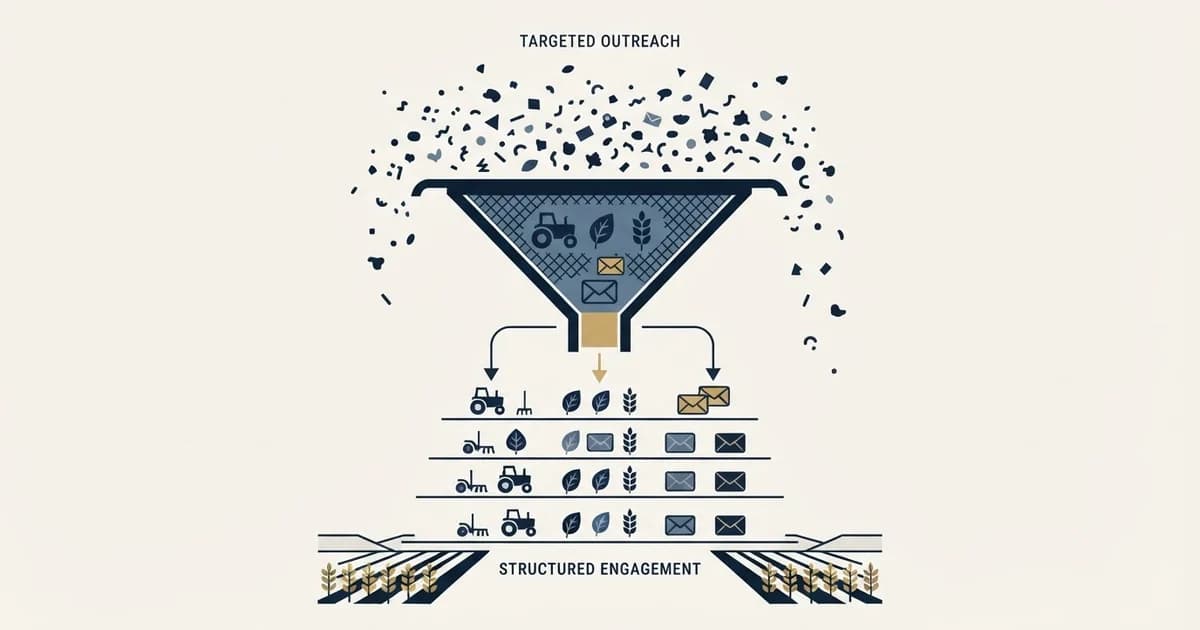
Cold email templates for agriculture work when they lead with per-acre or per-head economics, cite a peer operation nearby, stay under 120 words, and land outside planting and harvest. December through February and November are the strongest sending windows for North American row crop buyers.
Key takeaways
- The 2022 USDA Census of Agriculture counted 1.9 million US farms averaging 463 acres, so most agriculture cold email targets are owner-operators who buy, run, and read email themselves.
- December through February is the strongest sending window for row crop operations, with November a strong second because harvest results are known and Section 179 drives equipment decisions.
- Hold most campaigns from March to mid-May and August through October; planting and harvest silence reflects workload rather than disinterest.
- Translate every value proposition into dollars per acre, bushels per acre, or cost per head before sending, because that is the unit growers budget in.
- A reference from an operation two counties over outperforms an enterprise logo list; geography is the credibility unit in agriculture.
- First-touch asks should be smaller than a demo: a number, a name, or a yes or no on sending a document.
Reviewed and updated August 29, 2026
Cold Email Templates for Agriculture: 12+ Examples That Work
Send a cold email to a corn grower in central Iowa at 2 p.m. on May 12 and it will sit unopened until the second week of June. Planting does not pause for your campaign. Send that same email on January 22, when the same grower is sitting at a kitchen table pricing seed, fertilizer, and crop insurance for the coming year, and you have a real shot at a reply.
That timing gap is the single biggest reason cold email underperforms in agriculture. The second is language. These buyers run businesses on thin, volatile margins, and they have spent decades being pitched by vendors who say "platform" and "solution" without ever mentioning a cost per acre. The templates below are built around both realities: send at the right point in the season, and lead with a number the operation can check against its own books.
The 2022 Census of Agriculture counted 1.9 million US farms averaging 463 acres, so most of your list is small and mid-sized operations where the owner is the buyer, the operator, and the person reading email from a tractor cab. Source: USDA NASS Census of Agriculture.
What Agriculture Buyers Respond To
Per-acre or per-head math. A grower thinks in dollars per acre, bushels per acre, cost per head, and cents per pound. If your value proposition cannot be expressed that way, translate it before you send.
Local proof over logo proof. A reference from an operation two counties over carries more weight than a Fortune 500 customer list. Geography is the credibility unit here.
Short and mobile-readable. Long emails get skimmed on a phone in bad signal. Keep first touches under 120 words with a single ask.
Patience across the calendar. A no in April is often a yes in December.
Personalization Variables That Actually Move Replies
| Variable | Where to source it | Why it lands |
|---|---|---|
{{crop}} / {{livestock_type}} | USDA NASS county data, state ag directories | Signals you know what they grow or raise |
{{acreage}} / {{head_count}} | Plat books, FSA records, company site | Lets you scale economics to their operation |
{{county}} / {{region}} | Address data | Anchors local proof and weather context |
{{peer_operation}} | Customer list, co-op membership rosters | Supplies the neighbor reference that builds trust |
{{per_acre_number}} | Your own customer data | Converts the pitch into their unit of measure |
{{season_stage}} | USDA crop progress reports | Shows you understand their calendar |
{{deadline}} | Insurance closing dates, program signups, tax year end | Borrows urgency they already feel |
First-Touch Templates

Template 1: The Per-Acre Opener
Best for: Row crop operators, 500 to 5,000 acres
Subject: {{per_acre_number}}/acre on {{crop}} in {{county}}
Alt subject: quick {{crop}} question

Hi {{first_name}},

We work with {{crop}} operations around {{county}} on {{problem_area}}. On
roughly {{acreage}} acres, the operations we work with are seeing about
{{per_acre_number}} per acre difference, mostly from {{specific_driver}}.

I don't know if those numbers hold on your ground. Different soil, different
program.

Worth a 10-minute call after {{season_stage}} to run your actual numbers?
If it doesn't pencil out, I'll say so.

{{sender_name}}
{{phone}}
Why this works for agriculture: It opens in the buyer's own unit of measure, admits uncertainty instead of overclaiming, and defers the meeting to a point in the season when they have time. The "if it doesn't pencil out" line disarms a group that has been oversold for years.
Template 2: The Neighbor Reference
Best for: Any operation where you already have a customer within 50 miles
Subject: {{peer_operation}} in {{county}}

{{first_name}},

We've been working with {{peer_operation}} over in {{peer_county}} on
{{problem_area}} since {{start_period}}. {{peer_contact}} said I should talk
to a few more {{crop}} guys in the area, so here I am.

The short version: {{one_sentence_result}}.

Happy to have {{peer_contact}} tell you about it directly instead of hearing
it from a salesperson. Want me to connect you?

{{sender_name}}
Why this works for agriculture: Peer validation is the dominant trust mechanism in farming communities. Offering a conversation with the reference, rather than a demo with you, removes the sales pressure and makes the ask nearly free to accept.
Template 3: The Agronomist and Crop Advisor Angle
Best for: Certified crop advisers, independent agronomists, and consultants who influence multiple operations
Subject: {{crop}} {{problem_area}} across your book

Hi {{first_name}},

You're advising somewhere north of {{client_count}} operations on {{crop}}.
That means {{problem_area}} shows up in your recommendations more than most.

We built {{product}} specifically for the advisor side of that: {{advisor_benefit}}
without adding a scouting trip.

Not asking you to sell anything. If it's useful, your growers ask you for it.
Want the technical writeup, or is a 15-minute walkthrough easier?

{{sender_name}}
Why this works for agriculture: Agronomists are high-leverage influencers who resent being treated as a distribution channel. Framing the offer around recommendation quality, and explicitly not asking them to sell, respects their professional independence.
Template 4: The Co-op or Ag Retailer GM
Best for: Cooperative general managers, ag retail branch managers, grain merchandisers
Subject: member retention at {{co_op_name}}

{{first_name}},

Co-ops your size usually lose members on service consistency, not price.
{{problem_area}} is where that shows up first.

We handle {{capability}} for {{peer_co_op}}, which cut {{specific_metric}}
and gave their agronomy team back roughly {{time_saved}} during spring rush.

Board meeting cycles being what they are, I'd rather get in front of this
early. Are you the right person for this, or should I be talking to your
{{alternate_role}}?

{{sender_name}}
Why this works for agriculture: Co-ops answer to member boards and budget annually, so referencing board timing shows structural literacy. The routing question gives a busy GM an easy reply.
Template 5: The Livestock Operation Opener
Best for: Dairy, cattle, swine, and poultry operations
Subject: {{specific_metric}} on {{head_count}} head

Hi {{first_name}},

Running {{head_count}} head, a {{small_delta}} move in {{specific_metric}}
is worth about {{dollar_impact}} a year to you. That's the whole reason I'm
writing.

We work with {{livestock_type}} operations on {{problem_area}}. {{peer_operation}}
went from {{before_state}} to {{after_state}} in {{timeframe}}.

No pitch deck. Just want to know whether your {{specific_metric}} is where
you want it. Reply with a number and I'll tell you if we can help.

{{sender_name}}
Why this works for agriculture: Livestock producers track a handful of metrics obsessively. Asking for a single number as the reply is a much lower bar than a calendar slot.
Re-Approach Templates
We run one message per campaign. An operation that does not reply is never written to again underneath the note it already passed over. It goes into a fresh campaign weeks later, carrying its own subject line and its own reason to exist. A second note under an ignored one reads as pressure and is delivered to exactly the readers most likely to report it, so the reputation cost is charged to the sending domain across every other campaign it carries. A new email earns a fresh open. The full argument, with the numbers from our own campaigns, is in why we stopped using follow-ups.
Template 6: The One-Number Re-Approach
Best for: A later campaign, four to eight weeks on, to operations that did not answer
Subject: {{specific_result}} on {{peer_acreage}} acres of {{crop}}

{{first_name}},

One number worth having: {{peer_operation}} saw {{specific_result}} in the
first {{timeframe}}, on {{peer_acreage}} acres of {{crop}}.

That's the whole email. Happy to run your numbers whenever it makes
sense.

{{sender_name}}
Why this works for agriculture: It leads with information instead of asking again. A checkable number in its own subject line earns an open where "just following up" does not, and it arrives as a new email rather than underneath one this grower has already skipped.
Template 7: The Season-Aware Pause
Best for: Any campaign that lands mid-planting or mid-harvest
Subject: after {{season_stage}}

{{first_name}},

You're in the middle of {{season_stage}}, so I'll get out of your way.

Putting a note in my calendar for {{specific_future_date}}, which should be
after you're through it. If {{problem_area}} is still on the list then, we
can talk. If it isn't, tell me and I'll leave you alone.

Good luck with the rest of it.

{{sender_name}}
Why this works for agriculture: Explicitly acknowledging the field calendar is the fastest credibility signal available to an outsider. Naming a specific return date converts a silent contact into a scheduled one.
Template 8: The Resource Drop
Best for: A later campaign to prospects who opened an earlier one but never replied
Subject: {{crop}} {{problem_area}} numbers, no call required

{{first_name}},

Put together a one-pager on what {{client_count}} {{crop}} operations in
{{region}} are actually spending on {{problem_area}}, including the ones
that aren't customers.

Attaching it because it's useful whether or not you ever talk to me.

If anything in it looks off against your operation, I'd like to hear it.

{{sender_name}}
Why this works for agriculture: Regional benchmark data is scarce and valuable to operators who rarely see peer cost figures. Inviting disagreement flatters their expertise and often produces replies from people who would never book a call.
Trigger-Event Templates

Template 9: The Input Cost or Commodity Move
Best for: Sending within a week of a notable price move in inputs or output commodities
Subject: {{input_name}} pricing and your {{crop}} program

{{first_name}},

{{input_name}} pricing moved {{direction}} again this month, which changes
the math on {{crop}} programs for {{upcoming_season}}.

Most of the operations we work with are handling it by {{tactical_response}},
which recovers roughly {{per_acre_number}} per acre.

I've got the breakdown by {{crop}} if it's useful. Want it?

{{sender_name}}
Why this works for agriculture: Input and commodity swings are the news growers actually track, and they force budget conversations that were otherwise closed. Offering a breakdown rather than a meeting keeps the ask small.
Template 10: The Expansion or Equipment Trigger
Best for: After a land purchase, facility build, new hire, or major equipment announcement
Subject: the {{new_asset}} at {{operation_name}}

{{first_name}},

Saw {{operation_name}} picked up {{new_asset}}. Congratulations.

The operations we work with usually hit {{predictable_problem}} in the first
{{timeframe}} after a move like that, mostly because {{root_cause}}.

We fixed that for {{peer_operation}} after their {{similar_expansion}}.
Worth 10 minutes before it becomes a problem, or would you rather I check
back in {{timeframe}}?

{{sender_name}}
Why this works for agriculture: Expansion creates predictable, near-term operational strain. Naming the problem before it happens positions you as someone who has watched the pattern before.
Template 11: The Deadline Trigger
Best for: Crop insurance sales closing dates, USDA program signup windows, nutrient management filing, and tax year end
Subject: before the {{deadline_name}} deadline

Hi {{first_name}},

{{deadline_name}} is {{deadline_date}}. After that, {{consequence}} for the
{{upcoming_season}} season.

If {{problem_area}} is something you were planning to address this year,
now is the window. We can have {{quick_win}} in place inside {{short_timeframe}}.

If it's already handled, ignore this and I'll check back after {{season_stage}}.

{{sender_name}}
Why this works for agriculture: The vertical runs on hard external deadlines growers already have circled, including crop insurance sales closing dates published by USDA's Risk Management Agency and the Section 179 equipment expensing rules that drive December purchases. Borrowing a real deadline beats inventing scarcity. Source: USDA Risk Management Agency.
Referral Templates
Template 12: The Routing Request
Best for: Larger operations, co-ops, and food processors where you cannot identify the buyer
Subject: wrong person?

{{first_name}},

I may have the wrong person, which is on me.

We handle {{capability}} for {{crop}} operations around {{acreage}} acres.
At {{operation_name}}, is that you, your {{alternate_role_1}}, or your
{{alternate_role_2}}?

A name is all I need. I won't say you sent me if you'd rather I didn't.

{{sender_name}}
Why this works for agriculture: Farm and co-op org charts are informal and rarely published, so a routing question is honest rather than a trick. It is answerable in four words.
Template 13: The Warm Introduction Ask
Best for: After a successful engagement with a peer operation
Subject: {{referrer_name}} mentioned you

Hi {{first_name}},

{{referrer_name}} at {{peer_operation}} mentioned you run {{operation_name}}
and deal with a lot of the same {{problem_area}} they did.

We've been working with them since {{start_period}} on {{capability}}.
{{one_sentence_result}}.

{{referrer_name}} offered to walk you through it himself, which is probably
more useful than hearing it from me. Want me to set that up?

{{sender_name}}
Why this works for agriculture: Naming the referrer in the subject line clears the trust hurdle before the email is opened. Handing the conversation to the peer removes you from the middle of it.
Seasonal Close Templates

Template 14: The Seasonal Standing Offer
Best for: The last campaign of the year into a list, without burning the contact
Subject: parking this until {{future_season}}

{{first_name}},

Short one on {{problem_area}}. If the timing is wrong or it isn't a
priority, both are fine and neither needs a reply.

I'll come back once around {{future_season}}, when {{seasonal_reason}},
and leave it alone until then unless you tell me otherwise.

If something changes before that, my number is below.

{{sender_name}}
{{phone}}
Why this works for agriculture: It respects the calendar instead of guilting the prospect, and commits to exactly one future campaign rather than an open-ended chase. Growers buried in field work often reply to this one specifically to keep the door open.
The Agriculture Sending Calendar
Timing beats copy here. A rough guide for North American row crop operations:
| Window | Buyer state | Send or hold |
|---|---|---|
| December to February | Planning, budgeting, tax decisions, trade shows | Best window of the year |
| March to mid-May | Planting, insurance deadlines passed | Hold, deadline triggers only |
| Late May to July | In-season management | Light touch, resource drops |
| August to October | Harvest | Hold, except pause and standing-offer emails |
| November | Post-harvest, results known, Section 179 timing | Strong second window |
Livestock, dairy, and specialty crop operations run different clocks. Verify the calendar for your segment before building a campaign calendar around it.
Customizing These Templates Without Breaking Them

Verify every variable before you send. A wrong crop or county does more damage than no personalization at all, because the recipient will assume the rest of your claims are equally sloppy.
Strip the marketing vocabulary. Say what the thing does and what it costs. Keep one ask per email, and make the first ask smaller than a demo: a number, a name, a yes or no on sending a document. Space campaigns 60 to 120 days apart, with gaps that track the season.
The mistakes that cost the most are sending during planting or harvest and reading the silence as disinterest, leading with technology instead of economics, claiming yield improvements without the trial conditions behind them, and treating a co-op like a family farm.
If you'd rather have this built and run for you, RevenueFlow does done-for-you cold email for companies selling into agriculture: list building against crop and acreage data, seasonal campaign timing, and deliverability infrastructure. Book a strategy call.
Related Reading
- Cold Email Templates for Customer Success Managers: 10+ Examples by Scenario
- 15 Objection Handling Email Templates That Actually Work
- 8 Sales Pitch Email Templates That Convert
If you would rather have this run for you, RevenueFlow books qualified meetings on a pay-per-meeting basis and publishes client results.
Frequently asked questions.
Frequently asked questions- When is the best time to send cold emails to farmers?
- December through February is the strongest window for North American row crop operations, when growers are budgeting seed, fertilizer, and crop insurance for the coming year. November is a solid second window because harvest results are in and Section 179 tax planning drives equipment decisions. Hold most campaigns during planting (March to mid-May) and harvest (August to October).
- How long should a cold email to an agriculture buyer be?
- Keep first touches under 120 words with a single ask. Agriculture buyers frequently read email on a phone in poor signal between field tasks, so anything longer gets skimmed or skipped. Put the number that matters in the first two sentences and make the ask smaller than a demo request.
- What personalization actually works for cold email in agriculture?
- Crop or livestock type, acreage or head count, county, and a named peer operation nearby. Those four variables prove you researched the operation rather than bought a list. Accuracy matters more than volume here: a wrong crop or wrong county causes the recipient to discount every other claim in the email.
- Should I email farm owners directly or go through the co-op?
- Both, with different messaging. Owner-operators respond to per-acre economics and peer references. Co-op general managers and ag retail branch managers respond to member retention, agronomy team capacity, and board budget timing. Co-ops also work as a channel, so a single co-op relationship can put you in front of hundreds of grower members.
- Do closing emails work with agriculture prospects?
- Yes, when they are framed around the season instead of guilt. A closing email that says you are parking the file and will come back at a named future point, post-harvest or January planning, often gets a reply from growers who are interested but buried in field work. Commit to exactly one future campaign and honor it.
About the author.

Ben Carden is CRO at RevenueFlow, which builds and operates outbound revenue engines for B2B companies. Previously at Gartner Enterprise. Studied at London School of Economics.
Ben Carden · CRO
Connect on LinkedIn →Explore more.
Ready to scale your outreach?
We build GTM engines that book real meetings. See the receipts.
Related articles.
10 B2B Cold Email Templates for One-Message Sends
Ten B2B cold email templates written for a single send, with the four slot structure underneath them and the test that separates a good example from a bad one.
Cold Email Templates for Customer Success Managers
Eleven cold email templates for customer success managers, covering champion change, expansion, renewal rescue, and win-back, with subject lines and timing.
14 Renewal Email Templates That Retain Customers
Master subscription and contract renewals with 14 proven email templates. Reduce churn, lock in renewals early, and maintain customer relationships.
13 Case Study Request Email Templates That Get Results
Get proven email templates for requesting case studies, video testimonials, and written reviews from your happiest customers. Includes templates for every stage from initial ask to final approval.
13 Demo Follow-Up Email Templates to Close More Deals
Proven demo follow-up email templates for every scenario, from same-day recaps to re-engaging stalled prospects and handling competitive evaluations.
Email Subject Line Capitalization: What the Guides Say
What the style authorities actually rule on subject line case, what the published tests measured, and the default for a one to one sales email.