Enterprise Cold Email Benchmarks: Reaching Fortune 500
Industry benchmark data for cold email campaigns targeting enterprise companies, including open rates, reply rates, and meeting conversion metrics by company size and decision-maker level.
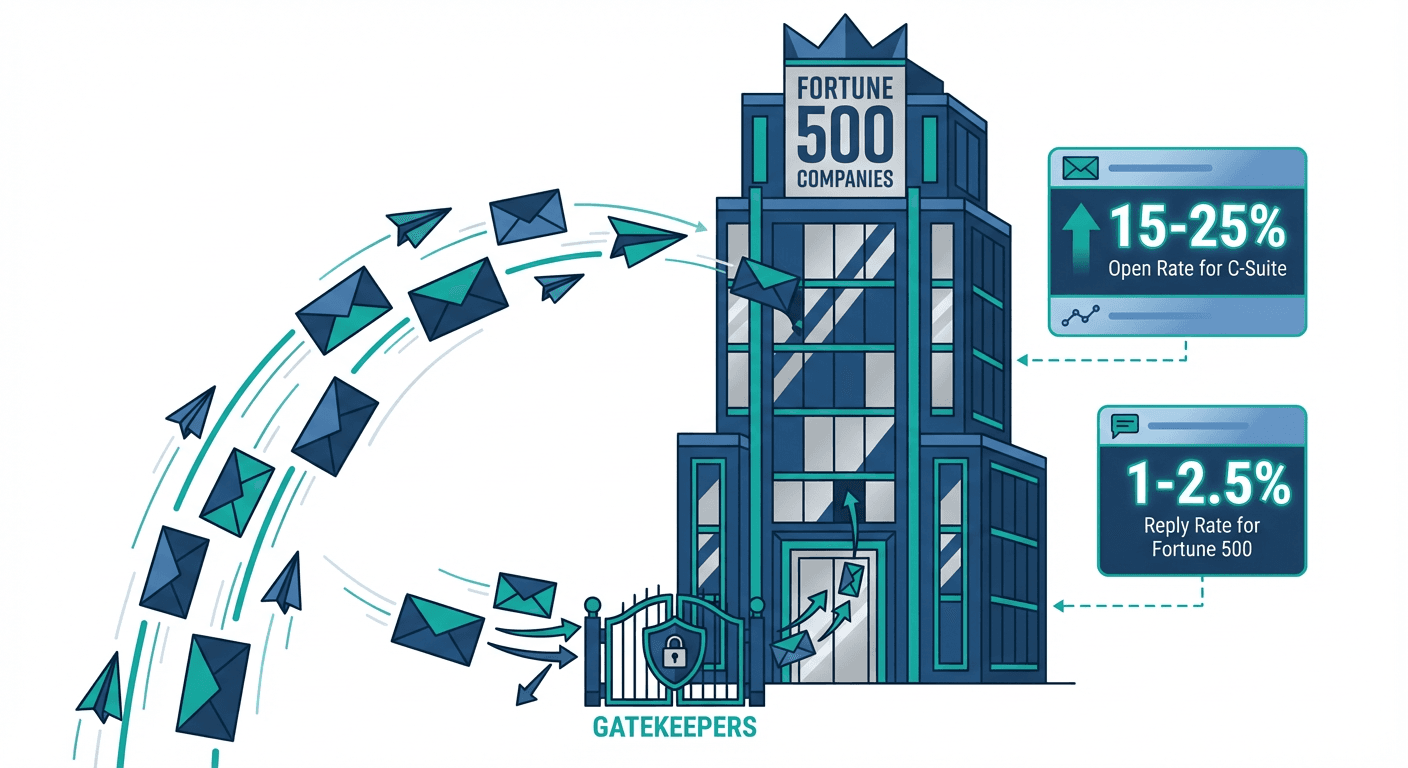
Enterprise cold email campaigns targeting Fortune 500 companies typically achieve 15-25% open rates for C-suite executives, 1-2.5% reply rates for companies with 10,000+ employees, and 0.3-0.8% overall meeting booking rates. These metrics are substantially lower than SMB campaigns because enterprise buyers face higher email volume, longer procurement cycles, and complex multi-stakeholder approval processes. Director-level contacts show the highest engagement with 25-35% open rates.
Key takeaways
- C-suite executives at Fortune 500 companies show 15-25% open rates, while director-level contacts achieve 25-35% open rates, making directors the most accessible buyer tier in enterprise selling.
- Fortune 500 companies deliver 0.8-2% reply rates, compared to 3-6% for companies with 1,000-2,500 employees, with company size correlating inversely to responsiveness.
- Enterprise cold email campaigns achieve 0.3-0.8% overall meeting booking rates, with reply-to-meeting conversion requiring 2-4 additional touchpoints after initial positive replies.
- Technology sector enterprises show the highest engagement with 2.5-5% reply rates and 3-6 month sales cycles, while financial services and healthcare face 6-12 month cycles due to regulatory requirements.
- Generic spray-and-pray approaches to Fortune 500 companies typically see reply rates below 0.5%, emphasizing the need for targeted campaigns with relevant value propositions.
Reviewed and updated October 1, 2026
Enterprise cold email campaigns targeting Fortune 500 and large enterprises operate under fundamentally different rules than SMB outreach. A 2% reply rate that would signal failure in mid-market campaigns can represent strong performance when targeting C-suite executives at companies with 10,000+ employees. Understanding these benchmarks is essential for setting realistic expectations and optimizing your enterprise outreach strategy.
Methodology and Data Sources
The benchmarks presented in this report are compiled from industry estimates, published research, and aggregated performance data from B2B outreach campaigns. These figures represent typical ranges observed across enterprise cold email programs and should be used as directional guidance rather than absolute standards.
Several factors influence these metrics:
- Industry vertical: Technology, financial services, and healthcare show different response patterns
- Geographic region: North American enterprises respond differently than European or APAC targets
- Economic conditions: Budget cycles and market conditions affect engagement
- Sender reputation: Domain authority and company brand recognition impact deliverability and open rates
Use these benchmarks to contextualize your own performance, but recognize that your specific results will depend on your targeting precision, message quality, and value proposition relevance.
Core Enterprise Cold Email Metrics
Open Rates by Decision-Maker Level
Enterprise open rates vary significantly based on the seniority of your target contact. Higher-level executives receive more email volume but also have more gatekeepers filtering their inbox.
Industry Estimate Ranges:
| Decision-Maker Level | Open Rate Range | Notes |
|---|---|---|
| C-Suite (CEO, CFO, CTO) | 15-25% | Lower volume, higher scrutiny |
| VP Level | 20-30% | Active inbox managers |
| Director Level | 25-35% | More accessible, higher engagement |
| Manager Level | 30-40% | Most responsive tier |
C-suite executives at Fortune 500 companies typically see hundreds of cold emails weekly. The 15-25% open rate range reflects both inbox filtering and the natural selectivity these leaders apply to unsolicited outreach.
Director and manager-level contacts show higher open rates because they often manage their own inboxes and are more frequently tasked with evaluating new solutions. They represent the "accessible buyer" tier in enterprise selling.
Reply Rates by Company Size
Company size correlates inversely with reply rates. Larger enterprises have more established vendor relationships, longer procurement cycles, and greater inertia against change.
Industry Estimate Ranges:
| Company Size | Reply Rate Range | Typical Characteristics |
|---|---|---|
| 1,000-2,500 employees | 3-6% | More agile, faster decisions |
| 2,500-5,000 employees | 2-4% | Established processes, moderate bureaucracy |
| 5,000-10,000 employees | 1.5-3% | Complex buying committees |
| 10,000+ employees | 1-2.5% | Multi-stakeholder approval required |
| Fortune 500 | 0.8-2% | Highest barriers, longest cycles |
These ranges assume well-targeted campaigns with relevant value propositions. Generic spray-and-pray approaches to Fortune 500 companies typically see reply rates below 0.5%.
Meeting Booking Rates
Converting replies to meetings represents another conversion step where enterprise campaigns face additional friction. Not every reply indicates genuine interest, and coordinating schedules with senior executives adds complexity.
Industry Estimate Ranges:
| Metric | Enterprise Average | Top Performer Range |
|---|---|---|
| Reply-to-Meeting Conversion | 15-25% | 30-40% |
| Overall Meeting Rate (from send) | 0.3-0.8% | 1-1.5% |
| No-Show Rate | 15-25% | 8-12% |
Enterprise meeting booking requires more persistence than SMB outreach. Expect 2-4 touchpoints after an initial positive reply before securing a calendar slot. Executive assistants often serve as intermediaries, adding another coordination layer.
Enterprise Benchmarks by Industry Vertical
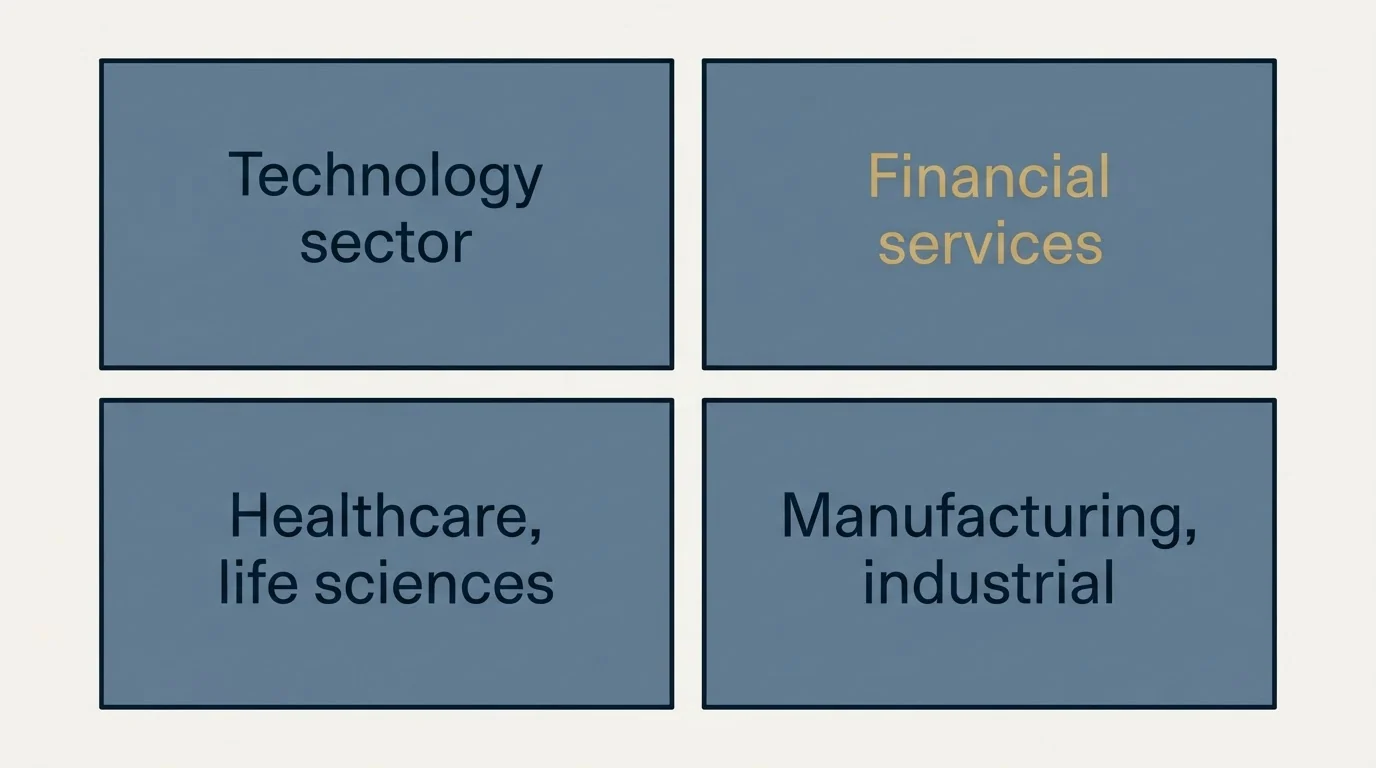
Response patterns vary substantially across industries. Regulatory environment, technology adoption rates, and cultural factors all influence how enterprise buyers engage with cold outreach.
Technology Sector
Technology companies, even large enterprises, maintain relatively high responsiveness to cold email. Technical leaders are accustomed to evaluating new solutions and often have discretionary budgets for pilot programs.
Industry Estimate Ranges:
- Open Rate: 25-35%
- Reply Rate: 2.5-5%
- Meeting Booking Rate: 0.5-1.2%
- Average Sales Cycle: 3-6 months
Technology buyers respond well to product-led messaging, ROI calculations, and competitive differentiation. Reference customers from recognizable brands significantly boost engagement.
Financial Services
Financial services enterprises present unique challenges due to heavy regulation, security concerns, and established vendor relationships. Compliance requirements mean that any new technology must pass extensive review processes.
Industry Estimate Ranges:
- Open Rate: 18-28%
- Reply Rate: 1.5-3%
- Meeting Booking Rate: 0.3-0.8%
- Average Sales Cycle: 6-12 months
Financial services buyers prioritize security credentials, compliance certifications, and references from similar institutions. Cold emails that address regulatory requirements directly see higher engagement.
Healthcare and Life Sciences
Healthcare enterprises face regulatory complexity similar to financial services, with additional considerations around patient data protection and clinical validation requirements.
Industry Estimate Ranges:
- Open Rate: 20-30%
- Reply Rate: 1.5-3.5%
- Meeting Booking Rate: 0.3-0.7%
- Average Sales Cycle: 6-18 months
Healthcare buyers respond to evidence-based messaging, clinical outcome data, and references from peer institutions. HIPAA compliance and integration with existing EHR systems are table-stakes requirements.
Manufacturing and Industrial
Traditional manufacturing enterprises often have lower email engagement overall, with key decision-makers spending more time on production floors than in front of computers.
Industry Estimate Ranges:
- Open Rate: 15-25%
- Reply Rate: 1-2.5%
- Meeting Booking Rate: 0.2-0.6%
- Average Sales Cycle: 4-9 months
Manufacturing buyers respond to operational efficiency metrics, implementation timelines, and total cost of ownership analyses. On-site demonstrations often carry more weight than virtual presentations.
Multi-Threading and Account-Based Metrics
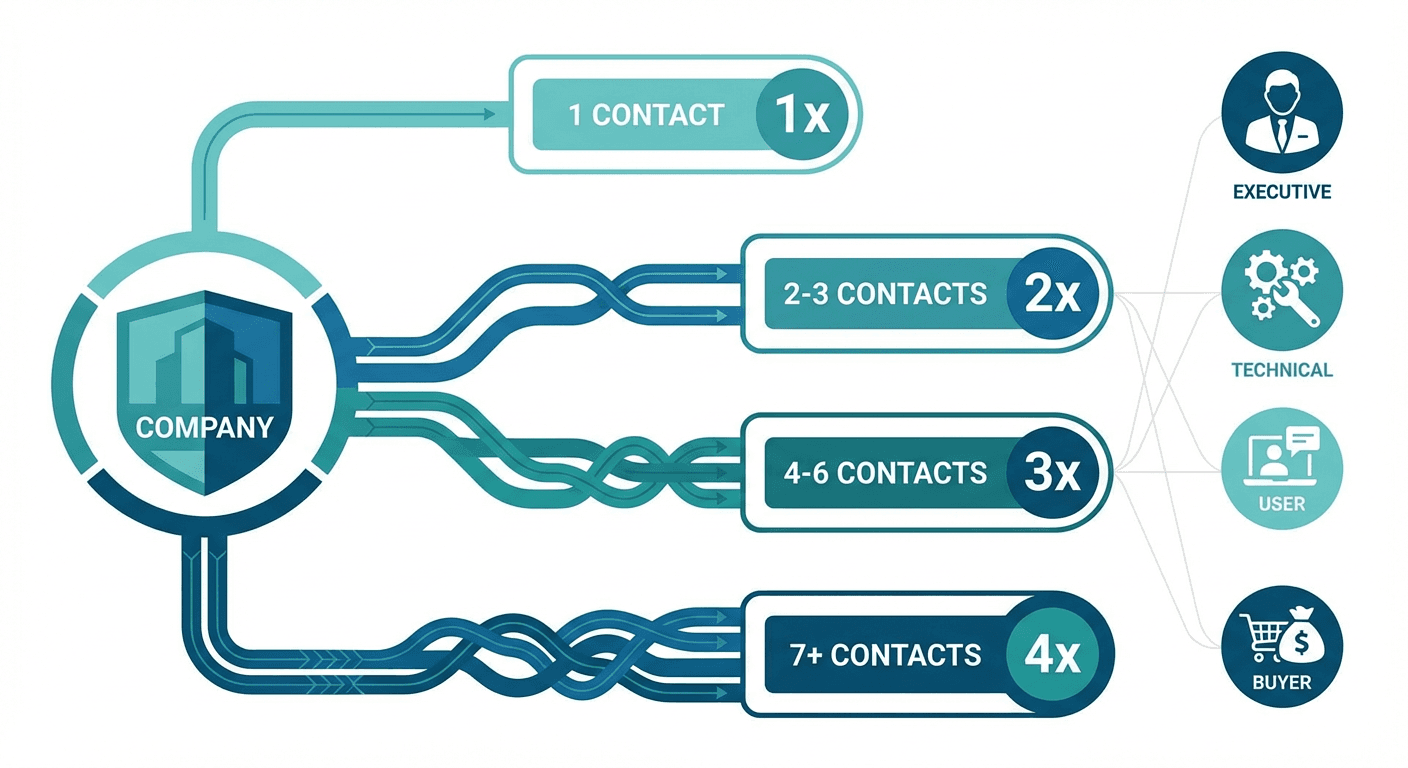
Enterprise deals rarely close through single-threaded relationships. Modern account-based approaches require engaging multiple stakeholders across different functions and seniority levels.
Multi-Threading Success Rates
Multi-threading refers to establishing relationships with multiple contacts within a target account. This approach increases deal velocity, improves win rates, and provides resilience if individual contacts leave or change roles.
Industry Estimate Ranges:
| Contacts Engaged | Win Rate Multiplier | Typical Response Pattern |
|---|---|---|
| 1 contact | Baseline | Single point of failure |
| 2-3 contacts | 1.5-2x baseline | Cross-functional visibility |
| 4-6 contacts | 2-3x baseline | Committee coverage |
| 7+ contacts | 3-4x baseline | Full account penetration |
Campaigns that successfully engage 4+ contacts within a target account see dramatically higher conversion rates. The optimal multi-threading approach involves:
- Executive sponsor: C-suite or VP-level champion
- Technical evaluator: Director or manager who assesses product fit
- End user: Individual contributor who will use the solution daily
- Economic buyer: Finance or procurement stakeholder who controls budget
Account Penetration Benchmarks
Account penetration measures how deeply your outreach reaches into target organizations. Higher penetration correlates with faster deal cycles and higher win rates.
Industry Estimate Ranges:
| Metric | Average Performance | Top Performer Range |
|---|---|---|
| Contacts per Account | 2-4 | 6-10 |
| Departments Reached | 1-2 | 3-5 |
| Reply Rate (multi-threaded) | 4-8% (per account) | 12-18% (per account) |
| Meeting Rate (multi-threaded) | 1-2% (per account) | 3-5% (per account) |
Note that multi-threaded metrics often report per-account performance rather than per-email performance. An account-level reply rate of 8% means that 8% of target accounts produced at least one reply across all contacts engaged.
What Works for Enterprise Outreach
Enterprise cold email success depends on different factors than SMB outreach. The following elements consistently correlate with above-benchmark performance in enterprise campaigns.
Personalization Depth
Surface-level personalization (company name, job title) no longer differentiates enterprise outreach. Decision-makers at large companies can immediately identify template-based messaging.
Effective personalization elements:
- Recent company initiatives or announcements
- Industry-specific challenges relevant to their role
- Mutual connections or shared backgrounds
- Specific metrics or KPIs relevant to their function
Campaigns with deep personalization typically see 40-60% higher reply rates compared to template-based approaches targeting similar audiences.
Value Proposition Specificity
Generic value propositions fail in enterprise contexts. Large companies have existing solutions for most categories and require compelling differentiation to consider change.
High-performing value proposition characteristics:
- Quantified ROI specific to their company size and industry
- Competitive displacement against named incumbent solutions
- Reference customers with similar profile and use case
- Time-to-value commitments appropriate for enterprise implementation
Where we differ from standard practice
Much of the advice on this page reflects how outbound is commonly run. We run it differently, and since this page sits on our site it is worth saying where the difference is and what it costs us.
- A sequence of messages to each prospect over several weeks
- Later messages often land in the same email thread
- Every contact is reached more than once, so a distracted reader gets another chance
- The later messages go only to people who did not answer the first
- Reputation cost accrues on the sending domain across everything else it sends
- One message, then that campaign is finished for that contact
- No thread replies and no bumps
- More of the work moves into targeting and into the one message
- We reach each contact less often, and that is the cost we accept
The reasoning is mechanical rather than moral. A follow-up arrives underneath a message the recipient has already seen and chosen not to answer, so it is delivered to the population most likely to mark it as spam, and the reputation cost of that lands on the sending domain across every campaign running on it. We set that cost against the replies a sequence recovers and decided the trade was not worth it. The full argument, with the numbers from our own campaigns, is in why we stopped using follow-ups.
Timing and Sequence Structure
Enterprise cold email sequences require longer durations and more touchpoints than SMB campaigns. Decision-makers need multiple exposures before engaging with unfamiliar vendors.
Optimal enterprise sequence structure:
- Sequence length: 8-12 touches over 6-8 weeks
- Email frequency: 4-6 emails with 7-14 day spacing
- Multi-channel touches: LinkedIn, phone calls interspersed with email
- Content variety: Mix of text-only emails, case studies, and video messages
Sequences that combine email with LinkedIn engagement typically see 25-35% higher overall response rates compared to email-only approaches.
Measuring Your Own Enterprise Performance
Establishing your own benchmarks requires consistent measurement methodology and sufficient sample sizes. Enterprise campaigns often struggle with statistical significance due to smaller target universes.
Minimum Sample Sizes for Meaningful Data
Enterprise campaigns targeting specific verticals or company sizes may have limited addressable markets. The following sample sizes provide reasonable confidence in performance metrics:
| Metric | Minimum Sample Size | Confidence Level |
|---|---|---|
| Open Rate | 500 sends | Directionally reliable |
| Reply Rate | 1,000 sends | Statistically meaningful |
| Meeting Rate | 2,500 sends | High confidence |
| Win Rate | 50 opportunities | Preliminary indicator |
Campaigns with fewer sends should be viewed as preliminary tests rather than definitive benchmarks. Seasonal variations, news events, and market conditions can significantly impact small-sample results.
Segmented Performance Tracking
Aggregate metrics obscure important performance variations. Track your enterprise campaigns across multiple dimensions:
Recommended segmentation:
- Company size tier: Separate metrics for 1000-5000, 5000-10000, and 10000+ employee companies
- Decision-maker level: Track C-suite, VP, director, and manager performance independently
- Industry vertical: Maintain industry-specific benchmarks
- Sequence stage: Monitor performance by sequence step to identify drop-off points
- Message variant: A/B test subject lines, value propositions, and CTAs
Performance Optimization Framework
Use benchmark data to prioritize optimization efforts. Focus on metrics with the largest gaps between your performance and industry benchmarks.
Optimization priority framework:
- Deliverability issues (open rates below 15%): Address technical infrastructure, domain reputation, and list quality
- Relevance issues (open rates above benchmark but low replies): Improve personalization, value proposition, and targeting
- Conversion issues (replies above benchmark but low meetings): Refine follow-up sequences and scheduling processes
- Qualification issues (meetings above benchmark but low win rates): Tighten targeting criteria and discovery processes
Setting Realistic Enterprise Campaign Goals
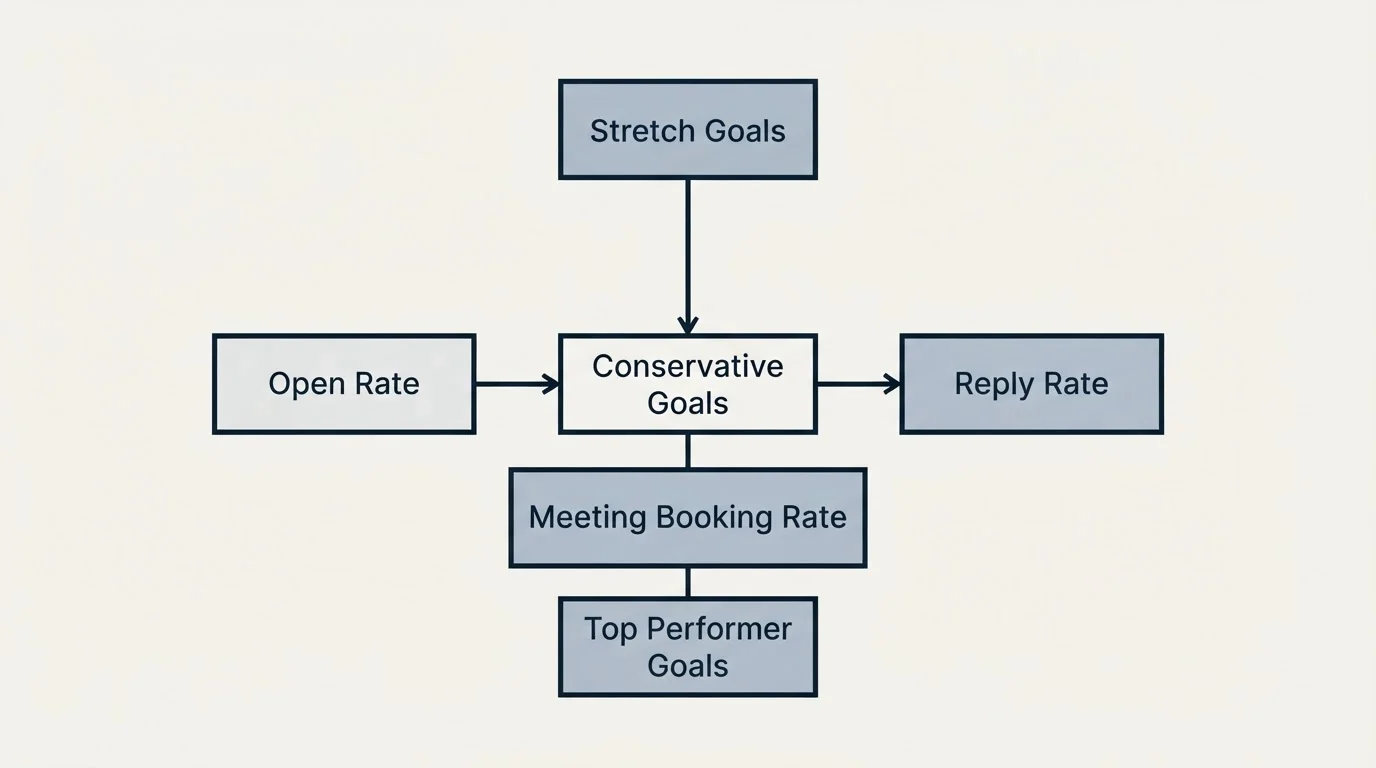
Based on industry benchmarks, the following represents realistic goal-setting for enterprise cold email campaigns:
Conservative Goals (Achievable with Basic Execution):
- Open Rate: 20-25%
- Reply Rate: 1.5-2.5%
- Meeting Booking Rate: 0.3-0.5%
- Contacts per Meeting: 200-350
Stretch Goals (Requires Optimized Execution):
- Open Rate: 30-35%
- Reply Rate: 3-5%
- Meeting Booking Rate: 0.8-1.2%
- Contacts per Meeting: 80-125
Top Performer Goals (Exceptional Targeting and Messaging):
- Open Rate: 35-45%
- Reply Rate: 5-8%
- Meeting Booking Rate: 1.5-2.5%
- Contacts per Meeting: 40-70
These benchmarks assume proper technical setup, verified email lists, and relevant value propositions. Campaigns with fundamental issues in any of these areas will underperform regardless of other optimizations.
Building Your Enterprise Cold Email Strategy
Enterprise cold email success requires patience, precision, and persistent optimization. The benchmarks in this report provide context for evaluating your performance and identifying improvement opportunities.
Key takeaways for enterprise outreach:
- Expect lower response rates than SMB campaigns, but higher deal values justify the investment
- Multi-threading is essential for both response rates and deal velocity
- Industry-specific messaging dramatically outperforms generic value propositions
- Longer sequences with more touchpoints match enterprise buying behavior
- Measurement requires larger samples due to smaller target universes
The most successful enterprise cold email programs combine rigorous data analysis with creative, highly personalized outreach. Benchmarks provide the analytical foundation, but differentiated messaging creates competitive advantage.
Related Reading
- SaaS Cold Email Benchmarks: Open Rates, Reply Rates, and Conversion Data
- B2B Cold Email Benchmarks 2026: The Complete Industry Report
Ready to build a high-performing enterprise cold email program? Schedule a free strategy session to discuss your target accounts and develop a customized outreach strategy based on industry benchmarks and your specific goals.
Frequently asked questions.
Frequently asked questions- What is a good reply rate for cold emails to Fortune 500 companies?
- A reply rate of 0.8-2% is considered typical for Fortune 500 cold email campaigns, with rates above 2% representing strong performance. This is significantly lower than mid-market campaigns because Fortune 500 executives face higher email volume, have established vendor relationships, and require multi-stakeholder approval processes. Generic outreach typically sees reply rates below 0.5%, while well-targeted campaigns with relevant value propositions achieve the 0.8-2% benchmark range.
- Should I target C-suite executives or directors for enterprise cold email?
- Director-level contacts typically deliver better results with 25-35% open rates and 1.5-3% reply rates compared to C-suite executives who show 15-25% open rates and lower engagement. Directors often manage their own inboxes and are frequently tasked with evaluating new solutions, making them the most accessible buyer tier. C-suite executives receive hundreds of cold emails weekly and have more gatekeepers filtering their inbox, though they remain important for account-based strategies.
- How many cold emails do I need to send to book one enterprise meeting?
- Enterprise campaigns typically achieve 0.3-0.8% overall meeting booking rates, meaning you need to send 125-330 emails to book one meeting at average performance levels. Top performers achieve 1-1.5% meeting rates, requiring 65-100 emails per meeting. After receiving an initial positive reply, expect to send 2-4 additional touchpoints before securing a calendar slot, as coordinating schedules with senior executives and their assistants adds complexity beyond the initial engagement.
- Do enterprise cold email benchmarks differ by industry?
- Enterprise benchmarks vary significantly by industry vertical. Technology companies show the highest engagement with 2.5-5% reply rates and 0.5-1.2% meeting booking rates due to their comfort evaluating new solutions. Financial services and healthcare enterprises deliver lower 1.5-3.5% reply rates and 0.3-0.8% meeting booking rates because of heavy regulation, security concerns, and compliance requirements. Technology sector sales cycles run 3-6 months, while financial services require 6-12 months and healthcare can extend to 6-18 months.
- How does company size affect cold email response rates?
- Company size correlates inversely with reply rates across all metrics. Companies with 1,000-2,500 employees achieve 3-6% reply rates, while organizations with 10,000+ employees drop to 1-2.5%. Fortune 500 companies specifically show 0.8-2% reply rates. Larger enterprises have more established vendor relationships, longer procurement cycles, complex buying committees, and greater organizational inertia against change, creating higher barriers to engagement than smaller enterprise targets.
About the author.

Hosun Chung is COO at RevenueFlow, which builds and operates outbound revenue engines for B2B companies. Previously at Gleacher Shacklock LLP. Studied at London School of Economics.
Hosun Chung · COO
Connect on LinkedIn →Explore more.
Ready to scale your outreach?
We build GTM engines that book real meetings. See the receipts.
Related articles.
B2B Cold Email Benchmarks 2026: The Complete Industry Report
The average B2B cold email reply rate is 3.43% on Instantly's data and 1.5% on Woodpecker's median. What each counts, and the levers that move your own rate.
Cold Email Spam Rate Benchmarks: 2026 Performance Data
Industry standards require keeping spam complaint rates below 0.1% to maintain sender reputation. Learn the benchmarks and strategies to protect your cold email deliverability.
Cold Email Follow-Up Benchmarks: 2026 Performance Data
The follow-up benchmarks kept intact and read against their own definitions, plus why RevenueFlow sends one message per campaign instead.
Cold Email Bounce Rate Benchmarks: 2026 Performance Data
A 3.04% platform bounce rate held 1.27% true hard bounces, 2.38% with blocks included, and 12.6% delay notices. What low bounce email data is made of.
Cold Email Subject Line Benchmarks: 2026 Performance Data
Industry data reveals that subject lines determine 35-50% of open rate variation. Discover the benchmarks for length, personalization, and format that drive the highest engagement.
Cold Email Personalization Benchmarks: 2026 Performance Data
LeadMagic, Cognism, Explorium and others sell funding and competitor signals. What published data ties to higher reply rates, and how to turn a signal into a line.