How to Book Sales Meetings with Accounting Firms
Accounting firms are reachable in roughly five windows a year. Here is the title map, sequence, templates and funnel math that turn outreach into booked calls.

Book meetings with accounting firms by sending only in the open windows (late April to mid June, summer, and post-October 15), targeting titles matched to firm headcount, and opening with an interest-based ask instead of a calendar request. Published planning models put the return at one to two held meetings per 100 verified contacts; we send one message per campaign, so that volume comes from a larger verified list rather than from repeated contact.
Key takeaways
- Accounting firms are effectively unreachable during Jan 15 to Apr 20, Sep 1 to Oct 20, and mid-December, leaving roughly five usable send windows per year.
- Target titles by headcount: owners at 1-10 staff, managing partners and firm administrators at 11-60, COOs and practice leaders at 60-250, and innovation or practice technology directors at 250+.
- US accounting graduates fell to 55,152 in the 2023-24 academic year, a 6.6% decline, which makes capacity the strongest offer angle in the vertical.
- The whole campaign has to fit inside one open window, so build and verify the list before the window opens and send while it is genuinely open rather than running into a deadline period.
- Open with an interest-based CTA rather than a calendar link, and when a partner replies, offer two specific slots before 8am or after 4pm.
- Plan on one to two held meetings per 100 verified contacts, and treat send-window timing and title accuracy as the two variables that move that number most.
Reviewed and updated September 1, 2026
How to Book Sales Meetings with Accounting Firms: A Step-by-Step Playbook
Count the weeks in a year when a tax partner at a CPA firm will realistically take a call from a stranger. Remove January 1 through April 15. Remove the two weeks after April 15, when partners are catching up on everything they deferred. Remove the first half of September and the first half of October, when extended returns come due. Remove December, which is year-end planning and close. What remains is a little over half the year, and most vendors selling into accounting spray their volume evenly across all twelve months.
That single scheduling fact explains most of the failure in this vertical. Booking meetings with accounting firms is a timing and targeting problem far more than a copywriting problem. Get the calendar and the title right and average copy books calls. Get them wrong and excellent copy lands during the week of April 10 and never gets read.
Pick Your Send Windows Before You Write a Word
Accounting firms run on statutory deadlines, which makes their availability more predictable than almost any other vertical. Build the campaign calendar around these windows:
| Window | Dates | Why it works |
|---|---|---|
| Post-busy-season reset | April 20 to June 15 | Partners are reviewing what broke and have budget conversations queued |
| Summer planning | June 15 to August 20 | Lightest workload of the year, longest attention spans |
| Post-extension | October 20 to November 20 | Second reset point, next-year budgets being set |
| Dead zones | Jan 15 to Apr 20, Sep 1 to Oct 20, Dec 10 to Jan 5 | Suppress sends and wait for the next open window |
Late spring is the highest-intent period for anything touching capacity, staffing, or workflow, because the memory of the last three months is still raw. If you run only two campaigns a year into accounting, run one in May and one in July.
Who to Target by Firm Size
Title targeting in accounting breaks cleanly by headcount. The same job carries four different titles depending on firm size, and the wrong one costs you the whole campaign.
| Firm size | Decision owner | Titles to target | Skip |
|---|---|---|---|
| 1 to 10 staff | The owner, full stop | Owner, Founder, Principal, Managing Member | Everyone else |
| 11 to 60 staff | Managing partner, often with a firm administrator | Managing Partner, Partner, Firm Administrator, Director of Operations | Staff and senior accountants |
| 60 to 250 staff | Functional leader plus operations | COO, Director of Firm Operations, Partner in Charge of Tax or Audit, Director of IT | Managing Partner (too insulated for a cold first touch) |
| 250+ / Top 100 | A committee, sponsored by a practice leader | Chief Innovation Officer, Director of Practice Technology, National Practice Leader, CFO | Anyone with "Partner" alone in the title |
Two title notes that materially change reply rates. The Firm Administrator at a 20 to 60 person firm is often the most responsive person in the building, controls operational vendor evaluation, and stays under-targeted because most sellers chase partner titles. Above 100 people, Director of Practice Technology and Chief Innovation Officer are newer roles created specifically to evaluate vendors, so they answer cold email more readily than partners.
Build the List With Firm-Level Filters
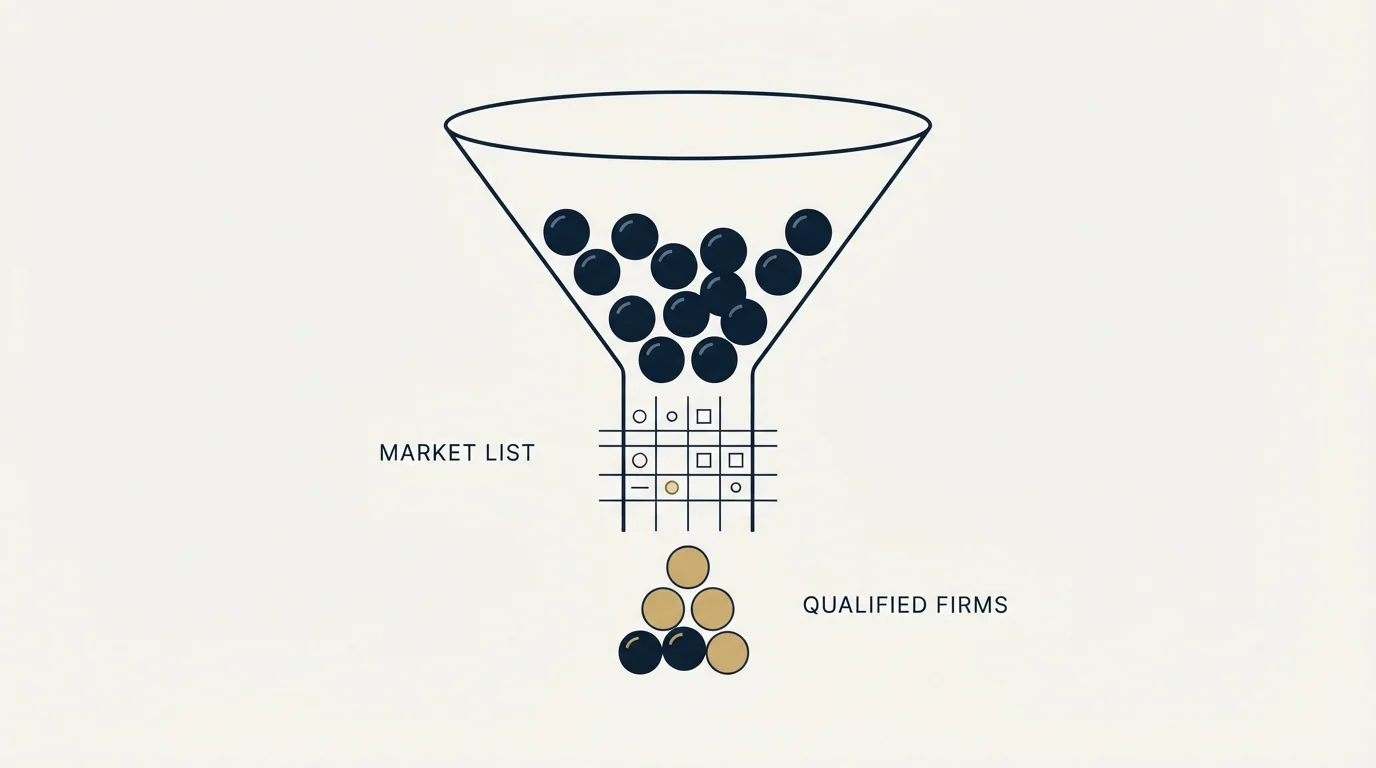
A title filter alone produces a list full of firms that will never buy. Layer on:
Firmographic filters that predict fit:
- Headcount band (one band per campaign; a 6-person firm and a 200-person firm have nothing in common)
- Service mix: tax-only, audit-heavy, CAS/advisory, bookkeeping, or full service
- Client vertical specialization (dental, construction, cannabis, nonprofit, real estate), which sits on the firm's own website and is the best personalization hook available
- Software stack signals (CCH Axcess, UltraTax, Karbon, Canopy, TaxDome, QuickBooks ProAdvisor status)
- Recent merger activity, which creates system consolidation projects
- Active job postings, which signal capacity pain and growth at once
Where to source it. State CPA society directories, the AICPA firm directory, Accounting Today and INSIDE Public Accounting rankings, local business journal lists, and QuickBooks or Xero partner directories all produce cleaner accounting data than a generic B2B database pull. Enrich with Apollo or Clay, then verify every address. Small firms use catch-all domains heavily, so route catch-alls to a separate low-volume group rather than dropping them.
A well-filtered list for one headcount band and one specialty in a metro region runs 300 to 1,500 contacts, and that is enough. Accounting is referral-driven, so a narrow list with strong personalization compounds in a way a 20,000-contact blast never will.
The Offer That Converts in This Vertical
Accounting firm owners buy against three problems. Everything else is a distant fourth.
Capacity. The talent pipeline has shrunk for years. US accounting graduates fell to 55,152 in the 2023-24 academic year, a 6.6% decline. Source: AICPA & CIMA. Journal of Accountancy has tracked the same contraction across reporting cycles. Source: Journal of Accountancy. Any offer that credibly promises more output without another hire starts strong.
Realization and write-offs. Partners track realization rate obsessively. Framing your product against unbilled hours, scope creep, or write-downs on fixed-fee engagements speaks their internal language.
Client churn and low-value work. Most firms know part of their client base is unprofitable and want to move up-market into advisory. Offers that help them fire the bottom tier or upsell the middle tier get attention.
The CTA matters as much as the offer. A hard "book 30 minutes" ask in a cold email underperforms here, because partners guard their time in six-minute increments. Each campaign carries one message and one ask, so the ask escalates across campaigns and replies rather than inside one thread:
- First campaign into a list: "Worth me sending the two-page breakdown?"
- Next campaign, next open window, non-repliers only: "Is this a problem at {{firm_name}}, or already handled?"
- In the reply to anyone who engages: "Tuesday at 8am or Thursday at 4pm for 15 minutes?"
Note the times. Partners are at their desks before 8am and after 4pm. Mid-day slots compete with client calls year-round.
The Campaign Structure

One email per campaign, and one campaign per open window. We send a single message and then that campaign is finished for that contact: no second email in the same thread, no bump, no permission close sitting under a message the partner already saw and left. Non-repliers are not lost. They go into the next window's campaign with a genuinely different premise, which is easy in this vertical because the calendar hands you a new reason to write three times a year.
| Campaign | Window | Premise | Ask |
|---|---|---|---|
| 1 | April 20 to June 15 | Capacity: what broke in busy season | Interest-based, "worth me sending the breakdown?" |
| 2 | June 15 to August 20 | Practice technology: the stack and the client specialty | Diagnostic, "is this friction real at {{firm_name}}?" |
| 3 | October 20 to November 20 | Timing: next year's budget and the extension reset | Routing, "reply 1, 2 or 3" |
A LinkedIn connection request with no pitch, sent a few days before the email, is the one addition worth making, and a single call in the same window can carry its own reason for calling. Neither is a reminder of the email. Send Tuesday through Thursday between 6:30am and 8:00am local time. Suppress the whole firm domain when anyone replies, so two people at the same 12-person firm never get different versions of your pitch in one week. The reasoning, with the numbers from our own campaigns, is in why we stopped using follow-ups.
Templates
Template 1: Capacity angle, managing partner at a 15 to 60 person firm
Subject: {{firm_name}} + busy season staffing

Hi {{first_name}},

Most {{city}} firms in the {{headcount}}-person range came out of April
short-staffed and are heading into extension season with the same gap.

We handle {{specific_task}} for firms like {{reference_firm_1}} and
{{reference_firm_2}}, which freed up roughly {{hours}} hours a week of
senior time during their last extension push.

Worth me sending the one-page breakdown of how it works? Happy to, or
happy to leave you alone.

{{sender_name}}
{{sender_title}} | {{phone}}
{{unsubscribe_line}}
Why this works: Naming the headcount band and city proves the list was filtered rather than scraped, and it anchors on a calendar event both parties know is coming. The ask is a reply rather than a calendar slot, and explicit permission to decline lowers the cost of engaging.
Template 2: Post-busy-season timing (send April 20 to June 15)
Subject: what broke in April

{{first_name}},

Now that returns are out the door, most firm leaders spend a couple of
weeks listing everything that broke between January and April and
deciding what to fix before September.

If {{pain_point}} is on that list at {{firm_name}}, we fix that
specific thing. If it isn't, ignore me until October.

Two questions, one line each:
1. Did {{pain_point}} cost you real hours this season?
2. Who owns fixing it?

{{sender_name}}
{{unsubscribe_line}}
Why this works: It arrives during the two-week window when partners run their post-season retrospective and mirrors that ritual back to them. Two one-line questions are the lowest-friction reply mechanic available, and the offer to disappear until October reads as confidence.
Template 3: Practice technology angle, 60+ person firm
Subject: {{software_stack}} at {{firm_name}}

Hi {{first_name}},

Saw {{firm_name}} runs {{software_stack}} and specializes in
{{client_vertical}} clients.

The firms we work with on that stack usually hit the same wall:
{{specific_technical_friction}}. It shows up as {{measurable_symptom}}
in the {{client_vertical}} practice specifically.

We built {{solution}} to sit alongside {{software_stack}} rather than
replace it, so nothing gets ripped out.

Is that friction real at {{firm_name}}, or already solved?

{{sender_name}}
{{unsubscribe_line}}
Why this works: Naming the practice management software and the client specialty is the highest-value personalization in this vertical, and both are usually public. The "sits alongside" line preempts the biggest objection at mid-size firms, which is the risk of migrating off an entrenched system.
Template 4: The routing ask (a later campaign to non-repliers)
Subject: {{pain_point}} at {{firm_name}}: 1, 2 or 3

{{first_name}},

Quick one on {{pain_point}} at {{firm_name}}. When a firm your size
hasn't looked at this yet, it is usually one of three things:

1. Not a priority right now
2. Wrong person, and someone else owns this
3. Bad timing, revisit after {{next_deadline}}

Reply with 1, 2, or 3 and I'll act accordingly. No reply and I'll
assume 1 and close the file.

{{sender_name}}
{{unsubscribe_line}}
Why this works: Numbered options convert a cold read into routable data, and this runs as its own campaign to the non-repliers of an earlier window, never as a reply into the earlier thread. Option 2 recovers the meeting where you targeted the wrong title, common in accounting. Option 3 produces a dated follow-up tied to a deadline the prospect already tracks.
Handling the Four Replies You Will Actually Get

"We're slammed, circle back after the deadline." A booked meeting in disguise, and the most common positive reply in the vertical. Never answer with "sounds good, I'll follow up." Answer with a date and a calendar hold: "Understood. I've put a hold on April 28 at 8am, decline it if it doesn't work." A dated commitment converts far better than an open-ended promise.
"We already use [CCH / Karbon / TaxDome]." Do not attack the incumbent. Ask a diagnostic question about a gap: "Makes sense, most firms your size do. Curious whether it covers {{specific_edge_case}}, that's usually where firms build a workaround in Excel." This reframes you as a complement and surfaces the real friction.
"Send me some information." Send one page and attach a date to it: "Attached. Two things in there are specific to {{client_vertical}} firms. If either lands, I'll take 15 minutes Thursday at 4pm." Information requests without a proposed next step die silently.
"Not interested" or "How did you get my email?" Suppress immediately, confirm removal in one sentence, move on. Accounting is a small profession with active state societies, and a reputation for ignoring opt-outs travels fast. CAN-SPAM compliance (a real physical address plus a working opt-out in every send) is non-negotiable regardless.
What a Realistic Outcome Looks Like
Work the arithmetic before committing budget. Using conservative planning assumptions rather than published benchmarks, a well-targeted campaign into one accounting segment models roughly like this per 100 verified contacts:
5% to 9%
30% to 40%
50% to 70%
70% to 80%
Bar widths are equal here because these stage values are not a single comparable measure.
| Stage | Planning assumption | Result per 100 |
|---|---|---|
| Verified contacts in the campaign | 100 | 100 |
| Total replies to the campaign | 5% to 9% | 5 to 9 |
| Replies that are positive or curious | 30% to 40% | 2 to 3 |
| Positive replies that book a call | 50% to 70% | 1 to 2 |
| Booked calls actually held | 70% to 80% | 1 to 2 |
One to two held meetings per 100 verified contacts is a workable planning number here. Calibrate it against your own first 500 sends, and watch the two variables that move it most: send-window timing and title accuracy. Both swing the result more than subject line testing ever will.
No-shows also spike inside deadline windows, so a meeting booked for September 8 is materially less likely to be held than the same meeting on June 8. Measure reply rate rather than open rate, because Apple Mail Privacy Protection and firm-level security scanners inflate opens on accounting lists to the point of uselessness.
RevenueFlow builds these segment-specific campaigns for teams selling into professional services, and the pattern holds: narrow list, calendar-aware sending, title precision, one message per campaign, and a patient re-approach in the next window.
Your 30-Day Launch Checklist
- Week 1List
Pick one headcount band and one client specialty.
- Week 2Infrastructure and copy
Set up dedicated sending domains and warm them for at least two weeks.
- Week 3Launch small
Start at 20 to 30 sends per inbox per day, run one campaign to a 200-contact sample before scaling, and set domain-level suppression.
- Week 4Read the data
Measure reply rate and positive reply rate.

Week 1: List. Pick one headcount band and one client specialty. Pull 300 to 1,500 firms from state society directories and rankings lists. Enrich for titles matched to that band, verify every address, and route catch-alls to a separate low-volume group.
Week 2: Infrastructure and copy. Set up dedicated sending domains and warm them for at least two weeks. Write three single-message campaigns (capacity, technology, timing), one per open window. Confirm the send window clears every deadline period. Add a physical address and one-click opt-out to every template.
Week 3: Launch small. Start at 20 to 30 sends per inbox per day, run one campaign to a 200-contact sample before scaling, and set domain-level suppression.
Week 4: Read the data. Measure reply rate and positive reply rate. Below 3% replies, the list or title mapping is wrong before the copy is. Healthy replies with no meetings means the CTA escalates too fast. Log every "circle back after the deadline" reply with a date and build the next campaign around them.
Booking meetings with accounting firms rewards patience and precision over volume. The capacity pain is real and well documented, and the calendar is public. Most competitors will keep sending on April 10.
If you would rather have this built and run for you, including the list, the infrastructure, the campaigns, and the meetings landing on your calendar, book a strategy call with RevenueFlow.
Related Reading
- Cold Email for Partnerships: Building Strategic Business Relationships
- Cold Email for Product Feedback: Complete Strategy Guide
- Cold Email for User Research: Complete Strategy Guide
If you would rather have this run for you, RevenueFlow books qualified meetings on a pay-per-meeting basis and publishes client results.
Frequently asked questions.
Frequently asked questions- When is the best time of year to cold email accounting firms?
- Late April through mid-June is the strongest window, because partners are running their post-busy-season retrospective and queuing budget decisions. Summer (mid-June to late August) is a close second. Late October through November works after extension deadlines pass. Suppress sends entirely from mid-January to April 20, September 1 to October 20, and mid-December through early January.
- Who is the right person to email at a CPA firm?
- It depends on headcount. At firms under 10 people, email the owner directly. At 11 to 60 people, target the managing partner or the firm administrator, who is frequently the most responsive contact and often owns operational vendor evaluation. At 60 to 250 people, target the COO, director of firm operations, or the partner in charge of tax or audit. Above 250, target practice technology and innovation directors.
- How many meetings should I expect per 100 accounting firm prospects?
- Published planning models assume 5 to 9 total replies per 100 verified contacts across a multi-message programme, with 30 to 40 percent of those replies positive or curious, and 50 to 70 percent of positive replies converting to a booked call. That works out to one to two held meetings per 100 contacts. We send one message per campaign and buy the same volume with a larger verified list, so calibrate against your own first 500 sends rather than treating any published figure as a benchmark.
- What do I say when a partner replies that they are too busy to talk?
- Treat it as a soft yes. Reply with a specific date rather than a vague promise: put a calendar hold on a date after the deadline passes and tell them to decline it if it does not work. A dated commitment converts far better than saying you will follow up later, and these replies are the most common positive response in the vertical.
- What personalization actually works for accounting firm outreach?
- Three things, all publicly available. The firm's client vertical specialization (dental, construction, nonprofit, real estate), which appears on the firm website. The practice management or tax software stack, such as CCH Axcess, UltraTax, Karbon, or TaxDome. And headcount band, which lets you reference peer firms of the same size. Generic compliments about the firm's website do nothing.
About the author.

Ben Carden is CRO at RevenueFlow, which builds and operates outbound revenue engines for B2B companies. Previously at Gartner Enterprise. Studied at London School of Economics.
Ben Carden · CRO
Connect on LinkedIn →Explore more.
Ready to scale your outreach?
We build GTM engines that book real meetings. See the receipts.
Related articles.
Cold Email for Influencer Outreach: Partner with Creators
Learn how to use cold email to build authentic influencer partnerships that drive real results for your brand, with proven templates and strategies.
Cold Email for Product Feedback: Complete Strategy Guide
Learn how to use cold email to gather valuable product feedback from users and prospects. Includes proven templates, feedback frameworks, and response optimization techniques.
Cold Email for PR: How to Pitch Journalists and Get Coverage
Learn how to craft cold emails that get journalists to open, read, and respond to your pitches. Includes real templates, timing strategies, and a complete PR outreach checklist.
Cold Email for Reviews: Complete Strategy Guide
Learn how to use cold email to generate authentic product reviews on G2, Capterra, and other platforms. Includes proven templates, compliance guidelines, and review generation frameworks.
Cold Email for Link Building: How to Get Quality Backlinks
Learn how to use cold email outreach to build high-quality backlinks that improve your SEO rankings, with proven templates and strategies that get responses.
Cold Email for Focus Groups: Complete Strategy Guide
Learn how to use cold email to recruit qualified participants for focus groups. Includes proven templates, screening strategies, and group composition frameworks.