How to Book Sales Meetings with Biotech
A tactical playbook for booking meetings with biotech buyers: titles to target, building lists from trigger data, sequence timing, CTAs, and templates.
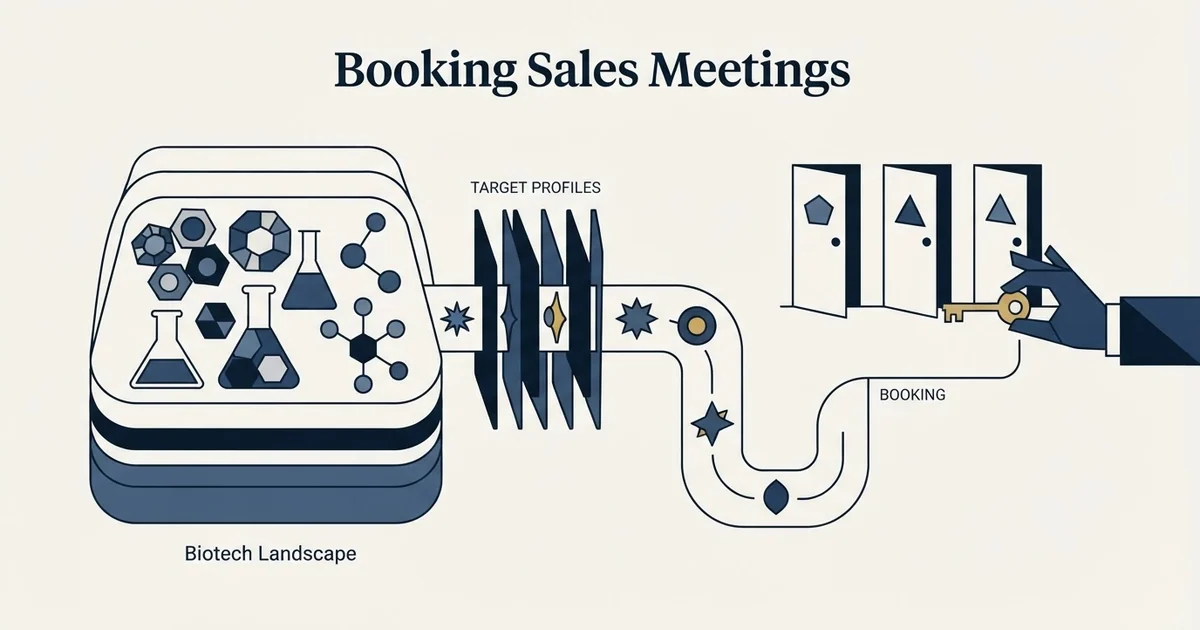
To book meetings with biotech, target the VP or head-of-function who owns the outcome (org charts are shallow), build lists from public triggers like ClinicalTrials.gov status changes, financing rounds, SEC filings and job posts, run 4 to 7 single-message campaigns across the program year, and open with a low-friction CTA rather than a calendar link.
Key takeaways
- Biotech splits into four distinct buying environments (discovery, clinical-stage, commercial, and tools/CDMO) and copy written for one will not work for the others.
- Org charts are shallow, so at companies under about 75 people the VP, COO, or CEO is usually the operator and the correct first target.
- Trigger data beats firmographic filters: ClinicalTrials.gov status changes, announced financing rounds, SEC risk factors, job postings, and conference abstracts.
- Run 4 to 7 single-message campaigns across the program year over email and LinkedIn, sending Tuesday to Thursday between 7:00 and 9:00 AM local time.
- First-touch CTAs should be interest confirmation or a named two-page asset, never a 30-minute demo request or a calendar link.
- Keep bounces under 2 percent and nurture by person rather than account, since the probability of a Phase 1 program reaching approval is roughly 12 percent and champions change companies often.
Reviewed and updated September 1, 2026
How to Book Sales Meetings with Biotech: A Step-by-Step Playbook
A 60-person clinical-stage biotech in Cambridge has one asset in Phase 2, roughly 22 months of cash, and a VP of Clinical Operations personally responsible for whether the readout lands on schedule. That person gets dozens of vendor emails a week: CROs, eClinical platforms, central labs, recruitment agencies, consultants. Almost all of them open with "I wanted to reach out about our end-to-end solution."
Booking a meeting with that VP is solvable, but it requires a different setup than selling to a mid-market software buyer. Biotech buying is driven by program milestones, not quarters. Headcount is small, so titles carry more surface area. And budget appears and disappears with financing events that are public information.
This playbook covers the mechanics: who to target, how to build the list, how to structure the campaigns, what CTA converts here, how to handle the objections you will hear, and what a realistic meetings-per-100-prospects number looks like.
Step 1: Decide Which Biotech You Are Actually Selling To
"Biotech" is four buying environments wearing one industry tag. Pick one before writing a word of copy.
Discovery and preclinical. Seed through Series A, often 10 to 40 people. Buyers care about assay throughput, data quality, and getting to a lead candidate. Purchases are small, fast, and frequently made by the scientist who will use the thing.
Clinical-stage. Series B and beyond, running trials. This is where the big vendor spend lives: CRO services, eClinical systems, site recruitment, biostatistics, regulatory consulting. Decisions are milestone-driven and slow to start, then urgent.
Commercial-stage and pre-commercial. Approaching or past approval. New functions appear (market access, medical affairs, commercial ops) and each of them buys. The FDA's drug evaluation center approved 46 novel drugs in 2025, so the population crossing this line each year is small and easy to track. Source: FDA Novel Drug Approvals for 2025.
Tools, platform, and CDMO companies. These sell into biotech themselves, so they buy commercial infrastructure: sales tooling, marketing, scientific content, competitive intelligence.
The same sentence lands completely differently across the four. "Accelerating enrollment" is irrelevant to a preclinical company and existential to a clinical-stage one.
Step 2: Target Titles That Own the Outcome, Not the Function
Biotech org charts are shallow. A 60-person company may have no director layer at all, which means the VP or C-level person is the operator. Go one level higher than you would in a comparable software company.
| What you sell | Primary title | Secondary title | Avoid |
|---|---|---|---|
| Clinical trial services, eClinical software | VP / Head of Clinical Operations | Director of Clinical Development, CMO | Procurement, Clinical Trial Associate |
| Lab instruments, reagents, assays | Head of Biology or Discovery | Senior Scientist (the user), VP Research | Lab manager (orders, does not select) |
| Regulatory or quality consulting | VP Regulatory Affairs | Head of Quality, COO | CEO above 100 headcount |
| Manufacturing and CMC | VP Technical Operations or CMC | Head of Manufacturing, COO | Supply chain only titles |
| Data, informatics, AI | Head of Computational Biology | CTO, VP Research | IT support functions |
| Finance, HR, facilities | CFO / VP Finance | COO, Head of People | Office manager |
Two rules hold throughout. Under about 75 people, the CEO or COO is a legitimate first target for anything touching runway or timeline, and an internal forward beats a cold reply from the eventual user. And scientists respond to scientific specificity while executives respond to timeline and cost, so do not send both the same email.
Step 3: Build the List From Trigger Data, Not Just a Filter

The biggest lift in biotech meeting rates comes from list construction. A generic "Biotechnology, 50 to 200 employees, United States" filter produces a list where most companies have no active need and no money. Layer public trigger data on top.
ClinicalTrials.gov. Free and updated constantly. Pull sponsors by phase, indication, enrollment status, start date, and site count. A sponsor who just moved a study to "Recruiting" has an enrollment problem today. One with a primary completion date nine months out is about to need biostatistics and regulatory support.
Financing events. Series B and C rounds are announced publicly and are the clearest budget signal in the industry. The 30 to 90 days after a round is when new vendor relationships form.
SEC filings for public micro-caps. 10-K and 10-Q filings state cash runway, program timelines, and risk factors in plain language. Risk factors are a list of the company's problems, written by the company.
Job postings. A biotech hiring its first Head of Regulatory is preparing an IND. A posting for three clinical research associates means a trial is scaling.
Conference and poster data. Presenting authors at ASCO, AACR, ASH, or a therapeutic-area meeting are named and reachable, and their abstract tells you what they are working on this year.
Verify emails hard. Biotech domains change after rebrands and acquisitions more than most industries. Get bounces under 2 percent before sending volume, because deliverability damage on a small addressable market is expensive to repair.
Step 4: One Message Per Campaign, Paced to a Biotech Calendar
Biotech buyers who do not answer are usually in a data review, at a site initiation visit, or building a board deck. The answer is not a sequence built to survive three weeks of silence. It is a set of campaigns that each carry one message and then stop, spaced far enough apart that the next one arrives after the calendar has moved.
| Campaign | Window | Channel | Job |
|---|---|---|---|
| 1 | Now | Email, one message | Trigger observation plus one line of relevance |
| Alongside 1 | Same week | LinkedIn view or connect | Name recognition, no pitch |
| 2 | Four weeks on | Email, one message | One concrete proof point, its own subject line |
| 3 | On the next trigger | Email, one message | A different problem they own |
| Alongside 3 | Same week | LinkedIn message | Short, human, no attachment |
| 4 | Next quarter | Email, one message | Asset offer: benchmark, template, checklist |
| 5 | After the milestone | Email, one message | The routing and timing ask |
Send Tuesday through Thursday, 7:00 to 9:00 AM in the prospect's time zone. Biotech operators are early. Avoid the two weeks around major conferences for that indication, when the entire buying committee is at the conference and the inbox is a wasteland.
Four to seven separate campaigns across a program year is the right range, and each of them carries exactly one email. Twelve messages over three months adds spam complaints rather than meetings, inside a small community where people know each other. A prospect who does not reply is written to again later with a new subject line and a new premise, never with a second message added under the first. We stopped sending that second message because a bump lands beneath something the reader has already decided to skip, in front of exactly the people most likely to complain, and the reputation cost follows the sending domain into every other sponsor's inbox. A fresh email also gets a fresh open. The reasoning, with the numbers from our own campaigns, is in why we stopped using follow-ups.
Step 5: Use a CTA That Costs the Prospect Almost Nothing
The default CTA ("do you have 30 minutes next week for a demo?") asks a person with no context to spend the most valuable thing they own. Size the first ask to the trust you have, which is zero.
CTAs that work here, roughly in order of how well they convert:
- Interest confirmation. "Worth a look, or is enrollment not the bottleneck right now?" A one-word reply is possible, and a reply is the goal.
- Named asset. "Want the enrollment benchmark set for autoimmune Phase 2s? Two pages." Specific, useful, no calendar.
- Referral routing. "If this sits with someone else on the clinical side, happy to send it their way."
- Short, honest call. "15 minutes to see if this is relevant to your timeline?" Best in a later campaign, or in the reply to anyone who engages.
What underperforms: calendar links in a first email, "quick sync," 30-minute demo requests, and any CTA implying the prospect already knows why they want this.
Step 6: Templates You Can Send Today
Template 1: Clinical-stage, enrollment trigger
Subject: {{trial_id}} enrollment

Hi {{first_name}},

Saw {{company}} moved {{trial_id}} to recruiting across {{site_count}} sites in {{indication}}.

Most {{indication}} Phase 2s at that site count lose 4 to 8 weeks to screen failures at the two or three weakest sites, and it surfaces too late to fix cheaply.

We handle {{your_service}} for sponsors running similar programs. The specific thing we fix is {{one_concrete_outcome}}.

Worth a look, or is enrollment tracking fine so far?

{{sender_name}}
{{sender_title}}
Why this works: the trigger is public and verifiable, so the email cannot be mistaken for a blast. It names a failure mode the VP of Clinical Ops has lived through, and the CTA offers an easy out, which is why people reply.
Template 2: Post-financing, executive target
Subject: after the {{round_name}}

{{first_name}},

Congrats on the {{round_amount}} {{round_name}}. Assuming the plan is {{stated_use_of_proceeds}} through {{milestone}}.

The part usually underestimated in that stretch is {{specific_operational_problem}}. Teams either build it internally (slow, and it pulls scientists off the science) or bolt it on late at a premium.

We do {{your_service}} for companies at this stage. Short version: {{outcome}}.

If this is a {{quarter}} problem rather than a today problem, say so and I will follow up then.

{{sender_name}}
Why this works: it uses the company's own stated use of proceeds, proving you read the announcement rather than scraped it. Offering to be deferred to a future quarter turns non-buyers into dated pipeline instead of a bounce.
Template 3: Scientist or technical buyer
Subject: {{assay_or_method}} in your {{conference}} poster

Hi {{first_name}},

Your {{conference}} poster on {{specific_finding}} used {{assay_or_method}} for {{step}}. That is where most groups working on {{target_class}} hit a throughput ceiling.

We built {{your_product}} to remove that step. {{One technical specification with a real number}}.

Happy to send the validation data for {{target_class}}. No call needed.

{{sender_name}}
{{credential_or_lab}}
Why this works: it engages the science before the sale and names a real methodological constraint rather than a business benefit. Technical buyers reply to data offers more readily than to meeting requests, and the data exchange is the natural on-ramp to a call.
Template 4: The lateral routing ask
Subject: who owns {{function}} at {{company}}?

{{first_name}},

When {{topic}} has not come up at a company your size, it usually means one of two things: it is not your area, or it is not a priority this quarter.

If the first, who owns {{function}} at {{company}} now? Happy to take it there and leave you alone.

If the second, I will check back after {{milestone}}.

{{sender_name}}
Why this works: it removes the pressure to reply positively and gives two exits, both useful to you. It goes out as its own campaign weeks after an earlier one, and it asks for information rather than commitment, which is why a routing question outperforms another pitch aimed at the same person.
Step 7: Handle the Four Objections You Will Actually Get
- No: "We already work with [large vendor]."
- No: "No budget until we close the next round."
- No: "Send me some information."
- No: "We are heads down on the readout."
"We already work with [large vendor]." Do not attack the incumbent. Position around the gap: "Makes sense, most sponsors your size do. We get pulled in for {{specific_narrow_scope}} that sits outside their statement of work. Worth 15 minutes to see if that gap exists for you?"
"No budget until we close the next round." Usually true, and a scheduling problem rather than a rejection. "Understood. When is the raise expected to close? I will follow up two weeks after." Then actually do it, with a note referencing the round.
"Send me some information." Often a polite exit, but it converts if your asset is specific. Send one document under three pages, tied to their indication or modality, with a single line proposing a time. Generic capability decks kill the thread.
"We are heads down on the readout." Accept it and set a dated trigger: "Totally fair. I will reach back out after {{expected_readout_window}}. If topline is positive, {{your_service}} becomes relevant fast, so I would rather be early than late." This is the highest-yield follow-up in biotech because the trigger is real and the prospect knows it.
What a Realistic Outcome Looks Like Per 100 Prospects
Set expectations with arithmetic rather than hope. Biotech has a small, verifiable universe of companies, so the math matters more than in a market with a million prospects. The chain runs: delivered, replied, positive reply, meeting booked, meeting held. Every stage leaks.
Bounce rate
All replies, including negatives
Replies expressing interest
Show rate
Bar widths are equal here because these stage values are not a single comparable measure.
| Stage | What to track | Target |
|---|---|---|
| Delivered | Bounce rate | Under 2 percent |
| Replied | All replies, including negatives | Above your all-industry baseline once triggers are used |
| Positive | Replies expressing interest | Roughly a quarter to a third of total replies |
| Held | Show rate | Confirm 24 hours prior |
Rather than chasing a published benchmark, run 200 to 300 contacts through one tightly defined segment, measure your own numbers, and treat that as the baseline. Two things predictably move it: tighter trigger-based targeting and a lower-friction CTA. Broader lists almost never do.
One note on patience. Analysis of more than 185,000 clinical trials estimated the probability of a Phase 1 program reaching approval at roughly 12 percent. Source: Estimation of clinical trial success rates and related parameters, Biostatistics. That shapes buying behavior: programs get killed, budgets vanish, and your champion may move companies within 18 months. Keep a dated re-approach list for everyone who said "not now," and track people rather than only accounts. A VP who ignored you at one company will often reply within a week of starting at the next.
Your Pre-Send Checklist
- One segment chosen, copy written for that segment only
- Titles map to who owns the outcome, one level up from a comparable software org
- Every contact carries a trigger: trial status, financing, filing, job post, or publication
- Emails verified, projected bounce rate under 2 percent
- Four to seven single-message campaigns across the program year, email plus LinkedIn
- Send window is Tuesday to Thursday, early morning, local time, no indication conference inside it
- First-touch CTA is interest confirmation or a named asset, never a calendar link
- Objection responses written in advance, with dated follow-ups
- Dated re-approach list for "not now" replies, tracked by person
Biotech rewards precision over volume. A list of 400 sponsors with a real trigger on each will outperform 4,000 filtered contacts on every metric that matters, without burning your domain inside a community where everyone talks to everyone.
If you would rather have this built and run for you, RevenueFlow does done-for-you cold email for teams selling into technical verticals: trigger-based list construction, copy, deliverability infrastructure, and meetings on your calendar. Book a strategy call and we will map the segment, titles, and trigger sources for your offer.
Related Reading
- Biotech Cold Email Benchmarks: 2026 Performance Data
- Cold Email for Partnerships: Building Strategic Business Relationships
- Cold Email for Product Feedback: Complete Strategy Guide
If you would rather have this run for you, RevenueFlow books qualified meetings on a pay-per-meeting basis and publishes client results.
Frequently asked questions.
Frequently asked questions- Who should I target at a biotech company?
- Target the person who owns the outcome, which in biotech is usually one level higher than in a comparable software company. For clinical trial services that is the VP or Head of Clinical Operations. For lab tools it is the Head of Biology or Discovery plus the senior scientist who will use it. Under 75 headcount, the COO or CEO is a legitimate first target.
- How do I build a good biotech prospect list?
- Start with public trigger data rather than an industry filter. ClinicalTrials.gov gives you sponsors by phase, indication, enrollment status, and site count. Announced Series B and C rounds signal budget. SEC filings for micro-caps list stated risks and runway. Job postings reveal upcoming INDs and scaling trials. Then verify emails to keep bounces under 2 percent.
- How many campaigns should biotech cold outreach run?
- Four to seven separate campaigns across the program year, each carrying exactly one email, mixing email with light LinkedIn activity. Biotech buyers go dark during data reviews, site visits, and board prep, so the next campaign waits for the calendar to move rather than landing under an unanswered message. Twelve messages over three months generates spam complaints rather than meetings in a small, well-connected community.
- What CTA works best when emailing biotech decision makers?
- Low-friction asks convert best. Interest confirmation ("Worth a look, or is enrollment not the bottleneck right now?") gets replies because a one-word answer is acceptable. Offering a named, specific two-page asset also works. Save the 15-minute call ask for touch three or later, after you have shown you understand their program. Avoid calendar links in a first email.
- When is the worst time to email a biotech prospect?
- The two weeks surrounding a major therapeutic-area conference for their indication, because the entire buying committee is physically at the meeting. Mondays and Friday afternoons underperform generally. Also avoid the window immediately before a readout, though that period is an excellent reason to schedule a fresh campaign for after topline data arrives.
About the author.

Ben Carden is CRO at RevenueFlow, which builds and operates outbound revenue engines for B2B companies. Previously at Gartner Enterprise. Studied at London School of Economics.
Ben Carden · CRO
Connect on LinkedIn →Explore more.
Ready to scale your outreach?
We build GTM engines that book real meetings. See the receipts.
Related articles.
Cold Email for Influencer Outreach: Partner with Creators
Learn how to use cold email to build authentic influencer partnerships that drive real results for your brand, with proven templates and strategies.
Cold Email for Product Feedback: Complete Strategy Guide
Learn how to use cold email to gather valuable product feedback from users and prospects. Includes proven templates, feedback frameworks, and response optimization techniques.
Cold Email for PR: How to Pitch Journalists and Get Coverage
Learn how to craft cold emails that get journalists to open, read, and respond to your pitches. Includes real templates, timing strategies, and a complete PR outreach checklist.
Cold Email for Reviews: Complete Strategy Guide
Learn how to use cold email to generate authentic product reviews on G2, Capterra, and other platforms. Includes proven templates, compliance guidelines, and review generation frameworks.
Cold Email for Link Building: How to Get Quality Backlinks
Learn how to use cold email outreach to build high-quality backlinks that improve your SEO rankings, with proven templates and strategies that get responses.
Cold Email for Focus Groups: Complete Strategy Guide
Learn how to use cold email to recruit qualified participants for focus groups. Includes proven templates, screening strategies, and group composition frameworks.