How to Book Sales Meetings with Cloud Services: A Playbook
A tactical playbook for booking meetings with cloud services buyers: the titles to target, signal-based lists, sequence timing, templates, and honest math.
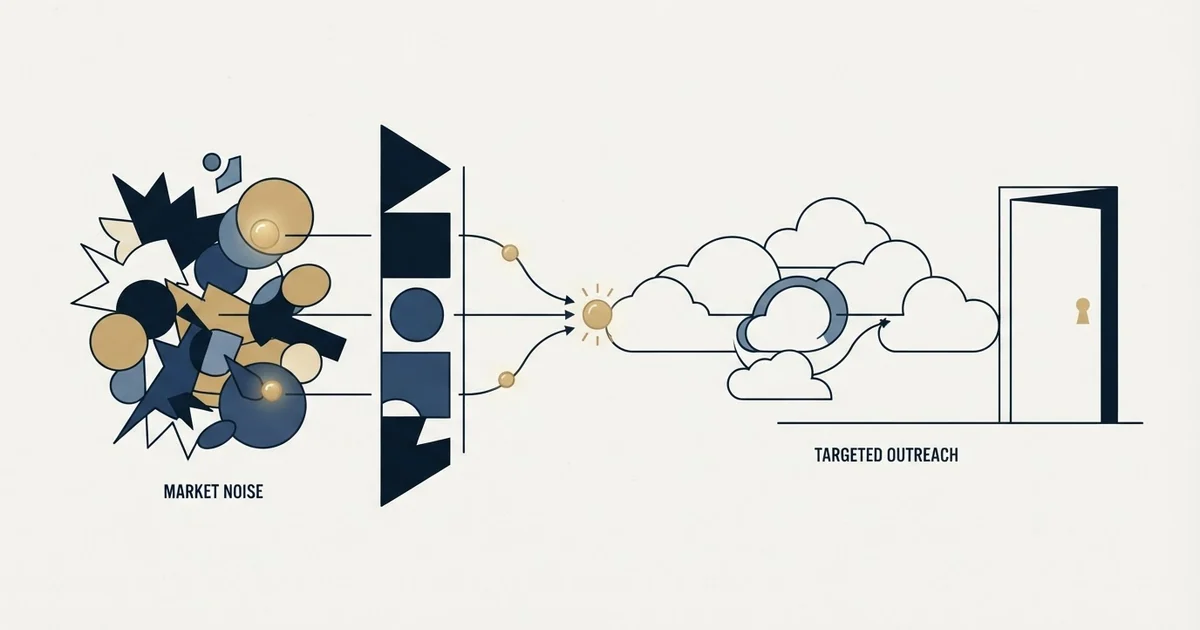
To book meetings with cloud services firms, target one buyer type per campaign (the founder at sub-50-person MSPs, the VP of Service Delivery at larger integrators), build lists from public signals like partner tier changes and hiring posts, and ask for interest rather than calendar time on the first email.
Key takeaways
- Belkins found founders and owners reply at 0.57% versus 0.42% for C-level and 0.32% for VPs across 7.5 million emails sent in 2025, so go straight to the founder at small cloud consultancies.
- Companies with 0 to 10 employees replied at 0.72% while companies over 10,000 employees replied at 0.22% in the same Belkins dataset, which favors boutique MSPs over enterprise integrators.
- Woodpecker reports campaigns with three to five follow-up steps reply at 8.3% versus 4.1% for sequences with no follow-up at all. Those are market figures rather than our practice: we send one message per campaign.
- Segment cloud services lists on public signals (partner tier changes, marketplace listings, Kubernetes and FinOps job posts, post-acquisition consolidation) rather than headcount and geography alone.
- Use an interest-based first ask with no calendar link; send the booking link only after the prospect replies.
- Plan on roughly 1 to 2 held meetings per 100 tightly segmented prospects, which means 500 to 1,000 fresh prospects per month to hold 10 meetings.
Reviewed and updated September 1, 2026
How to Book Sales Meetings with Cloud Services: A Step-by-Step Playbook
A regional managed cloud provider with 60 engineers has a VP of Service Delivery who reads email between 6:40 and 7:15 AM, before standup and before the ticket queue eats the day. That person signs off on tooling worth six figures a year and gets pitched by every observability, backup, migration, and FinOps vendor in the market. Booking 20 minutes on their calendar is a targeting and timing problem long before it becomes a copywriting problem.
This playbook covers the mechanics of turning cold outreach into held meetings with cloud services buyers: which titles to target, how to build the list, the campaigns across channels, the CTA that converts in this vertical, the four objections you will hear, and what a realistic meetings-per-100-prospects number looks like.
One clarification before the tactics. "Cloud services" covers two very different buying units. The provider side is managed service providers, cloud consultancies, system integrators, hosting firms, and hyperscaler partners who manage infrastructure for others. The consumer side is internal platform, SRE, and infrastructure teams buying capacity and the tools around it. The campaign structure below works for both. The titles, triggers, and offers differ, and mixing them in one campaign is the fastest way to burn a list.
Step 1: Pick the Title Before You Write a Word
Cloud services organizations spread purchasing authority across delivery, alliances, and finance in ways that do not map cleanly to a standard org chart. Sending the margin pitch to a practice lead who has influence but no budget wastes the message.
| Title | What they own | What gets you a meeting | Where they stall |
|---|---|---|---|
| Founder / CEO (under 50 headcount) | Everything | Revenue, margin, and headcount leverage | Zero patience for setup; needs relevance in line one |
| COO / VP Service Delivery | Utilization, SLAs, tooling stack | Engineer hours per ticket, escalation volume | Skeptical of anything unproven in production |
| Director of Cloud Practice (AWS / Azure / GCP) | Delivery methodology, certifications | Billable capacity, competency requirements | Strong influence, limited signing authority |
| VP Alliances / Partner Manager | Hyperscaler relationship, marketplace, funding | Co-sell pipeline, tier progression, MDF | Not a technical evaluator; routes you elsewhere |
| Head of FinOps / Cloud Economics | Committed spend, unit economics | Waste reduction, forecast accuracy | Wants data before agreeing to talk |
| CRO / VP Sales | Pipeline and attach rate | Sourced meetings, services attach on renewals | Ignores infrastructure framing entirely |
Two published datapoints should shape how you weight this list. Belkins analyzed 7.5 million emails sent in 2025 and found founders and owners replied at 0.57% versus 0.42% for C-level executives and 0.32% for VPs. The same study found companies with 0 to 10 employees replied at 0.72% while companies over 10,000 employees replied at 0.22%. Source: Belkins.
The practical read: at boutique consultancies and sub-50-person MSPs, go straight to the founder. At a 500-person integrator, the founder is unreachable and the VP of Service Delivery or practice lead is the real entry point.
Step 2: Build the List Around Signals, Not Firmographics Alone

A list of "MSPs, 50 to 500 employees, United States" produces a campaign that reads like it was written for nobody. Cloud services firms are unusually legible from the outside, and the public signals are strong enough to segment on.
- Partner tier movement. The AWS, Microsoft, and Google Cloud partner directories publish tier and competency data. A firm that just hit Advanced Tier or added a new specialization is actively investing in that practice and has budget attached to it.
- Marketplace listings. A new AWS or Azure Marketplace listing means the firm is trying to move from services revenue toward repeatable product revenue, which changes what they need.
- Hiring posts. Job listings for Kubernetes, Terraform, FinOps analysts, or a first Director of Security tell you which practice is expanding and which gap they are currently feeling.
- M&A and PE ownership. MSP roll-ups are constant. Firms 6 to 18 months post-acquisition are consolidating tool stacks and are the most reachable they will ever be.
- Case study announcements. These name the exact workload types the firm sells, which lets you write copy about the workload rather than the category.
- Vertical expansion. A new regulated-industry practice (healthcare, financial services, public sector) creates compliance and tooling requirements on a deadline.
Then exclude aggressively. Cut firms under your minimum viable size, firms locked into a competing partner program, and anything with recent public layoffs. Verify every address, and drop catch-all domains into a separate low-volume segment rather than mixing them into your main sends.
Step 3: Design a CTA the Buyer Can Answer in Four Seconds
The biggest lever on meeting rate in this vertical is the size of the ask. Cloud services leaders run on billable utilization and ticket queues. A 30-minute demo request from a stranger is a commitment they will not make on a first touch.
Asks that convert, in rough order of effectiveness:
- Interest-based, not calendar-based. "Worth me sending the two-page breakdown of how {{peer_company_type}} handled this?" A yes costs them one word and starts the thread.
- The specific, bounded call. "15 minutes, and I will come with the three numbers from your public {{cloud_platform}} listing that made me reach out." Naming the agenda and the duration removes the fear of a pitch.
- The asynchronous teardown. A short recorded walkthrough of something specific to their environment. This works especially well with FinOps and platform leads who want to evaluate before committing time.
- The routing ask. "If this sits with whoever owns {{practice_area}}, happy to go straight there." This turns a non-buyer into an internal referral, often the fastest path into a large integrator.
Skip the embedded calendar link in email one. It signals volume outreach and shifts the work onto the recipient. Send the link after they reply.
Step 4: One Message Per Campaign, Then a Fresh Angle

Cloud services buying cycles are tied to fiscal quarters, hyperscaler program years, and renewal dates you cannot see from outside. That argues for a plan that runs long enough to catch a window, spaced widely enough to avoid annoying anyone, and multichannel enough to be recognized. What it does not argue for is stacking messages under one subject line: every campaign carries exactly one email, and the angles are spread across separate campaigns.
Woodpecker's analysis of more than 20 million emails found campaigns running three to five follow-up steps replied at 8.3% versus 4.1% for sequences with no follow-up at all, and that a single follow-up added roughly 66% more total replies. Source: Woodpecker. That is the market's case for follow-ups, and we still do not send them. We stopped because a bump arrives under a message the reader has already chosen to leave, in front of exactly the people most likely to report it, and the reputation cost of that is charged to the sending domain across every other campaign it carries, which a reply-rate comparison never counts. A non-replier is written to again weeks later in a new single-message campaign with its own subject line and its own premise, and a fresh email gets a fresh open. The full argument, with the numbers from our own campaigns, is in why we stopped using follow-ups.
| Window | Message | Purpose |
|---|---|---|
| Campaign 1, now | Email, one message | Trigger-specific opener, interest-based ask |
| Alongside campaign 1 | View profile, follow the company page | |
| Alongside campaign 1 | Connection request, no note | |
| Alongside campaign 1 | Phone, one call | Its own reason to ring, plus a voicemail |
| Campaign 2, four weeks on | Email, one message | New angle on the same problem, its own subject line |
| Campaign 3, on the next trigger | Email, one message | Proof: peer firm, specific number, or short asset |
| Campaign 4, next quarter | Email, one message | Two lines, one question, easiest possible yes |
| Campaign 5, next fiscal window | Email, one message | The routing ask, tied to their fiscal event |
| +90 | Recycle | New trigger, fresh opener, back into a live segment |
On timing: Belkins found sends between 8 AM and noon produced the highest reply rate in their dataset at 0.54%, with Wednesday and Thursday strongest. Source: Belkins. For delivery-side titles, test the pre-standup window before 8 AM local against the mid-morning slot.
Templates That Book Calls in Cloud Services
Template 1: Service Delivery Leader, Utilization Angle
Subject: {{company}} escalation load

Hi {{first_name}},

You are hiring two more L2 cloud engineers in {{city}}, which usually
means escalation volume is growing faster than the team can absorb it.

{{peer_company_type}} teams we work with hit the same wall around
{{headcount}} engineers, usually because {{specific_workflow}} is still
manual across accounts.

Worth me sending the two-page breakdown of how they cut that? No call
needed unless you want one.

{{sender_name}}
Why this works: The opener is a public fact about them rather than a claim about you, and the problem is stated in operational language a delivery leader recognizes. The ask costs one word to accept and explicitly removes the meeting pressure.
Template 2: Alliances Lead, Partner Tier Trigger
Subject: {{cloud_platform}} {{tier_name}} tier

{{first_name}},

Congrats on hitting {{tier_name}} on {{cloud_platform}}. That usually
comes with co-sell targets that are easier to set than to hit.

The gap I see most often at this stage is {{specific_gap}}, which stalls
marketplace deals in the last third of the cycle.

Are you the right person for how {{company}} is handling that, or does
it sit with {{likely_other_title}}?

{{sender_name}}
Why this works: It uses a verifiable, dated trigger, so the email could only have been written for this recipient. It ends with a routing question rather than a request, which is a low-cost reply for a busy person and still moves you forward when the answer is "talk to someone else."
Template 3: Founder of a Boutique Cloud Consultancy
Subject: {{practice_area}} margin

{{first_name}},

Your team's {{practice_area}} work shows up in the {{cloud_platform}}
partner directory, but your public case studies are all
{{other_practice}}. Usually that means the newer practice is delivering
without a repeatable motion behind it yet.

We build the outbound side of that motion for firms in the
{{headcount_band}} range so the new practice sells as reliably as the
old one.

15 minutes next week? I will bring the three things I would change about
how {{company}} is currently positioned.

{{sender_name}}
Why this works: Founders respond to observations about how their business actually makes money. The mismatch between the directory listing and the case studies is a real inference rather than flattery, and the CTA names both the duration and the agenda so the call is not a black box.
Template 4: The Routing Ask, a Later Campaign to Non-Repliers
Subject: {{specific_problem}} at {{company}}: handled or parked?

{{first_name}},

At a firm your size {{specific_problem}} is usually either handled or not
a priority this quarter. Both are fine answers.

If it comes back around after {{fiscal_event}}, reply here and I will
pick it up.

One favor: if this belongs with someone else on the {{practice_area}}
team, point me there and I will take it from there.

{{sender_name}}
Why this works: Naming a future fiscal event gives the recipient a reason to re-engage later instead of ending the relationship. It runs as its own campaign weeks after an earlier one, with its own subject line and nothing in it that depends on a previous email having been read. The routing request regularly produces internal referrals from people who were never going to buy themselves.
Step 5: The Four Objections You Will Actually Hear
- No: "We already have a vendor for that."
- No: "Send me some information."
- No: "Budget is frozen until next fiscal year."
- No: "I'm not the right person."
"We already have a vendor for that." Almost always true in cloud services, since the stack is mature. Do not argue. Ask a narrow question about the seam: "Makes sense. Does {{incumbent}} cover {{specific_edge_case}} across all your managed accounts, or is that still manual?" You are looking for the gap, not the replacement.
"Send me some information." Half a yes and half a brush-off. Send one specific asset, then attach a question that requires a real answer: "Sent. One thing I could not tell from outside: are you handling {{workflow}} per client or centrally?" The question keeps the thread alive.
"Budget is frozen until next fiscal year." Common in PE-owned and post-acquisition firms. Take the date and use it: "Understood. Your fiscal year turns in {{month}}, so I will come back the second week of {{month}}. In the meantime, here is the one thing worth knowing before then." Then actually do it.
"I'm not the right person." The most valuable objection in this vertical. Reply immediately with a one-line summary they can forward verbatim. Make the forward effortless and a dead end becomes a warm internal introduction.
What a Realistic Outcome Looks Like Per 100 Prospects
Published benchmarks are measured differently, so read them carefully before modeling from them. Belkins reports a 0.45% average reply rate measured per email sent across 7.5 million strictly cold emails in 2025. Source: Belkins. Woodpecker reports a 3.43% platform-wide reply rate measured per prospect across more than 20 million emails, with well-structured multi-step campaigns reaching 8.3%. Source: Woodpecker.
Model the per-prospect number, since that is what list size controls. Take 100 verified cloud services prospects, tightly segmented, running the set of campaigns above. Landing in the 4% to 8% per-prospect reply band puts you at 4 to 8 replies. The share of replies that are positive rather than "no" or "wrong person" is something to measure in your own data rather than borrow, but treating roughly a third as a planning assumption gives you 1 to 3 interested conversations and, after no-shows, 1 to 2 held meetings per 100 prospects.
That arithmetic sets everything upstream. Ten held meetings a month implies 500 to 1,000 fresh, verified prospects entering campaigns monthly. At a conservative 30 to 40 sends per mailbox per day, that volume needs a warmed multi-domain sending setup rather than your primary company domain. List building, infrastructure, and per-segment copy at that scale is where most in-house cloud services campaigns stall, and it is the part RevenueFlow runs as a managed service.
The Pre-Send Checklist

- Segment is one buyer type and one trigger, never a blended list
- Every record verified, catch-alls in their own low-volume segment
- Opening line references something publicly verifiable about that firm
- First-touch CTA is interest-based, with no calendar link
- Each campaign carries one message, with the distinct angles split across later campaigns
- Sending domains are separate from your primary domain and fully warmed
- Reply handling is staffed, since a 24-hour lag kills booked-call rate
- Non-responders route to a 90-day recycle tied to a new trigger
Cloud services buyers are reachable, publicly documented, and used to evaluating vendors. The constraint is rarely their willingness to take a call. It is whether your email arrives with a reason that could only apply to them, at a size of ask they can accept in four seconds.
If you would rather have the list building, infrastructure, copy, and reply handling run for you, book a strategy call and we will map the segments and campaigns for your specific cloud services target market.
Related Reading
- Cold Email for Partnerships: Building Strategic Business Relationships
- Cold Email for Product Feedback: Complete Strategy Guide
- Cold Email for Cloud Services: The Complete Guide
If you would rather have this run for you, RevenueFlow books qualified meetings on a pay-per-meeting basis and publishes client results.
Frequently asked questions.
Frequently asked questions- Who should I target at a cloud services company?
- It depends on size. At firms under 50 people, the founder or CEO is the fastest path and the most responsive title in published benchmark data. At larger integrators, the COO or VP of Service Delivery owns tooling and utilization, the cloud practice director influences the technical decision, and the VP of Alliances owns anything tied to hyperscaler co-sell, marketplace, or partner funding.
- How many emails should a cloud services campaign send to one prospect?
- One. Woodpecker's data across more than 20 million emails shows campaigns with three to five follow-up steps reply at 8.3% versus 4.1% for sequences with no follow-up, and most of the market prices that incremental return as worth having. We send one message per campaign, because the same effort spent segmenting partner tier changes, marketplace listings and FinOps hiring buys a better first message to a bigger list, and it leaves the account approachable on a new premise later.
- What CTA works best for booking meetings with MSPs and cloud consultancies?
- An interest-based ask rather than a calendar request. Offering to send a specific, short asset costs the recipient one word to accept and starts a thread. If you do ask for time, name both the duration and the agenda, for example fifteen minutes with three specific observations about their setup. Send the scheduling link only after they reply.
- How many meetings can I expect per 100 cloud services prospects?
- With a verified, tightly segmented list, the published 4% to 8% per-prospect reply band produces 4 to 8 replies per 100, though that band is measured across multi-message programmes. Assuming roughly a third are positive, that is 1 to 3 interested conversations and 1 to 2 held meetings after no-shows. We send one message per campaign, so measure your own positive-reply share rather than borrowing an assumed rate.
- When is the best time to email cloud services decision makers?
- Belkins found the 8 AM to noon window produced the highest reply rate in their 2025 dataset at 0.54%, with Wednesday and Thursday the strongest days. For delivery-side titles like service delivery leads, it is worth testing an earlier pre-standup send before 8 AM local time, since those inboxes get read before the ticket queue opens.
About the author.

Ben Carden is CRO at RevenueFlow, which builds and operates outbound revenue engines for B2B companies. Previously at Gartner Enterprise. Studied at London School of Economics.
Ben Carden · CRO
Connect on LinkedIn →Explore more.
Ready to scale your outreach?
We build GTM engines that book real meetings. See the receipts.
Related articles.
Cold Email for Influencer Outreach: Partner with Creators
Learn how to use cold email to build authentic influencer partnerships that drive real results for your brand, with proven templates and strategies.
Cold Email for Product Feedback: Complete Strategy Guide
Learn how to use cold email to gather valuable product feedback from users and prospects. Includes proven templates, feedback frameworks, and response optimization techniques.
Cold Email for PR: How to Pitch Journalists and Get Coverage
Learn how to craft cold emails that get journalists to open, read, and respond to your pitches. Includes real templates, timing strategies, and a complete PR outreach checklist.
Cold Email for Reviews: Complete Strategy Guide
Learn how to use cold email to generate authentic product reviews on G2, Capterra, and other platforms. Includes proven templates, compliance guidelines, and review generation frameworks.
Cold Email for Link Building: How to Get Quality Backlinks
Learn how to use cold email outreach to build high-quality backlinks that improve your SEO rankings, with proven templates and strategies that get responses.
Cold Email for Focus Groups: Complete Strategy Guide
Learn how to use cold email to recruit qualified participants for focus groups. Includes proven templates, screening strategies, and group composition frameworks.