How to Book Sales Meetings with E-commerce
A tactical playbook for booking sales meetings with e-commerce decision makers: trigger-based lists, title mapping by revenue band, sequences and templates.
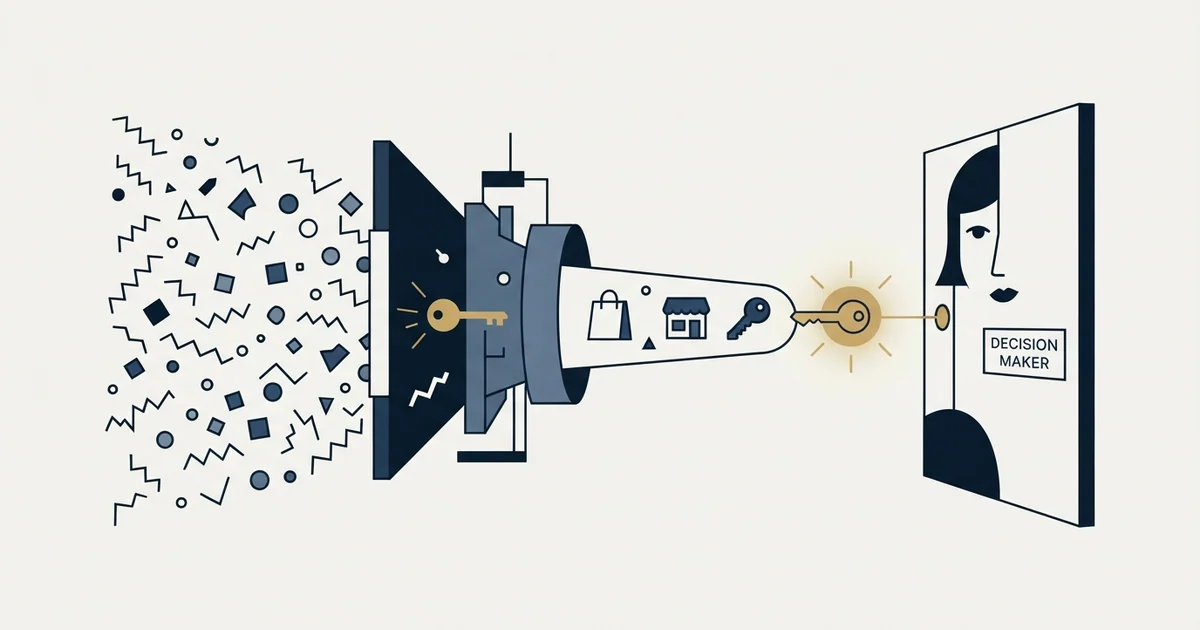
To book meetings with e-commerce brands, build each campaign around one buying trigger (a replatform, a new app install, a retention hire, heavy paid social), email the title that owns the metric your offer moves, and run six to seven single-message campaigns outside the September to December peak. Expect one to two held meetings per 100 well-targeted prospects.
Key takeaways
- Build one campaign per buying trigger (replatform, app install or removal, a new retention or CX hire, heavy paid social spend) instead of blasting a generic 'Shopify brands' list.
- Match the title to the metric your offer moves, and go higher at smaller brands: Belkins found founders and owners reply at 0.57% versus 0.32% for VPs, and 0-10 employee companies at 0.72% versus 0.22% for 10,000+ enterprises.
- Keep segments small. Woodpecker's analysis of over 20 million sales emails found campaigns under 50 contacts averaged a 5.8% reply rate versus 2.1% for lists of 1,000 or more.
- Woodpecker reports four to seven touchpoints as optimal, with three to five step sequences replying at 8.3% versus 4.1%. Those are market figures rather than our practice: we run the same four to seven as separate single-message campaigns.
- Treat mid-September through December as a no-meetings window and log every 'after peak' deferral with a specific January date to convert it later.
- Plan on one to two held meetings per 100 correctly targeted prospects, so 10 meetings a month needs roughly 500 to 1,000 prospects in flight across multiple sending domains.
Reviewed and updated September 1, 2026
How to Book Sales Meetings with E-commerce: A Step-by-Step Playbook
A Head of E-commerce at a $30M DTC brand opens her inbox between a Klaviyo flow review and a 3PL escalation about a delayed container. Eleven unread vendor pitches are waiting. Nine of them say some version of "we help brands like yours increase revenue." She archives all nine in under twenty seconds, because none of them named a number she is personally accountable for this quarter.
That twenty seconds is the entire game. Most teams try to win it with better copy, when the real leverage sits earlier: the trigger you build the campaign around, the title you send to, and whether the list survives verification. This playbook covers the full path from raw list to booked call: who to email inside an e-commerce org, how to build a list worth sending to, how to schedule campaigns around peak season, which asks convert, how to handle the objections you will hear every week, and what a realistic meetings-per-100-prospects outcome looks like.
Step 1: Pick the trigger before you pick the list
E-commerce brands buy on events rather than on calendars. Budget unlocks when something changed: they replatformed, they raised, they hired someone whose job it is to fix the thing you fix, or they survived a peak season that exposed a gap. Write down the single event that makes your offer urgent. A few that produce replies here:
| Trigger | How you detect it | What it unlocks |
|---|---|---|
| Migrated to Shopify Plus or BigCommerce | BuiltWith, Store Leads, Wappalyzer | Stack re-evaluation over 60 to 120 days |
| Installed or removed a retention app (Klaviyo, Recharge, Attentive, Gorgias) | App install tracking | Active unhappiness with a category |
| Hiring an E-commerce Manager, Retention Lead, or Head of CX | Careers page, LinkedIn Jobs | Budget already approved for that function |
| Running heavy paid social | Meta Ad Library ad counts | CAC pressure, appetite for efficiency plays |
| Raised a round, or launched wholesale | Funding databases, press | New spend authority, new problems |
One trigger per campaign. "Shopify brands" is not a campaign. "Shopify Plus brands running a subscription program that hired a retention lead in the last 90 days" is a campaign, and it lets you write a first line no competitor can copy.
Step 2: Target the title that owns the number you move
Org charts vary by revenue band, and emailing the wrong altitude is the most common reason good copy gets no reply.
| Brand size | Who actually decides | Who to skip |
|---|---|---|
| Under $5M GMV | Founder or CEO, sometimes one E-commerce Manager | Directors (the role usually does not exist) |
| $5M to $50M GMV | Head of E-commerce, Head of Growth, Head of Retention or CRM | Founder (delegated by now) |
| $50M to $250M GMV | VP E-commerce, VP Digital, CMO, Director of Performance Marketing, Director of Ops | E-commerce Manager (executes, does not buy) |
| $250M+ | VP or SVP Digital, Head of Digital Product, Head of Supply Chain, procurement | Anyone below Director |
Then match the title to your offer instead of chasing seniority. Retention tooling goes to Head of Retention or CRM. Paid media goes to Head of Performance Marketing or Growth. Fulfillment and freight go to Operations or Supply Chain. Conversion rate and site speed go to Head of E-commerce. Support automation goes to Head of CX. At small brands everything goes to the founder, because the founder is all of those people.
Published data supports going high at small companies. Belkins, analyzing 7.5 million cold emails sent in 2025, found founders and owners replied at 0.57% versus 0.32% for VPs, and companies with 0 to 10 employees replied at 0.72% versus 0.22% for enterprises with 10,000 or more. Source: Belkins
Build in two contacts per account: the economic owner and the person who feels the pain daily. Email them a week apart.
Step 3: Build a list that survives verification
A large share of "stores" are not real businesses, so filtering here is mostly subtraction. Cut these before you spend a cent on enrichment:
- Dropshipping and print-on-demand stores. Generic catalogs, no brand assets, no About page with a real team.
- Dormant stores. Nothing in the Meta Ad Library and no review movement in six months means nobody is home.
- Agencies with a storefront. They will forward your email to their clients.
- Marketplace-only sellers, if your product requires a direct site. Amazon-first brands often have no owned-site team.
- Domains where the only contact is info@ or support@. Shared inboxes drag reply rates down and complaint rates up.
Then enrich in order: domain, tech stack signals, revenue or headcount proxy, named contact, verified personal email. Route catch-all domains into a separate low-volume campaign rather than deleting them, since plenty of independent brands run catch-all.
Keep segments small. Woodpecker's analysis of more than 20 million sales emails found campaigns sent to fewer than 50 contacts averaged a 5.8% reply rate versus 2.1% for lists of 1,000 or more. Source: Woodpecker
Step 4: One message per campaign, scheduled around peak season
E-commerce has a hard calendar constraint no other vertical shares. From mid-September through the end of December, operators are in peak mode and will not evaluate anything new. Treat that window as read-only: keep the genuinely useful campaigns running, stop asking for meetings.
January to mid-March is the best window of the year, since budgets reset and the BFCM post-mortem is fresh. April to June is solid. July to early September is second-best, because brands are locking in the stack they will run through peak.
Seven separate campaigns across the year, one message each:
- Campaign 1, January. Trigger-specific observation plus a soft ask.
- Alongside campaign 1, LinkedIn. Connection request, no pitch.
- Campaign 2, four to six weeks on. New angle, different pain, one proof point, its own subject line.
- Campaign 3, on the next trigger. Short proof asset (benchmark, teardown, number).
- Alongside campaign 3, LinkedIn. One message carrying its own reason to write.
- Campaign 4, pre-peak in July. Direct meeting ask with two specific times.
- Campaign 5, once the BFCM numbers are in. The routing ask, with a permission-to-close question.
Four to seven touchpoints is the range Woodpecker reports as optimal, and the same dataset found campaigns with three to five steps replying at 8.3% versus 4.1% for sequences with no follow-up. Source: Woodpecker
We take the four to seven and run them as separate campaigns rather than as steps inside one thread. We stopped sending the follow-up step because a bump lands under a message the operator already archived, in front of exactly the readers most likely to mark it as spam, and the reputation cost is charged to the sending domain across every other brand you write to. A prospect who does not answer gets a new single-message campaign later in the year, with a new subject line and a new premise, and a fresh email gets a fresh open. The reasoning, with the numbers from our own campaigns, is in why we stopped using follow-ups.
Send in the morning: Belkins found 8am to noon produced the highest reply rate in its 2025 dataset. Source: Belkins
Step 5: Use an ask that costs nothing to say yes to

E-commerce operators are pitched constantly and have learned that "15 minutes" means 45 minutes with a screen share and two follow-ups. Asks that convert here name a metric the recipient personally owns, stay bounded, and can be answered in one word.
Metrics that land, by role:
- Retention or CRM: repeat purchase rate, 90-day revenue per customer, subscription churn
- Performance Marketing: blended MER or ROAS, CAC payback window, creative throughput
- Head of E-commerce: conversion rate by device, checkout drop-off, mobile site speed
- Operations: on-time delivery rate, cost per shipment, split-shipment percentage
- CX: first response time, ticket deflection rate, tickets per thousand orders
Rank your asks from easiest to hardest and use the easy ones early: an interest check ("worth me sending the two-line version?"), an asset offer ("want the teardown, no call attached?"), a referral ask ("is this even your area?"), and only then a meeting ask with two specific slots. The referral ask is underused and works especially well here, where org charts are fluid and people do not mind pointing you at the right colleague.
Step 6: The templates
Template 1: Tech stack trigger
Subject: {{company}} + {{app_name}}

Hi {{first_name}},

Noticed {{company}} is running {{app_name}} alongside {{platform}}. Most
brands at your size end up with flow revenue stuck around {{benchmark}}%
of total email revenue after year one, usually because post-purchase and
winback never get rebuilt after launch.

We rebuild those two flows specifically. {{reference_brand}} is the
closest comparison to you.

Worth me sending the two-line version of what we changed for them?

{{sender_name}}
Why this works: The stack detection proves you looked, the observation describes a failure mode specific to their setup, and the ask is an interest check that costs one word to answer.
Template 2: Paid social pressure
Subject: your Meta creative volume

{{first_name}},

Counted {{ad_count}} active ads on {{company}}'s Meta account this week,
with most of the spend on {{creative_theme}}. That concentration usually
shows up as rising CAC about six weeks in, when the winning angle
fatigues.

We produce {{volume}} net-new creative concepts a month for DTC brands in
{{category}}, built off reviews and support tickets.

Is creative throughput actually a bottleneck right now, or is the
constraint somewhere else?

{{sender_name}}
Why this works: The Meta Ad Library is public, so this specificity is available at scale. Ending with a diagnostic question invites a correction, and corrections are replies.
Template 3: Hiring signal
Subject: the {{job_title}} role

Hi {{first_name}},

Saw {{company}} is hiring a {{job_title}}. That usually means
{{pain_area}} has been on the list for a while and nobody has had the
hours for it.

We handle {{scope}} for brands in the {{revenue_band}} range, which buys
the new hire six to eight weeks of runway on day one.

If that is worth a look, I can send scope and pricing in one email. If
the role already covers it, say so and I will stop.

{{sender_name}}
Why this works: A live job posting proves budget for the function already exists, and the explicit permission to shut you down lowers the cost of replying honestly.
Template 4: Founder direct, sub-$5M brand
Subject: {{company}} repeat rate

{{first_name}},

Quick one. At {{company}}'s order volume, moving repeat purchase rate
from {{current_estimate}}% to {{target}}% is worth roughly
{{annual_impact}} a year in contribution, without touching ad spend.

That is the whole pitch. We do {{service}} on a {{term}} term, first
{{deliverable}} in {{timeframe}}.

Want the math on your actual numbers? Send your last 90 days of order
data and I will run it, no call needed.

{{sender_name}}
Why this works: Founders at this size think in contribution dollars and have no patience for discovery calls. Offering the analysis without requiring a meeting inverts the usual ask, and it frequently produces a meeting anyway.
Step 7: Handle the four objections you will get every week
- No: "We already work with an agency."
- No: "Send me some info."
- No: "Not right now, we are heading into peak."
- No: "What does it cost?"
"We already work with an agency." Do not attack the incumbent. Ask what the agency does not cover and position against the gap. "Most brands we work with keep their main agency and bring us in only for {{narrow_scope}}. Is that in scope for them today?"
"Send me some info." Usually a soft no, and sending a full deck ends the thread. Send one paragraph and one number, then re-ask. "Short version: {{one_sentence}}. The number that matters is {{metric}}. If that number is off for you, I will send the longer version."
"Not right now, we are heading into peak." Accept immediately and book the future. "Fair. Should I come back the second week of January when the BFCM numbers are in?" Then log it and actually come back. This one move converts a meaningful share of Q4 rejections into Q1 meetings.
"What does it cost?" Answer with a real range. Dodging price is the fastest way to lose an e-commerce operator, because they benchmark vendors constantly. "Brands at your volume land in the {{range}} band, and where inside it depends on {{variable}}. Worth 20 minutes to figure out which?"
What a realistic meetings-per-100-prospects outcome looks like
Two published benchmarks measure reply rate differently, so read them carefully before setting a target. Woodpecker reports a platform-wide average of 3.43% across more than 20 million sales emails, measured per prospect across a sequence. Source: Woodpecker Belkins reports 0.45% for 2025, measured as replies divided by total emails sent, a much stricter denominator. Source: Belkins
Use per-prospect numbers for planning. The arithmetic on 100 well-built e-commerce prospects, assuming the full set of campaigns and clean deliverability:
Verified, trigger-matched, correct title
Below 3% means targeting or copy is broken
A quarter to a third of all replies
Expect no-shows without a confirmation touch
Bar widths are equal here because these stage values are not a single comparable measure.
| Stage | Range | Notes |
|---|---|---|
| Prospects contacted | 100 | Verified, trigger-matched, correct title |
| Total replies | 4 to 9 | Below 3% means targeting or copy is broken |
| Positive replies | 1 to 3 | A quarter to a third of all replies |
| Meetings held | 1 to 2 | Expect no-shows without a confirmation touch |
One to two held meetings per 100 prospects is a healthy outcome here. Hitting 10 meetings a month therefore requires roughly 500 to 1,000 correctly targeted prospects in flight, which at safe sending limits means multiple domains and mailboxes rather than one.
Two things move that number more than any copy edit: list quality, since a trigger-matched list of 300 beats an untargeted list of 3,000, and re-approach discipline. Woodpecker attributes 42% of all replies to follow-ups rather than the first email, which is why most of the market runs follow-up steps. Source: Woodpecker We take the same second bite from a later campaign to the people who did not answer, rather than from a second message added under the first one.
Pre-send checklist

- One trigger per campaign, written in a single sentence
- Title matched to the metric your offer moves, not just to seniority
- Dropshippers, dormant stores, and agencies removed from the list
- Two contacts per account, emailed a week apart
- Every address verified, catch-alls in a separate low-volume campaign
- Campaigns run outside the mid-September to December peak window
- The first campaign's ask is an interest check, with the meeting ask held for a later campaign or a reply
- Pricing range prepared in advance, and every Q4 deferral logged with a January date
Where teams usually go wrong
The most common failure is treating e-commerce as one market. A $3M skincare brand run by two founders and a $200M apparel group with a 40-person digital team share a platform and almost nothing else. Splitting the list by revenue band before writing a line of copy fixes more problems than any subject line test. The second failure is asking for a meeting before earning one. Front-load value, keep the first ask cheap, and let the meeting be the second or third yes.
If you would rather have this built and run for you, RevenueFlow does done-for-you cold email for B2B teams selling into e-commerce: trigger-based list building, inbox infrastructure, copy, and reply handling. Book a strategy call and we will map the trigger, the titles, and the volume you need to hit your meeting target.
Related Reading
- Cold Email for Product Feedback: Complete Strategy Guide
- Cold Email for Partnerships: Building Strategic Business Relationships
- Cold Email for User Research: Complete Strategy Guide
If you would rather have this run for you, RevenueFlow books qualified meetings on a pay-per-meeting basis and publishes client results.
Frequently asked questions.
Frequently asked questions- Who should I actually email at an e-commerce brand?
- It depends on revenue. Under $5M, email the founder or CEO. Between $5M and $50M, target the Head of E-commerce, Growth, or Retention. Above $50M, go to VP Digital, CMO, or the relevant director, and skip the E-commerce Manager, who executes rather than buys. Always match the title to the metric your offer moves.
- When is the worst time to cold email e-commerce companies?
- Mid-September through the end of December. Operators are in peak season around Black Friday, Cyber Monday, and holiday fulfillment, and they will not evaluate new vendors. Keep nurturing during that window but stop asking for meetings. January to mid-March is the strongest period, since budgets reset and the BFCM post-mortem is still fresh.
- How many meetings can I expect per 100 e-commerce prospects?
- With a verified, trigger-matched list and the full set of campaigns, plan on four to nine total replies, one to three positive replies, and one to two held meetings per 100 prospects. Booking 10 meetings a month therefore requires roughly 500 to 1,000 correctly targeted prospects in flight, spread across multiple domains and mailboxes.
- What CTA books the most meetings with e-commerce operators?
- An ask that can be answered with one word and costs nothing to accept. Start with an interest check ('worth me sending the two-line version?') or an asset offer ('want the teardown, no call attached?'), then a referral ask, and only request a meeting with two specific times at the fifth or sixth touch.
- How do I handle 'we already work with an agency'?
- Do not attack the incumbent. Ask what the agency does not cover, then position against that gap: most brands keep their main agency and bring in a specialist for one narrow scope. If nothing is uncovered, ask when the contract renews and log a date to come back rather than pushing for a meeting now.
About the author.

Ben Carden is CRO at RevenueFlow, which builds and operates outbound revenue engines for B2B companies. Previously at Gartner Enterprise. Studied at London School of Economics.
Ben Carden · CRO
Connect on LinkedIn →Explore more.
Ready to scale your outreach?
We build GTM engines that book real meetings. See the receipts.
Related articles.
Cold Email for Influencer Outreach: Partner with Creators
Learn how to use cold email to build authentic influencer partnerships that drive real results for your brand, with proven templates and strategies.
Cold Email for Product Feedback: Complete Strategy Guide
Learn how to use cold email to gather valuable product feedback from users and prospects. Includes proven templates, feedback frameworks, and response optimization techniques.
Cold Email for PR: How to Pitch Journalists and Get Coverage
Learn how to craft cold emails that get journalists to open, read, and respond to your pitches. Includes real templates, timing strategies, and a complete PR outreach checklist.
Cold Email for Reviews: Complete Strategy Guide
Learn how to use cold email to generate authentic product reviews on G2, Capterra, and other platforms. Includes proven templates, compliance guidelines, and review generation frameworks.
Cold Email for Link Building: How to Get Quality Backlinks
Learn how to use cold email outreach to build high-quality backlinks that improve your SEO rankings, with proven templates and strategies that get responses.
Cold Email for Focus Groups: Complete Strategy Guide
Learn how to use cold email to recruit qualified participants for focus groups. Includes proven templates, screening strategies, and group composition frameworks.