How to Book Sales Meetings with FinTech
A tactical playbook for booking meetings with fintech buyers: titles, list signals, a 21-day sequence, four templates, and the objections that stall deals.
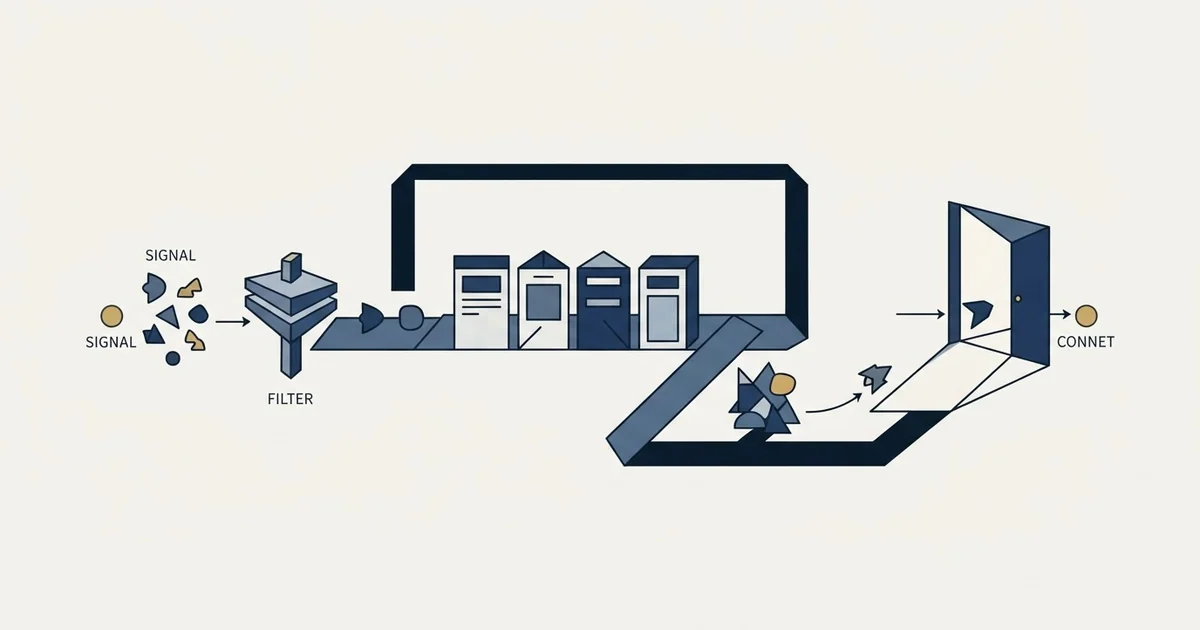
To book meetings with fintech, target one segment at a time, email the operator who owns the metric (VP Payments, Head of Credit Risk, BSA Officer), build lists from licensing registries, funding rounds, and job postings, run six single-message campaigns across a quarter, and ask for interest or an asset instead of sending a calendar link.
Key takeaways
- Segment before you write: payments, lending, banking as a service, wealth, insurtech, regtech, and crypto buyers own different metrics and need separate campaigns.
- Email the operator at companies under 500 people and the executive above 1,000, and always add a compliance contact (Head of Compliance, BSA Officer, MLRO) as a second-line entry point.
- Build lists from public fintech signal: NMLS Consumer Access, FINRA BrokerCheck, SEC IAPD, the FCA Register, funding announcements, and open roles for fraud, compliance, and reconciliation staff.
- Run six single-message campaigns spread across a quarter over email, LinkedIn, and phone rather than five emails in nine days, and send Tuesday to Thursday between 7 and 9 AM local time.
- Replace first-email calendar links with an interest ask or a specific asset offer, since a regulated buyer is weighing whether a call triggers an internal vendor review.
- Model meetings backward from your own reply, positive-reply, booking, and show rates before launch, and treat 300 well-researched contacts per segment as the working list size.
Reviewed and updated September 1, 2026
How to Book Sales Meetings with FinTech: A Step-by-Step Playbook
A Head of Payments at a Series B lending platform will forward your email to two people before she replies: her security lead, who wants to know if you touch cardholder data, and her CFO, who wants to know what it costs. That forwarding behavior is the biggest difference between booking meetings in fintech and booking them anywhere else. Your first email is read by a committee that assembled itself in a Slack thread you will never see.
Most outbound programs aimed at fintech obsess over the opening line and ignore the prospect's real question, which is whether talking to you creates work for the compliance team. This playbook covers the mechanics of turning cold outreach into booked calls: title selection, list construction, campaign design, the CTA that converts here, the objections you will hear on repeat, and how to model meetings per 100 prospects before you spend a dollar.
Step 1: Choose One Fintech Segment Per Campaign
"Fintech" covers a payments infrastructure company with 40 engineers and a 60-person insurance brokerage running on a modern stack. They share almost nothing operationally, and campaigns written for the category average convert with no one. Segment first, then write per segment. These divisions hold up in practice:
| Segment | Primary buyer | Metric they own |
|---|---|---|
| Payments and acquiring | VP Payments | Authorization rate, chargebacks |
| Lending and credit | Head of Credit Risk | Approval rate, fraud loss |
| Banking as a service | VP Banking Ops | Reconciliation, audit findings |
| Wealth and investing | Head of Client Ops | Onboarding friction, advisor capacity |
| Insurtech | VP Claims | Loss ratio, claims cycle time |
| Regtech, KYC, AML | BSA Officer, MLRO | Alert volume, false positive rate |
| Crypto and digital assets | Head of Compliance | Custody risk, licensing coverage |
Pick one or two segments per campaign. A campaign aimed at Head of Credit Risk at consumer lenders beats a general fintech campaign, because you can name the exact system they use and the metric their bonus depends on.
Step 2: Target Titles That Own a Number
Fintech org charts are flatter than enterprise charts, titles drift, and the person with the budget often sits a level below where you would expect. Three rules.
Target the operator at companies under 500 people. At a 200-person fintech, the VP of Payment Operations runs vendor evaluation end to end and the CFO signs. Emailing the CFO first routes you into a procurement queue with no internal advocate.
Target the executive at companies over 1,000 people. Above that size, operators rarely start vendor conversations without cover. A VP or C-level introduction creates the permission that gets an operator on the call.
Include the adjacent compliance title as a second-line contact. Head of Compliance, BSA Officer, MLRO, and Head of Vendor Risk kill deals late. Emailing them in parallel with a different angle (audit readiness, evidence collection, examiner questions) gives you a second entry point.
Other titles worth prioritizing: Director of Operations, Head of Risk, Head of Fraud, VP Engineering (for API products), Head of Partnerships (anything touching a sponsor bank), and Chief of Staff at early-stage companies, where that person quietly runs vendor selection.
Step 3: Build the List from Regulatory and Funding Signals

Fintech firms are licensed, registered, and funded in public, which beats a generic firmographic pull.
- Licensing registries. NMLS Consumer Access for US lenders and money transmitters, FINRA BrokerCheck and SEC IAPD for broker-dealers and advisers, the FCA Register in the UK. New state licenses show who is expanding, and expansion precedes tooling purchases.
- Funding announcements. A Series A or B round is the cleanest buying trigger here. Budget appears, headcount gets approved, and the operating leader has a mandate to fix something within two quarters.
- Job postings. An opening for a Fraud Analyst, Compliance Manager, or Reconciliation Specialist says a team is drowning in manual work in that exact area. Postings often beat paid intent data, being specific and dated.
- Sponsor bank, processor, and enforcement news. A new sponsor bank, a processor migration, a consent order, or a move into a new regulated product reopens integrations and forces control builds, and control builds carry budget.
Verify every address before it enters a campaign, and suppress anyone already in your CRM plus any domain with an open opportunity. Fintech is a small world, and two reps hitting one company with different pitches costs you credibility.
Keep lists small. Three hundred well-researched contacts in one segment outperform three thousand scraped ones, because the tokens that matter here (processor, sponsor bank, license type, last round) only exist if a human or an enrichment workflow found them.
Step 4: One Message Per Campaign, Paced to a Fintech Buying Cycle
Fintech buyers evaluate slowly and reply late, so sequences that fire five emails in nine days burn the list before the buying window opens. We do not run one at all: each campaign carries exactly one email, and the angles are spread across separate campaigns weeks apart. A structure built for this vertical:
| Campaign | Window | Channel | Job of the campaign |
|---|---|---|---|
| 1 | Now | Email, one message | Named trigger, one observation, soft interest CTA |
| Alongside 1 | Same week | LinkedIn connect, no pitch | Face to name, nothing sold in the note |
| 2 | Four weeks on | Email, one message | New angle: metric, peer pattern, or compliance |
| 3 | On the next trigger | Email, one message | Proof asset offered, no meeting ask |
| Alongside 3 | Same week | Phone or LinkedIn message | Direct, brief, its own reason to make contact |
| 4 | Next quarter | Email, one message | The routing and timing ask, tied to their cycle |
Send windows matter. Ops and risk leaders at fintechs carry heavy meeting loads midweek and clear their inboxes early, so Tuesday through Thursday between 7 and 9 AM local time is reliable. Avoid month end and quarter end for anyone in payments or finance operations, since close cycles absorb the week.
The proof campaign usually generates more replies than the first one, so give it a real asset: a two-page teardown, a benchmark comparison, a checklist an operator can hand to their team. It goes out as its own message with its own subject line, never as a bump under the first email. We stopped sending those because a message saying "just bumping this" trains people to ignore you, and because it lands in front of exactly the readers most likely to report it, so the reputation cost is charged to the sending domain across every other fintech you write to. A fresh email gets a fresh open. The reasoning, with the numbers from our own campaigns, is in why we stopped using follow-ups.
Step 5: The CTA That Converts in FinTech

Calendar links in a first email underperform badly here. A regulated-industry buyer is calculating internal cost, and a scheduling link asks them to commit before they know whether talking to you triggers a vendor review. Three patterns work better.
The interest ask. "Worth a look?" or "Want me to send the breakdown?" A one-word reply is cheap, and once they reply you own a live thread you can book from.
The asset offer. Something specific and useful (an authorization rate comparison by card network, a due diligence questionnaire template, a reconciliation exception taxonomy) converts because the buyer gets value either way.
The named short call with an agenda. If you ask for time, say what happens in it: "15 minutes, I walk through how three other lenders cut manual review volume, you tell me if the numbers look like yours." Specificity reads as a meeting with a defined end.
Never lead with a demo. In fintech that is a mid-funnel event which usually requires a security questionnaire first.
Step 6: Templates You Can Ship
Template 1: Funding trigger, operations leader
Subject: {{company}}'s {{round}} and payment ops headcount

Hi {{first_name}},

Saw the {{round}} announcement in {{month}}. Congrats.

Most {{segment}} teams that raise at your stage hit the same wall
within two quarters: volume roughly doubles, the ops team stays
the same size, and manual exception handling eats the gains.

We work with {{peer_company_1}} and {{peer_company_2}} on exactly
that, mostly on the reconciliation side.

Worth me sending the two-page breakdown of how they handled it?

{{sender_name}}
{{sender_title}}
Why this works: The trigger is public and dated, so the email cannot be mistaken for a blast, and the problem is specific to the stage they just entered. The CTA asks for a yes or no on a document, a far lower bar than surrendering a calendar slot.
Template 2: Job posting signal, risk or compliance leader
Subject: the {{job_title}} role you're hiring for

{{first_name}},

You've had a {{job_title}} opening live for {{weeks_open}} weeks.
Usually that means alert volume grew faster than the team and
someone senior is absorbing the overflow.

Two things other {{segment}} compliance teams did before the
backfill landed: tightened the rules generating their top three
false positive categories, and moved evidence collection out of
email so audit prep stopped costing a week per cycle.

Happy to send the triage checklist we put together. No pitch
attached to it.

{{sender_name}}
Why this works: The signal is one the prospect knows is public, so it reads as observant rather than invasive, and it names a consequence they are personally feeling. The asset offer explicitly disclaims a pitch, which lowers the cost of replying.
Template 3: The re-approach campaign, peer pattern
Best for: a later campaign to people who did not answer an earlier one, four to eight weeks on.
Subject: where {{segment}} teams actually spend the money

{{first_name}},

One number, and that is the whole email.

Across the {{segment}} teams we work with, most of the cost sits
in headcount added to compensate for manual steps nobody ever
documented.

I put the comparison in a one-pager, {{asset_name}}.

Want it? One word is fine.

{{sender_name}}
Why this works: One email carrying one number and one ask removes the fear of an endless sequence more convincingly than a promise to stop would. It carries new information rather than repeating an earlier campaign, it arrives with its own subject line so nothing depends on the first email being remembered, and the ask is a single word.
Template 4: Converting a positive reply into a booked call
Best for: answering a prospect who has just replied to you. That is a conversation, not outreach, so it belongs under their own subject line.
Subject: Re: {{their_subject}}

Great, sending it over now.

While you look at it, would 15 minutes Thursday or Friday morning
be useful? Short agenda: three questions about how {{company}}
handles {{specific_process}} today, then the two places
{{peer_company_1}} found the biggest savings.

If it's clearly not relevant after those questions, I'll say so
and we'll end early.

{{sender_name}}
Why this works: Two named options beat an open scheduling link, and the stated agenda plus explicit permission to end early reduce the perceived risk of saying yes.
Step 7: Handling the Objections You Will Actually Hear
- No: "We built this in-house."
- No: "Send me information."
- No: "We can't onboard vendors, we're mid-audit."
- No: "You need to talk to compliance or vendor risk."
- No: "What does it cost?"

"We built this in-house." Common here, where engineering teams are strong and building is the default. Do not argue. Ask what the roadmap owner would deprioritize to extend it, and offer a comparison of maintenance cost against feature velocity. Aim for a scoping call.
"Send me information." Usually a soft no. Answer with a specific asset plus a specific question so the thread has somewhere to go: "Sending the one-pager. Quick question so I send the right version, are you on {{processor_a}} or {{processor_b}}?"
"We can't onboard vendors, we're mid-audit." The best objection you get, because it is a dated no. Confirm the timeline, ask what evidence the auditors want, and set a reminder for two weeks after that date. Reference the audit by name when you return.
"You need to talk to compliance or vendor risk." Say yes and ask for the introduction, then send that contact a different email covering data handling, subprocessors, and certifications. Arriving with completed answers shortens the cycle by weeks.
"What does it cost?" Give a range and a driver ("most teams your size land between X and Y depending on transaction volume"). Refusing any number reads as evasive and usually ends the thread.
Step 8: Model the Meetings Before You Send
Set expectations with arithmetic rather than hope. The figures below are planning assumptions, not published benchmarks. Replace them with your own data after two campaigns.
Bar widths are equal here because these stage values are not a single comparable measure.
| Stage | Assumption you set |
|---|---|
| Deliverable after verification | 95 percent of 100 loaded |
| Finished the campaigns, no bounce or opt-out | 90 percent |
| Replied at all | your own reply rate |
| Positive share of replies | 25 to 40 percent |
| Positive replies that become a booked call | 50 to 70 percent |
| Booked calls that show up | 70 to 85 percent |
Two implications. The show rate is a real leak, and a confirmation email plus a text on the morning of the call recovers part of it. And once copy clears a reasonable bar, list size drives output more than further copy edits do. If you need eight meetings a month, work backward through your own rates to the number of verified contacts you must load, before writing a subject line.
Compliance and Deliverability Notes Specific to FinTech

Your prospects operate under obligations that make them cautious about any vendor touching customer information. Non-bank financial institutions in the US fall under the FTC Safeguards Rule, which requires a written information security program and oversight of service providers. Source: FTC Safeguards Rule guidance. Companies regulated in New York face further cybersecurity requirements, including third-party service provider policies. Source: NYDFS Cybersecurity Resource Center. Write campaigns that speak to the review your buyer will actually have to run.
Deliverability discipline matters more here too, since recipients sit behind aggressive filtering. Use sending domains separate from your primary, warm them properly, keep per-mailbox volume low, write in plain text, skip tracking pixels on the first touch, and give a visible unsubscribe path. One complaint spiral inside a connected segment can cost you the vertical for a quarter.
Your 30-Day Rollout
- Week one: choose one segment, define three target titles, build a 300-contact list from licensing registries, funding news, and job postings, and verify every address.
- Week two: write one campaign per title, one message each, spread across the quarter, two channels. Set up sending infrastructure and start warming it.
- Week three: launch at 20 to 30 sends per mailbox per day. Read every reply personally and log the objection type behind each one.
- Week four: cut the two weakest campaigns, rewrite the first email using language lifted from positive replies, and expand within the same segment before adding a second.
Running this well takes a list builder, a copywriter, deliverability monitoring, and someone answering replies within the hour. If you would rather have it operated for you, RevenueFlow builds and runs segmented cold email programs for B2B teams selling into regulated verticals. Book a strategy call and we will map the segment, titles, and campaigns with you first.
Related Reading
- Cold Email for Partnerships: Building Strategic Business Relationships
- Cold Email for Product Feedback: Complete Strategy Guide
- Best CRM Tools for FinTech (2026)
If you would rather have this run for you, RevenueFlow books qualified meetings on a pay-per-meeting basis and publishes client results.
Frequently asked questions.
Frequently asked questions- Who should I target to book meetings at a fintech company?
- Target the operator who owns the metric your product moves: VP Payments or Head of Payment Ops in payments, Head of Credit Risk in lending, VP Banking Ops in banking as a service, and BSA Officer or MLRO in KYC and AML. At companies over 1,000 people, start one level higher, because operators there rarely open vendor conversations without executive cover.
- How many campaigns should fintech cold outreach run?
- Six separate campaigns spread across a quarter works better than a compressed sequence, and each one carries exactly one email. Run the opener now, a LinkedIn connection in the same week, a new-angle campaign four weeks on, a proof campaign on the next trigger with a call beside it, and a routing ask next quarter. Fintech buyers evaluate slowly, and a nine-day sequence burns the list before the buying window opens.
- Should I put a calendar link in a cold email to a fintech prospect?
- Not in the first email. A regulated-industry buyer is calculating whether talking to you triggers a vendor review, so a scheduling link asks for commitment too early. Ask for interest instead ("want me to send the breakdown?"), then convert the reply into a call with two named time options and a stated agenda.
- What buying triggers work best for fintech outreach?
- New funding rounds, new state licenses in NMLS, sponsor bank or processor changes, consent orders, and open job postings for fraud, compliance, or reconciliation roles. Each one is public, dated, and tied to budget or workload, which makes the resulting email read as observation rather than a mass send.
- How do I handle the compliance and vendor risk objection?
- Accept it and ask for the introduction. Send the compliance or vendor risk contact a separate email covering data handling, subprocessors, certifications, and what your onboarding review will require of them. Fighting the process costs months, while arriving with completed answers shortens the cycle by weeks.
About the author.

Ben Carden is CRO at RevenueFlow, which builds and operates outbound revenue engines for B2B companies. Previously at Gartner Enterprise. Studied at London School of Economics.
Ben Carden · CRO
Connect on LinkedIn →Explore more.
Ready to scale your outreach?
We build GTM engines that book real meetings. See the receipts.
Related articles.
Cold Email for Influencer Outreach: Partner with Creators
Learn how to use cold email to build authentic influencer partnerships that drive real results for your brand, with proven templates and strategies.
Cold Email for Product Feedback: Complete Strategy Guide
Learn how to use cold email to gather valuable product feedback from users and prospects. Includes proven templates, feedback frameworks, and response optimization techniques.
Cold Email for PR: How to Pitch Journalists and Get Coverage
Learn how to craft cold emails that get journalists to open, read, and respond to your pitches. Includes real templates, timing strategies, and a complete PR outreach checklist.
Cold Email for Reviews: Complete Strategy Guide
Learn how to use cold email to generate authentic product reviews on G2, Capterra, and other platforms. Includes proven templates, compliance guidelines, and review generation frameworks.
Cold Email for Link Building: How to Get Quality Backlinks
Learn how to use cold email outreach to build high-quality backlinks that improve your SEO rankings, with proven templates and strategies that get responses.
Cold Email for Focus Groups: Complete Strategy Guide
Learn how to use cold email to recruit qualified participants for focus groups. Includes proven templates, screening strategies, and group composition frameworks.