How to Book Sales Meetings with Gaming
A tactical playbook for booking meetings with game studios and publishers: targeting, list building, sequence timing, templates, and realistic outcomes.
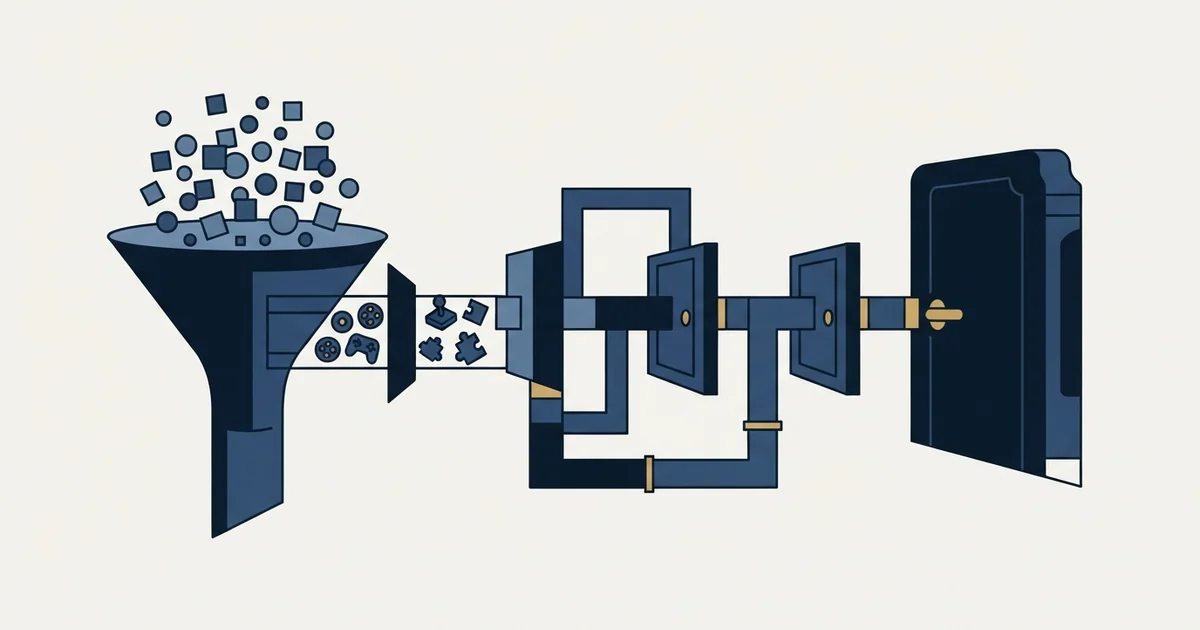
To book sales meetings in gaming, pick one segment (mobile F2P, PC/console, publishers, esports, hardware), target whoever owns the metric you move, tie every email to a public trigger like a launch or job posting, avoid crunch and conference weeks, and offer an asset instead of a demo. Expect one to three meetings per 100 researched prospects.
Key takeaways
- Gaming splits into at least six operationally distinct segments (mobile F2P, PC/console, publishers, esports, Web3/UGC, hardware); one campaign written for all of them underperforms in each.
- Target by metric ownership: founders and studio heads under 100 employees, functional directors (Live Ops, UA, Player Support, Technical Director) at 100 to 500, multithreaded Director-then-VP above that.
- Woodpecker's own sending data found campaigns under 50 recipients averaged a 5.8 percent reply rate, with reply rates declining as list size grew, which favors small researched lists over scraped volume.
- Avoid sending in the four to six weeks before an announced launch, the two weeks after launch, and the weeks of GDC in March and Gamescom in August; the weeks right after those events convert well.
- Asset offers (teardowns, benchmarks, 4-minute Looms) and single-question asks outperform demo requests and bare calendar links with engineer, analyst, and producer buyers.
- A realistic outcome per 100 researched, verified gaming prospects is 4 to 10 total replies, 2 to 5 positive replies, and 1 to 3 booked meetings, with a longer reply-to-meeting lag than other verticals.
Reviewed and updated September 1, 2026
How to Book Sales Meetings with Gaming: A Step-by-Step Playbook
A live-service mobile studio has 40 people, one title generating 80 percent of revenue, and a Director of Live Ops who spends her week staring at a day-7 retention chart. She gets pitched by a dozen vendors a month: analytics, live ops tooling, UA agencies, player support outsourcing, anti-cheat, ad mediation. Almost all open with "I'd love to show you a demo of our platform." She books maybe one of those calls a quarter, and it goes to whoever referenced her actual game.
That is the entire problem in miniature. Gaming is a large, well-funded market (global games revenue passed $200 billion in 2025 with roughly 3.6 billion players. Source: Newzoo via GamesBeat), and it is also a small, tightly networked industry where generic outreach gets flagged instantly. Booking meetings here is a targeting and timing problem far more than a volume problem.
This playbook covers who to email, how to build the list, campaign structure, the CTA that converts here, objection handling, and what a realistic meetings-per-100-prospects number looks like.
Step 1: Decide Which Gaming You Mean
"Gaming" covers at least six businesses that share almost nothing operationally. Pick one before building anything.
| Segment | Who they are | What they buy | Deal reality |
|---|---|---|---|
| Mobile F2P studios | Live-service mobile teams, casual and midcore publishers | UA, monetization, analytics, ad mediation, player support | Fast cycles, ROAS-obsessed buyers |
| PC and console developers | AA and AAA studios, self-published indies | Engine tooling, QA, localization, playtesting, build infra | Milestone-driven, tied to ship dates |
| Publishers and platform holders | Publishers, storefronts, subscription services | Marketing services, business intelligence, compliance | Committee buying, long cycles |
| Esports and tournament orgs | Leagues, teams, event operators | Sponsorship tech, broadcast, ticketing, fan data | Seasonal, sponsorship-funded |
| Web3 and UGC platforms | Blockchain games, creator platforms | Payments, fraud, KYC, infrastructure | Volatile, funding-dependent |
| Gaming hardware | Headsets, controllers, PC OEMs, peripherals | Supply chain, retail media, creator marketing | Retail and holiday-quarter driven |
A single campaign written for "gaming companies" underperforms against all six. Choose the segment where your product moves a number the buyer already reports on, then build one campaign for it.
Step 2: Target the Titles That Can Actually Say Yes
Gaming org charts are flatter than enterprise SaaS and titles are inconsistent between studios. What stays consistent is who owns the metric.
Studios under 100 people: go to the top. CEO, COO, Studio Head, or Founder. At this size the executive is the buyer, the champion, and procurement. A Head of Studio at a 30-person team will read a good email and reply personally.
Studios of 100 to 500: target the functional owner. Director or VP of Live Ops, Head of Player Experience, VP User Acquisition, Head of Publishing, Technical Director, Head of Production, Director of Player Support, Head of Analytics.
Publishers and enterprise (500 plus): the person with the metric usually cannot sign, so plan a multithreaded campaign. Reach the Director-level owner first, then bring in the VP once you have internal interest. Build lists around VP Publishing, VP Marketing, Director of Business Intelligence, Head of Platform Partnerships, and Director of Global Player Support.
Two titles are worth deprioritizing. Community Managers rarely control budget, and studio recruiters surface constantly in the same searches as ops buyers. Both will politely ignore you.
Step 3: Build the List From Gaming-Native Sources
Standard B2B databases have thin coverage of game studios, especially outside North America. Layer these sources instead.
Start with a company universe rather than a contact search. Steam publisher and developer pages plus App Store and Google Play top-grossing charts give you companies that are actively shipping. Filter by genre and monetization model so the list matches your product. A studio running a live-service RPG with battle passes has different problems than a premium indie shipping one-and-done.
Layer credits and staffing data on top. MobyGames and LinkedIn Sales Navigator (filtered to the Computer Games industry, then by headcount and country) get you the human names. Company career pages are the highest-signal source most teams skip: a studio hiring three Live Ops Analysts is telling you what it is investing in this quarter. Then enrich with event data. GDC, Gamescom, Devcom, and Pocket Gamer Connects publish speaker names and session titles for free, and anyone who spoke on a panel in your problem area has a public opinion you can reference by name.
Verify every email before it sends. Gaming studios use a lot of vanity domains and subdomains, so bounce rates run high without verification. Cap each campaign at a few hundred researched contacts rather than thousands of scraped ones. Woodpecker's analysis of its own sending data found campaigns under 50 recipients averaged a 5.8 percent reply rate, with reply rates falling as list size grew. Source: Woodpecker
Step 4: Time the Send Around the Development Calendar
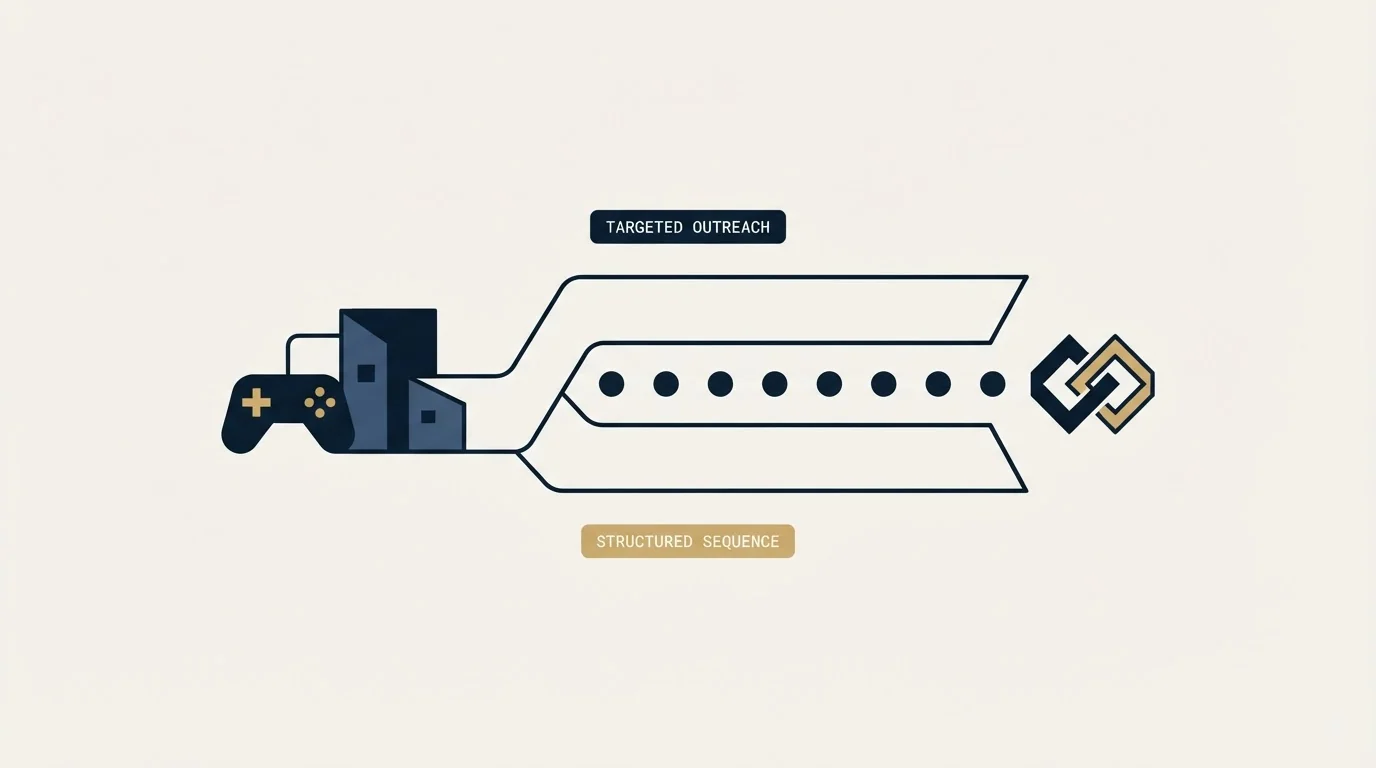
Gaming has harder timing constraints than almost any vertical. Emailing a studio during crunch throws the contact away.
Avoid the four to six weeks before an announced launch date, the two weeks after launch (all hands are on live issues), and the run-up to a season drop or console certification submission. Skip the weeks of GDC in March and Gamescom in August, when inboxes are buried and everyone is traveling. The weeks right after those events are excellent, since buyers return with a list of things they decided to fix.
Positive triggers worth building alerts for: a funding round, a title announcement six or more months out, a storefront or platform policy change (privacy framework shifts, store fee changes, engine licensing), a job posting in your function, a public postmortem about a problem you solve, a new executive hire in your buying function, and a soft launch in a test market. Each gives you a first line no competitor is using.
Step 5: One Message Per Campaign, Then a Fresh Angle
Gaming buyers respond to patience and to being treated like practitioners. Seven separate campaigns across the year works well, each carrying exactly one message, mixing email with LinkedIn.
| Window | Message | Purpose |
|---|---|---|
| Campaign 1, now | Email, one message | Trigger-based opener, one observation, soft CTA |
| Alongside campaign 1 | Connection request, no pitch, one-line note at most | |
| Campaign 2, four weeks on | Email, one message | A concrete asset (teardown, benchmark, clip), its own subject line |
| Campaign 3, on the next trigger | Email, one message | New angle: different metric, different stakeholder pain |
| Alongside campaign 3 | Comment on their post or share something relevant | |
| Campaign 4, after their ship date | Email, one message | Social proof from a comparable studio, named if permitted |
| Campaign 5, next quarter | Email, one message | The routing ask, plus an offer to come back after the next milestone |
Two structural rules matter more than the exact timing. Keep every email under 90 words, because gaming leads read email on a phone between meetings. And never send a second message underneath the first one at all. We stopped because a bump lands beneath something a producer has already skipped, in front of exactly the people most likely to report it, and in an industry this tightly networked the reputation cost is charged to the sending domain across every other studio you write to. Every campaign carries new information and its own subject line, a non-replier gets the next one weeks later, and a fresh email gets a fresh open. The reasoning, with the numbers from our own campaigns, is in why we stopped using follow-ups.
Step 6: The CTA That Converts in Gaming
The default B2B ask ("do you have 30 minutes for a demo next week?") converts poorly here. Gaming buyers are engineers, analysts, and producers who evaluate things by looking at them rather than sitting through a deck. The asks that consistently outperform:
- The teardown offer. "I pulled your store page and day-1 through day-7 funnel against four comparable titles. Want the two-page writeup?" Send the asset whether or not they book. The meeting comes after they read it.
- The single-question ask. "Is player support volume during season launches something you own, or does it sit with another team?" Answerable in five words, and the reply opens a thread.
- The async-first offer. "I can send a 4-minute Loom instead of booking a call. Want it?" Converts well with technical buyers who resent calendar invites.
- The 15-minute cap, stated explicitly. If you ask for a call, name a short duration and say what will happen in it.
Skip calendar links in the first email. Skip "quick sync." Skip anything implying you want to learn about their business rather than tell them something.
Step 7: Templates
Template 1: Live Ops and Retention Angle (Mobile F2P)
Subject: {{game_name}} season 4 drop

Hi {{first_name}},

Saw {{game_name}} shipped the season 4 battle pass on {{launch_date}}.
The pattern we see with live-service titles at your scale is support
volume spiking 3-4x in the 72 hours after a season drop, then the team
eating it manually.

I put together a two-pager on how three studios in your genre handled
that spike without adding headcount. Want me to send it over?

{{sender_name}}
Why this works: the opener proves you looked at the actual game and its release calendar, the pain is specific to live-service operations, and the ask is permission to send something instead of time on a calendar.
Template 2: User Acquisition and Performance Marketing Angle
Subject: {{game_name}} UA mix

{{first_name}},

Noticed you're hiring a second UA Manager for {{game_name}} and running
creative on {{ad_network}}. Usually that means either scale is working
or creative fatigue is eating CPI.

We pulled creative performance data across {{n}} titles in {{genre}}
last quarter. The part most teams find useful is the breakdown of which
hook types held CPI past week 3.

Is creative throughput the constraint right now, or is it channel mix?

{{sender_name}}
Why this works: the job posting is a verifiable public trigger, naming two plausible causes shows you understand UA mechanics, and the closing either-or takes one sentence to answer.
Template 3: Studio Ops and Technical Angle (PC and Console)
Subject: build times at {{company_name}}

Hi {{first_name}},

Your {{conference_name}} talk on {{talk_topic}} covered the automated
test suite you built. The bit about nightly builds landing at 4am and
blocking the morning stand-up is a problem I hear from most
{{engine_name}} teams at this stage of production.

Happy to send a 4-minute walkthrough of how {{reference_studio}} cut
that cycle, instead of setting up a call. Want it?

{{sender_name}}
Why this works: referencing a public talk proves you exist inside the industry, the cited detail is too specific to have been templated across a list, and the async offer respects an engineering buyer's calendar.
Template 4: The Re-Approach That Gets Replies
Best for: a later campaign to people who did not answer an earlier one, once the season has shipped.
Subject: support tickets per DAU, by genre

{{first_name}}, a two-pager you may find useful. No reply needed.

Page 2 has the support-tickets-per-DAU benchmark by genre, which is the
part most live ops leads end up screenshotting.

If season prep has you buried, just say "after {{next_milestone}}" and
I'll disappear until then.

{{sender_name}}
Why this works: it delivers value unconditionally, removes the obligation to respond, and gives the prospect a low-effort way to defer. It goes out as its own campaign with its own subject line, so a producer who never opened the earlier email still gets a clean one.
Step 8: Handle the Four Objections You Will Actually Hear
- No: "We build this in house."
- No: "We're heads down until launch."
- No: "We already use {{competitor}}."
- No: "Budget is frozen."
"We build this in house." Common at studios with strong engineering cultures. Do not argue. Ask where it sits on the roadmap and offer to be the fallback if it slips past the next milestone. Studios deprioritize internal tooling constantly.
"We're heads down until launch." Take it at face value and get a date. "Understood. Is {{month}} after ship a reasonable time to revisit?" A confirmed future date beats a forced meeting now.
"We already use {{competitor}}." Ask a diagnostic question rather than pitching against them. "Makes sense. Is it handling {{specific_edge_case}}, or are you working around that?" Most gaming tools have known gaps, and naming one credibly opens a conversation.
"Budget is frozen." Common given the industry's recent contraction. Shift the ask to information. Send the benchmark or teardown with no strings, keep them on a quarterly re-approach list, and write again on a funding or launch signal.
What a Realistic Outcome Looks Like
Per 100 researched, verified prospects in one gaming segment, run through a set of trigger-based campaigns, a healthy programme lands roughly here.
Bar widths are equal here because these stage values are not a single comparable measure.
| Metric | Range per 100 prospects |
|---|---|
| Delivered to inbox | 90 to 97 |
| Total replies | 4 to 10 |
| Positive or curious replies | 2 to 5 |
| Booked meetings | 1 to 3 |
| Qualified opportunities | 0 to 1 |
Those numbers are modest, which is why volume and quality both matter. Reaching 15 to 20 meetings a month usually requires 600 to 1,500 prospects in campaigns at any time, spread across multiple warmed mailboxes. Campaigns that skip research and blast large lists land at the bottom of that range or below it, consistent with reply rates falling as list size grows in Woodpecker's data and the wide campaign-level variance in Belkins' response rate study.
One gaming-specific adjustment: expect a longer lag between reply and meeting than in other verticals. A prospect who says "yes, but after cert" in March and books in May is normal rather than lost. Forecast around that lag or you will kill campaigns that were working.
Your Pre-Send Checklist
- Campaign targets one gaming segment, not "gaming"
- Titles chosen by metric ownership, matched to studio headcount
- Every contact tied to a verifiable trigger (launch, hire, funding, policy change)
- No sends during crunch, launch weeks, GDC, or Gamescom
- Emails verified, domains warmed, list capped at a few hundred
- Every email under 90 words with one game-level detail
- CTA is an asset offer or a single question, never a bare calendar link
- Every campaign carries new information, never a reminder of the last one
- Deferred prospects get a dated re-engagement, not deletion
The studios worth selling to ship constantly, so the trigger you need is almost always already public. Most teams that struggle to book meetings in gaming write perfectly good copy. They send it at the wrong moment, to a title that does not own the metric, with an ask that assumes the buyer wants a demo.
If you would rather have the list building, campaign build, and inbox infrastructure handled for you, RevenueFlow runs done-for-you cold email campaigns for companies selling into gaming and other specialized verticals. Book a strategy call and we will map the segment, titles, and trigger set before a single email goes out.
Related Reading
- Cold Email for Gaming and Video Games: The Complete Guide
- Cold Email for Partnerships: Building Strategic Business Relationships
- Cold Email for Product Feedback: Complete Strategy Guide
If you would rather have this run for you, RevenueFlow books qualified meetings on a pay-per-meeting basis and publishes client results.
Frequently asked questions.
Frequently asked questions- Who should I email at a game studio to book a meeting?
- It depends on headcount. Under 100 employees, email the CEO, COO, or Studio Head, since the executive is the buyer and the approver. Between 100 and 500, email the functional owner of your metric: Director of Live Ops, VP User Acquisition, Technical Director, Head of Player Support, or Head of Analytics. Above 500, start with the Director-level owner and multithread up to VP once you have interest.
- When is the worst time to cold email a game studio?
- During crunch. Avoid the four to six weeks before an announced launch date, the two weeks immediately after launch when the team is firefighting live issues, and the run-up to a season drop or console certification submission. Also skip the weeks of GDC in March and Gamescom in August, when inboxes are buried. The weeks right after those conferences are among the best windows.
- How many meetings can I expect per 100 cold emails to gaming companies?
- For 100 researched, verified prospects in a single gaming segment run through a set of trigger-based single-message campaigns, expect roughly 4 to 10 total replies, 2 to 5 positive or curious replies, and 1 to 3 booked meetings. Scraped lists with no trigger research land at or below the bottom of that range. Booking 15 to 20 meetings monthly typically requires 600 to 1,500 prospects in campaigns.
- What CTA works best in cold emails to gaming buyers?
- Asset offers and single questions beat demo requests. Offering a teardown, a genre benchmark, or a four-minute recorded walkthrough converts better than asking for 30 minutes on a calendar, because gaming buyers are engineers, analysts, and producers who evaluate by looking rather than sitting through a deck. Send the asset whether or not they book; the meeting usually follows after they read it.
- Where do I find contact data for game studios?
- Standard B2B databases have thin coverage. Build a company universe from Steam publisher and developer pages and App Store or Google Play top-grossing charts, then add names via MobyGames and LinkedIn Sales Navigator filtered to the Computer Games industry. Company career pages and conference speaker lists from GDC, Gamescom, Devcom, and Pocket Gamer Connects add high-signal triggers. Verify every address before sending.
About the author.

Ben Carden is CRO at RevenueFlow, which builds and operates outbound revenue engines for B2B companies. Previously at Gartner Enterprise. Studied at London School of Economics.
Ben Carden · CRO
Connect on LinkedIn →Explore more.
Ready to scale your outreach?
We build GTM engines that book real meetings. See the receipts.
Related articles.
Cold Email for Influencer Outreach: Partner with Creators
Learn how to use cold email to build authentic influencer partnerships that drive real results for your brand, with proven templates and strategies.
Cold Email for Product Feedback: Complete Strategy Guide
Learn how to use cold email to gather valuable product feedback from users and prospects. Includes proven templates, feedback frameworks, and response optimization techniques.
Cold Email for PR: How to Pitch Journalists and Get Coverage
Learn how to craft cold emails that get journalists to open, read, and respond to your pitches. Includes real templates, timing strategies, and a complete PR outreach checklist.
Cold Email for Reviews: Complete Strategy Guide
Learn how to use cold email to generate authentic product reviews on G2, Capterra, and other platforms. Includes proven templates, compliance guidelines, and review generation frameworks.
Cold Email for Link Building: How to Get Quality Backlinks
Learn how to use cold email outreach to build high-quality backlinks that improve your SEO rankings, with proven templates and strategies that get responses.
Cold Email for Focus Groups: Complete Strategy Guide
Learn how to use cold email to recruit qualified participants for focus groups. Includes proven templates, screening strategies, and group composition frameworks.