How to Book Sales Meetings with Government Contractors
A tactical playbook for booking meetings with government contractors: contract-event targeting, list building from federal data, sequences, and templates.
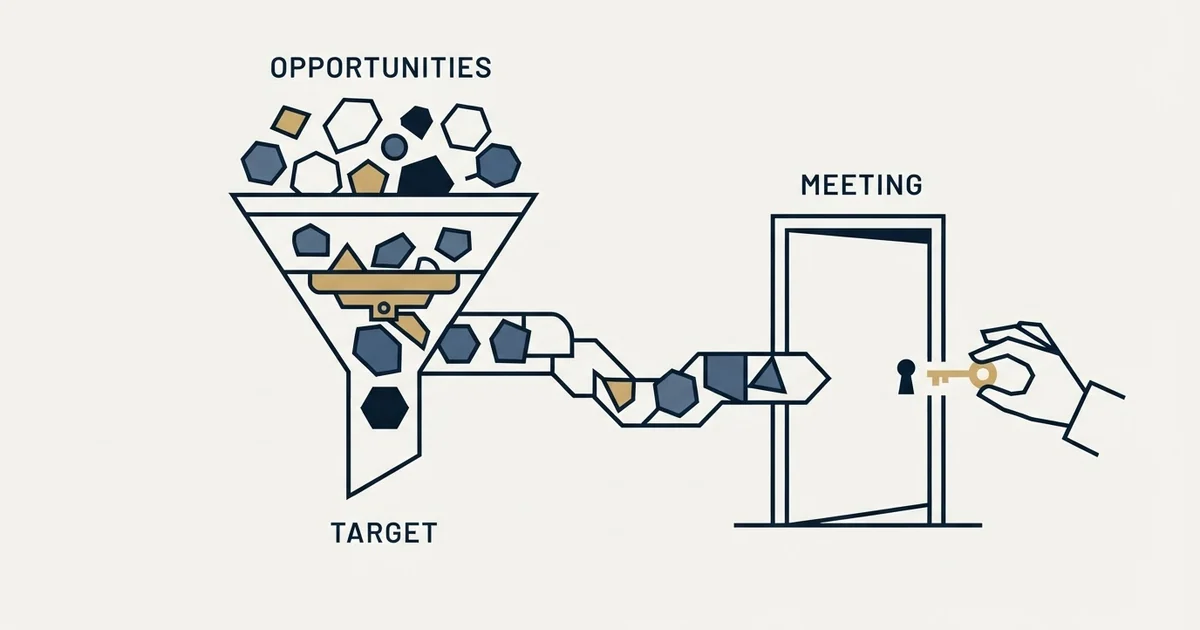
Book meetings with government contractors by targeting contract events rather than calendar quarters. Build lists from SAM.gov and USAspending data filtered by trailing obligations, email the program or functional owner instead of the CEO at large primes within 30 to 90 days of an award or recompete window, and offer a useful artifact rather than a demo.
Key takeaways
- The highest-converting outreach window is the 30 to 90 days between a contract award notice and full performance, when funds are already obligated.
- Build lists from SAM.gov, USAspending/FPDS, SBA's Dynamic Small Business Search, and GSA eLibrary, then filter by trailing twelve-month obligations rather than firmographics.
- The federal government carries a statutory goal of awarding 23% of prime contract dollars to small businesses, and agencies are scored against it annually (SBA Procurement Scorecard).
- Buyer altitude tracks company size: CEO under 50 employees, functional owners from 50 to 500, program and capture teams above 5,000.
- Seven single-message campaigns across the year over email, LinkedIn, and phone fit GovCon attention spans better than a twelve-touch grind in a small addressable market.
- Late September is a meeting dead zone, and continuing resolution periods freeze new starts, so shift messaging toward readiness during both.
Reviewed and updated September 1, 2026
How to Book Sales Meetings with Government Contractors: A Step-by-Step Playbook
The best week to email a government contractor is the week after they win something. A prime that just captured a multi-year task order has to staff it, clear it, tool it, and start reporting on it, usually inside the 30 to 90 days between award notice and full performance. The money is already obligated. The program manager has a start date on a whiteboard. The buying decisions that follow are the fastest you will see in an industry otherwise famous for moving at the speed of a protest docket.
Most outbound teams miss that window completely. They pull a list of "aerospace and defense" companies out of a data tool, run a generic four-touch sequence, and watch the reply rate sit near zero. Government contractors do not buy against your calendar quarter. They buy against contract events: awards, recompetes, option year exercises, vehicle onramps, and compliance deadlines written into their own contracts. This playbook covers targeting, list building, campaign structure, the CTA that converts, objection handling, and realistic meetings-per-100-prospects math.
Step 1: Pick the Right Buyer Before You Pick the Company
The most common failure in GovCon outbound is emailing the CEO of a 4,000-person integrator about something a program manager buys. Corporate titles at large contractors often hold no authority over program spend, because that spend is priced into a contract a specific program owns. Use company size to choose your altitude:
- Under 50 employees: the CEO or COO buys nearly everything.
- 50 to 500: a functional owner (Director of Talent, Controller, IT Director) holds real budget. The CEO forwards your email there anyway, so save a step.
- 500 to 5,000: functional owners plus a growth organization (BD, capture, proposals), both viable.
- 5,000+: go to the program or capture team. Corporate functions are locked into enterprise agreements you will not displace cold.
Then map your offer to a title:
| What you sell | Primary title | Strong secondary |
|---|---|---|
| Cleared or specialized recruiting | Director of Talent Acquisition, VP Recruiting | Program Manager, Capture Manager |
| Proposal, capture, or pricing support | Director of Proposals, VP Business Development | Capture Manager, Chief Growth Officer |
| Cybersecurity and CMMC readiness | CISO, IT Director, Facility Security Officer | Director of Contracts (clause flowdown) |
| DCAA-compliant accounting and ERP | Controller, Director of Government Accounting | Contracts Manager |
| Engineering or niche technical capability | Capture Manager, Subcontracts Manager | Small Business Liaison Officer |
| Facilities, logistics, secure space | Director of Operations, FSO | Program Manager |
Two titles are underused. The Small Business Liaison Officer sits at primes carrying subcontracting plans and is a warm door for small businesses trying to sub. The Facility Security Officer owns clearance and physical security and is often the fastest responder in the building, because almost nobody cold emails them.
Step 2: Build the List From Federal Contract Data
Standard B2B databases will tell you a company is in "defense" with 200 employees, which says nothing about whether it can buy. Federal contract data says everything. Start with the free public sources:
- SAM.gov for active registrations, NAICS codes, set-aside status, and entity location.
- USAspending.gov and FPDS for award history: agency, vehicle, trailing twelve-month obligations, and period of performance end dates.
- SBA's Dynamic Small Business Search for 8(a), HUBZone, WOSB, and SDVOSB designations.
- GSA eLibrary for Multiple Award Schedule holders and their SINs.
Paid tools (GovTribe, HigherGov, Deltek GovWin IQ) compress this work and add recompete forecasting, though the free sources are enough for a first list of a few hundred accounts. The filters that actually predict a meeting:
- Trailing twelve-month obligations above a floor. SAM.gov registration proves nothing, since many registered entities have never won a dollar. Set a floor (say $2M obligated in the last year) and list quality changes overnight.
- Agency concentration. A firm doing 80% of its work with one agency has different pain than a diversified integrator, so message them differently.
- Set-aside status. The federal government carries a statutory goal of awarding 23% of prime contract dollars to small businesses, and agencies are scored against it annually. Source: SBA Small Business Procurement Scorecard. If you sell teaming, compliance, or capture support, this is a primary segmentation variable.
- Period of performance end dates. A contract ending in 14 months means capture is starting now.
- Active job postings. The highest-value free enrichment signal available. A contractor posting twelve cleared roles in Huntsville is standing up a program, and everyone supporting that ramp (recruiting, security, IT, facilities, accounting) has a problem this month.
Step 3: Anchor Every Email to a Contract Event

Personalization in GovCon means referencing a contract event. The events worth building segments around:
- New award or task order. Highest urgency, 30 to 90 day window.
- Recompete approaching. Capture starts 12 to 18 months out, and anything lifting win probability is buyable.
- Protest resolved. Frozen work restarts on compressed timelines.
- Vehicle onramp or new schedule award. They now need pipeline to feed a vehicle they just paid to get on.
- Compliance deadline in a clause. Cybersecurity requirements flowing down from DoD contracts create hard, dated obligations. Source: DoD CMMC program.
- New facility, clearance, or geography. Triggers hiring, security, and IT spend at once.
- Joint venture formed, or graduation from 8(a). Both change competitive position.
One trigger per segment, one message per trigger. That discipline separates a dead campaign from a productive one in this vertical.
Step 4: One Message Per Campaign, Fitted to GovCon Attention Spans
Program people sit in meetings and secure spaces for large parts of the day. Proposal people disappear for three weeks when a solicitation drops. Your campaigns have to survive both.
| Window | Channel | Purpose |
|---|---|---|
| Campaign 1, on the award | Email, one message | Trigger-anchored opener, one ask, under 90 words |
| Alongside campaign 1 | Connection request, no message | |
| Alongside campaign 1 | Phone plus voicemail | Named accounts only, carrying its own reason to call |
| Campaign 2, six weeks on | Email, one message | One concrete asset, its own subject line |
| Campaign 3, on the next contract event | Email, one message | New angle on a new trigger |
| Alongside campaign 3 | LinkedIn message | Short, with its own reason to write |
| Campaign 4, 90-day re-entry | Email, one message | The routing ask, easy to decline |
Each row is its own campaign carrying exactly one message, and then it stops for that contact. Anyone who does not answer is re-entered in 90 days against a new contract event, with a new subject line, never with a second message dropped under the first. We stopped sending that bump because it arrives beneath something a program manager has already skipped, in front of exactly the people most likely to report it, and contractors run heavy email security stacks, so the reputation cost is charged to the sending domain across every other account you write to. A fresh email gets a fresh open, and in a market this small you cannot burn contacts with a twelve-touch grind either. The reasoning, with the numbers from our own campaigns, is in why we stopped using follow-ups. Federal calendar rules override all of it:
- October to December (Q1): new appropriations and program starts. Best window for anything needing planning and a fresh approval.
- January to March: heavy proposal season. Capture and proposal contacts go dark without warning.
- April to June: recompete capture ramps. Good for win-rate and teaming offers.
- July to September (Q4): expiring-funds urgency. Excellent for anything purchasable off an existing vehicle or under simplified acquisition thresholds, poor for anything needing a new budget line. The last two weeks of September are a meeting dead zone.
- Continuing resolution periods: new starts freeze. Shift messaging toward efficiency and readiness.
Step 5: The Offer That Converts

"Do you have 15 minutes for a quick demo" performs badly here. The offers that book calls share one property: they deliver something the recipient could use in a capture or program review this week. Offers worth testing:
- A one-page competitor win history on the vehicle they are chasing.
- Three sample cleared candidate profiles for the roles they just posted.
- A short readout of which agencies bought their NAICS last quarter and who won.
- A gap summary against a compliance requirement already in their contract.
- An introduction to a complementary teaming partner.
Lead with interest instead of the calendar. "Want me to send it over?" clears a much lower bar than a booking link, and once someone replies yes, a 20-minute call becomes a normal next step. Frame that call as a working session ("20 minutes to walk you through what we found on the recompete") instead of a discovery call.
Templates
Template 1: Post-Award Trigger
Subject: {{company}} + {{contract_name}}

{{first_name}},

Saw {{company}} picked up {{contract_name}} with {{agency}} on {{award_month}}. Congrats.

Ramps like this usually mean {{specific_ramp_problem}} inside the first 60 days, before the program is fully staffed.

We put together a short breakdown of how {{peer_company_type}} handled that on similar {{agency}} task orders. Want me to send it over?

{{sender_name}}
{{sender_title}} | {{sender_company}}
Why this works: The award is public record, so the personalization is verifiable and specific. It names a problem tied to the ramp window, and the ask is a document rather than a meeting. Under 70 words.
Template 2: Recompete / Capture Manager
Subject: {{incumbent_contract}} recompete

{{first_name}},

{{incumbent_contract}} runs out in {{months_remaining}} months. Assuming {{company}} is defending it, capture is probably already underway.

Two things usually decide these: {{decision_factor_1}} and {{decision_factor_2}}. We help capture teams tighten the second one.

Pulled the last three award histories on that vehicle, including who bid and what the evaluation weighting looked like. Useful to you, or already covered?

{{sender_name}}
{{sender_title}} | {{sender_company}}
Why this works: It speaks capture language (defend, evaluation weighting, bid history), which signals you are inside the industry. The closing question gives an easy, dignified out, which lifts replies from senior people who dislike ignoring competent outreach.
Template 3: Compliance Deadline, Security or IT Owner
Subject: {{clause_or_requirement}} flowdown

{{first_name}},

Quick one. {{company}}'s work with {{agency}} carries {{clause_or_requirement}} flowdown, and most {{employee_range}}-person contractors we talk to are handling it with {{common_workaround}}.

That usually holds until an assessment or a prime audit, then it costs {{consequence}}.

I have a two-page checklist of what assessors have actually been asking for. Send it across?

{{sender_name}}
{{sender_title}} | {{sender_company}}
Why this works: Security and compliance owners are under-emailed and over-obligated. The message names a requirement they already carry and offers a checklist that costs nothing to accept.
Template 4: The Routing Ask
Best for: a later campaign to people who did not answer an earlier one, 90 days on against a new contract event.
Subject: {{next_natural_milestone}} at {{company}}

{{first_name}},

This probably sits below the {{agency}} work on your list right now. Fair enough.

Should I leave it, or come back after {{next_natural_milestone}}?

{{sender_name}}
Why this works: It offers a binary, low-effort reply and names a specific milestone (option year exercise, proposal submission, fiscal year start) that makes "check back later" a real answer. A message that asks for nothing frequently produces the highest reply rate of any campaign in the set, and this one carries its own subject line, so it works on somebody who never opened the first.
Objection Handling
- No: "Send me your capability statement."
- No: "We only buy through GSA Schedule or a specific vehicle."
- No: "We're not funded until the option year."
- No: "You need to talk to Contracts."
- No: "We already have a teaming partner for that."
- No: "Not until after award."

"Send me your capability statement." Send it, and add a question in the same reply: "Sending now. Is {{agency}} still your largest customer by obligations, or has that shifted?" The question keeps the thread alive after the PDF lands.
"We only buy through GSA Schedule or a specific vehicle." Answer directly with your vehicle status. If you do not have one, name the path: teaming with a schedule holder, a reseller, or purchase under simplified acquisition thresholds. Contracts people disqualify vagueness permanently.
"We're not funded until the option year." This objection hands you a date. Confirm the option exercise month, ask what would need to be true by then, and re-engage 60 days before.
"You need to talk to Contracts." Accept, ask for a warm handoff, and keep your original contact copied. Contracts evaluates risk, so lead with compliance posture, insurance, and past performance.
"We already have a teaming partner for that." Ask which scope. Teaming agreements are usually scope-specific and non-exclusive across a portfolio, so the real question is whether they are covered on the next pursuit.
"Not until after award." Set the recontact date in your reply and log it. Post-award is the window from the top of this playbook, making this a strong outcome disguised as a rejection.
What a Realistic Outcome Looks Like
Published cold email benchmarks vary enormously by list quality, infrastructure, and offer, and most public figures come from platform aggregates that will not match your niche. Build the arithmetic and measure against yourself. The model per 100 prospects:
100 prospects contacted (tight ICP, trigger-matched)
  x deliverability and inbox placement
  x reply rate
  x share of replies that are positive
  = booked meetings
Two GovCon-specific drags to plan for. Contractors run heavy email security stacks, so inbox placement demands genuinely warmed domains, low daily volume per mailbox, and clean sending infrastructure. And the addressable market is small: an ICP of $5M to $100M contractors in three NAICS codes might total 800 accounts, so volume cannot rescue a weak offer. You get roughly two credible passes per contact per year.
That changes budget allocation. Spending twice as long on list construction and trigger research, then sending a quarter of the volume, works better here than in almost any other vertical. Teams that treat GovCon as a spray market exhaust their TAM in one quarter.
Track four numbers by segment: inbox placement, reply rate, positive reply rate, and meetings held (booked and held diverge sharply during proposal crunches). If a segment yields zero positive replies across 150 well-targeted contacts, examine the offer before blaming the list.
Pre-Send Checklist
- Buyer altitude matches company size (program level for large primes)
- Every account has a documented contract event from the last 90 days
- Trailing twelve-month obligation floor applied to the list
- Contract end dates and option exercise months stored as CRM fields
- One trigger per segment, one message per trigger
- First email under 90 words with a single ask for an artifact
- Campaigns capped at two credible passes per contact per year, one message each
- Fiscal calendar checked (no new-budget asks in late September, no expansion messaging under a CR)
- Vehicle and set-aside answers prepared for the Contracts objection
- Re-entry date set 90 days out against a new trigger
Teams that run this well usually have one person doing nothing but contract-event research feeding the campaigns. That research layer is the entire edge.
If you would rather have this done for you, RevenueFlow builds and runs the whole motion: contract-event monitoring, targeting, sending infrastructure, copy, and booked meetings on your calendar. Book a strategy call.
Related Reading
- Cold Email for Partnerships: Building Strategic Business Relationships
- Cold Email for Product Feedback: Complete Strategy Guide
- Cold Email for User Research: Complete Strategy Guide
If you would rather have this run for you, RevenueFlow books qualified meetings on a pay-per-meeting basis and publishes client results.
Frequently asked questions.
Frequently asked questions- Who should I email at a government contractor?
- It depends on company size. Under 50 employees, email the CEO or COO. Between 50 and 500, go to the functional owner such as the Controller, IT Director, or Director of Talent Acquisition. Above 5,000 employees, corporate functions are usually locked into enterprise agreements, so target the program manager or capture manager who controls contract-priced spend.
- What is the best time of year to prospect government contractors?
- October through December is strongest for anything requiring planning and a new approval, since fresh appropriations and program starts land then. July through September carries expiring-funds urgency and works well for purchases off an existing vehicle. Avoid the last two weeks of September for meetings, and avoid expansion messaging during continuing resolution periods when new starts freeze.
- How do I build a list of government contractors worth emailing?
- Start with SAM.gov for registrations and NAICS codes, USAspending.gov or FPDS for award history and obligation amounts, SBA's Dynamic Small Business Search for set-aside status, and GSA eLibrary for schedule holders. Then apply a trailing twelve-month obligation floor, because a large share of registered entities have never won a federal dollar.
- How many meetings should I expect per 100 prospects in GovCon?
- Model it rather than borrowing a published benchmark, since public cold email figures come from platform aggregates that rarely match this niche. Multiply contacts by inbox placement, reply rate, and positive reply share. Plan for heavy corporate email security stacks and a small addressable market, which means offer quality matters far more than volume here.
- What CTA works best when cold emailing government contractors?
- Offer an artifact instead of a calendar link. A one-page competitor win history on a vehicle they are chasing, sample cleared candidate profiles for roles they just posted, or a compliance gap summary all clear a lower bar than a demo request. Once someone replies yes, moving to a 20-minute working session is a natural next step.
About the author.

Ben Carden is CRO at RevenueFlow, which builds and operates outbound revenue engines for B2B companies. Previously at Gartner Enterprise. Studied at London School of Economics.
Ben Carden · CRO
Connect on LinkedIn →Explore more.
Ready to scale your outreach?
We build GTM engines that book real meetings. See the receipts.
Related articles.
Cold Email for Influencer Outreach: Partner with Creators
Learn how to use cold email to build authentic influencer partnerships that drive real results for your brand, with proven templates and strategies.
Cold Email for Product Feedback: Complete Strategy Guide
Learn how to use cold email to gather valuable product feedback from users and prospects. Includes proven templates, feedback frameworks, and response optimization techniques.
Cold Email for PR: How to Pitch Journalists and Get Coverage
Learn how to craft cold emails that get journalists to open, read, and respond to your pitches. Includes real templates, timing strategies, and a complete PR outreach checklist.
Cold Email for Reviews: Complete Strategy Guide
Learn how to use cold email to generate authentic product reviews on G2, Capterra, and other platforms. Includes proven templates, compliance guidelines, and review generation frameworks.
Cold Email for Link Building: How to Get Quality Backlinks
Learn how to use cold email outreach to build high-quality backlinks that improve your SEO rankings, with proven templates and strategies that get responses.
Cold Email for Focus Groups: Complete Strategy Guide
Learn how to use cold email to recruit qualified participants for focus groups. Includes proven templates, screening strategies, and group composition frameworks.