How to Book Sales Meetings with Healthcare
A tactical playbook for booking healthcare sales meetings: target titles, list building, sequence timing, offers that convert, and realistic meeting math.
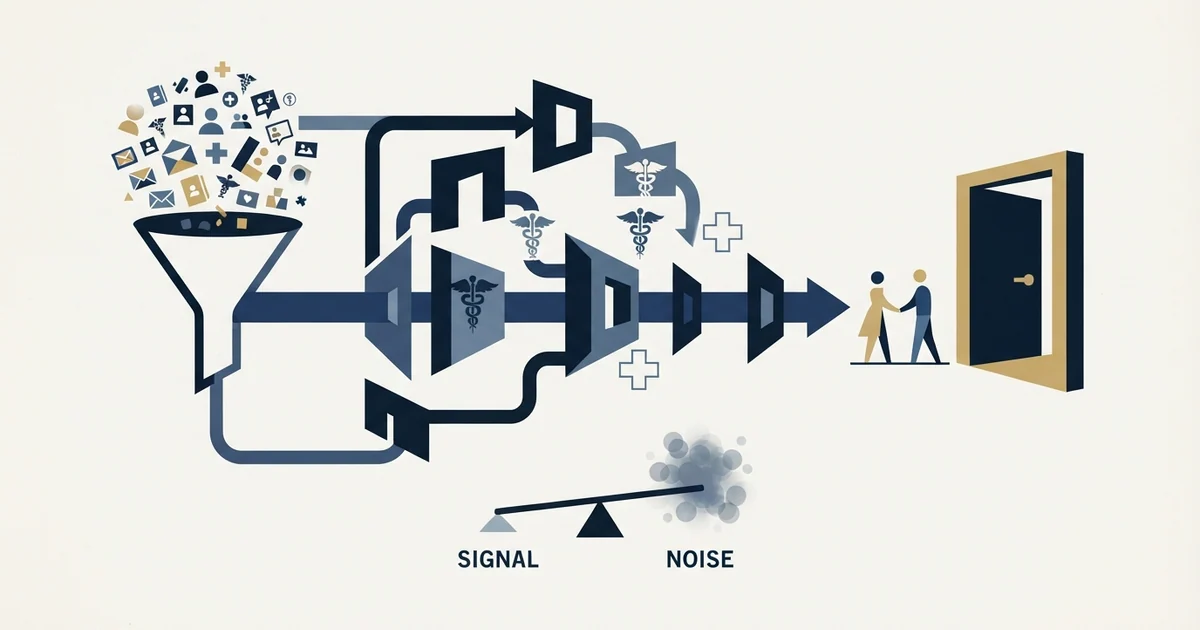
To book healthcare sales meetings, target one segment and one to three operational titles per account, verify every contact, and run seven single-message campaigns across a quarter. Ask for a peer benchmark or a 15-minute problem check instead of a demo, and plan on one to two held meetings per 100 well-targeted contacts.
Key takeaways
- Healthcare splits into at least five buying centers (provider systems, ambulatory groups, payers, health IT vendors, life sciences) with almost no shared buying behavior, so pick one before building a title list.
- The American Hospital Association counts more than 6,000 U.S. hospitals, a universe small enough to enumerate account by account rather than filter blindly.
- Run seven single-message campaigns across a quarter using email, LinkedIn, and phone, since 48-hour follow-ups read as pressure to clinical and operational leaders.
- Replace the demo request with a peer benchmark, a 15-minute problem check, a routing ask, or a deadline hook tied to fiscal planning or a CMS effective date.
- Plan on one to two held meetings per 100 well-targeted contacts, which means roughly 500 to 1,000 contacted prospects per month to produce 10 meetings.
- HIPAA is not triggered by emailing an administrator at a work address, but CAN-SPAM still requires a valid physical address and an opt-out honored within 10 business days.
Reviewed and updated September 1, 2026
How to Book Sales Meetings with Healthcare: A Step-by-Step Playbook
A 500-bed health system routes new vendor purchases through a value analysis committee that meets on a fixed calendar, and a single contract can require sign-off from clinical leadership, supply chain, IT security, privacy, and finance. The person who replies to your cold email rarely holds signature authority. That gap explains why most outbound into healthcare produces polite interest, a forward to procurement, and zero calendar invites.
Booking meetings in healthcare differs from SaaS or professional services in four ways: unfamiliar titles, aggressive email filtering, a fiscal rather than quarterly budget calendar, and a buying group large enough that your first conversation is a qualification call. This playbook covers who to target, how to build the list, how to structure the campaigns, what CTA converts, how to handle recurring objections, and what a realistic meetings-per-100-prospects outcome looks like.
Step 1: Pick the Buying Center Before You Pick Titles
"Healthcare" covers at least five markets that share almost no buying behavior. Choosing one is the highest-leverage decision in the campaign, because it sets your title list, your proof points, and your compliance exposure.
| Segment | Titles that take meetings | What moves them |
|---|---|---|
| Provider systems (hospitals, IDNs) | VP/Director of Revenue Cycle, CNO, VP Patient Access, Director of Perioperative Services, VP Supply Chain, CMIO | Throughput, length of stay, denials, labor cost |
| Ambulatory groups (practices, MSOs, ASCs) | Practice Administrator, COO, Director of Operations, Managing Partner | Collections per visit, staffing, no-show rate |
| Payers (health plans, TPAs, Medicaid MCOs) | Director of Network Ops, VP Care Management, Director of Stars/HEDIS, Director of Claims | Star ratings, medical loss ratio, member retention |
| Digital health and HCIT vendors | VP Sales, VP Marketing, VP Customer Success, Head of Implementation | Pipeline, deployment speed, churn |
| Life sciences (pharma, device) | Director of Commercial Ops, Director of Medical Affairs, Field Ops | Field productivity, trial enrollment, compliance |
Clinical and administrative titles behave very differently. A Chief Nursing Officer engages on retention and patient safety and ignores anything framed as cost savings, while a CFO is the inverse. Size matters just as much: at a 12-provider orthopedic group the Practice Administrator can decide and implement in the same month, while at a 20-hospital system no single person can.
Anchor on one segment and one to three titles per account.
Step 2: Build a List That Survives Contact With Reality
Healthcare list building fails in repeatable ways. Clinician directories are full of physicians with no purchasing role. Generic B2B databases go stale on health system leadership, since those roles turn over often and titles get restructured after every merger. Role-based addresses (info@, contact@, referrals@) drag down deliverability and never reach a buyer. A build order that works:
- Define the account universe first. For provider targeting, the American Hospital Association counts more than 6,000 hospitals in the United States, a universe small enough to enumerate deliberately rather than filter blindly. Source: AHA Fast Facts on U.S. Hospitals.
- Add firmographic filters that predict fit. Bed count, ownership type (system-owned, independent, government, critical access), payer mix, EHR vendor, and trauma level all predict relevance. EHR is often the single best filter for health IT sellers.
- Confirm the person is in the role today. Leadership pages, recent press releases, and conference speaker lists are more current than most databases. The CMS NPI Registry is authoritative for clinicians and organizations but says nothing about administrative roles.
- Verify every address and drop catch-alls. A list with 8% invalid addresses will get your domain flagged before the third send.
- Cap the list at what you can personalize. Two hundred researched contacts beat 5,000 generic ones here, because replies hinge on naming something specific about the organization.
Infrastructure matters more here than in most verticals. Use dedicated sending domains, warm them properly, and keep per-inbox volume low. Plain-text emails with no images, no tracking pixels, and no link in the first touch land better in hospital environments.
Step 3: Choose an Offer the Buyer Can Say Yes To
The demo request is the wrong first ask in healthcare. A director who agrees to one has implicitly committed to a procurement path they cannot start unilaterally, so they decline rather than create work. Offers that convert are smaller and framed around the recipient's own numbers. Four asks that work, in rough order of ease:
- The peer benchmark. "I can send you how three systems your size are handling {{specific_problem}}. Want it?" This gets replies from people who will never take a call.
- The 15-minute problem check. "Worth 15 minutes to see whether this even applies to {{hospital_name}}? If it doesn't, I'll say so." Explicitly permitting a no raises acceptance.
- The routing ask. "If this belongs with someone else on the {{department}} team, point me there and I'll stop emailing you." This converts non-buyers into internal referrals, often the fastest path into a value analysis process.
- The deadline hook. Tie the meeting to a real external date: fiscal year budget planning, a CMS rule effective date, an EHR upgrade window, or open enrollment.
Frame value in the metric the title owns. Revenue cycle leaders care about denial rate, days in A/R, and clean claim rate. Perioperative directors care about block utilization and first-case on-time starts. Patient access leaders care about no-show rate. The buyer's operating vocabulary does more for reply rate than any subject line trick.
Step 4: One Message Per Campaign, on a Longer Clock
Healthcare outreach should run longer and slower than standard B2B cadences. Clinical and operational leaders are in meetings or on the floor most of the day, and a follow-up sent 48 hours after the first reads as pressure. Our answer is not a slower sequence but no sequence at all: each campaign carries exactly one message, and the angles are spread across a quarter of separate campaigns.
| Campaign | Window | Channel | Purpose |
|---|---|---|---|
| 1 | Now | Email, one message | Specific observation plus a soft ask |
| Alongside 1 | Same week | Connect, no pitch | |
| Alongside 1 | Week two | Phone, one call | Department line, mid-morning, its own reason to call |
| 2 | Four to six weeks on | Email, one message | New angle, its own subject line |
| 3 | Next quarter | Email, one message | Peer proof and one concrete number |
| 4 | On the next trigger | Email, one message | Routing ask to the right owner |
| 5 | Ahead of their planning cycle | Email, one message | The timing ask, door left open |
Every row is its own campaign, and it ends for that contact once the message is sent. A director who does not answer is written to again weeks later under a new subject line with a new premise, never with a reply added beneath the first email. We stopped sending that bump because it lands in front of exactly the readers most likely to report it, and hospital mail environments filter aggressively, so the reputation cost is charged to the sending domain across every other system you write to. A fresh email gets a fresh open. The reasoning, with the numbers from our own campaigns, is in why we stopped using follow-ups.
Timing details that matter: send between 6:30 and 8:00 a.m. local time, because administrators clear inboxes before their first standing meeting. Avoid Monday. Avoid the closing week of the segment's fiscal year, since many health systems run a fiscal year ending June 30 or September 30. Skip the weeks around a known EHR go-live and re-engage 60 days later.
Do not discard non-responders. Move them to a quarterly re-approach list with useful content (regulatory summaries, peer benchmarks, a teardown of a public quality metric) and run a fresh campaign when a trigger fires: a new hire in the target role, a merger, a published CMS penalty, a capital announcement, or an EHR migration.
Step 5: Templates You Can Send Today

Template 1: Operational leader at a hospital or system
Subject: OR block utilization at {{hospital_name}}

Hi {{first_name}},

Saw {{hospital_name}} added {{specific_detail_service_line_or_facility}} this year, which usually
puts pressure on block scheduling before it shows up anywhere else.

Most perioperative teams we talk to at systems your size are managing release
windows manually and only find unused block time after the fact. The fix is
usually process and visibility rather than new capital.

Worth 15 minutes to compare notes on how other {{bed_count}}-bed hospitals are
handling it? If your utilization is already where you want it, tell me and
I'll leave you alone.

{{sender_name}}
{{sender_title}} | {{company}}
{{physical_address}} | Reply STOP to opt out
Why this works: It names an operational metric the recipient owns, references something verifiably true about their organization, and asks for a comparison rather than a demo. Explicit permission to decline lowers the cost of replying.
Template 2: Revenue cycle or finance leader
Subject: denials at {{hospital_name}}

{{first_name}},

Quick question rather than a pitch. When {{payer_name}} changed
{{specific_policy_or_rule}}, did your denial volume move, or did the team
absorb it upstream in authorization?

Asking because the systems I talk to split about evenly, and the ones absorbing
it upstream tend to be carrying the cost in FTE hours instead of write-offs.

I put together a short comparison of how four systems in {{state}} handled it.
Want me to send it over? No call required.

{{sender_name}}
{{sender_title}} | {{company}}
{{physical_address}} | Reply STOP to opt out
Why this works: The ask is a document rather than a meeting, which lowers the reply threshold. It opens with a question the recipient can answer from memory, and the framing signals that you understand the tradeoff between denials and upstream labor.
Template 3: Practice administrator or ambulatory operator
Subject: no-shows at {{practice_name}}

Hi {{first_name}},

Running {{provider_count}} providers across {{location_count}} locations means
every no-show is a slot you cannot refill same day, and the front desk is
usually the only lever you have.

We help groups your size cut no-shows using {{one_sentence_mechanism}}. The
groups that see the biggest change are the ones already doing reminder calls
and still landing above 10%.

Are you above or below that? If above, I'll show you what changed for
{{comparable_practice_type}} in about 15 minutes.

{{sender_name}}
{{sender_title}} | {{company}}
{{physical_address}} | Reply STOP to opt out
Why this works: Smaller organizations reward directness and specificity about scale. The either/or question is easy to answer, and the meeting is conditional on the answer, which makes it feel earned rather than pushed.
Template 4: The routing campaign
Best for: a later campaign to people who did not answer an earlier one.
Subject: who owns {{problem_area}} at {{hospital_name}}?

{{first_name}},

When this has not come up at a system your size, it is usually one of three
things: it is not a priority, it is not your area, or the timing is wrong.

If it is not your area, who owns {{problem_area}} at {{hospital_name}}? I will
reach out to them and stop emailing you.

If the timing is wrong, tell me when your {{fiscal_year_or_planning_cycle}}
planning starts and I will come back then.

Either way, thanks for the time.

{{sender_name}}
{{sender_title}} | {{company}}
{{physical_address}} | Reply STOP to opt out
Why this works: Naming the three likely reasons makes replying a one-word task. It runs as its own campaign with its own subject line, so nothing in it depends on an earlier email having been read. In healthcare, the routing branch produces a large share of the internal referrals that become booked meetings, because the first person you email frequently is not the owner.
Step 6: Handling the Five Objections You Will Actually Get
- No: "We're in an EHR freeze."
- No: "Send information to procurement."
- No: "We buy through our GPO."
- No: "No budget until next fiscal year."
- No: "We need security and privacy review."
"We're in an EHR freeze." Confirm the end date and book the meeting two weeks after it. A freeze is a scheduling constraint rather than a rejection.
"Send information to procurement." Ask one clarifying question first: is procurement evaluating alternatives, or processing a decision clinical leadership already made? If it is the former, you need a clinical sponsor. Send the material and ask for a 10-minute call to confirm you are answering the right questions.
"We buy through our GPO." Ask which GPO and whether your category is on contract. Many are not, and even for contracted categories a local sponsor drives selection.
"No budget until next fiscal year." Get the fiscal year end date and the month planning starts, then book inside that planning window rather than accepting a vague "reach out later."
"We need security and privacy review." Answer proactively with certification status, data handling practices, and whether your product touches protected health information at all. Sellers who can say clearly that they never receive PHI shorten this conversation considerably.
Step 7: What a Realistic Outcome Looks Like

Set expectations with arithmetic rather than a promised rate.
4% to 8%
~35% of replies
~65% of positives
Bar widths are equal here because these stage values are not a single comparable measure.
| Stage | Planning assumption | Result per 100 contacts |
|---|---|---|
| Verified, deliverable contacts | 100 | 100 |
| Total replies across the campaigns | 4% to 8% | 4 to 8 |
| Positive or routing replies | ~35% of replies | 1.4 to 2.8 |
| Meetings actually held | ~65% of positives | 1 to 2 |
One to two held meetings per 100 well-targeted healthcare contacts is a workable planning figure. A program needing 10 meetings a month therefore needs roughly 500 to 1,000 contacted prospects a month. Treat the table as a planning model rather than a published benchmark, and replace every assumption with your own measured rates as soon as you have them.
Two variables move the outcome most. List precision sets the ceiling, since wrong titles cap results no matter how good the copy is. Show rate improves sharply with a same-day confirmation, a calendar invite stating the agenda in one line, and a reminder the morning of.
Compliance Guardrails
Cold outreach to healthcare organizations is legal in the United States. The constraints are specific rather than prohibitive.
HIPAA governs protected health information, so emailing an administrator at their work address about your product does not trigger it. It becomes relevant the moment patient information enters the conversation. Never include patient data, never ask a prospect for a sample data set, and never reference a specific case. Source: HHS HIPAA for Professionals.
CAN-SPAM applies to commercial email in every industry. You need accurate header and subject information, a valid physical postal address, and a working opt-out honored within 10 business days. Source: FTC CAN-SPAM Act Compliance Guide.
If you manufacture drugs, devices, biologicals, or medical supplies, or if anything you offer could be construed as remuneration to someone positioned to refer federal healthcare program business, get legal review before offering gift cards, meals, or paid pilots. The Anti-Kickback Statute and physician self-referral rules carry serious penalties, and Open Payments reporting may apply. Source: HHS OIG Fraud and Abuse Laws and CMS Open Payments. The "$50 gift card for 30 minutes" offer that is routine in software outbound can be a genuine problem here.
Pre-Send Checklist

- Segment chosen, one to three target titles per account
- Every contact verified, no role-based or catch-all addresses
- One specific, verifiable fact about the organization in the first email
- Value framed in the metric that title owns
- The first campaign's CTA is a benchmark, a 15-minute problem check, or a routing ask
- Campaigns spread across at least a quarter, one message each, across email, LinkedIn, and phone
- Send window early morning local time, never Monday
- Physical address and working opt-out in every message
- No PHI requested or referenced
- Reply, positive reply, and show rates tracked from the first send
Running this well takes a clean list, warmed infrastructure, copy in the buyer's operational vocabulary, and patience to work a quarter of separate campaigns into accounts whose fiscal calendars ignore yours. RevenueFlow builds and runs this kind of program for companies selling into provider, payer, and health IT organizations.
If you would rather have it done for you, book a strategy call.
Related Reading
- Healthcare Cold Email Benchmarks: 2026 Performance Data
- Cold Email for Partnerships: Building Strategic Business Relationships
- Cold Email for Product Feedback: Complete Strategy Guide
If you would rather have this run for you, RevenueFlow books qualified meetings on a pay-per-meeting basis and publishes client results.
Frequently asked questions.
Frequently asked questions- Who should I target to book meetings at a hospital?
- Target the operational owner of the metric your product moves, not the C-suite by default. For revenue products that means VP or Director of Revenue Cycle. For throughput it means Director of Perioperative Services or VP Patient Access. For clinical workflow it means the CNO or CMIO. Pick one to three titles per account and research each one individually.
- How many meetings should I expect per 100 healthcare prospects?
- Use one to two held meetings per 100 verified, well-targeted contacts as a planning figure. That assumes a 4 to 8 percent total reply rate, roughly a third of replies being positive or routing responses, and about two-thirds of positive replies converting into a meeting that actually happens. Track your own numbers and replace these assumptions quickly.
- Does HIPAA stop me from cold emailing healthcare organizations?
- No. HIPAA governs protected health information, and emailing an administrator at their work email address about your product involves none. HIPAA becomes relevant the moment patient data enters the conversation, so never include patient information, never ask a prospect to send a sample data set, and never reference a specific patient case in outreach.
- What is the best call to action for a first cold email in healthcare?
- Something smaller than a demo. Offering a peer benchmark ("I can send how three systems your size handle this") gets replies from people who will never take a call. A 15-minute problem check with explicit permission to decline works well. A routing ask converts non-buyers into internal referrals, which is often the fastest path to a real meeting.
- When should I send cold emails to hospital administrators?
- Send between 6:30 and 8:00 a.m. local time on Tuesday through Thursday, when administrators clear their inbox before the first standing meeting. Avoid Monday, avoid the closing week of the organization's fiscal year (often June 30 or September 30 in healthcare), and skip the weeks surrounding a known EHR go-live.
About the author.

Ben Carden is CRO at RevenueFlow, which builds and operates outbound revenue engines for B2B companies. Previously at Gartner Enterprise. Studied at London School of Economics.
Ben Carden · CRO
Connect on LinkedIn →Explore more.
Ready to scale your outreach?
We build GTM engines that book real meetings. See the receipts.
Related articles.
Cold Email for Influencer Outreach: Partner with Creators
Learn how to use cold email to build authentic influencer partnerships that drive real results for your brand, with proven templates and strategies.
Cold Email for Product Feedback: Complete Strategy Guide
Learn how to use cold email to gather valuable product feedback from users and prospects. Includes proven templates, feedback frameworks, and response optimization techniques.
Cold Email for PR: How to Pitch Journalists and Get Coverage
Learn how to craft cold emails that get journalists to open, read, and respond to your pitches. Includes real templates, timing strategies, and a complete PR outreach checklist.
Cold Email for Reviews: Complete Strategy Guide
Learn how to use cold email to generate authentic product reviews on G2, Capterra, and other platforms. Includes proven templates, compliance guidelines, and review generation frameworks.
Cold Email for Link Building: How to Get Quality Backlinks
Learn how to use cold email outreach to build high-quality backlinks that improve your SEO rankings, with proven templates and strategies that get responses.
Cold Email for Focus Groups: Complete Strategy Guide
Learn how to use cold email to recruit qualified participants for focus groups. Includes proven templates, screening strategies, and group composition frameworks.