How to Book Sales Meetings with Insurance
A tactical playbook for booking meetings with carriers, agencies, MGAs and TPAs: titles, list sources, renewal-calendar timing, sequences and templates.
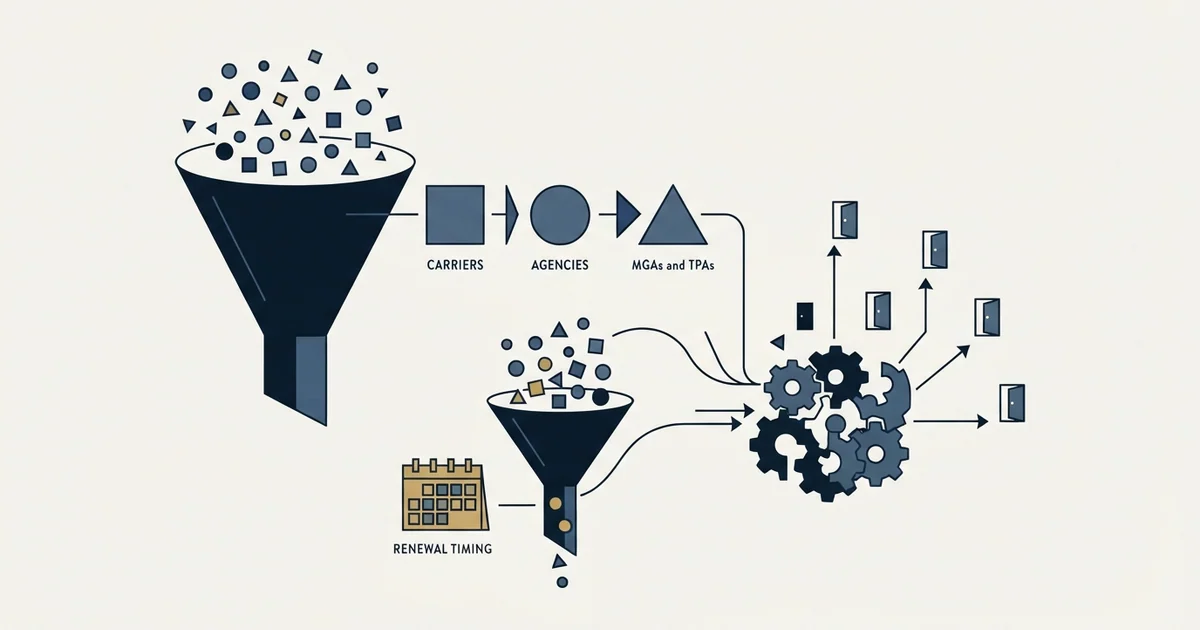
To book meetings with insurance decision makers, pick one segment (carrier, agency, MGA, TPA or benefits), target the title that owns the metric you name, build the list from state DOI, NAIC, AM Best and association directories, and time single-message email, LinkedIn and phone campaigns around renewal dates. Expect one to three booked meetings per 100 well-researched prospects.
Key takeaways
- Treat insurance as five separate markets (carriers, retail agencies, MGAs, TPAs, benefits brokers) and build messaging for one of them, because the metrics each segment buys on do not overlap.
- Time campaigns around the renewal calendar: the four to six weeks before January 1, April 1, July 1 and October 1 effective dates are dead, and the weeks immediately after are the best window.
- Employee benefits buyers are effectively frozen from late September through December during open enrollment, so run benefits outreach January through May.
- Use nine single-message campaigns across email, LinkedIn and phone rather than a four-touch two-week sequence, and add a 90-day re-entry campaign timed to the account's next prime window.
- Aim at VP and Head level at large carriers rather than the C-suite, since those roles run evaluations, and skip compliance titles on the first touch.
- Plan on one to three booked meetings per 100 well-researched prospects, which means roughly 500 to 1,000 prospects in campaigns per month to hold ten meetings.
Reviewed and updated September 1, 2026
How to Book Sales Meetings with Insurance: A Step-by-Step Playbook
The most common reason cold outreach dies in insurance has nothing to do with copy. It is that the email landed in the last three weeks of December, when every commercial lines team in the country is buried in January 1 renewals, or in the middle of open enrollment, when benefits brokers are working nights. Same email, sent six weeks earlier, gets a reply.
Insurance is a bookable vertical. Carriers, agencies, MGAs, and TPAs run on recurring cycles, have clearly named roles, and measure their pain in loss ratio, submission volume, quote-to-bind, and retention. What it does not tolerate is vague outreach. These buyers have been pitched by every AI underwriting startup for a decade, and their pattern recognition is excellent.
Step 1: Pick One Insurance Segment, Not "Insurance"
"Insurance" is four or five distinct buying markets wearing the same coat. Targeting all of them with one message is the fastest way to a dead campaign.
| Segment | What they buy on | Buying reality |
|---|---|---|
| Carriers | Loss ratio, combined ratio, regulatory exposure | Long cycles, procurement, security review |
| Retail agencies and brokerages | Producer capacity, retention, cross-sell | Principal or COO decides, faster |
| MGAs and program administrators | Submission throughput, bind ratio | Decide fast, care about speed to quote |
| TPAs and claims organizations | Cycle time, indemnity leakage, caseload | Operations-led, ROI must be arithmetic |
| Benefits brokers | Renewal capacity, employer retention | Buying freeze Sept through Dec |
Choose one. Your list, subject lines, proof points, and CTA all change depending on which you pick. A message about indemnity leakage means nothing to an agency principal, and producer capacity means nothing to a claims VP.
Step 2: Target the Titles That Own the Problem
Insurance org charts are deep and full of titles that sound senior but hold no budget. An "Account Executive" at a brokerage is a salesperson. A "Vice President" at a large carrier may sit four levels below a buyer.
Carriers. Chief Underwriting Officer, VP of Underwriting, Head of Claims, VP Claims Operations, Head of Distribution, VP Digital Transformation, line-specific Head of Product, plus CIO and Head of Data for technology sales. Above a few thousand employees, aim at VP and Head level rather than the C-suite, since those roles run evaluations and carry proposals upward.
Agencies and brokerages. Agency Principal, Owner, President, COO, Director of Operations, Head of Commercial Lines, Head of Personal Lines, Head of Employee Benefits. Under roughly 50 employees the principal decides almost everything, so go straight there. Above that, operations owns process and technology.
MGAs and program administrators. President, Head of Underwriting, Head of Program Development, COO. Small and flat, so the person who replies is often the person who signs.
TPAs. VP of Claims, Director of Claims Operations, Head of Quality Assurance, COO.
Deprioritize two groups on a first touch: CEOs at any carrier of size (they forward or ignore), and compliance titles (a gate you clear later, not a champion you recruit first).
Step 3: Build the List From Insurance-Specific Sources
Generic database exports produce generic results. Start with structural sources: state Department of Insurance licensee lookups, NAIC company search for carriers and group structure, AM Best listings to segment carriers by size and rating, Big I and PIA member directories for agencies, and wholesale market directories for MGAs.
Then layer signals that tell you why now:
- Carrier appointment announcements. An agency that just picked up a new appointment is expanding into a line and has an active problem.
- M&A activity. Agency roll-ups create integration pain across agency management systems, and the acquiring platform team stays a live buyer for six to twelve months.
- Job postings. An agency hiring three commercial lines account managers has a capacity problem. A carrier hiring a "Director of Underwriting Automation" has an initiative and probably a budget. Postings also reveal the stack (Applied Epic, Vertafore AMS360, HawkSoft), which changes what you should say.
- Conference attendance. ITC Vegas, RIMS, WSIA Annual Marketplace, and NAMIC publish attendee and speaker lists that double as target lists.
Aim for a list where you can write one true, specific sentence about every account before the campaigns start. If you cannot, that account belongs in a lower tier or off the list.
Step 4: Time the Campaigns Around the Renewal Calendar

This is the highest-leverage decision here, and the one most teams skip.
- January 1 heaviest, then July 1, then April 1 and October 1
- The four to six weeks before a major renewal date are dead for new vendor conversations
- The four to six weeks after are excellent
- Open enrollment, roughly late September through December, is a hard freeze
- January through May is the productive window
- Go quiet during Atlantic hurricane season (June through November)
- August through October is the window for anything needing a new line item
Commercial property and casualty concentrates renewals on quarterly effective dates, January 1 heaviest, then July 1, then April 1 and October 1. The four to six weeks before a major renewal date are dead for new vendor conversations. The four to six weeks after are excellent, because the team just lived through the pain.
Employee benefits runs a different clock. Open enrollment, roughly late September through December, is a hard freeze. January through May is the productive window.
Coastal property and catastrophe-exposed lines go quiet during Atlantic hurricane season (June through November) and during any active catastrophe response. Pitching a Florida carrier the week after a named storm makes landfall is a fast way to get blocked. Carriers also plan next year's budgets in H2, which makes August through October the window for anything needing a new line item.
Practical rule: build the target calendar before the campaigns. Assign every account a do-not-contact window and a prime window, and let that drive launch dates.
Step 5: One Message Per Campaign, Timed to Produce Calendar Invites
Insurance buyers reply late. A four-touch, two-week sequence underperforms badly here. Plan a longer arc with real spacing and more than one channel, and split it into separate campaigns rather than steps, because every campaign carries exactly one message.
| Window | Channel | Purpose |
|---|---|---|
| Campaign 1, prime window | Email, one message | Specific observation about their book, line, or a recent event, plus a soft ask |
| Alongside campaign 1 | Connection request, no pitch | |
| Alongside campaign 1 | Call | Two attempts at different times of day, voicemail on the second |
| Campaign 2, four to six weeks on | Email, one message | A concrete proof point or peer example, its own subject line |
| Alongside campaign 2 | Engage with something they posted, or a one-line message | |
| Campaign 3, after the next renewal date | Email, one message | New angle, different pain, different CTA |
| Alongside campaign 3 | Call | One attempt, carrying its own reason to ring |
| Campaign 4, next prime window | Email, one message | Short timing-aware message that leaves a door open |
| Campaign 5, 90 days on | Email, one message | Re-entry timed to their next prime window |
Three rules matter more than the exact dates. Change the angle rather than the volume, so each new campaign tests a different problem (submission throughput, then retention, then reporting burden) under its own subject line, and nobody ever receives a second message added beneath the first. We stopped sending that bump because it lands under something a broker already skipped mid-renewal, in front of exactly the readers most likely to report it, and the reputation cost is charged to the sending domain across every other carrier and agency you write to, whereas a fresh email gets a fresh open. Keep every message under 90 words, since these buyers reply from phones between meetings. And never run a campaign through a renewal freeze. Pause and resume instead. The reasoning, with the numbers from our own campaigns, is in why we stopped using follow-ups.
Step 6: The Offer That Converts in This Vertical
The generic "worth a 15-minute call?" ask converts poorly here because it asks for time before the buyer has evidence you understand their business. Offers that deliver something on the call itself, framed around a number they already track, do better:
- Peer comparison. "Here is what six regional carriers your size are doing about X." Insurance is intensely peer-referential.
- A bounded diagnostic. "A 20-minute review of where submissions stall between intake and quote."
- Line-specific proof. "Cut quote turnaround on contractor GL from four days to under one" beats "improve efficiency by 30%."
- A named artifact. A one-page teardown they can forward internally, useful as a later-campaign de-escalation.
Ladder the CTAs: interest question first ("worth a look?"), then a small commitment (send the one-pager), then a specific time. Do not open with a calendar link.
Templates You Can Send Today
Template 1: Agency Principal, Post-Renewal Window
Subject: {{agency_name}} commercial lines capacity

Hi {{first_name}},

Saw {{agency_name}} picked up the {{carrier_name}} appointment in {{state}}. Most agencies that add a commercial lines market hit the same wall a quarter later: account managers absorbing more submissions per head without more hours in the day.

We work with independent agencies around {{employee_count}} people on that handoff between producer and service team.

Worth a look, or is capacity not the bottleneck right now?

{{sender_name}}
Why this works: It opens with a verifiable public event rather than flattery, names a consequence that follows from it, and ends with a question answerable in one word. The "or is it not the bottleneck" phrasing gives an easy honest out, which tends to raise reply rates.
Template 2: Carrier Underwriting Leader
Subject: submission triage at {{company_name}}

{{first_name}},

Quick one. Most regional carriers writing {{line_of_business}} tell us the same thing: underwriters spend a real share of the day on submissions that were never going to be quoted, because appetite screening happens after intake instead of at it.

Two carriers in {{region}} restructured that step this year. Happy to walk you through what changed and what it did to their quote turnaround.

20 minutes, no deck. Useful?

{{sender_name}}
Why this works: It names a process failure specific to underwriting rather than a generic efficiency claim, positions the call as peer intelligence, and pre-empts the "this will be a demo" objection with "no deck."
Template 3: A Later Campaign That Changes the Angle
Best for: a new campaign to people who did not answer an earlier one, on a different problem entirely.
Subject: how {{company_name}} finds out it lost a renewal

{{first_name}},

One question.

When {{company_name}} loses a mid-market renewal, do you know why within the week, or does it show up in a quarterly retention report?

Most teams we talk to are in the second bucket, and the root cause is usually a reporting gap. I put together a one-page teardown of how three brokerages closed that loop.

Want me to send it?

{{sender_name}}
Why this works: It abandons the original pitch and asks a diagnostic question the prospect can answer instantly and probably has opinions about. It goes out as its own campaign with its own subject line, so it reads as a first email to anyone who never opened the last one. The ask is permission to send a document, a far lower commitment than a meeting, and prospects who accept the artifact convert to meetings far better than cold ones.
Template 4: The Timing-Aware Standing Offer
Best for: a later campaign sent just before a renewal freeze, to people who did not answer an earlier one.
Subject: after {{renewal_date}}, not before

Hi {{first_name}},

I know {{renewal_date}} renewals are eating the next few weeks, so this is not a today conversation.

If {{specific_problem}} is still on your list after things settle, I will come back in {{month}}. If it is not a priority at all, reply "not a fit" and I will close the file.

Either way, good luck with the renewal push.

{{sender_name}}
Why this works: It shows you understand their calendar, the strongest credibility signal in this vertical. It also sets up a legitimate re-entry point 60 to 90 days later, and the explicit "not a fit" option keeps your list clean.
Objection Handling

| What they say | How to respond |
|---|---|
| "We're mid-renewal, circle back" | Accept immediately, propose a specific post-renewal date, confirm the problem is still on their list |
| "We're on Applied Epic / AMS360, this won't work" | Answer directly on integration status, then give one example of a customer on the same system |
| "Compliance would never approve this" | Ask what the last vendor had to clear, offer the security packet before any meeting |
| "Send me some information" | Send a genuinely short artifact with one specific question attached, so replying is easy |
| "We already have a vendor for this" | Ask what the vendor does well, then position around the gap you hear most often |
| "We're captive, we can't choose" | Verify the authority level, redirect to the corporate or regional decision maker if real |
The pattern running through all of these: acknowledge the constraint literally, ask one clarifying question, stay in the thread. Insurance buyers notice reframing techniques and dislike them.
What a Realistic Outcome Looks Like Per 100 Prospects
Published cold email benchmarks vary enormously by list quality, sender infrastructure, and segment, so treat the numbers below as planning assumptions for sizing a pipeline rather than measured results. Replace them with your own data after a few thousand sends. Per 100 contacts entering the full set of campaigns:
90 to 95% after verification
4 to 8% of contacts
Roughly half of all replies
50 to 70% of positive replies
70 to 80% of booked
Bar widths are equal here because these stage values are not a single comparable measure.
| Stage | Planning assumption | Per 100 prospects |
|---|---|---|
| Deliverable, valid contacts | 90 to 95% after verification | 92 |
| Prospects who reply at all | 4 to 8% of contacts | 4 to 8 |
| Positive or curious replies | Roughly half of all replies | 2 to 4 |
| Booked meetings | 50 to 70% of positive replies | 1 to 3 |
| Meetings that actually happen | 70 to 80% of booked | 1 to 2 |
The working assumption: one to three booked meetings per 100 well-researched insurance prospects, with one to two actually sitting down. A team that wants ten held meetings a month therefore needs roughly 500 to 1,000 fresh, correctly-timed prospects in campaigns monthly, plus infrastructure that reaches them without landing in spam.
Two things move that ratio more than copy does. Timing against the renewal calendar is the first. Title precision is the second, because a message reaching the person who owns the metric you named converts far better than the same message one level off.
Your Insurance Meeting-Booking Checklist
- One segment chosen, messaging built for that segment only
- Titles defined by segment, large-carrier CEOs and compliance excluded from first touch
- List built from insurance-specific sources, one true fact per account
- Renewal calendar mapped with do-not-contact and prime windows
- Campaigns spread across a quarter minimum, one message each, across email, LinkedIn, and phone
- Each campaign tests a different pain, every message under 90 words
- Sending domains warmed and separate from your primary domain, verified contacts only
- Reply-to-meeting conversion tracked separately from reply rate
Insurance rewards teams that sound like they have worked in the industry and time outreach to its calendar. Most competitors do neither, which is why the vertical is still open.
If you would rather have this built and run for you, RevenueFlow does done-for-you cold email including list building, infrastructure, copy, and booked meetings. Book a strategy call and we will map your segment, titles, and renewal timing before a single email goes out.
Related Reading
- Cold Email for Partnerships: Building Strategic Business Relationships
- Cold Email for Product Feedback: Complete Strategy Guide
- Cold Email for User Research: Complete Strategy Guide
If you would rather have this run for you, RevenueFlow books qualified meetings on a pay-per-meeting basis and publishes client results.
Frequently asked questions.
Frequently asked questions- What job titles should I target to book meetings in insurance?
- At carriers, target Chief Underwriting Officer, VP of Underwriting, Head of Claims, VP Claims Operations, Head of Distribution and VP Digital Transformation. At agencies and brokerages, target the Principal, Owner, COO or Director of Operations. At MGAs, target the President or Head of Underwriting. Skip large-carrier CEOs and compliance titles on a first touch.
- When is the best time of year to cold email insurance companies?
- Avoid the four to six weeks before major commercial renewal dates, especially January 1, and avoid late September through December for benefits brokers during open enrollment. The strongest windows are the weeks right after a big renewal date, January through May for benefits, and August through October for carrier conversations that need next year's budget.
- How many meetings can I expect per 100 insurance prospects?
- A reasonable planning assumption for a well-targeted, deliverability-clean campaign is one to three booked meetings per 100 prospects, with one to two actually held after no-shows. That comes from roughly 4 to 8 percent of contacts replying, about half of those replies being positive, and most positive replies converting to a calendar invite.
- Where do I get a good list of insurance prospects?
- Start with state Department of Insurance licensee lookups, the NAIC company search, AM Best listings, Big I and PIA member directories, and wholesale market directories. Then layer intent signals: new carrier appointments, agency M&A, job postings that reveal capacity gaps and the agency management system in use, and conference attendee lists from ITC Vegas, RIMS and WSIA.
- What call-to-action works best with insurance buyers?
- Offers that give the buyer something on the call itself. Peer comparisons (what similar carriers or agencies are doing), a bounded diagnostic such as a 20-minute review of where submissions stall, or a one-page teardown they can forward internally. Ladder the ask from an interest question to a document to a specific time slot rather than opening with a calendar link.
About the author.

Ben Carden is CRO at RevenueFlow, which builds and operates outbound revenue engines for B2B companies. Previously at Gartner Enterprise. Studied at London School of Economics.
Ben Carden · CRO
Connect on LinkedIn →Explore more.
Ready to scale your outreach?
We build GTM engines that book real meetings. See the receipts.
Related articles.
Cold Email for Influencer Outreach: Partner with Creators
Learn how to use cold email to build authentic influencer partnerships that drive real results for your brand, with proven templates and strategies.
Cold Email for Product Feedback: Complete Strategy Guide
Learn how to use cold email to gather valuable product feedback from users and prospects. Includes proven templates, feedback frameworks, and response optimization techniques.
Cold Email for PR: How to Pitch Journalists and Get Coverage
Learn how to craft cold emails that get journalists to open, read, and respond to your pitches. Includes real templates, timing strategies, and a complete PR outreach checklist.
Cold Email for Reviews: Complete Strategy Guide
Learn how to use cold email to generate authentic product reviews on G2, Capterra, and other platforms. Includes proven templates, compliance guidelines, and review generation frameworks.
Cold Email for Link Building: How to Get Quality Backlinks
Learn how to use cold email outreach to build high-quality backlinks that improve your SEO rankings, with proven templates and strategies that get responses.
Cold Email for Focus Groups: Complete Strategy Guide
Learn how to use cold email to recruit qualified participants for focus groups. Includes proven templates, screening strategies, and group composition frameworks.