How to Book Sales Meetings with Law Firms
A tactical playbook for booking meetings with law firms: which titles to target, how to build the list, sequence timing, and realistic output per 100 prospects.

To book meetings with law firms, target business-side titles such as COO, Executive Director, Firm Administrator, or Director of Legal Operations rather than partners, focus on mid-market firms of 50 to 400 attorneys, and open with a peer benchmark or a specific cost-reclaim number. Ask for 15 minutes, not a demo.
Key takeaways
- Target business-side titles (COO, Executive Director, Firm Administrator, Director of Legal Operations) instead of partners, whose assistants act as effective filters.
- Mid-market firms of roughly 50 to 400 attorneys convert best, because they have an operations layer with budget and are small enough for one executive to move a decision.
- A realistic planning model is 5 to 12 total replies and 1 to 2 held meetings per 100 well-matched prospects, so eight meetings a month needs 500 to 800 prospects in flight.
- Avoid the last four business days of each month and the last two weeks of December, when billing and collections consume the operations staff you are trying to reach.
- Lead with a peer benchmark, a specific reclaim number, or a 60-day single-practice-group pilot, and ask for 15 minutes rather than a 30-minute demo.
- CAN-SPAM requires accurate sender information, a valid physical postal address, and opt-out requests honored within 10 business days.
Reviewed and updated September 1, 2026
How to Book Sales Meetings with Law Firms: A Step-by-Step Playbook
The billable hour sets the price of your prospect's attention. A partner billing at $700 an hour is being asked, every time your email lands, to trade roughly $12 of realizable revenue for a minute of reading. That constraint explains most of what works and what fails in legal outreach. Short emails beat long ones. A specific ask beats an open-ended one. Any message that forces the reader to reconstruct your value proposition gets archived before the second sentence.
Firms are partnerships, so authority sits in places an org chart will not show you, and the buying committee usually includes someone professionally trained to find flaws in whatever you send. This playbook covers the decisions that turn cold outreach into calendar holds: segment, titles, list, offer, campaign plan, objections, and realistic output per 100 prospects.
Step 1: Pick the Firm Segment Before You Pick a Title
The most common mistake in legal outreach is sending one campaign to every firm with a website. A 900-lawyer global firm and a 12-lawyer plaintiff-side boutique share a NAICS code and nothing else.
| Segment | Headcount | Who decides | What lands |
|---|---|---|---|
| Am Law 100/200 | 400+ | CIO, Legal Ops, CFO, plus committee sign-off | Peer benchmarking, security posture, stack integration |
| Mid-market and large regional | 50 to 400 | COO or Executive Director plus a partner sponsor | Time or cost reclaim, single-group pilot |
| Boutiques | 10 to 50 | Managing partner or firm administrator | Speed, simplicity, a number they can picture this year |
| Solo and small | 1 to 10 | The owner-attorney | Price transparency, self-serve trial |
Pick one band. Selling a $60,000 platform to solos wastes your list; selling a $99/month tool to an Am Law 50 CIO fails because the evaluation costs more than the contract. The mid-market band (roughly 50 to 400 attorneys) usually performs best, because those firms have an operations layer that owns problems and holds budget while staying small enough for one motivated executive to move a decision.
Step 2: Target the Titles That Can Actually Say Yes
Law firms have business-side staff that most vendors skip in favor of emailing partners. Partners are the hardest audience to reach and often the wrong first contact, since they are optimized for client work and their assistants are effective filters.
| If you sell | Lead title | Backup title |
|---|---|---|
| Practice management, billing, time capture | COO, Executive Director, Firm Administrator | Director of Finance |
| Document automation, contract and drafting tools | Director of Legal Operations, Chief Knowledge Officer | Practice Group Chair |
| eDiscovery, litigation support | Litigation Support Manager, Director of Practice Technology | Litigation Chair |
| Security, infrastructure, managed IT | CIO, Director of IT | Chief Risk Officer |
| Intake, CRM, business development | CMO, Director of Business Development | Managing Partner |
| Outsourced services (staffing, experts, translation) | Practice Group Chair | Director of Legal Operations |
At firms under about 60 attorneys, most of these roles collapse into one Firm Administrator, so emailing that person reaches the whole operations function. Practice group chairs work as first contacts when your offer attaches to a specific matter type, because they can authorize a trial inside their own group.
Step 3: Build the List From Legal's Unusually Public Data
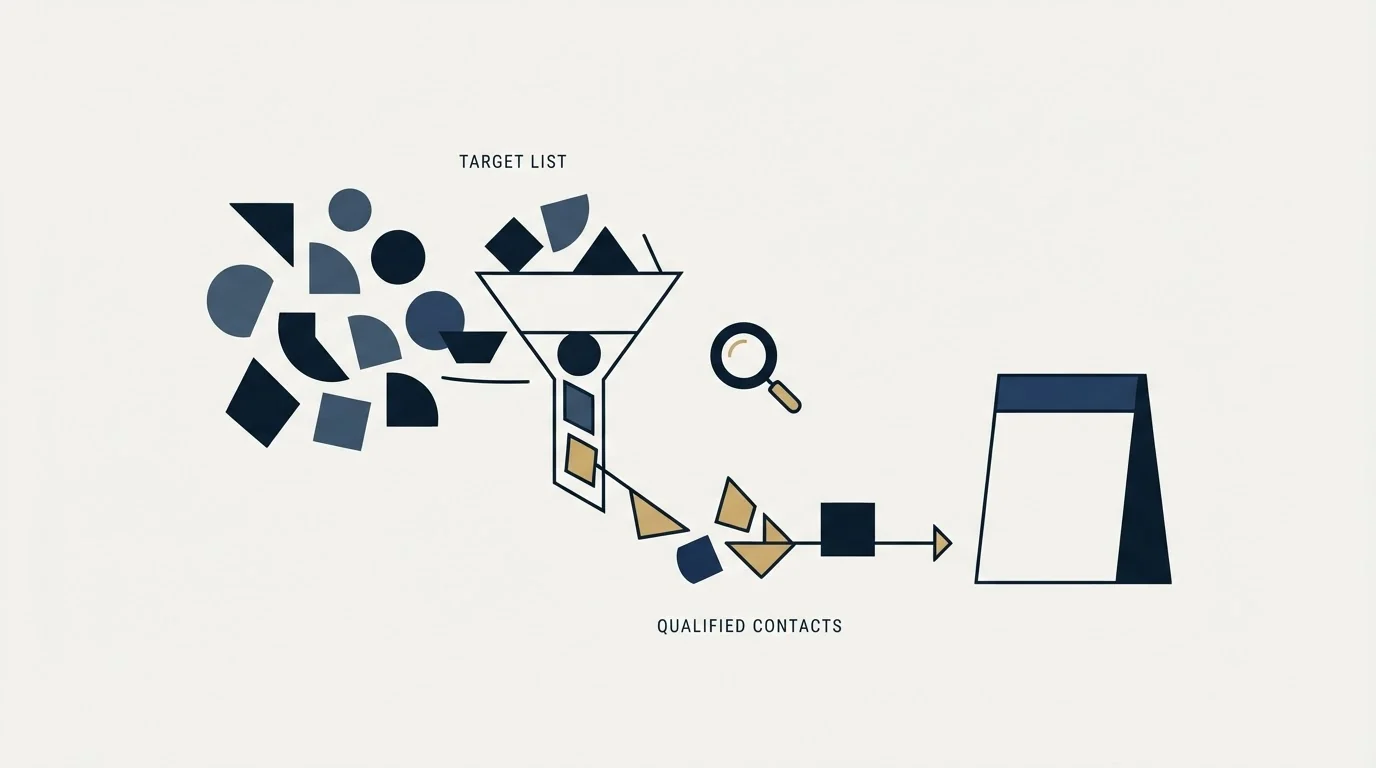
Legal is one of the few verticals where the target universe is nearly fully enumerated in public sources. Every practicing attorney is licensed and listed by a state bar, and nearly every firm publishes its roster with practice areas.
Start at the firm level. Pull firms by headcount and geography from state bar directories, ALM rankings on Law.com, and directories like Martindale-Hubbell, Chambers and Partners, and The Legal 500. Filter by practice mix next: practice pages reveal whether a firm runs high-volume matters (insurance defense, immigration, collections) or low-volume complex work (M&A, appellate, white collar). Volume firms buy efficiency. Complex-matter firms buy risk reduction. Then layer in operational signals: job postings for legal operations or billing roles indicate an active initiative, and membership in the International Legal Technology Association marks a real technology function.
Only then enrich to contacts, scraping the firm's own "Administration" page before touching a data vendor, because firm sites are more accurate about business-side staff than databases that over-index on attorneys. Verify every address and quarantine catch-alls. Aim for 300 to 800 qualified firms rather than 5,000 loose matches. Legal buyers talk constantly through bar associations and peer groups, so a sloppy blast carries reputational cost.
Step 4: Lead With a Number or a Peer Comparison Instead of a Demo
"Book a 30-minute demo" is a weak first ask here, because it asks someone who charges for time to donate half an hour to a stranger. Three offers that convert:
- A peer benchmark. Legal buyers are comparison-driven. "How 40 firms in the 100 to 300 attorney range handle X" earns replies from people who ignore demos.
- A specific reclaim number. Tie value to something the firm already measures: unbilled time, write-offs, realization rate, days in receivables, associate attrition. Clio's annual Legal Trends Report is worth reading before you write copy so your framing uses the language on the reader's own dashboards.
- A single-practice-group pilot. "Run it with the eight attorneys in your employment group for 60 days" is a decision one chair can make alone, which sidesteps the firmwide politics that stall legal deals.
Whatever you pick, ask for fifteen minutes rather than thirty, and put a number in the ask. "A 15-minute call the week of the 12th" outperforms "some time to connect."
Step 5: One Message Per Campaign, Timed to a Law Firm Calendar

Legal buyers move slowly for a structural reason: their week is built around client deadlines and court dates that outrank every internal priority, so a message arriving during a filing week gets read and forgotten.
We send one message per campaign. A partner who does not answer is never written to again underneath the email they already passed over: no reply in that thread, no nudge, no permission-to-close sitting below an ignored note. They go into a later campaign with its own subject line and its own premise. A second message under an unanswered one reads as pressure, it is delivered to exactly the readers most likely to report it, and the reputation cost is charged to the sending domain across every other campaign it carries. A fresh email earns a fresh open. The full argument, with the numbers from our own campaigns, is in why we stopped using follow-ups.
| Campaign | Window | Channel | Purpose |
|---|---|---|---|
| 1 | January | Email, one message | Value proposition, one specific ask |
| 1 | Same week | LinkedIn connect, no pitch | Familiarity, not a second copy of the email |
| 1 | Same week | Phone, direct line | Its own reason to call, highest-yield for ops titles |
| 2 | About ten weeks on | Email, new subject line | A different problem, not the same ask again |
| 2 | Same week | Phone, direct line | Its own reason to call, never "did you see my email" |
| 3 | September | Email, new subject line | Peer benchmark or resource offer |
| 3 | Same week | LinkedIn message | Its own premise, no reference to the emails |
| 4 | On the next trigger | Email, new subject line | Proof from a comparable firm, or the routing ask |
Timing rules that matter here:
- Send before 7:30 a.m. or after 6:00 p.m. local time, since firm days run wall to wall from mid-morning and business-side executives clear inboxes at the edges.
- Tuesday through Thursday beats Monday and Friday, and the gap is wider here because Monday is docket and status-meeting day at many firms.
- Avoid the last four business days of any month and the last two weeks of December, when billing and collections consume the operations staff you want.
- January and September open strongest, because most firms run calendar fiscal years, so budget talk starts in Q4 and money becomes spendable in January.
- Non-responders go into the next quarter's campaign, not a reminder under a message they already saw. Legal deals reactivate 60 to 120 days later more often than in most verticals.
Step 6: Templates That Book Meetings With Law Firms
Template 1: COO or Firm Administrator (mid-market)
Subject: {{firm_name}} + unbilled time

Hi {{first_name}},

You run operations for {{attorney_count}} attorneys across
{{office_count}} offices, so time capture is probably one of those
problems that never fully closes.

The gap is rarely the software. Attorneys reconstruct the day at 9pm from
memory, and anything under six minutes disappears. At {{reference_firm}},
closing that gap was worth about {{reference_outcome}} in two quarters.

Worth 15 minutes the week of {{proposed_week}} to see whether the same
pattern shows up in your numbers?

{{sender_name}}
{{sender_title}} | {{company}} | {{phone}}
Why this works: It names a metric the reader is accountable for, describes the mechanism in one sentence so they recognize their own firm, and asks for a defined slot in a named week.
Template 2: Practice Group Chair (matter-type specific)
Subject: {{practice_area}} at {{firm_name}}

{{first_name}},

{{firm_name}}'s {{practice_area}} group is up to {{practice_group_size}}
attorneys. That is usually the point where {{specific_bottleneck}} starts
eating associate hours that should be billable.

Short version: {{one_sentence_capability}}. Groups your size run it as a
60-day pilot inside one practice area, so it does not need a firmwide
decision or an IT project.

If that is useful, I will send the two-page pilot outline. If not, say so
and I will leave you alone.

{{sender_name}}
{{company}} | {{phone}}
Why this works: The pilot framing removes the firmwide politics that kill legal deals, the growth observation proves you looked at the firm, and offering an easy no lifts total reply rate.
Template 3: Director of Legal Operations or CIO (larger firms)
Subject: How {{peer_firm_count}} firms your size handle {{problem_area}}

Hi {{first_name}},

We put together how {{peer_firm_count}} firms in the
{{headcount_range}}-attorney range handle {{problem_area}}: which tools
they run and where the process breaks.

No pitch attached. It is annoying to assemble yourself and useful when you
are building a business case.

Want me to send it? Happy to walk through it live if the comparison to
{{firm_name}} is interesting, but the document stands on its own.

{{sender_name}}
{{sender_title}} | {{company}}
Why this works: Peer comparison is the format legal operations leaders use internally to justify spend. The ask is a document rather than a meeting, so replying costs nothing and the call becomes opt-in.
Template 4: The routing ask (a later campaign to non-repliers)
Best for: a later campaign to firms that did not answer an earlier one, sent as a new email with its own subject rather than a reply into the old thread.
Subject: {{problem_area}} at {{firm_name}}: not a priority, handled, or wrong month?

{{first_name}},

When a firm the size of {{firm_name}} has not looked at {{problem_area}}
yet, it is usually one of three things: not a priority, already handled,
or wrong timing.

If it is timing, tell me a month and I will come back then. Otherwise no
reply is a fine answer.

{{sender_name}}
Why this works: Three low-effort exits are easier to answer than one request, and "tell me a month" converts a share of silent prospects into scheduled conversations. It runs as its own campaign to the people an earlier one did not reach, so it arrives as a new message with a new premise rather than a reminder about an old one.
Step 7: The Objections You Will Actually Get
- No: "Send me some information."
- No: "We're happy with our current provider."
- No: "The partners will never adopt it."
- No: "Our security review takes months."
- No: "No budget until next year."

"Send me some information." Send one short document and, in the same reply, propose a specific 15-minute slot with a stated agenda. Never send a 40-page deck to a lawyer, because they will find the one weak claim.
"We're happy with our current provider." Skip the incumbent teardown. Ask the renewal date and what would have to change for them to evaluate alternatives, then book the follow-up 90 days before renewal. Switching in legal happens on contract boundaries far more than on features.
"The partners will never adopt it." Answer with adoption mechanics: what attorneys do differently, how many clicks, whether it runs inside Outlook and Word where they already live. Then offer the single-group pilot.
"Our security review takes months." Often true at larger firms, because client outside counsel guidelines flow down to vendors. Get ahead of it with SOC 2 documentation and a completed security questionnaire ready on the first call. Volunteering that early is a strong credibility signal here.
"No budget until next year." Ask whether the constraint is budget or the compensation cycle. At partnerships, second-half spending competes with partner distributions, which is why proposals land better in Q4 for January execution.
Step 8: What a Realistic Outcome Looks Like Per 100 Prospects
Treat this as a planning model rather than a benchmark, and replace each row with your own data after 500 sends.
Bar widths are equal here because these stage values are not a single comparable measure.
| Stage | Per 100 prospects |
|---|---|
| Total replies (positive, neutral, negative) | Roughly 5 to 12 |
| Positive replies | Roughly 2 to 5 |
| Meetings booked | Roughly 1 to 3 |
| Meetings held (legal reschedules often) | Roughly 1 to 2 |
The implication is arithmetic. If you need eight held meetings a month and land mid-range, you need roughly 500 to 800 prospects in campaigns per month, which requires continuous list building rather than a one-time scrape. That is the piece most teams underinvest in, and it is why campaigns that look promising in week two stall in month three. Narrowing the segment until one message is true for every recipient moves these numbers more than any subject-line test.
Compliance and Deliverability Notes
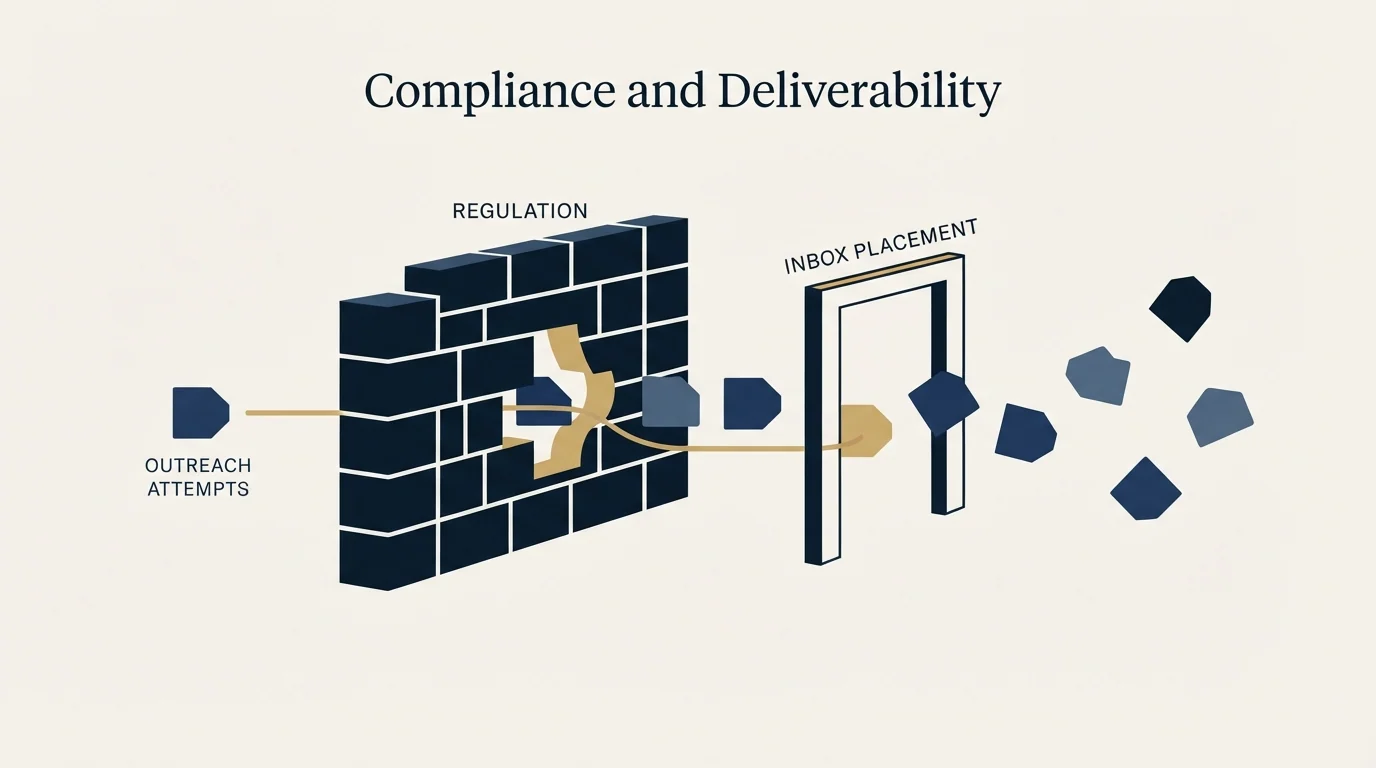
Commercial email to US law firms falls under CAN-SPAM like any other B2B outreach: accurate sender information, a subject line that reflects the message, a valid physical postal address, a clear opt-out, and opt-out requests honored within 10 business days. Source: FTC CAN-SPAM Act Compliance Guide.
Two vertical-specific practices. Never quote a client matter you found in court filings; docket data is fine for targeting and reads as invasive when repeated back. And avoid fake reply threads, false "as discussed" openers, and misleading subject lines, because this audience is trained to notice and one bad experience travels through a firm's referral network.
Your First Week Checklist
- Choose one headcount band and one practice-mix profile
- Map your product to a primary and backup title
- Build 300 to 800 firms, enrich to named contacts, verify every address
- Pick one offer: benchmark, reclaim number, or single-group pilot
- Write three emails plus a routing ask, all under 120 words
- Load four single-message campaigns, with a phone call beside the email in the first two
- Send before 7:30 a.m. Tuesday to Thursday, and block month-end
- Prepare security documentation before the first meeting
Work the list for a full cycle before changing anything. The most common self-inflicted wound here is rewriting copy in week two off a sample of 40 sends, which teaches nothing and resets your learning.
If you would rather have this built and run for you, RevenueFlow handles done-for-you cold email for teams selling into professional services, from list building and infrastructure through copy and campaign management. Book a strategy call and we will map the segment, titles, and offer for your product.
Related Reading
- Cold Email for Partnerships: Building Strategic Business Relationships
- Cold Email for Product Feedback: Complete Strategy Guide
- Cold Email for User Research: Complete Strategy Guide
If you would rather have this run for you, RevenueFlow books qualified meetings on a pay-per-meeting basis and publishes client results.
Frequently asked questions.
Frequently asked questions- Who should I email at a law firm to book a meeting?
- For operations, billing, or technology offerings, start with the Chief Operating Officer, Executive Director, or Firm Administrator at firms under about 400 attorneys, and with the Director of Legal Operations or CIO at larger ones. Practice group chairs are good first contacts when your offer attaches to a specific matter type, since they can approve a pilot inside their own group.
- How many meetings should I expect per 100 law firm prospects?
- Plan on roughly 5 to 12 total replies, 2 to 5 positive replies, 1 to 3 meetings booked, and 1 to 2 meetings actually held per 100 well-matched, verified prospects, as a published multi-message planning model. We send one message per campaign and reach the same monthly number through a larger verified list, so replace any published figure with your own once you have around 500 sends of history.
- What is the best time to cold email a law firm?
- Send before 7:30 a.m. or after 6:00 p.m. local time on Tuesday through Thursday, since firm days run wall to wall from mid-morning. Avoid the last four business days of any month and the last two weeks of December, when billing and collections consume operations staff. January and September tend to open strongest.
- Is cold emailing law firms legal in the United States?
- Yes. Business-to-business cold email to law firms is governed by CAN-SPAM, which requires accurate sender and header information, a subject line that reflects the message, a valid physical postal address, a clear opt-out mechanism, and opt-out requests honored within 10 business days. Attorney solicitation rules govern lawyers marketing to clients, not vendors emailing firms.
- What offer works best for booking meetings with law firms?
- Peer benchmarks convert well because legal buyers are comparison-driven and use size-band comparisons to justify spend internally. A specific reclaim number tied to a metric the firm already tracks (unbilled time, write-offs, realization rate, days in receivables) also works. A 60-day pilot scoped to one practice group avoids firmwide politics.
About the author.

Ben Carden is CRO at RevenueFlow, which builds and operates outbound revenue engines for B2B companies. Previously at Gartner Enterprise. Studied at London School of Economics.
Ben Carden · CRO
Connect on LinkedIn →Explore more.
Ready to scale your outreach?
We build GTM engines that book real meetings. See the receipts.
Related articles.
Cold Email for Influencer Outreach: Partner with Creators
Learn how to use cold email to build authentic influencer partnerships that drive real results for your brand, with proven templates and strategies.
Cold Email for Product Feedback: Complete Strategy Guide
Learn how to use cold email to gather valuable product feedback from users and prospects. Includes proven templates, feedback frameworks, and response optimization techniques.
Cold Email for PR: How to Pitch Journalists and Get Coverage
Learn how to craft cold emails that get journalists to open, read, and respond to your pitches. Includes real templates, timing strategies, and a complete PR outreach checklist.
Cold Email for Reviews: Complete Strategy Guide
Learn how to use cold email to generate authentic product reviews on G2, Capterra, and other platforms. Includes proven templates, compliance guidelines, and review generation frameworks.
Cold Email for Link Building: How to Get Quality Backlinks
Learn how to use cold email outreach to build high-quality backlinks that improve your SEO rankings, with proven templates and strategies that get responses.
Cold Email for Focus Groups: Complete Strategy Guide
Learn how to use cold email to recruit qualified participants for focus groups. Includes proven templates, screening strategies, and group composition frameworks.