How to Book Sales Meetings with SaaS Companies
A practitioner playbook for booking meetings with SaaS companies: title targeting, trigger-based lists, a six-touch sequence, templates, and funnel math.
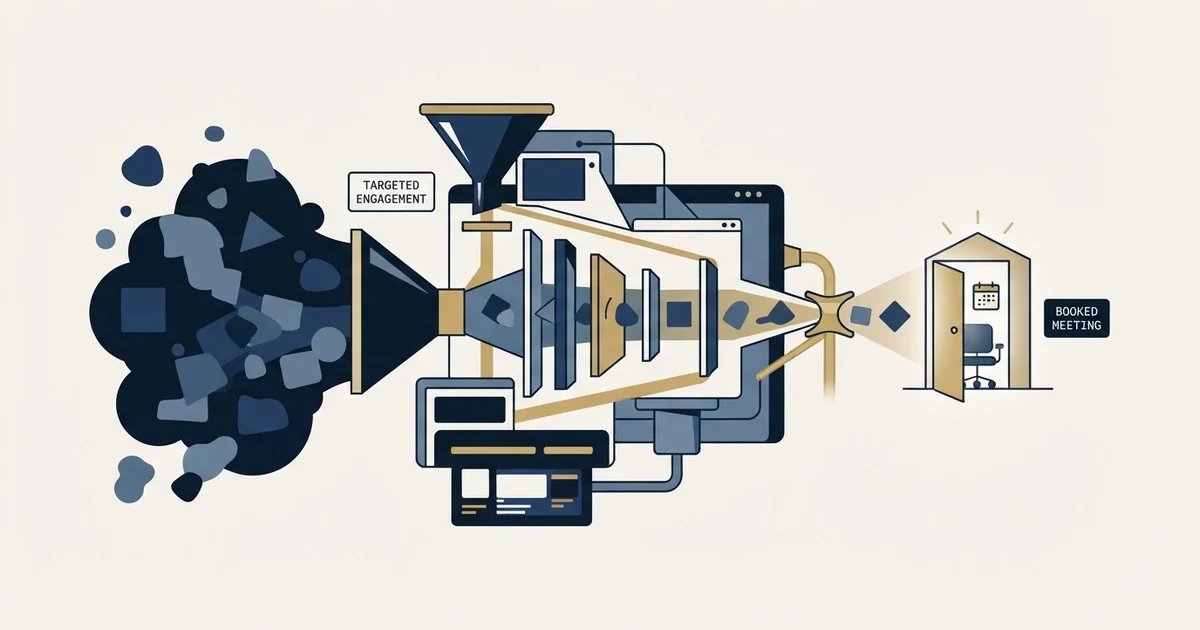
Book meetings with SaaS companies by narrowing to one slice (headcount band, funding stage, GTM motion), targeting the person who owns the metric rather than the most senior title, building lists on triggers like job postings and funding rounds, and running four single-message campaigns spread across months with an interest-based ask instead of a calendar link.
Key takeaways
- Segment SaaS targets on four axes before writing copy: headcount band, funding recency, go-to-market motion (product-led or sales-led), and tech stack.
- Below roughly 60 employees, email one level up to the founder; above roughly 300, email one level down from the executive, since the director builds the shortlist.
- Multi-thread two contacts per account staggered about a week apart rather than one contact across twice as many accounts.
- Job postings are the highest-signal, lowest-cost trigger for SaaS outreach; funding announcements work best in the 30 to 120 day window after the raise, not on announcement day.
- Run four single-message campaigns spread across months, keep every email under 90 words, and never paste a calendar link into a cold email.
- Measure five funnel stages per 100 verified contacts (delivered, replied, positive, booked, held) and report them by segment, since aggregate numbers hide the diagnosis.
Reviewed and updated September 1, 2026
How to Book Sales Meetings with SaaS Companies: A Step-by-Step Playbook
A 180-person Series B SaaS company usually has three people who can green-light a new vendor: the VP who owns the number your product moves, the director who would run it day to day, and the RevOps or IT person who has to connect it to Salesforce. Most cold outreach aimed at that company reaches none of them. It lands on the founder, who forwards nothing, or on a "Head of Growth" whose title was renamed twice since the data provider last scraped it.
Booking meetings with SaaS companies is a targeting and campaign-planning problem before it is a copywriting problem. SaaS buyers are the most email-literate people in B2B. They run outbound themselves, recognize every framework you might use, and spot a broken merge tag at a glance. That cuts both ways. They ignore anything templated, and they reply fast to something obviously relevant, because they know how rare that is.
This playbook covers the path from raw list to a call that actually gets held.
Step 1: Narrow to the Slice of SaaS You Can Win
"SaaS companies" is not a segment. A 12-person bootstrapped PLG tool and a 900-person sales-led platform with a procurement function share a business model and nothing else. Define your slice on four axes before writing a word of copy.
Headcount band. Under 50 employees, the founder decides and there is no budget process, but also little budget. The 50 to 250 range is the sweet spot for most vendors: real budget, real pain, no procurement gauntlet. Above 500 you need a champion plus security review plus legal, and your campaign has to sell an internal meeting rather than a purchase.
Funding stage and recency. A company that raised a Series A four months ago is hiring and buying. One that raised eighteen months ago at a valuation it cannot grow into is cutting. Same headcount, opposite intent, different email.
Go-to-market motion. Product-led companies buy activation, onboarding, and monetization tooling. Sales-led companies buy data, sequencing, enablement, and CRM-adjacent products. Pitching an SDR tool to a company that has no SDRs is the most common list-building error in this vertical.
Tech stack. Whether they run HubSpot or Salesforce changes both who you email and what problem you lead with.
Compress the slice into a one-line filter you could hand to a researcher. If you cannot, the list will be noise.
Step 2: Target the Title That Owns the Number
SaaS org charts churn constantly, so target by ownership rather than seniority. The question to answer for every account: who gets asked about this metric in the Monday leadership meeting?
| What you sell | Primary title | Secondary title | Who to skip |
|---|---|---|---|
| Pipeline generation, outbound, contact data | VP Sales, VP Demand Gen | Sales Development Manager | CEO above 200 headcount |
| Product analytics, activation, onboarding | VP Product, Head of Growth | Director of Product Analytics | CTO |
| Dev tooling, infrastructure, security | VP Engineering, Head of Platform | Staff Engineer, Head of SecOps | CTO above 500 headcount |
| Billing, pricing, revenue operations | CFO under 100, VP RevOps over 100 | Controller, Billing Lead | VP Sales |
| Support and customer success tooling | VP Customer Success | Director of Support Ops | COO |
Two rules hold across the vertical. Below roughly 60 employees, go one level up, because there is no middle management and the founder signs everything. Above roughly 300, go one level down from the executive, because the director builds the shortlist and the VP approves it.
Multi-thread from the start. Two contacts per account, staggered about a week apart, beats one contact across twice as many accounts, because SaaS buying is a committee sport even at small deal sizes.
Step 3: Build the List Around Triggers

A static firmographic list decays fast and gives you no reason to be in the inbox this particular week. Triggers give you timing and an opening line at once. The ones that work on SaaS targets:
- Job postings. A req for a Sales Development Representative tells you they are building outbound right now. A req for a Revenue Operations Manager tells you their data is a mess. Job boards are the highest-signal, lowest-cost trigger in this market.
- Funding announcements. Useful in the 30 to 120 day window after the raise, when the spending plan gets written. Congratulation emails on announcement day hit the most crowded inbox moment of that company's year.
- Leadership changes. A new VP has about two quarters to show a change and almost always buys new tooling. Track title changes among your personas.
- Stack additions and removals. A company that just added a CRM is about to buy five things around it.
- Public pricing and product changes. A new enterprise tier or a rewritten pricing page implies a new GTM motion and new gaps.
- Integration directories and category listings. If your product complements a platform, that platform's public integration list is a pre-qualified account list.
Verify every address before sending. SaaS companies use catch-all domains more than most industries, and catch-alls are where deliverability goes to die. When a verification tool flags an address as risky, route it to a separate low-volume inbox instead of your main sending pool.
Step 4: One Message Per Campaign, Built for a Short Attention Window
SaaS buyers have no seasonality to work around, but they do have quarter-end crunches and a strong preference for short emails from people who did homework. A structure that fits:
| Campaign | Window | Channel | Job of this message |
|---|---|---|---|
| 1 | Day 0 | Email, one message | Trigger observation plus one specific problem |
| 1 | Day 3 | LinkedIn connection request, no pitch | Attach a face to the name, not a copy of the email |
| 2 | About four weeks on | Email, new subject line | A different problem, softer ask |
| 3 | About eight weeks on | Email, new subject line | Proof: a peer company, a number, a short teardown |
| 3 | Same week | LinkedIn message | Its own premise, no reference to the emails |
| 4 | Next quarter, or a fresh trigger | Email, new subject line | The routing question |
One message per campaign, then that campaign is finished for that contact: no second email in the same thread, no permission close sitting under a message they already skipped. SaaS buyers run outbound themselves, and they read a second message under an ignored one for exactly what it is. A non-responder goes into the next campaign weeks later with its own subject line and a genuinely different problem, and into a quarterly re-entry after that. A message threaded under an ignored one reaches the readers most likely to mark it as spam, and the reputation cost is charged to the sending domain across every other campaign it carries. The full argument, with the numbers from our own campaigns, is in why we stopped using follow-ups. Keep every email under 90 words, send between 7am and 10am local time Tuesday through Thursday, warm each sending domain for at least two weeks before it carries real traffic, and keep per-inbox volume well under the platform ceiling rather than at it.
Never send the same email to the second contact at an account. Change the angle so a forwarded message does not read as a mail merge.
Step 5: Templates That Book Calls with SaaS Buyers

Template 1: The hiring trigger
Subject: your {{job_title}} req

{{first_name}} - saw {{company}} is hiring a {{job_title}}. Usually that
means {{inferred_problem}} is already landing on someone's desk before the
seat gets filled.

{{peer_company}} had the same gap last spring and used us to
{{specific_outcome}} while they were still interviewing.

Worth 12 minutes to compare notes on how they set it up? Happy to just send
the breakdown instead if that is easier.

{{sender_first_name}}
Why this works: the job posting is public, dated, and specific, so the opening line cannot read as a generic merge field. The inference ("that means X is landing on someone's desk") shows you understand the operational consequence. Offering the written breakdown as an alternative gives a non-committal reader something to say yes to.
Template 2: The stack complement
Subject: {{crm_name}} + {{their_use_case}}

{{first_name}} - you are running {{crm_name}}, which usually means
{{specific_limitation}} costs your team a few hours a week in manual cleanup.

We sit on top of {{crm_name}} and handle that piece. {{peer_company_1}} and
{{peer_company_2}} both run it this way.

Is that worth solving this quarter, or is it further down the list?

{{sender_first_name}}
Why this works: naming the tool proves research and filters out anyone for whom the email is irrelevant. The closing question is a qualifier rather than a calendar ask, which makes "further down the list" an easy reply. A negative answer is still a data point for next quarter.
Template 3: The proof re-approach
Best for: a later campaign to accounts that did not answer an earlier one. Its own subject line, sent as a new email rather than a reply into the old thread.
Subject: {{peer_company}} at {{headcount}} people

Something concrete instead of a nudge.

{{peer_company}} is a {{headcount}}-person {{category}} company, similar
shape to {{company}}. Before: {{before_state}}. Sixty days in:
{{after_state}}.

I wrote up how they did it in about 400 words. Want me to paste it in a
reply? No call needed.

{{sender_first_name}}
Why this works: most second messages add pressure and no information. This one adds a peer comparison the reader evaluates in five seconds, arrives as its own campaign rather than a nudge under an unanswered note, and asks only for some text back. Readers not ready to book will often take the write-up, which moves them from cold to known.
Template 4: The routing ask
Best for: a later campaign to accounts that did not answer the earlier ones. Its own subject line and one question.
Subject: {{problem_area}}: 1, 2 or 3?

{{first_name}} - when a company your size has not looked at
{{problem_area}} yet, it is usually one of three things:

1. Not a priority this quarter
2. Wrong person, should be someone else on your team
3. Real priority, but bad timing right now

Reply with a number and I will do the right thing with it.

{{sender_first_name}}
Why this works: a one-character reply costs almost nothing, and each answer is actionable. Option 2 in particular generates warm internal referrals, which convert to held meetings far better than anything you can cold-target.
Step 6: The Ask That Converts in This Vertical
Do not paste a calendar link in a first cold email to a SaaS buyer. It signals volume sending, and this audience reads that signal faster than any other.
Use an interest-based ask in every campaign's one message: "worth comparing notes?", "want the write-up?", "is this a this-quarter problem?". On any positive reply, switch immediately to two specific times in their timezone with a link as fallback. The handoff from interest to calendar is where most programmes leak, usually because the reply-handler sends a generic "great, here's my link" instead of proposing a slot.
Keep the meeting small. Twelve or fifteen minutes books better than thirty here, and a short call that runs long beats a long call that gets cancelled.
Step 7: Handle the Four Objections You Will Actually Get
- No: "We already use [competitor]."
- No: "No budget right now."
- No: "Send me some information."
- No: "I'm not the right person."

"We already use [competitor]." They have budget and a category owner. Ask what one thing they would change about it, then decide whether you can win that one thing. Never open with a feature comparison.
"No budget right now." Ask when the next planning cycle closes, offer a short business case they can reuse internally, and set a reminder for four weeks before that date.
"Send me some information." Send exactly one page, in the email body, never an attachment or a deck. Close with a specific next step and a date.
"I'm not the right person." Ask for the name and offer to copy them in on your reply. Internal referrals are the cheapest meetings you will ever book.
Step 8: What a Realistic Meetings-Per-100-Prospects Outcome Looks Like
Treat published cold email benchmarks with suspicion. Reported reply rates vary enormously by list quality, offer strength, and how the publisher defines a "reply." Model your own funnel, then replace the assumptions with real numbers inside the first month. Five stages per 100 verified contacts:
Contacts minus bounces and spam placement
Any human response
Interest, question, or referral
Calendar event created
Prospect showed up
Bar widths are equal here because these stage values are not a single comparable measure.
| Stage | What to measure | Where a healthy SaaS campaign tends to land |
|---|---|---|
| Delivered | Contacts minus bounces and spam placement | Bounce rate under 3 percent |
| Replied | Any human response | Single-digit percentage of delivered |
| Positive | Interest, question, or referral | Roughly a quarter to a third of replies |
| Meeting booked | Calendar event created | Most positives, if the handoff is fast |
| Meeting held | Prospect showed up | Expect meaningful drop-off without confirmations and reminders |
The compounding matters more than any single stage. A campaign that doubles its positive-reply share and halves its no-show rate has quadrupled held meetings without sending one extra email. That arithmetic points at the list and the confirmation process well before subject line testing.
Two habits move held-meeting counts more than copy does. Send a same-day confirmation and a morning-of reminder, both from the human who will run the call. And book no more than seven days out, since every extra day raises the chance priorities shift.
Step 9: Instrument by Segment, Not in Aggregate
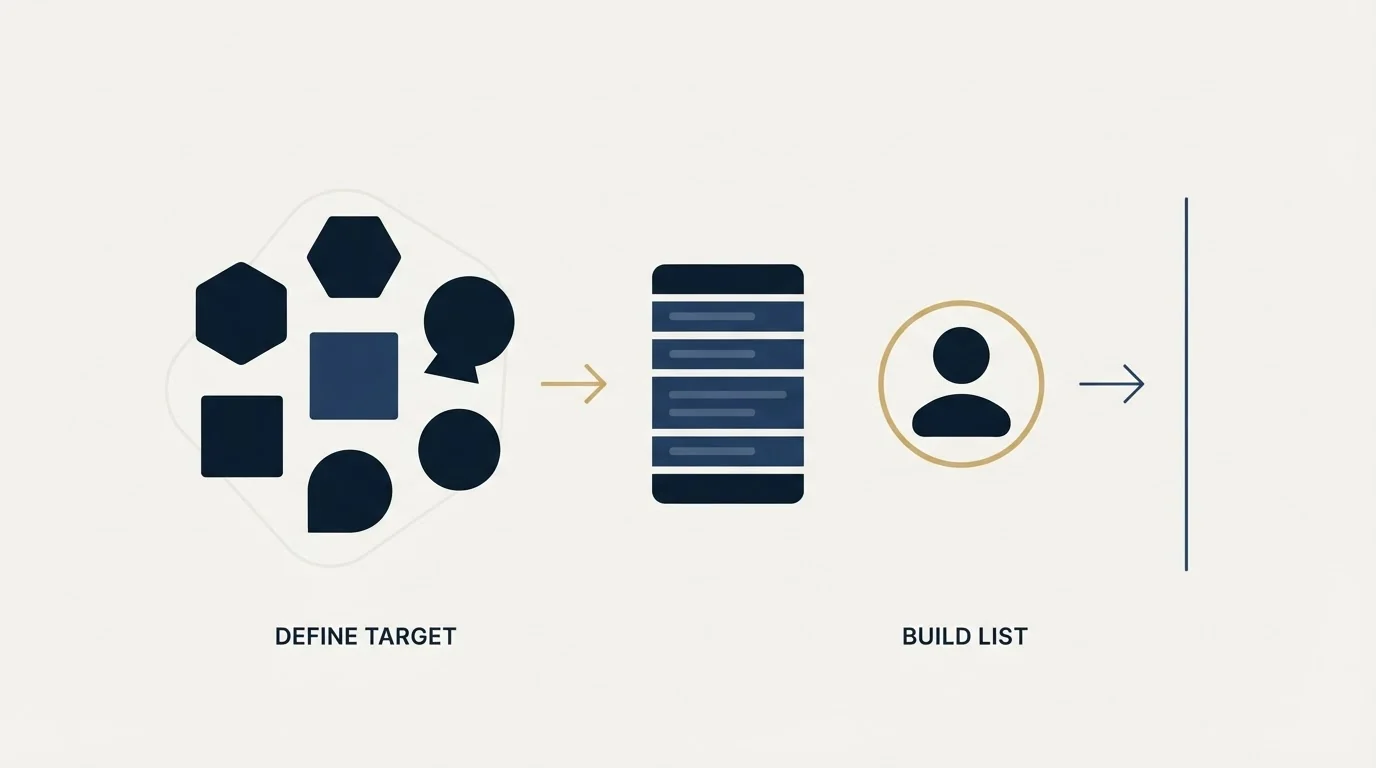
Aggregate stats hide everything worth knowing. Split reporting by segment (headcount band, funding stage, persona, trigger type) and the diagnosis becomes obvious:
- High bounce rate points at data sourcing and verification.
- Low reply rate with clean delivery points at the list or the offer, rarely the copy.
- Good reply rate with a low positive share means right people, wrong message.
- Good positive rate with few bookings means the reply handoff is slow or the ask is too large.
- Good bookings with poor attendance means you are booking too far out or qualifying too loosely.
Teams that run this well, including the campaigns RevenueFlow builds for clients selling into SaaS, tend to kill most of their initial segments within six weeks and pour volume into whichever slice replies. That reallocation is the highest-leverage decision in the program.
Where This Playbook Breaks
It breaks when the offer is undifferentiated, because no personalization rescues a message with no reason to exist. It breaks when deal size cannot support the effort, since researched outreach into 25-employee startups paying $200 a month rarely pays back. And it breaks when sending infrastructure is neglected, because a domain landing in spam produces zero replies regardless of copy quality.
To start: pick one slice, build 200 verified contacts against a single trigger, run the first campaign to all of them, and hold the copy constant so the data means something. Then change one variable at a time.
If you would rather have this built and run for you, RevenueFlow does done-for-you cold email for companies selling into SaaS, from list construction through booked calls. Book a strategy call and we will map the segments, triggers, and campaigns for your offer.
Related Reading
- Cold Email for Product Feedback: Complete Strategy Guide
- Cold Email for Partnerships: Building Strategic Business Relationships
- Cold Email for User Research: Complete Strategy Guide
If you would rather have this run for you, RevenueFlow books qualified meetings on a pay-per-meeting basis and publishes client results.
Frequently asked questions.
Frequently asked questions- Who should I email at a SaaS company to book a meeting?
- Target whoever owns the metric your product moves, not the most senior person. At companies under about 60 employees that is usually a founder, because there is no middle management. Above about 300 employees, email one level below the executive: the director builds the vendor shortlist and the VP signs off on it.
- Should I follow up when a SaaS buyer does not reply?
- Four single-message campaigns spread across months, mixing email and LinkedIn, then a quarterly re-entry for non-responders. Each campaign carries a new angle rather than a check-in, and none of them is a reply into an earlier thread. Keep every email under 90 words and send between 7am and 10am in the prospect's local time, Tuesday through Thursday.
- Should I put a calendar link in my first cold email?
- No. A calendar link in a first touch signals volume sending, and SaaS buyers read that signal faster than any other audience. Use an interest-based ask instead, such as asking whether the problem is a this-quarter priority. Once someone replies positively, propose two specific times in their timezone with a link as a fallback.
- How many meetings should I expect per 100 prospects?
- Published benchmarks vary too widely to plan against, because vendors define replies differently and list quality dominates the result. Model five stages instead: delivered, replied, positive reply, meeting booked, meeting held. Track those per segment for four weeks, then replace your assumptions with real numbers and reallocate volume to whichever slice replies.
- What is the best trigger to build a SaaS prospect list around?
- Job postings. A req for a Sales Development Representative shows they are building outbound right now; a req for a Revenue Operations Manager shows their data is a mess. Postings are public, dated, and specific, which gives you both the timing signal and an opening line that cannot read as a merge field.
About the author.

Ben Carden is CRO at RevenueFlow, which builds and operates outbound revenue engines for B2B companies. Previously at Gartner Enterprise. Studied at London School of Economics.
Ben Carden · CRO
Connect on LinkedIn →Explore more.
Ready to scale your outreach?
We build GTM engines that book real meetings. See the receipts.
Related articles.
Cold Email for Influencer Outreach: Partner with Creators
Learn how to use cold email to build authentic influencer partnerships that drive real results for your brand, with proven templates and strategies.
Cold Email for Product Feedback: Complete Strategy Guide
Learn how to use cold email to gather valuable product feedback from users and prospects. Includes proven templates, feedback frameworks, and response optimization techniques.
Cold Email for PR: How to Pitch Journalists and Get Coverage
Learn how to craft cold emails that get journalists to open, read, and respond to your pitches. Includes real templates, timing strategies, and a complete PR outreach checklist.
Cold Email for Reviews: Complete Strategy Guide
Learn how to use cold email to generate authentic product reviews on G2, Capterra, and other platforms. Includes proven templates, compliance guidelines, and review generation frameworks.
Cold Email for Link Building: How to Get Quality Backlinks
Learn how to use cold email outreach to build high-quality backlinks that improve your SEO rankings, with proven templates and strategies that get responses.
Cold Email for Focus Groups: Complete Strategy Guide
Learn how to use cold email to recruit qualified participants for focus groups. Includes proven templates, screening strategies, and group composition frameworks.