How to Book Sales Meetings with Telecom
A tactical playbook for booking telecom sales meetings: segment targeting, public buying triggers, sequence timing, templates, and realistic meeting math.
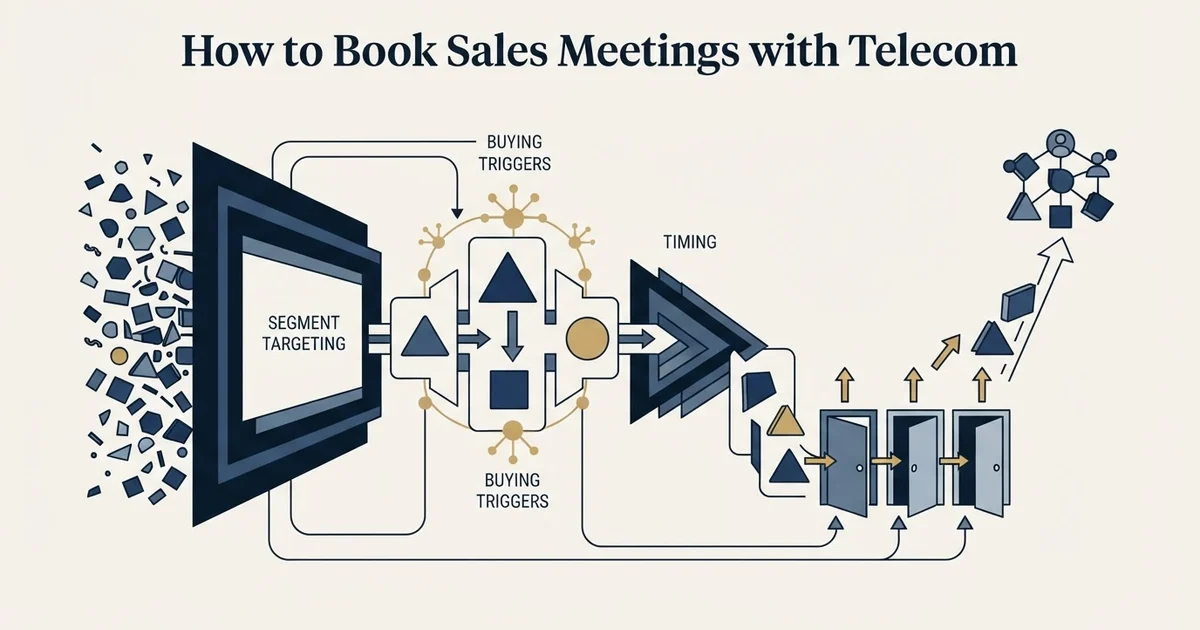
To book telecom meetings, pick one segment (regional ISPs, MSPs, or infrastructure contractors convert faster than Tier 1 carriers), build a 150 to 400 account list from public triggers like BEAD awards and FCC filings, run four single-message campaigns spread across months, and ask for a yes/no reply instead of a demo.
Key takeaways
- Regional ISPs, rural co-ops, MSPs and infrastructure contractors book meetings far faster than Tier 1 carriers, which need an account-based motion rather than a volume campaign.
- Telecom buying intent is publicly filed: BEAD allocations (a $42.45 billion federal program), FCC Broadband Data Collection filings, PUC dockets, permits and job postings all date the buying event.
- Woodpecker platform data shows campaigns under 50 contacts average a 5.8% reply rate versus 2.1% for campaigns of 500 or more, so tight trigger-based lists beat volume.
- Sequences with three to five follow-up steps averaged 8.3% reply rates versus 4.1% with no follow-up, and adding a single follow-up lifted total replies by 65.8% (Woodpecker), which we read as a case for a second contact rather than for putting it in the same thread.
- Belkins analyzed 7.5 million 2025 emails and found a 0.45% average reply rate per email sent, dropping to 0.22% at companies with 10,000 or more employees, which is why carrier campaigns need five to ten times the list size.
- Plan on roughly 1 to 3 held meetings per 100 well-researched regional operator or MSP prospects, and 0 to 1 per 100 at Tier 1 carriers.
Reviewed and updated September 1, 2026
How to Book Sales Meetings with Telecom: A Step-by-Step Playbook
There are three national wireless carriers in the United States. There are thousands of regional ISPs, rural broadband cooperatives, fiber overbuilders, managed service providers, and telecom infrastructure contractors. Most cold email aimed at "telecom" is built as if the first group were the market and the second an afterthought, which is why it books almost nothing.
Booking meetings in telecom is a targeting and campaign-planning problem before it is a copywriting problem. The buyer set is small, technically literate, allergic to marketing language, and organized around procurement processes designed to slow vendors down. The structure works in your favor once you know it: telecom decision makers are findable, their buying triggers are publicly filed, and their renewal cycles are predictable.
Step 1: Pick Your Telecom Segment Before You Write Anything
"Telecom" spans organizations with wildly different budgets, committees, and speeds. One campaign across all of them guarantees mediocre copy.
| Segment | Typical size | Sales cycle | Who decides |
|---|---|---|---|
| Tier 1 carriers and large MSOs | 10,000+ employees | 9 to 24 months | Committee, gated by sourcing |
| Regional ISPs, overbuilders, rural co-ops | 20 to 800 employees | 2 to 6 months | CTO, VP Network Ops, GM |
| MSPs, VARs, telecom agents | 5 to 300 employees | 3 weeks to 3 months | Owner, VP Sales |
| Infrastructure contractors (tower, fiber, OSP) | 30 to 2,000 employees | 1 to 4 months | VP Operations, Dir. Construction |
| CPaaS, UCaaS and telecom software | 10 to 5,000 employees | 1 to 6 months | VP Product, VP Engineering |
If you need pipeline this quarter, the middle three rows are where meetings come from. Tier 1 carriers deserve a named-account motion rather than a volume campaign.
Step 2: Target Titles That Own a Budget and a Problem
Telecom orgs separate network engineering, operations, and procurement more strictly than most industries. Emailing an engineer about cost savings or a sourcing lead about latency both fail for the same reason: the message misses what that person is measured on.
Network and technical buyers. CTO, VP of Engineering, VP of Network Operations, Director of Network Engineering, Head of OSS/BSS. Measured on uptime, capacity, mean time to repair, and clean cutovers. They respond to specificity about equipment, protocols, and failure modes.
Operational buyers. COO, VP of Operations, Director of Field Operations, VP of Customer Experience. Measured on truck rolls, install intervals, churn, and NPS. They respond to cost per subscriber and cycle-time claims.
Revenue buyers. CRO, VP of Sales, Director of Channel. Measured on ARPU, subscriber growth, and partner-sourced revenue.
Procurement and sourcing. Strategic Sourcing, Category Manager (Network), Vendor Management. Rarely a cold-email entry point, useful once a technical champion exists.
A practical rule: target one level below the C-suite at companies over 200 employees, and the C-suite directly under 200. At a 60-person rural ISP the CTO reads their own email and will answer it. At a 4,000-person MSO the CTO will not.
Step 3: Build the List Around Public Triggers
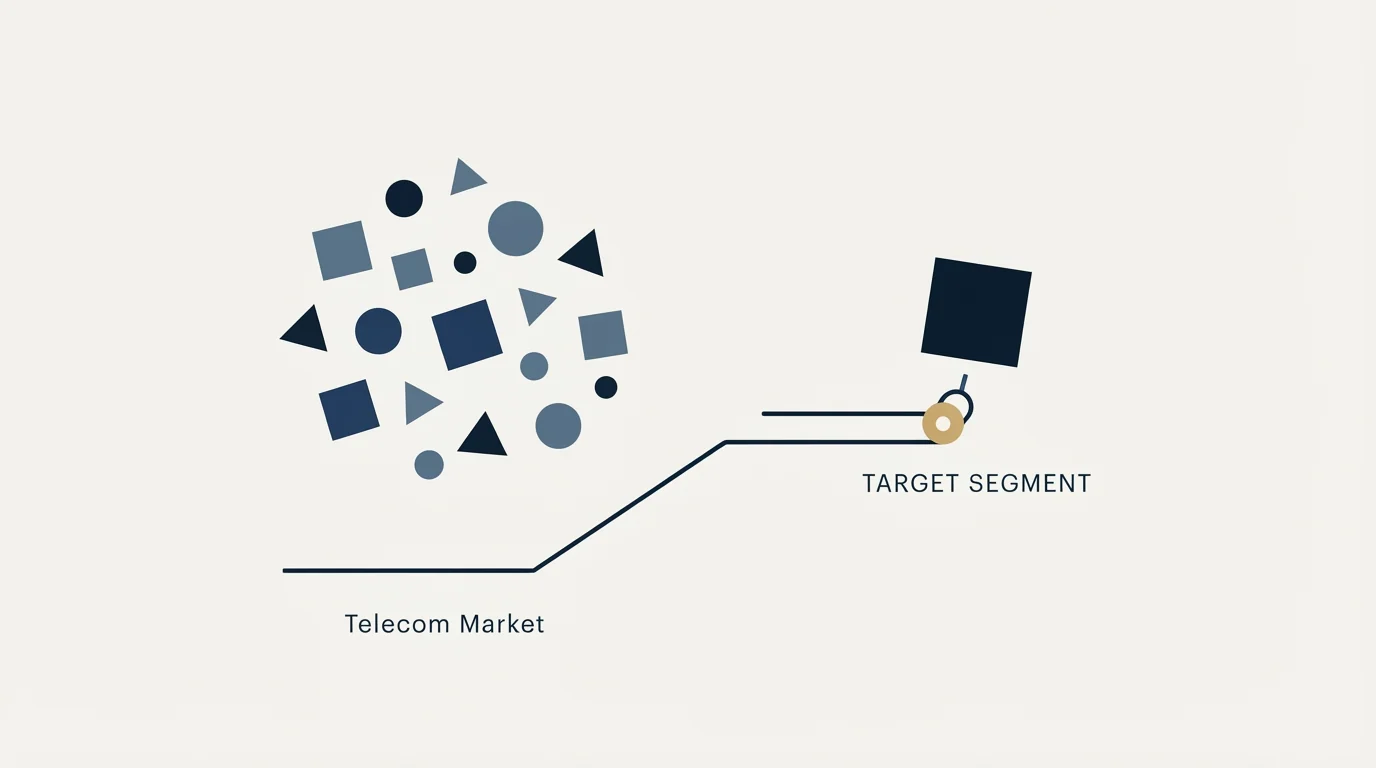
Telecom is one of the few industries where buying intent is filed with the government. That is the biggest advantage available in the vertical, and most senders ignore it.
- FCC Broadband Data Collection filings. Every facilities-based provider reports where it offers service and at what speeds. New or expanded coverage indicates an active buildout.
- BEAD program allocations. The federal Broadband Equity, Access, and Deployment program allocated $42.45 billion for broadband deployment. Source: NTIA. State award announcements name operators, dollar amounts, and counties, which is a dated, funded, publicly documented buying event.
- State PUC and franchise filings. Rate cases, franchise agreements, and pole attachment disputes reveal expansion plans months ahead of press releases.
- Job postings. An ISP hiring three OSP engineers and a splicing supervisor is building fiber. An MSP posting for a NOC manager is scaling managed services.
- Permits and vendor press releases. Permitting records surface site work before a network goes live, and a release naming a new BSS platform reveals the integration roadmap.
Use these to build lists of 150 to 400 accounts per campaign rather than 5,000. Woodpecker's platform data found campaigns under 50 contacts averaged a 5.8% reply rate while campaigns of 500 or more averaged 2.1%. Source: Woodpecker.
Expect standard B2B data providers to have thin coverage on rural co-ops and small ISPs. Supplement with association directories (state broadband associations, NTCA, WISPA), conference exhibitor lists, and company websites, which for smaller operators often list leadership with direct emails.
Step 4: The Campaign Structure That Books Telecom Meetings
Telecom buyers are in the field, in a NOC, or in back-to-back vendor reviews. Most silence comes from your email landing during a cutover. That calls for patience measured in months between campaigns, not for more messages inside three weeks.
| Campaign | Window | Channel | Purpose |
|---|---|---|---|
| 1 | Day 0 | Email, one message | Trigger-specific opener, one ask |
| 1 | Day 3 | LinkedIn connect (no pitch) | Recognition, not a copy of the email |
| 1 | Day 14 | Phone or LinkedIn message | Its own reason to make contact |
| 2 | About six weeks on | Email, new subject line | New angle, add a proof point |
| 3 | About twelve weeks on | Email, new subject line | Benchmark, teardown, or peer example |
| 4 | On the next public trigger | Email, new subject line | Referral ask |
Coming back matters more here than almost anywhere. Woodpecker's data shows sequences with three to five follow-up steps averaged 8.3% reply rates versus 4.1% for sequences with no follow-up, and that adding a single follow-up increased total replies by 65.8%. Source: Woodpecker. We read that as a case for a second and third contact, not for putting them in the same thread. Ours go out as their own campaigns weeks later, each with a new subject line and a new premise, only to the operators who did not answer. A message threaded under an ignored one is delivered to the readers most likely to mark it as spam, and the reputation cost is charged to the sending domain across every other campaign it carries. The full argument, with the numbers from our own campaigns, is in why we stopped using follow-ups.
Two timing notes. Avoid the last two weeks of the fiscal quarter for anything needing a procurement conversation, since sourcing teams are closing existing deals. And skip storm season outreach to operators in affected regions, where field and network leadership are running restoration.
Step 5: The Offer and CTA That Actually Converts
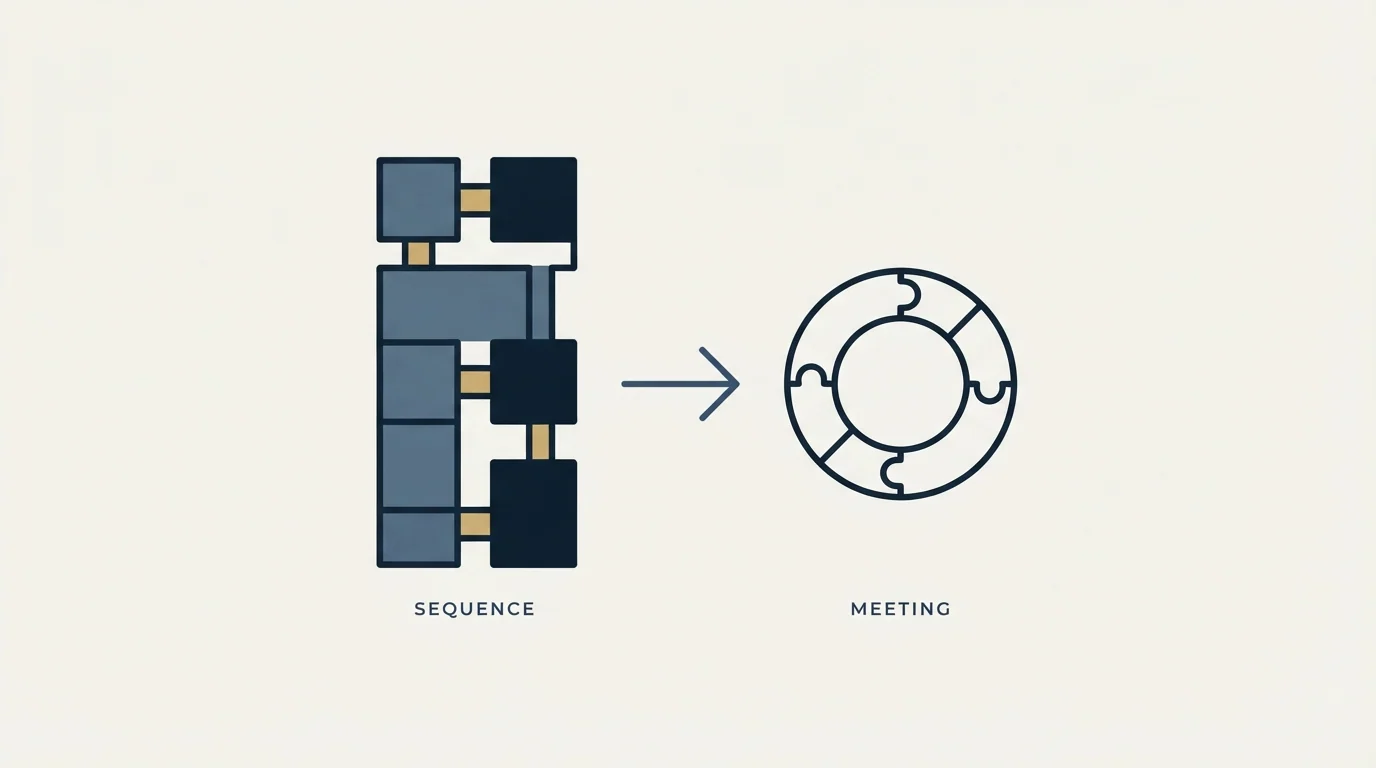
The default B2B CTA ("do you have 15 minutes next week?") underperforms here because it asks a technical buyer to grant a demo to a stranger. Three structures work better.
- Yes: The interest check
- Yes: The specific artifact
- Yes: The scoped technical call
The interest check. "Worth a look, or is this already handled?" A yes/no that costs nothing to answer and converts to a meeting on the second message.
The specific artifact. "I can send the interconnect checklist we built for two other regional operators. Want it?" You trade something concrete for a reply and earn the meeting inside that reply.
The scoped technical call. "Would 20 minutes with our network engineer, not a salesperson, be useful before you scope the RFP?" Naming who is on the call and how long it runs removes the fear of a pitch deck.
What fails: calendar links in a first touch, "let me show you a quick demo," and any subject line containing "solution," "partnership," or "revolutionize."
Telecom Cold Email Templates
Template 1: Regional ISP, buildout trigger
Subject: {{state}} BEAD award, {{county}} buildout
Hi {{first_name}},

Saw {{company}} named in the {{state}} BEAD allocation for
{{county}}. Congrats. The awkward part of those awards is the 18
months of OSP work between announcement and first subscriber.

We handle {{specific_capability}} for {{peer_operator_1}} and
{{peer_operator_2}}, both mid-buildout on similar footprints. The
issue they both hit was {{specific_operational_problem}}, much
cheaper to solve at design stage than after the first 500 drops.

Worth a look, or do you have this covered internally?

{{sender_name}}
{{sender_title}} | {{phone}}
Why this works: The trigger is public, dated, and specific to their county, which proves the email was not blasted. Peer operators establish credibility with the only reference class this buyer trusts, and the CTA offers an easy out.
Template 2: MSP or channel partner, margin angle
Subject: {{competitor_msp}} added this to their stack last quarter
{{first_name}},

Quick one. You're running {{service_line}} for mostly
{{customer_segment}} clients in {{metro}}.

Most MSPs your size hit the same wall there: the work is billable
but the margin gets eaten by {{cost_driver}}. {{reference_msp}}
moved that piece to us and freed their engineers for the
higher-margin {{other_service}} work.

Not asking for a demo. If it's useful I'll send the one-page
margin breakdown they used to make the call. Want it?

{{sender_name}}
Why this works: MSP owners buy on unit economics and peer behavior. Explicitly declining to ask for a demo removes the main reason this persona deletes cold email, and asking permission to send a document converts better than a calendar request.
Template 3: Carrier or large MSO, named-account approach
Subject: {{prospect_first_name}} - question on {{specific_program_name}}
Hi {{first_name}},

{{company}}'s {{specific_program_name}} announcement mentioned
{{specific_technical_detail}}. I've been curious how you're
handling {{specific_technical_challenge}} at that scale, since
the two other operators we work with at that volume ended up
splitting the workload across {{approach}}.

I won't pretend I know your architecture. If
{{specific_technical_challenge}} is on the roadmap for the next
two quarters, 20 minutes with {{engineer_name}} on our team
(engineer, not sales) might save you a discovery cycle.

Wrong timing or wrong person, happy to be pointed elsewhere.

{{sender_name}}
{{sender_title}}
Why this works: It leads with a genuine technical question instead of a claim, the only opener that survives a carrier engineer's filter. Admitting you do not know their architecture defuses the credibility objection before they raise it, and the closing line makes a referral the easiest response.
Template 4: The lateral referral ask (a later campaign)
Best for: a later campaign to operators who did not answer an earlier one. Its own subject line, sent as a new email rather than a reply into the old thread.
Subject: who owns {{topic}} at {{company}}?
{{first_name}},

Assuming {{topic}} isn't a priority right now, which is a fine
answer.

One ask anyway: if {{likely_other_owner_title}} is the one
who owns {{topic}} at {{company}}, would you forward this? Takes
you five seconds and saves me guessing.

Either way, good luck with {{known_initiative}}.

{{sender_name}}
Why this works: A message that asks for a redirect rather than a meeting reliably pulls replies from people who meant to respond and never did. The ask is trivially small and lets the recipient be helpful without committing. In telecom orgs where ownership splits across network, operations, and sourcing, the forward is often worth more than the reply.
Handling the Four Objections You Will Hear

| Objection | What it usually means | How to respond |
|---|---|---|
| "We're locked into a contract with {{vendor}}." | Real, and it has an end date. | Ask when it renews and offer to reconnect 90 days before. Get the date on record and book the future meeting now. |
| "Everything goes through procurement / we run RFPs." | You need a technical champion first. | "Understood, not trying to skip that. Most of our work happens before the RFP, helping the technical team scope requirements. Worth 20 minutes at that stage?" |
| "Send me some information." | Soft no, or genuine but distracted. | Send one page rather than a deck, with a dated next step. "Sending the two-pager now. If it's relevant, Thursday at 10 works on my end." |
| "We build that in-house." | Often true and often partial. | Concede, then narrow: "Makes sense for {{core_part}}. The piece most in-house teams skip is {{narrow_adjacent_piece}}, since it isn't worth the headcount. Is that also handled?" |
The pattern across all four: agree with the premise, then narrow to the sliver of the problem they have not solved. Arguing with a telecom engineer about what they can build is a losing position.
What a Realistic Meetings-Per-100-Prospects Outcome Looks Like
Published benchmarks have gotten stricter, largely because credible studies now measure replies against emails sent rather than against opens. Belkins analyzed 7.5 million emails from 2025 campaigns and reported a 0.45% average reply rate, with C-level contacts at 0.42%, VPs at 0.32%, and contacts at companies of 10,000 or more employees at 0.22%. Source: Belkins. Those per-email figures across broad campaigns are the honest floor.
Tight, trigger-based campaigns land higher per prospect. Working from Woodpecker's small-campaign figure of 5.8% under 50 contacts, here is the arithmetic to plan against. Treat it as a planning model, not a promise.
| Segment | Reply rate per 100 prospects | Positive replies | Meetings held |
|---|---|---|---|
| Regional ISPs, co-ops, overbuilders | 5 to 9 | 2 to 4 | 1 to 3 |
| MSPs, VARs, channel partners | 6 to 10 | 2 to 4 | 1 to 3 |
| Infrastructure contractors | 4 to 8 | 1 to 3 | 1 to 2 |
| Tier 1 carriers and large MSOs | 1 to 3 | 0 to 1 | 0 to 1 |
Two things follow. A campaign built entirely on Tier 1 carriers needs roughly five to ten times the list size for the same meeting count, which is why carrier motions should be account-based and multi-threaded. And eight meetings a month from regional operators requires roughly 400 to 800 well-researched prospects in campaigns, not 5,000 scraped rows.
Budget for the gap between a booked meeting and a held one. Field and network leadership cancel more than office-bound buyers because outages do not respect calendars. Confirm the morning of, and treat a reschedule as normal.
Your Telecom Meeting-Booking Checklist
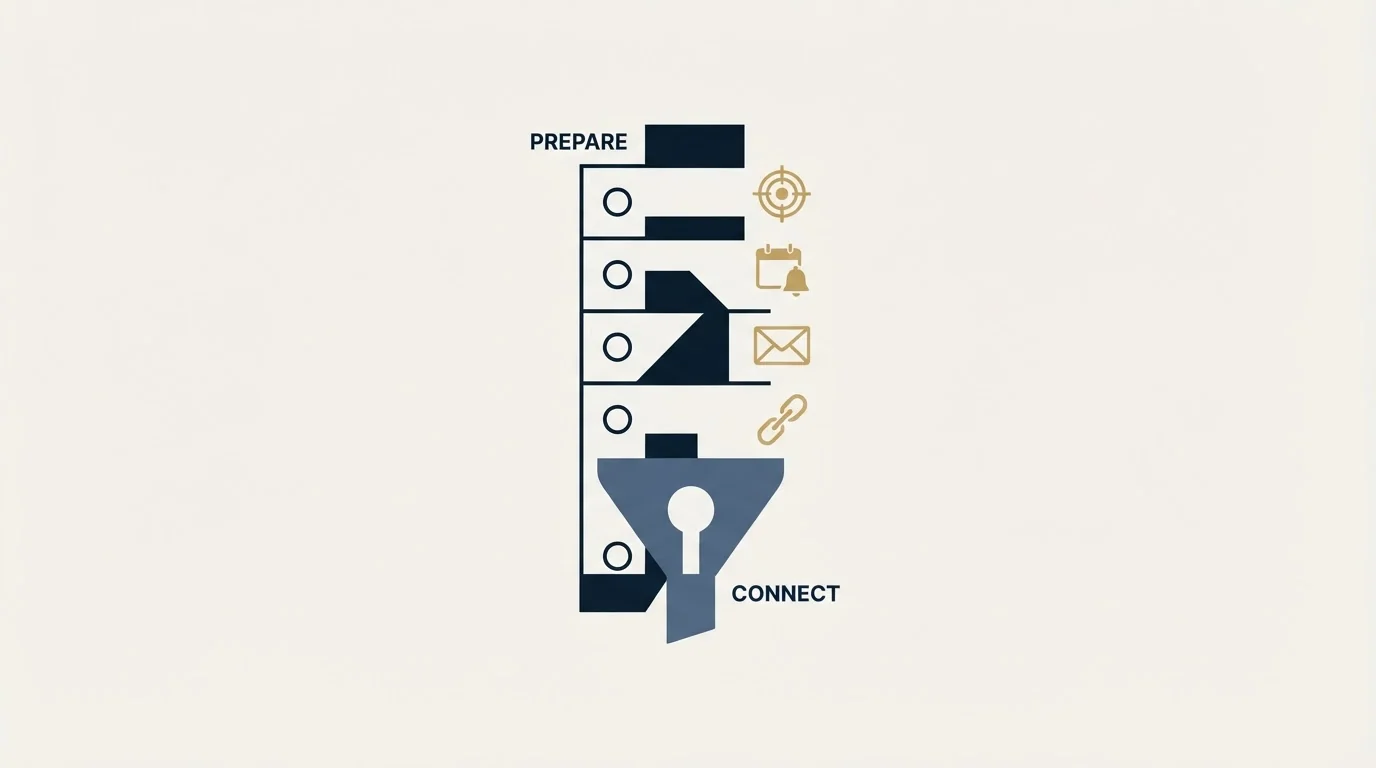
- One segment per campaign, with separate copy for network, operations, and revenue buyers
- List built from at least one public trigger (BEAD award, FCC filing, permit, job posting)
- 150 to 400 accounts per campaign, verified against company sites for small operators
- Four single-message campaigns spread across months, mixing email, LinkedIn, and phone
- First email under 120 words, no calendar link, yes/no or artifact-based CTA
- Objection responses drafted for contract, procurement, and in-house pushback
- Renewal dates captured from "we're under contract" replies and scheduled
- Meeting confirmation sent the morning of the call
The operators worth selling to are running networks rather than reading pitch decks. Prove you understand what is happening on their network this quarter, ask for something small, and keep coming back with new campaigns for longer than feels reasonable.
If you would rather have this built and run for you, RevenueFlow does done-for-you cold email for B2B teams selling into verticals like telecom, including trigger-based list building, campaign design, and deliverability. Book a strategy call and we will map the segment, titles, and triggers for your offer.
Related Reading
- Telecom Cold Email Benchmarks: 2026 Performance Data
- Cold Email for Telecom: Reaching Carriers, MSPs, and Communications Providers
- Cold Email for Partnerships: Building Strategic Business Relationships
If you would rather have this run for you, RevenueFlow books qualified meetings on a pay-per-meeting basis and publishes client results.
Frequently asked questions.
Frequently asked questions- Who should I target at a telecom company to book a meeting?
- Match the title to the metric. Network buyers (CTO, VP Network Operations, Director of Network Engineering) care about uptime, capacity and cutovers. Operational buyers (COO, VP Operations, Director of Field Operations) care about truck rolls and install intervals. Target one level below the C-suite above 200 employees, and the C-suite directly at smaller operators. Procurement is a second touch, not an entry point.
- How many meetings can I realistically book per 100 telecom prospects?
- On a tight, trigger-based list of regional ISPs, MSPs or infrastructure contractors, plan for roughly 4 to 10 replies, 1 to 4 positive replies, and 1 to 3 held meetings per 100 prospects. Tier 1 carriers run far lower, closer to 0 to 1 held meeting per 100, because enterprise reply rates drop sharply and buying committees are larger.
- What CTA works best in cold emails to telecom buyers?
- Avoid asking for a demo or dropping a calendar link in the first email. Three CTAs perform better: an interest check ("Worth a look, or is this already handled?"), an artifact offer ("Want the checklist we built for two other operators?"), and a scoped technical call with a named engineer rather than a salesperson. Each lowers the perceived cost of replying.
- How do I respond when a telecom prospect says they are locked into a vendor contract?
- Treat it as a scheduling problem. Ask when the contract comes up for renewal, confirm the date, and offer to reconnect roughly 90 days before that window when requirements get rewritten. Capture the date in your CRM and book the future conversation immediately. Contract objections in telecom are usually true and usually temporary.
- Should I follow up when a telecom prospect does not reply?
- Four single-message campaigns spread across months, mixing email, LinkedIn and phone. Telecom decision makers are frequently in the field, in a NOC, or mid-cutover, so one email rarely lands during an available window. Woodpecker data shows sequences with three to five follow-up steps average 8.3% reply rates versus 4.1% for sequences with no follow-up at all.
About the author.

Ben Carden is CRO at RevenueFlow, which builds and operates outbound revenue engines for B2B companies. Previously at Gartner Enterprise. Studied at London School of Economics.
Ben Carden · CRO
Connect on LinkedIn →Explore more.
Ready to scale your outreach?
We build GTM engines that book real meetings. See the receipts.
Related articles.
Cold Email for Influencer Outreach: Partner with Creators
Learn how to use cold email to build authentic influencer partnerships that drive real results for your brand, with proven templates and strategies.
Cold Email for Product Feedback: Complete Strategy Guide
Learn how to use cold email to gather valuable product feedback from users and prospects. Includes proven templates, feedback frameworks, and response optimization techniques.
Cold Email for PR: How to Pitch Journalists and Get Coverage
Learn how to craft cold emails that get journalists to open, read, and respond to your pitches. Includes real templates, timing strategies, and a complete PR outreach checklist.
Cold Email for Reviews: Complete Strategy Guide
Learn how to use cold email to generate authentic product reviews on G2, Capterra, and other platforms. Includes proven templates, compliance guidelines, and review generation frameworks.
Cold Email for Link Building: How to Get Quality Backlinks
Learn how to use cold email outreach to build high-quality backlinks that improve your SEO rankings, with proven templates and strategies that get responses.
Cold Email for Focus Groups: Complete Strategy Guide
Learn how to use cold email to recruit qualified participants for focus groups. Includes proven templates, screening strategies, and group composition frameworks.