How We Turned 2,200 Schools Into 22,000 Targeted Leads
Your data enrichment isn't broken. You're using the wrong job titles. Here's how we 10x'd a prospect list by learning the actual language of a niche industry instead of forcing B2B terminology onto it.
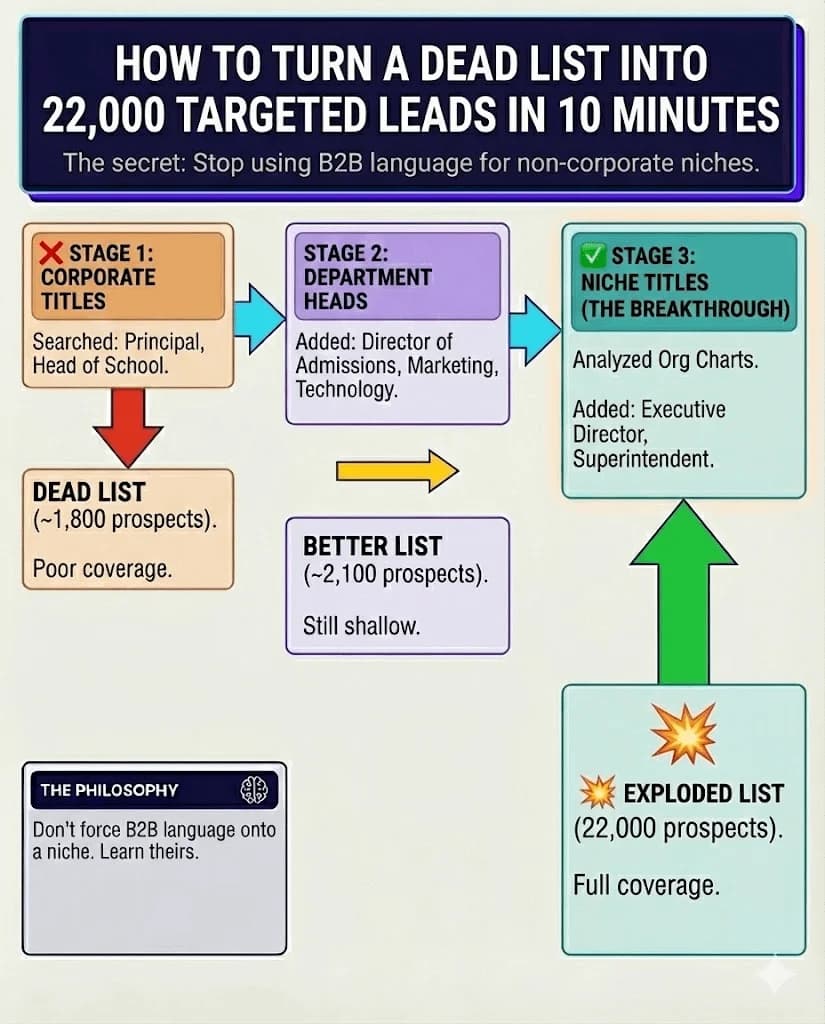
To multiply targeted leads, research industry-specific job titles instead of using standard B2B terminology. The author expanded a list of 2,200 schools from 1,800 to 22,000 prospects by adding titles like 'Superintendent' and 'Executive Director' discovered through studying actual school org charts. Every niche uses its own vocabulary: healthcare has 'Chief Medical Officer,' education has 'Dean of Students.' Thirty minutes researching 10-15 target companies' leadership pages reveals the titles data enrichment tools need to return comprehensive results.
Key takeaways
- The list grew from 1,800 to 22,000 prospects (10x increase) by adding just two overlooked titles: Executive Director and Superintendent.
- Studying 10-15 actual organizational charts in the target industry reveals title patterns that generic B2B searches miss.
- Thirty minutes of title research produced 12x more pipeline meetings (132 vs 11) by improving search inputs without new tools or budget.
- Using multiple People Finder columns in Clay with different title variations, then deduplicating, delivers more comprehensive coverage than single searches.
- Standard B2B titles like 'Chief Revenue Officer' rarely exist in non-corporate niches like K-12 education, causing 80% data loss.
Reviewed and updated September 10, 2026
How We Turned a Dead List of 2,200 Schools Into 22,000 Targeted Leads in 10 Minutes
We had a list of 2,200 private schools.
The goal was simple: find the decision-makers.
But our initial searches were dead. We kept getting sparse results, poor coverage, maybe 60-70% of schools had anyone matching our criteria.
The problem wasn't our tools. It wasn't Clay. It wasn't our data sources.
The problem was us. We were using standard B2B language for a non-corporate niche.
You won't find many "Chief Revenue Officers" at a K-12 private school.
We had to throw out the B2B playbook and learn their actual language.
The Three-Stage Evolution
Here's the exact iteration process we used in Clay to crack this:
- Step 1The Obvious Corporate Titles (Failed)
Principal, Head of School, Assistant Principal. Result: ~1,800 prospects.
- Step 2The Department Heads (Better, Still Shallow)
Director of Admissions, Marketing, Technology. Result: ~2,100 prospects.
- Step 3The Real Decision-Makers (The Breakthrough)
Executive Director and Superintendent. The list exploded to 22,000 prospects.
Stage 1: The Obvious Corporate Titles (Failed)
We started where everyone starts: the obvious titles.
Searched for:
- Principal
- Head of School
- Assistant Principal
Result: ~1,800 prospects
Coverage was poor. We had 2,200 schools but only found contacts at maybe 80% of them. And we were only getting one contact per school.
This is where most people give up. "The data just isn't there."
Wrong. The data is there. You're just asking for the wrong thing.
Stage 2: The Department Heads (Better, Still Shallow)
We expanded to functional roles.
Added:
- Director of Admissions
- Director of Marketing
- Director of Technology
Result: ~2,100 prospects
Better. We increased coverage slightly and added depth at some schools.
But we were still missing something. There had to be more decision-makers at these institutions.
Stage 3: The Real Decision-Makers (The Breakthrough)
We stopped guessing and did something radical: we looked at actual school organizational charts.
We pulled up the websites of 10-15 schools and studied how they structured their leadership teams.
Two titles jumped out that we'd never considered:
- Executive Director
- Superintendent
These aren't common in the corporate world. But in K-12 education? They're often the top decision-makers, especially at larger institutions or school networks.
Added:
- Executive Director
- Superintendent
Result: The list exploded to 22,000 prospects.
Same 2,200 schools. 10x the contacts.
Why This Happens
Every industry has its own vocabulary.
In tech startups, you have "Head of Growth" and "VP of RevOps."
In healthcare, you have "Chief Medical Officer" and "Director of Patient Experience."
In education, you have "Superintendent" and "Dean of Students."
If you're using B2B SaaS job titles to search a non-corporate niche, you're leaving 80% of your prospects on the table.
The tools work fine. Clay works fine. Apollo works fine.
Your assumptions about job titles are the bottleneck.
How to Find Industry-Specific Titles

- Yes: Study Actual Org Charts
- Yes: LinkedIn Deep Dive
- Yes: Ask Industry Insiders
- Yes: Industry Publications and Associations
Method 1: Study Actual Org Charts
Pick 10-15 companies in your target niche. Go to their websites. Look at their "About" or "Leadership" pages.
Write down every title you see. Even the weird ones. Especially the weird ones.
Patterns will emerge. You'll see titles repeated across companies that you never would have guessed.
Method 2: LinkedIn Deep Dive
Search LinkedIn for people at companies in your niche. Don't filter by title. Look at what titles actually exist.
Scroll through 50-100 profiles. Note the variations.
"Director of Development" might mean fundraising at a nonprofit but product development at a tech company.
Method 3: Ask Industry Insiders
If you have any contacts in the industry, ask them:
"Who actually makes purchasing decisions for [your product category]? What are their job titles?"
You'll get answers like "Oh, at most schools that would be the Business Manager or the CFO, but at smaller schools it's usually the Head of School directly."
That's gold. That's the information that 10x's your list.
Method 4: Industry Publications and Associations
Trade publications and professional associations often have member directories or publish articles about industry roles.
A quick search for "[industry] leadership roles" or "[industry] organizational structure" can reveal titles you'd never think of.
Applying This to Your Campaigns
Here's the framework:
Before you build a list:
- Identify 3-5 "obvious" titles you'd normally search for
- Spend 30 minutes researching actual org structures in your niche
- Add 3-5 "discovered" titles to your search
- Run the search with ALL titles
- Compare results to your initial assumptions
For Clay specifically:
Use multiple People Finder columns with different title variations. Don't try to get everything in one search.
Column 1: C-suite and obvious leadership Column 2: Department heads Column 3: Industry-specific titles you discovered
Then deduplicate and you'll have comprehensive coverage.
The Bigger Lesson

This isn't just about job titles. It's about a fundamental mindset shift in outbound sales.
Don't force your language onto a niche industry. Learn theirs.
This applies to:
- Job titles (as we just covered)
- Pain points (they describe problems differently than you do)
- Solutions (they have different words for what you sell)
- Buying processes (their procurement works differently)
When you learn to speak like an insider, everything gets easier:
- Your searches return better results
- Your emails resonate more
- Your calls feel less like cold outreach
- Your close rates improve
The ROI of 30 Minutes of Research
Let's do the math on our schools example:
Without research:
- 1,800 prospects
- At 3% positive reply rate: 54 interested responses
- At 20% meeting rate: ~11 meetings
With 30 minutes of title research:
- 22,000 prospects
- At 3% positive reply rate: 660 interested responses
- At 20% meeting rate: ~132 meetings
That's 12x the pipeline from 30 minutes of upfront research.
No new tools. No new budget. Just better inputs.
Common Niches and Their Hidden Titles
Here are some industries where standard B2B titles fail:
Education (K-12):
- Superintendent, Principal, Dean, Department Chair, Business Manager
Higher Education:
- Provost, Registrar, Bursar, Department Chair, Program Director
Healthcare:
- Chief Medical Officer, Director of Nursing, Practice Manager, Medical Director
Nonprofits:
- Executive Director, Development Director, Program Director, Board Chair
Government:
- City Manager, Department Head, Commissioner, Administrator
Religious Organizations:
- Pastor, Elder, Deacon, Ministry Director, Operations Pastor
Legal:
- Managing Partner, Practice Group Leader, Of Counsel, Legal Administrator
If you're targeting any of these niches with standard corporate titles, you're missing most of your TAM.
What to Do Next
-
Audit your current campaigns. Are you using generic titles for a specific niche?
-
Spend 30 minutes on research. Study 10-15 org charts in your target industry.
-
Rebuild your searches with discovered titles.
-
Watch your lists explode.
The data exists. The decision-makers exist. You just need to ask for them in their language, not yours.
Related Reading
If you would rather have this run for you, RevenueFlow books qualified meetings on a pay-per-meeting basis and publishes client results.
Ready to enrich these leads? Learn how to personalize at scale with Clay or build custom scraping engines for even more data.
Frequently asked questions.
Frequently asked questions- Why do standard job titles fail in data enrichment for niche industries?
- Standard B2B titles don't match how non-corporate industries structure their organizations. For example, K-12 schools use 'Superintendent' and 'Executive Director' for top decision-makers, not 'Chief Revenue Officer.' When enrichment tools search for corporate titles in education, healthcare, or nonprofits, they return sparse results: not because the data is missing, but because you're asking for roles that don't exist in those sectors. The tools work fine; the title assumptions are wrong.
- How do I find the right job titles for a specific industry?
- Use four methods: First, visit 10-15 target companies' websites and study their 'About' or 'Leadership' pages to identify repeated titles. Second, browse 50-100 LinkedIn profiles in that industry without title filters to see what roles actually exist. Third, ask industry contacts directly who makes purchasing decisions and what their titles are. Fourth, check trade publications and professional association directories for articles on organizational structure. Patterns emerge quickly, revealing titles you'd never guess.
- What's the ROI of researching job titles before building a lead list?
- In the article's example, 30 minutes of title research produced 12x more sales meetings. The initial search with obvious titles yielded 1,800 prospects and about 11 projected meetings. After discovering industry-specific titles, the same 2,200 schools generated 22,000 prospects and 132 projected meetings, at identical reply and conversion rates. This improvement required no additional tools, budget, or data sources, only better search inputs based on how the target industry actually labels its decision-makers.
- How should I structure title searches in Clay or similar tools?
- Run multiple separate People Finder columns rather than combining all titles in one search. Use Column 1 for C-suite and obvious leadership titles, Column 2 for department heads, and Column 3 for industry-specific titles you discovered through research. After all columns complete, deduplicate the results. This approach delivers more comprehensive coverage than trying to capture everything in a single search query and ensures you don't miss decision-makers with non-standard titles.
About the author.

Tim Carden is CMO / CTO at RevenueFlow, which builds and operates outbound revenue engines for B2B companies. Studied at McGill University.
Tim Carden · CMO / CTO
Connect on LinkedIn →Explore more.
Ready to scale your outreach?
We build GTM engines that book real meetings. See the receipts.
Related articles.
Lead Verification: What Each Check Actually Proves
Lead verification covers two different jobs. One asks whether a mailbox will accept mail, the other asks whether the person behind the row is real and lawful to contact.
Two Agencies, One Target List: Who Owns Which Accounts
Two outbound suppliers on one market will contact the same companies unless the buyer splits it first. How to cut the list, run the exclusion feed and check the overlap.
HR Lead Generation: The Renewal Clock and Who Signs
An HR buyer who agrees with every word still cannot act outside their own renewal window. Which triggers are observable, and who signs.
IT Lead Generation: The Buyer Runs Your Playbook
Technology buyers evaluate outbound for a living, and their purchases carry a security review nobody in your meeting owns. Which triggers are real.
B2B Database: What to Test Before You Pay
Total record count is the number every vendor leads with and the one that predicts least. The test that replaces it takes a day and settles the purchase.
Crunchbase Pricing: The Annual Rate Is Introductory
The annual figure Crunchbase shows a new visitor is a first year rate, and its own help centre says so. Where the price lives, and why the export cap decides it.