Contract SDRs: When Temporary Capacity Is the Right Shape
Contracting sits between employing a rep and buying a managed outcome, and the defining feature is that the management stays with you. Where that trade is worth making.
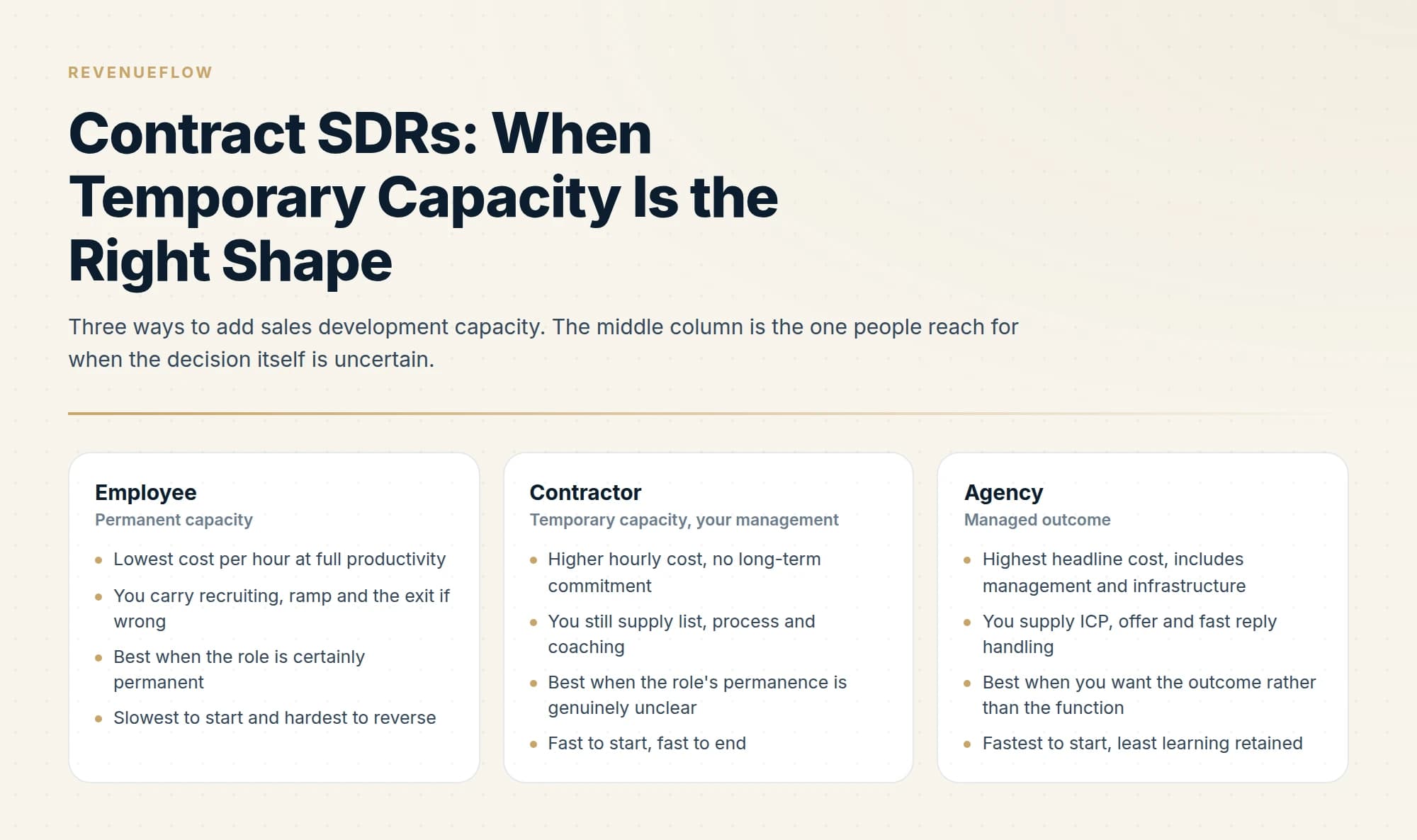
Contracting an SDR means engaging an individual on a fixed-term or freelance basis rather than employing them or buying an agency's managed service. You are buying capacity without permanence, and the defining feature is that the list, the process, the coaching and the management all stay with you.
Key takeaways
- The four situations that fit share one characteristic: the uncertainty is about duration rather than about whether outbound works at all.
- A contractor renewed for two years is an employee with worse economics, no career path and a weaker attachment to the outcome.
- An experienced contractor is good at the craft and knows nothing about your market on day one, so skipping the ramp produces a fast start into the wrong accounts.
- A target list worked by a contractor and returned without outcome data looks identical to an untouched list, which makes the next person burn already-burned accounts.
Reviewed and updated August 14, 2026
A contract SDR costs more per hour than an employee and less per quarter than a bad hire. That trade is the whole case for the arrangement, and whether it is a good one depends almost entirely on how certain you are that the role should exist permanently.
Contracting an SDR means engaging an individual on a fixed-term or freelance basis rather than employing them or buying an agency's managed service. It is a distinct third option and it suits a narrower set of situations than either.
What it is, and what it is not
A contract SDR is a person you direct. They work your list, use your process, and report to someone on your side. What you are buying is capacity without permanence.
That distinguishes it from the two neighbours it gets confused with. An agency sells a managed outcome: their process, their infrastructure, their management layer. A staffing provider supplies people but usually as an ongoing arrangement with their own overhead attached. Contracting sits between, and the defining feature is that the management stays with you.
- Lowest cost per hour at full productivity
- You carry recruiting, ramp and the exit if wrong
- Best when the role is certainly permanent
- Slowest to start and hardest to reverse
- Higher hourly cost, no long-term commitment
- You still supply list, process and coaching
- Best when the role's permanence is genuinely unclear
- Fast to start, fast to end
- Highest headline cost, includes management and infrastructure
- You supply ICP, offer and fast reply handling
- Best when you want the outcome rather than the function
- Fastest to start, least learning retained
When contracting is the right shape
Four situations, and they share a characteristic: the uncertainty is about duration rather than about whether outbound works at all.
Testing a new segment or geography. You want to know whether a market responds before committing a permanent role to it. A contract of a few months answers that at a known cost.
Covering a gap. Parental leave, a resignation at an awkward moment, a hiring process that is going to take a quarter. The alternative is a rushed permanent hire, which is worse.
A campaign with an end date. An event push, a product launch, a specific expansion. Work that genuinely finishes should not create a permanent role.
Buying time to define the role properly. If you are not yet sure what the job should be, a contractor lets you find out while producing something, provided somebody is paying attention to what is learned.
The situation it does not suit is the most common reason it gets chosen: avoiding a hiring decision indefinitely. A contractor renewed for two years is an employee with worse economics, no career path and a weaker attachment to the outcome.
What you still have to supply

This is where contracting engagements fail, and the failure is predictable because the arrangement looks like buying a solution while actually buying a pair of hands.
A contract SDR needs the same inputs an employee needs. A target list someone has signed off. Verified contact data. Written qualification criteria. Sending infrastructure on domains separate from your primary company domain. A named person answering replies quickly. And coaching, which is the one most often assumed away on the grounds that a contractor should already be good.
An experienced contractor will be good at the craft and will still know nothing about your market on day one. Skipping the ramp because they are senior produces a fast start into the wrong accounts with the wrong framing, and on a finite target list those accounts are spent. The sequencing that protects the list is in SDR training and ramp.
- Yes: A signed-off target list with measured contact coverage
- Yes: Written qualification criteria agreed before contact begins
- Yes: Sending infrastructure separate from your primary domain
- Yes: A named internal person who answers replies within hours
- Yes: A coaching cadence, even for a senior contractor
- No: You are contracting to postpone a hiring decision indefinitely
- Depends: Whether the work genuinely ends, or the role is permanent in disguise
Structuring the engagement
Three terms decide whether the arrangement stays useful.
A defined end, with an explicit renewal decision. Not a rolling contract that renews by inertia. A date at which someone asks whether this should become a role, end, or continue for a stated further period.
Output defined the same way you would define it for an employee. Held meetings meeting written criteria. Paying a contractor on activity produces activity, and the incentive is sharper than with an employee because the relationship is shorter.
Explicit ownership of the assets. The list, the enriched data, the reply history and the sequences they build. All of it should be in your systems rather than theirs, and this is much easier to arrange at the start. A contractor leaving with the account history in a personal inbox is a genuine loss and an entirely avoidable one.
Worth adding: agree what happens if it goes well. A contractor you want to hire permanently is a good outcome, and whether that is permitted, and on what terms, is far easier to settle before either side is invested.
The cost comparison, done honestly
Compare on cost per qualified meeting across a defined period, not on hourly or monthly rate.
A contractor's higher rate buys optionality, and optionality has real value when the decision is genuinely uncertain. It has no value when the role was always going to be permanent, in which case you have paid a premium for flexibility you did not use.
Include what stays yours regardless: data, tooling, infrastructure, and the management hours. Those are constant across employee and contractor, which means the rate difference overstates the total difference. The method for building a fully loaded internal comparison from your own numbers is in outsourced SDR versus in-house, and it applies here with the ramp period shortened and the exit cost close to zero.
The exit cost is the part worth weighting properly. A permanent hire who does not work out costs a notice period, a rehire, and a second ramp. That risk is precisely what the contractor premium is buying down, and when the uncertainty is real it is frequently cheap at the price.
Finding and assessing a contract SDR

The candidate pool is different from the permanent one, and the assessment should be too.
Experienced contract SDRs are usually people who have chosen the arrangement deliberately: they like variety, they price their own time, and they have worked several markets. That breadth is genuinely useful, because someone who has run outbound into five ICPs recognises patterns faster than someone who has run one for three years.
The risk on the other side is a contractor who is between permanent roles and will leave the moment a permanent offer lands. That is not disqualifying and it is worth knowing, because it changes how much account context you allow to live only in their head.
Three things to assess that differ from a permanent interview.
Speed of ramp, evidenced. Ask how quickly they became productive in their last two engagements and what specifically they did in week one. A good contractor has a repeatable method for learning a market fast, and can describe it.
What they need from you. Strong candidates ask about list quality, contact coverage, who answers replies, and whether qualification criteria exist. A contractor who does not ask these will discover the gaps in week three and lose a month.
Whether they work in your systems. Some contractors prefer their own stack. That is convenient for them and it means the account history, sequences and reply data leave when they do. Insist on your systems, and price the friction if they push back.
The reference question that matters most: ask a previous client whether the handover at the end was clean, because the end of the engagement is the part of contracting that most reliably goes badly.
Where an agency beats both
If what you actually want is the outcome rather than the function, neither employment nor contracting is the efficient route, because both leave you supplying the management, the infrastructure and the process.
The honest test is whether you want to own the capability afterwards. If yes, employ or contract and keep the learning. If no, buy the outcome and keep your attention on the parts only you can do. That decision is set out in outbound sales outsourcing, and the vendor types in outsourced sales companies.
The handover, which is the part that goes wrong
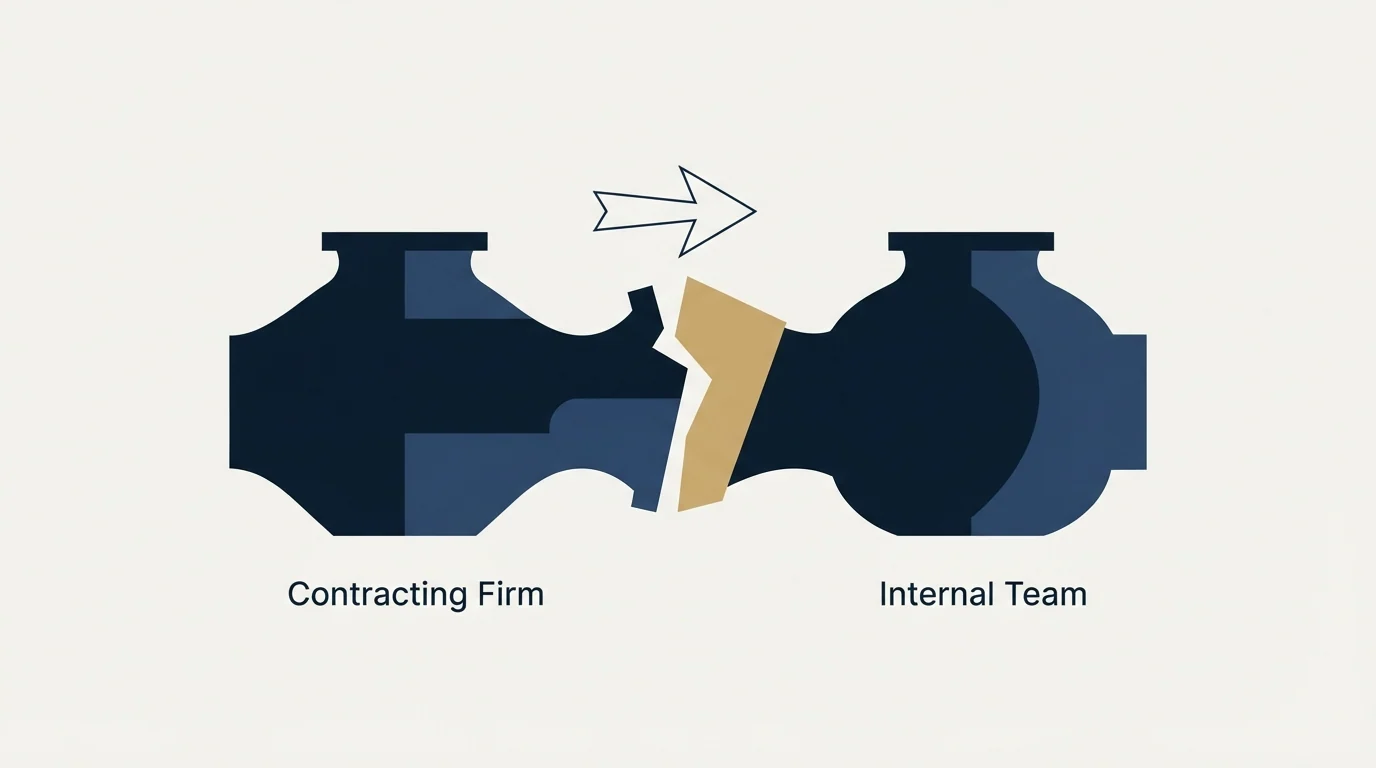
Contract engagements end, and the ending is where the value either transfers or evaporates.
Plan it at the start rather than in the final fortnight. What should exist on the last day: every account with its history in your CRM, the sequences and messaging in your systems, a written note on which segments responded and which did not, and a list of accounts contacted with the outcome, so nobody re-contacts them next quarter believing they are fresh.
That last item is the one most often missed and the most costly. A target list worked by a contractor and returned without outcome data looks identical to an untouched list, which means the next person starts by burning accounts that have already been burned.
- Day oneEverything lands in your systems
The list, the enriched data, the reply history and the sequences they build, held on your side rather than in a personal inbox.
- The renewal dateAn explicit decision, not inertia
Someone asks whether this should become a role, end, or continue for a stated further period.
- Final fortnightA summary rather than an excavation
If the work lived in your systems throughout, there is very little left to extract.
- Last dayWhat should exist
Every account with its history in your CRM, the sequences and messaging in your systems, a written note on which segments responded, and the accounts contacted with their outcomes.
- Next quarterWhy the outcome data is the costly omission
A worked list returned without it looks identical to an untouched one, so the next person starts by burning accounts that are already spent.
Build the handover into the engagement rather than bolting it on. If the contractor works in your systems from day one, as recommended above, most of it happens automatically and the final week is a summary rather than an excavation.
The short version
Contract an SDR when the uncertainty is about how long the role should exist, not about whether outbound works. It suits new-segment tests, cover, fixed-term campaigns and buying time to define a role properly. It does not suit postponing a hiring decision indefinitely. You still supply the list, the criteria, the infrastructure, the reply handling and the coaching, because you bought capacity rather than a managed outcome. Define an end date with an explicit renewal decision, pay on qualified meetings rather than activity, and keep every asset in your systems from day one.
If you want the outcome without owning the function, we work on a pay-per-qualified-meeting basis with the criteria agreed in writing first, and you can see what a campaign would look like for your market.
Frequently asked questions.
Frequently asked questions- When does contracting an SDR make sense?
- Four situations. Testing whether a new segment or geography responds before committing a permanent role. Covering a gap such as parental leave or a resignation at an awkward moment. Running a campaign with a genuine end date, such as an event push or a launch. And buying time to define the role properly while still producing something, provided somebody is paying attention to what is learned.
- What do you still have to supply?
- Everything an employee needs. A signed-off target list with measured contact coverage, verified contact data, written qualification criteria, sending infrastructure on domains separate from your primary one, a named person answering replies quickly, and coaching. Coaching is the one most often assumed away on the grounds that a contractor should already be good, which is where these engagements fail.
- How should the engagement be structured?
- With a defined end and an explicit renewal decision rather than a contract that rolls by inertia. With output defined as held meetings meeting written criteria, since paying on activity produces activity and the incentive is sharper over a short relationship. And with explicit asset ownership, so the list, enriched data, reply history and sequences sit in your systems from day one.
- What should you assess in a contract SDR?
- Speed of ramp, evidenced by what they did in week one of their last two engagements, because a good contractor has a repeatable method for learning a market fast. What they need from you, since strong candidates ask about list quality, contact coverage and qualification criteria. And whether they will work in your systems rather than their own stack.
About the author.

B2B cold email experts helping companies generate qualified leads through done-for-you outreach campaigns.
RevenueFlow Team
Explore more.
Ready to scale your outreach?
We build GTM engines that book real meetings. See the receipts.
Related articles.
Inbound vs Outbound Sales: How the Two Motions Differ
Inbound and outbound sales compared as motions: what the rep knows at first touch, what each costs, the team each needs, and the metrics that belong to each.
Readymode Pricing: The Seat Is Dear for What Is Inside It
Readymode publishes $199 and $249 per licence per month, near the top of the dialer range. What the seat includes that others bill separately, and when that pays.
PhoneBurner Pricing: What the Seat Price Covers
PhoneBurner publishes all three seat prices in both billing states. The metered resource is contact imports, not minutes, and the spam layer is an add-on at every tier.
Multi-Threading in Sales: Who the Second Contact Should Be
Six contacts on an opportunity and one real relationship is still single-threaded. Which second person to add, when to ask, and how to tell whether it worked.
Koncert Dialers: Line Counts Published, Price Is Not
Koncert publishes the parallel line ceiling on every tier, which most of this category will not. It publishes no price. What its pages state, and what the quote decides.
Sales Productivity: Four Different Ratios Wear the Same Name
Sales productivity names four ratios that share no denominator, and improving one can move another the wrong way. The version you mean decides what happens next.