Suomispam Reputation: Read the Code Before You File
Suomispam publishes four zones and four listing classes, and the response code names which one you have. Two pieces of common delisting advice will not move it.
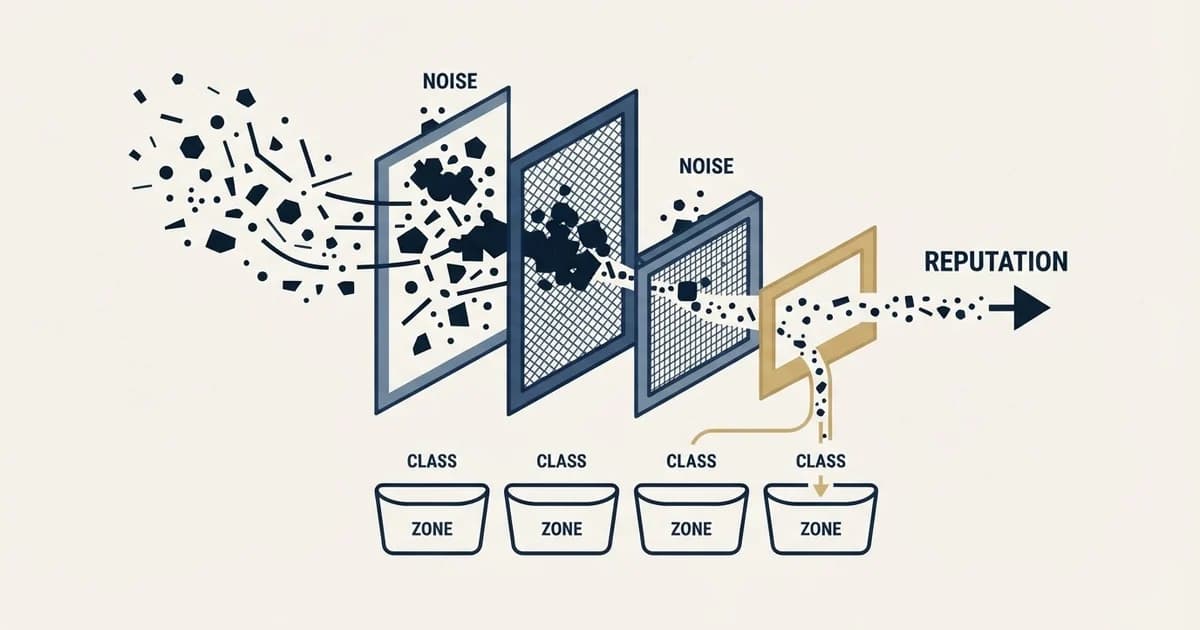
Suomispam reputation is a reputation service covering likely senders of spam in Finnish or related to Finland. It publishes four zones and a response code that names the listing class. The operator states that SPF and DMARC records have nothing to do with its listings and that it operates no whitelist.
Key takeaways
- Four zones sit behind the one name, including a grey list the operator says should not be used for direct blocking, and an aggregated report collapses them into one row.
- The response code distinguishes a spam source from an escalation, a target site, a suspicious network and an uncategorised Other, and the remedies for those share almost nothing.
- The operator's FAQ states directly that fixing SPF and DMARC records will not produce a delisting, because those records had nothing to do with the listing.
- There is no whitelist and no exemption inside a network listing, so an individual sender in an escalated range has to work through the hosting provider.
Reviewed and updated September 19, 2026
Suomispam reputation is a reputation service published as DNS blocklists for one linguistic area: its operator describes it as covering likely senders of spam in Finnish language or related to Finland. It publishes four zones, returns a response code that names the kind of listing, and says in its own FAQ that SPF and DMARC records have nothing to do with its listings. Read the code before filing anything.
A US outbound programme with no Finnish recipients, no Finnish copy and no Finnish infrastructure turns up on Suomispam, and the obvious question is what a Finnish reputation service has to do with any of it. The answer is in the operator's own scope statement, and it changes what the row is worth.
It also changes what to do about it, because Suomispam publishes a delisting policy that rules out most of the advice circulating about the list.
What Suomispam reputation is, and what it covers
Suomispam describes itself as "a reputation service covering likely senders of spam in Finnish language or related to Finland", and gives its reason for existing in the next sentence: global blocklists do not always have good coverage of small countries and linguistic areas, so it fills the gap.
It also states the limit of what it does. In the operator's words, "Suomispam by itself does not block email to third parties. It only provides lists of senders that we consider probable sources of Finnish spam." That is a service that publishes an opinion and leaves the decision to whoever consults it, which is how every DNS blocklist works and which is worth remembering when reading a red row.
The service is four zones rather than one, and an aggregated report usually says only Suomispam. The operator publishes them by name: bl.suomispam.net is the main list, gl.suomispam.net is a grey list which the operator says "should not be used for direct blocking of email" and describes as being aimed at scoring risky networks, dbl.suomispam.net is a domain blocklist, and ebl.suomispam.net is an experimental list keyed on hashed email addresses for spammers using large consumer providers.
Which zone fired decides both what is being alleged and who can act on it.
What gets listed

The operator's policy defines spam as unsolicited bulk email and says explicitly that whether the sender is breaking a law in their own country is not relevant to the definition. Four categories of listing follow, and the operator names them in its FAQ: "spam source, spamvertized site, escalation and suspicious."
The response code the zone returns tells you which one you have, and the operator publishes the mapping. A 127.0.0.2 answer is a spam source. A 127.0.0.3 answer is an escalation, which the operator describes as "A larger listing that may cover resources not directly used to send spam but where the spam situation is bad enough to warrant an escalation". A 127.0.0.4 answer is a target site, covering redirector domains and the sites a spam message points at. A 127.0.0.5 answer is a suspicious network, and the operator describes that class as networks with no apparent legitimate use that its analysis flagged and whose provider has not explained. The table carries a fifth code, 127.0.0.99, which the operator labels Other for an uncategorised listing.
The listing criteria are judgement rather than a threshold, and the operator says so. It estimates the type of sending host first, listing a suspicious or spam-focused host immediately while trying to be more patient with a shared mail server carrying real traffic, and it says an operator known to support spam or carrying previous listings gets less patience. Whole networks may be listed where they look like significant spam sources or snowshoe ranges.
Finding out which zone and which code
The operator runs a lookup on its own site, and that is where to start, because it names the zone and returns the code. An aggregated checker collapses all of that into one row labelled with the service name.
The operator has a specific complaint about one class of third-party reporting, and it is worth knowing before trusting a domain row. Some lookup sites, it writes, "totally mix up the concept of shared hosting and may claim that you are listed when in fact someone else on the same hosting provider is listed", and it names MXToolbox in that sentence. Its own advice is to check the domain at its site, and if the service does not list it, to take the complaint to whoever claimed otherwise. The operator adds that it does not recommend filtering based on DNSBL lookups against the address a sender's domain resolves to, which is the mechanism producing those false rows.
The general form of that problem, and the reason an aggregated row so often names the wrong identifier, is worked through in which of your domains actually got listed.
Removal, and the advice the operator rules out

Suomispam publishes a delisting policy and it is unusually candid about what will and will not move it.
The base position: "We delist when we are convinced that the justification for the listing is no longer valid." The operator says it is happy to delist and reluctant to relist, that a credible notification from the network operator may be sufficient for an address listing, and that egregious cases may require evidence that the flow has actually stopped. It also publishes its review cadence, describing IP listings as subject to automatic and manual review on a cycle it says is typically several months long unless new input triggers a faster look, with domain listings moving more slowly still.
Then two specific refusals that contradict most of the guidance written about this list.
Authentication records are not the lever. The operator's FAQ has a heading for people who have fixed their SPF and DMARC records and want to be delisted, and answers it directly: "SPF and DMARC records have nothing to do with our listings. You were not listed because of them and you will not be delisted because of them." MailReach's guide to this list tells readers to delist by authenticating with SPF, DKIM and DMARC, and Warmy's step-by-step guide puts configuring all three in its pre-request checklist, both read 2 September 2026 and again for this update.
There is no whitelist. The operator says it has none and is technically unable to exempt a single address from a network listing. Where the listing carries a wildcard and you hold one address inside it, the operator's own advice is to bring the hosting provider into the conversation, because either they act or the situation waits out the abuse.
A third thing it asks for is precision. The operator says a delisting request that does not identify what is listed is pointless, and that it usually will not take an unspecified assurance that a problem is fixed. A request naming the address or domain, the zone, and what was actually changed is the one that gets read.
Carries weight
- The exact address or domain, and the zone that returned it
- What was changed, specific enough to check against the operator's own observations
- A credible notification from whoever runs the network
- For egregious cases, proof that the flow of spam has stopped
Will not move it
- Fixed SPF and DMARC records, which had nothing to do with the listing
- A request to be whitelisted: the operator has no whitelist
- An exemption for one address inside a network listing
- A request that does not identify what is listed
What it means for a cold outbound programme
Start with the scope, because it does most of the work. The service covers senders of Finnish-language spam or spam related to Finland. A programme with no Finnish audience and no Finnish infrastructure that turns up here is almost always inside an escalation or a network listing rather than being named as a spam source, and the operator publishes the code that tells you which.
That reading suggests the order to work in.
Read the code before anything else. A spam-source listing is a statement about your address. An escalation is a statement about your neighbourhood. The remedies share nothing.
If it is a network listing, the conversation is with the provider. The operator says it cannot exempt an address inside one, so there is no request for you to file that would help. What the row is genuinely useful for is as an input to a decision about where outbound sends from.
If it is a spam-source listing, diagnose before writing. The causes worth ruling out are the ordinary ones: an unverified list producing a bounce spike, a compromised mailbox sending traffic nobody wrote, or volume that stepped rather than ramped. The order to work through them is in checking and recovering from a blacklisting, and the list-quality half is in what verification actually removes.
Weight the row against your own evidence. The operator says its purpose is coverage of a linguistic area that global lists handle thinly, which is a statement about who benefits from consulting it. Whether your prospects sit behind a receiver that does is answerable from your bounce strings and from nowhere else, and the same test applies to the invaluement IP lists on the same report.
The posture that makes all of this cheap is the usual one. Sending domains kept separate from the corporate estate, one purpose per domain, and spare warmed capacity so that an address inside a bad neighbourhood is left behind rather than argued over. That architecture is set out in email domain reputation.
The short version

Suomispam is a reputation service scoped to senders of Finnish-language spam or spam related to Finland. It publishes four zones, a main list, a grey list it says should not be used for direct blocking, a domain list and an experimental address list, and an aggregated report usually collapses all four into one row.
The response code names the listing class: spam source, escalation, target site, suspicious network, or an uncategorised listing the operator labels Other. Reading it is the first step, because an escalation covers a range rather than your address and the operator says it cannot exempt an address inside one.
Two pieces of common advice are ruled out by the operator's own FAQ. Publishing or fixing SPF and DMARC records will not produce a delisting, because those records had nothing to do with the listing. And there is no whitelist, so an individual sender inside a network listing has no route of their own and has to work through the hosting provider.
What the operator does respond to is a specific request naming what is listed and what changed, backed by a credible account from whoever runs the network.
If you would rather send from address space chosen for outbound rather than inherited from a shared pool, we plan the first campaign for free.
The scope statement, the four zone names, the grey list caveat, the listing categories, the response code meanings, the delisting policy, the position on SPF and DMARC, and the absence of a whitelist are taken from suomispam.net's own service, FAQ and policy pages, fetched 2 September 2026 and re-read for this update. Verify current list behaviour with the operator before relying on it.
Sources: Suomispam (one page carrying the service description, the FAQ, the policy, the zone names and the response code table), MailReach on Suomispam, Warmy on Suomispam
Frequently asked questions.
Frequently asked questions- What is Suomispam reputation?
- A reputation service published as DNS blocklists. Its operator describes it as covering likely senders of spam in Finnish language or related to Finland, filling a gap that global lists leave for small countries and linguistic areas. It says it does not block email itself; it publishes lists that mail server operators may or may not use.
- Why is a US sender on a Finnish blacklist?
- Usually because of a network listing rather than a direct one. The operator scopes the service to senders of spam in Finnish or related to Finland, and publishes an escalation class covering resources not directly used to send spam where the situation across a range is bad enough. Read the response code before assuming the listing names your address.
- Will fixing SPF and DMARC get me delisted?
- No. The operator's FAQ answers that question under its own heading and states that SPF and DMARC records have nothing to do with its listings, that you were not listed because of them, and that you will not be delisted because of them. MailReach and Warmy both prescribe exactly that remedy in their guides to this list.
- Can I be whitelisted if my neighbours caused the listing?
- The operator says no. It has no whitelist and describes itself as technically unable to punch holes in a network listing carrying a wildcard. Its own advice for a sender holding one address inside such a range is to bring the hosting provider into the conversation, because either the provider acts or the listing waits out the abuse.
About the author.

Tim Carden is CMO / CTO at RevenueFlow, which builds and operates outbound revenue engines for B2B companies. Studied at McGill University.
Tim Carden · CMO / CTO
Connect on LinkedIn →Explore more.
Ready to scale your outreach?
We build GTM engines that book real meetings. See the receipts.
Related articles.
Backscatterer Blacklist: Two Causes, One Four-Week Clock
Backscatterer lists addresses for misdirected bounces and for sender callouts, never for spam. The listing expires after four weeks, so the work is finding the system.
Woody's SMTP Blacklist: The Delisting Route Refuses
Every page about this list tells you to file a delisting request. Measured on 2 September 2026, the operator's removal endpoint returned HTTP 403.
ivmSIP and ivmSIP/24: Which One Listed Your IP
invaluement publishes two IP lists and the search results merge them. One names your address, the other names the range around it, and only one is yours to fix.
ZapBL: A List of Opinions, and How Yours Clears
ZapBL says it does not block email and is not calling anyone a spammer. What actually gets listed, why three neighbours can catch you, and the four-rung removal ladder.
UCEPROTECT Level 2: Listed for the Neighbours
Level 2 lists allocations rather than senders. The escalation thresholds, the provider grace windows, and why the free removal is automatic and the paid one optional.
How Lemwarm Works: The Network, the Ramp and the Score
What lemwarm's pool of real inboxes does, how the ramp is sized in the vendor's own numbers, what the score is made of, and where the tool stops.