Backscatterer Blacklist: Two Causes, One Four-Week Clock
Backscatterer lists addresses for misdirected bounces and for sender callouts, never for spam. The listing expires after four weeks, so the work is finding the system.
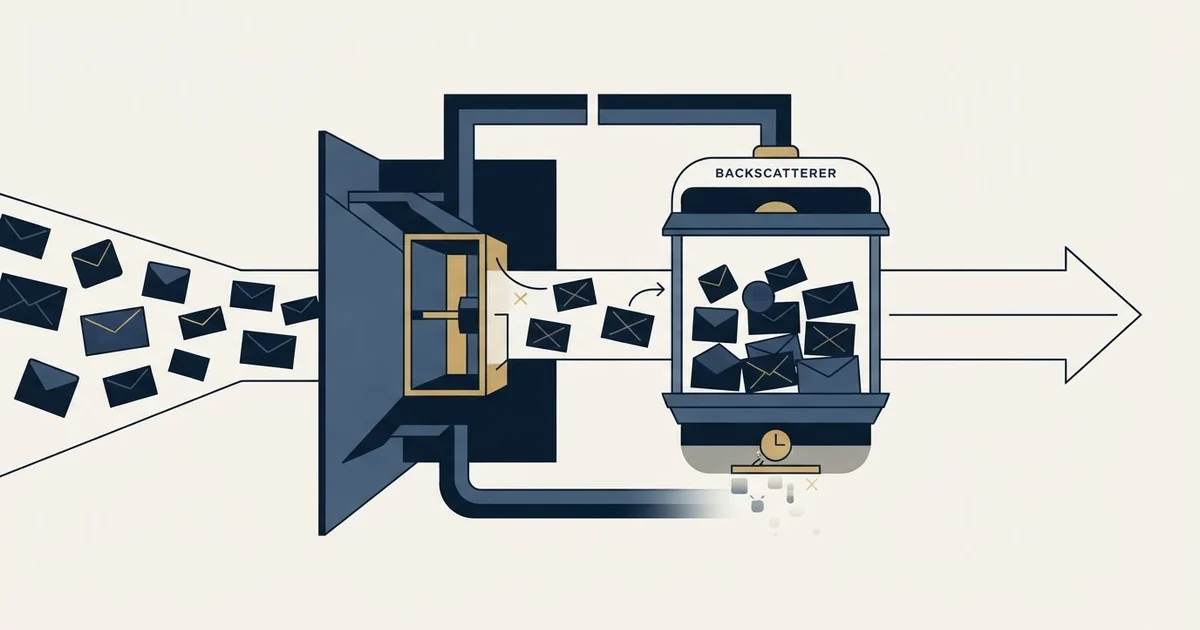
Backscatterer is a UCEPROTECT-Network blocklist for backscatter: misdirected bounces, misdirected autoresponders and sender callouts, never spam. Removal is automatic: a backscattering IP is listed for the next four weeks, so the listing clears once the behaviour stops. Find the system causing it rather than paying to delist.
Key takeaways
- Backscatterer.org is run by the UCEPROTECT-Network, and the operator states its zone "is NOT a spammerlist": it lists misdirected bounces, autoresponders and sender callouts.
- The operator asks receivers to query the zone in safe mode, only for null-sender and postmaster traffic, so ordinary campaign mail never reaches the check.
- Removal is an expiry: a backscattering IP is listed for the next four weeks, so the work is finding the system causing it, not filing a request.
- Callout-based email verification that probes recipient servers can get an IP listed even with a clean list, clean copy and a flat bounce rate.
Reviewed and updated September 19, 2026
Backscatterer is a DNS blocklist run by the UCEPROTECT-Network that lists IP addresses for backscatter: misdirected bounces, misdirected autoresponders and sender callouts, never spam. Backscatterer blacklist removal is automatic: the operator lists a backscattering address for the next four weeks, so a listing clears on its own once the behaviour stops, and the only work is finding the system that caused it.
A monitoring job turns a row red for Backscatterer, and the team spends the morning auditing a list nobody bought and copy nobody complained about. Neither is the cause. Backscatterer does not look at what you send to prospects at all. It looks at the automated replies your infrastructure sends to strangers, and one of the two behaviours it lists is something an email verification setup does on purpose.
That distinction decides whether the row deserves an hour or a note in a spreadsheet.
What Backscatterer Is, and Who Runs It
Backscatterer.org is operated by the UCEPROTECT-Network, which says so on the page banner and again in the licence text for the zone. The service publishes one DNS blocklist, and its home page describes the scope in a single sentence: "Our DNSBL lists any kind of Backscatterer which we see at the UCEPROTECT-Network."
The zone is ips.backscatterer.org, and the operator says it exists "for scoring or rejecting misdirected bounces and misdirected autoresponders and sender callouts from abusive systems".
The next thing the operator publishes is the part most reports strip out. Its usage page carries a warning in capitals that the zone "is NOT a spammerlist. It's a Backscatterer list", and points anybody wanting a spam list at UCEPROTECT instead. A red Backscatterer row is therefore not an accusation of spamming, and treating it as one sends a team looking in the wrong place.
The same page tells receivers how the operator wants the list consumed. Safe mode, in the operator's wording, "means you will do DNSBL-Querys if MAIL FROM: is <> or postmaster only", and the operator says a receiver using it that way "will protect you against misdirected bounces and misdirected autoresponders and sender callouts while you can not lose any real mail". A receiver following that advice only consults the list for null-sender and postmaster traffic, which is bounce traffic. Ordinary mail from your campaign never reaches the query.
Each statement above sits on backscatterer.org's own pages, fetched 2 September 2026 and re-read for this update.
The two things that get an IP listed
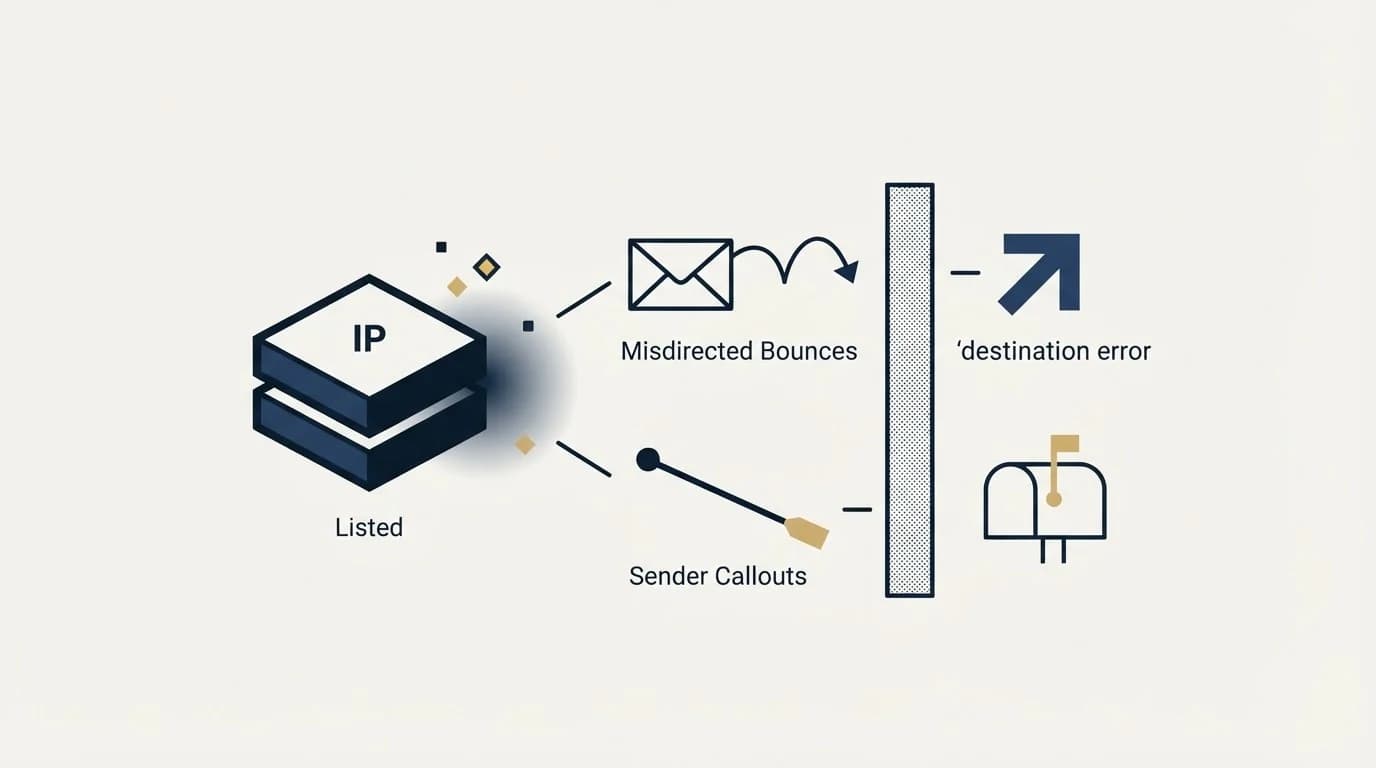
The operator states one listing policy for both causes: "Every IP which backscatters (Sending misdirected bounces or misdirected autoresponders or sender callouts) will be listed the next 4 weeks here."
Misdirected bounces. The operator's own page on the subject sets the rule for a well configured server: "Email servers should be configured to provide Non-Delivery Reports (bounces) to local users only. Unacceptable email from anywhere else should be rejected." A server that accepts a message for a mailbox that does not exist, discovers the problem afterwards, and returns a report to the address in the envelope has sent that report to whoever was forged into it. At spam-run volumes those reports land on strangers, and some of them land on the operator's traps. The receiving side of that experience is worked through in bounces for mail you never sent; this list is about being on the sending side of it.
Sender callouts. This is the cause that catches senders who have never emitted a stray bounce in their lives. A sender callout, also written SAV or sender verify, is the technique of opening an SMTP conversation with somebody else's mail server purely to find out whether an address exists, then dropping the connection. The operator's argument against it starts from the fact that the SMTP command designed for that purpose, VRFY, is disabled almost everywhere, and that disabling it is a statement of policy. It then makes a claim about the technique's value that is worth reading before buying any tool that uses it: "The maximum that your system can test with such an abusive SAV call is whether an emailaddress would accept email from you at the time of connection, after which the answer is out-dated."
That is the operator's own view, and you do not have to agree with the reasoning to care about the consequence. A verification step that probes recipient servers from an address you control can put that address on this list, and it will look for all the world like a deliverability problem caused by your campaign.
Finding out which address is actually listed
Two checks answer different questions and both are free.
The operator runs its own lookup, reached from the Test and Remove IP link in its navigation, and that is the authoritative answer because it is the live zone rather than an aggregator's cached row. MXToolbox publishes a problem page for the list, and its description matches the operator's: a listing "indicates that your server is issuing" backscatter in the form of non-delivery reports to external users, "or misdirected autoresponders and sender callouts".
The harder question is whose address to check, and it is a question about your own architecture rather than about the list. If your mail leaves through Google Workspace, Microsoft 365 or a relay, the address that connects to the receiving server belongs to that provider, is shared with an enormous sender population, and is not yours to fix. That whole diagnosis, including the rule that the address to check is the one quoted in a rejection message, is worked through in whose IP a blocklist lookup is checking.
Can put an IP on the list
- A verification tool or script that probes recipient servers
- A mail server that accepts mail for unknown users, then bounces it
- An out of office or vacation autoresponder answering forged senders
- A ticketing or helpdesk system acknowledging every inbound message
- A shared provider address you send through, which you did not cause
Never evaluated by it
- Your campaign copy
- Your list source
- Your sending volume
Backscatterer Blacklist Removal: Four Weeks, and Two Answers on One Page

The operator publishes an expiry rather than a queue. Its listing policy says a backscattering address "will be listed the next 4 weeks here", so a listing whose cause has stopped clears on its own. There is no case to argue and nothing to write.
MXToolbox's problem page for the list carries two statements that do not agree with each other, and disclosing that is more useful than picking one. It says the list "does not offer any form of manual request to delist" and that an address "will either automatically expire from listing after a given timeframe, or after time expires from the last receipt of spam into their spamtraps". Further down the same page it says the list "does support a manual request to remove, delist, or expedite your IP Address from their database upon Payment or Donation of fees to their organization". The same page gives MXToolbox's own view of that route in one sentence: "Simply requesting delisting and paying their fee will do nothing to help you correct the problem and will give you no guarantee that you won't get blacklisted again."
Both statements were read on the same page on 2 September 2026, and both were still there when it was re-read for this update. What follows from either of them is the same: the four week clock only starts once the behaviour stops, so the work is finding the system that is doing it.
What a listing is worth to a cold outbound programme
Weight it by what the list tests and by how receivers are told to use it.
The operator asks receivers to consult the zone in safe mode, for null-sender and postmaster traffic only. A receiver doing that cannot reject your campaign on this list, because your campaign does not arrive with a null sender. That is the operator's own recommendation rather than a guarantee about every receiver, and a receiver querying the zone against ordinary mail is doing something the operator advises against. The practical reading is that a Backscatterer row rarely explains a placement problem on its own, which is why it belongs low in the triage order set out in checking and recovering from a blacklisting.
What it is genuinely worth is as a signal about a system you did not know was talking to strangers. Two of the three common causes are configuration rather than campaign work. The third, callout-based verification, is a real choice with a real cost, and the alternative is verification that reads published records and provider signals rather than probing mailboxes. The trade-offs there sit in how the verification tools differ.
The architectural version is shorter than any of the remedies. Outbound leaves on domains and infrastructure kept separate from the corporate estate, so a listing earned by a helpdesk autoresponder cannot reach the mail that matters. One purpose per domain. Verification that does not require probing other people's servers. And enough spare warmed capacity that any single address going bad is a swap rather than an outage, which is the same posture that makes a UCEPROTECT Level 2 listing a note rather than an incident.
The short version

Backscatterer is run by the UCEPROTECT-Network and lists addresses for two behaviours: sending misdirected bounces, autoresponses and sender callouts. The operator states plainly that the zone "is NOT a spammerlist", so the row says nothing about your list, your copy or your volume.
The listing policy is an expiry rather than a queue. The operator publishes four weeks from the last observed behaviour, which means the only work that matters is finding the system producing it. MXToolbox's page for the list contradicts itself on whether a paid expedite exists, and separately recommends against paying for delisting anywhere.
The cause worth checking first is the least obvious one. Callout-based address verification connects to other people's servers to test whether mailboxes exist, and the operator lists addresses that do it. A team can hold a clean list, clean copy and a flat bounce rate and still be listed for a verification step that runs before every send.
Receivers are asked to query the zone only for null-sender and postmaster traffic, so a listing here is a low weight row on a report rather than an explanation for a bad week. Read it as a configuration finding, fix the system, and let the four weeks run.
If you would rather run outbound on infrastructure where verification never probes a stranger's server and a bad address is replaced rather than argued over, we plan the first campaign for free.
The zone name, the listing policy, the four week window, the safe mode definition and the sender callout reasoning are taken from backscatterer.org's own home, usage, bounces and sender callout pages, fetched 2 September 2026 and re-read for this update. The delisting statements and the view on paying are taken from MXToolbox's Backscatterer problem page, fetched the same day. Verify current list behaviour with the operator before relying on it.
Sources: Backscatterer, usage page, bounces page, sender callouts page, MXToolbox on Backscatterer
Frequently asked questions.
Frequently asked questions- What is Backscatterer?
- A DNS blocklist, ips.backscatterer.org, run by the UCEPROTECT-Network. It lists IP addresses that send backscatter: misdirected bounces, misdirected autoresponders and sender callouts. The operator states in capitals that it is not a spam list, so a listing says nothing about your campaign copy, list source or sending volume.
- How do I get removed from the Backscatterer blacklist?
- Stop the behaviour and wait. The operator lists every backscattering IP for the next four weeks, so a listing whose cause has stopped expires on its own. MXToolbox's page on the list mentions a paid expedite in one place and says no manual delisting exists in another, and it separately advises that paying fixes nothing.
- Why is my IP on Backscatterer if we do not send spam?
- Because the list is about automated replies, not campaigns. A mail server bouncing mail for unknown users, an autoresponder answering forged senders, a helpdesk acknowledging every message, or a verification tool probing recipient servers can each get an IP listed. If you send through a shared provider, the listed address may not be yours to fix.
- Does a Backscatterer listing hurt cold email delivery?
- Rarely on its own. The operator asks receivers to query the zone only for null-sender and postmaster traffic, which is bounce traffic, so a receiver following that advice never checks your campaign against it. Treat the row as a configuration finding about a system talking to strangers, fix it, and let the four weeks run.
About the author.

Tim Carden is CMO / CTO at RevenueFlow, which builds and operates outbound revenue engines for B2B companies. Studied at McGill University.
Tim Carden · CMO / CTO
Connect on LinkedIn →Explore more.
Ready to scale your outreach?
We build GTM engines that book real meetings. See the receipts.
Related articles.
Woody's SMTP Blacklist: The Delisting Route Refuses
Every page about this list tells you to file a delisting request. Measured on 2 September 2026, the operator's removal endpoint returned HTTP 403.
Suomispam Reputation: Read the Code Before You File
Suomispam publishes four zones and four listing classes, and the response code names which one you have. Two pieces of common delisting advice will not move it.
ivmSIP and ivmSIP/24: Which One Listed Your IP
invaluement publishes two IP lists and the search results merge them. One names your address, the other names the range around it, and only one is yours to fix.
ZapBL: A List of Opinions, and How Yours Clears
ZapBL says it does not block email and is not calling anyone a spammer. What actually gets listed, why three neighbours can catch you, and the four-rung removal ladder.
UCEPROTECT Level 2: Listed for the Neighbours
Level 2 lists allocations rather than senders. The escalation thresholds, the provider grace windows, and why the free removal is automatic and the paid one optional.
How Lemwarm Works: The Network, the Ramp and the Score
What lemwarm's pool of real inboxes does, how the ramp is sized in the vendor's own numbers, what the score is made of, and where the tool stops.