Domain Age: What It Means and Why the Textbook Definition Misleads
Domain age is the elapsed time since registration, read from public WHOIS data. In email it stands in for how established a sender is, and the causal factor is sending history rather than age. A domain registered years ago and never used for email has age and no standing at all.
Key takeaways
- Google published sender requirements enumerate authentication, DNS, TLS and spam rate, and never domain age.
- A new domain performs poorly because it has no history, not because it is young.
- Buying an aged domain buys a registration date, and possibly somebody else bad history.
- Some enterprise gateways do apply explicit rules against recently registered domains.
Domain age is the time elapsed since a domain name was first registered, read from public WHOIS or registry data. In email it is used as a rough proxy for how established a sender is, on the reasoning that domains used for abuse tend to be new and disposable while legitimate businesses keep theirs for years.
The proxy is doing a lot of work in that sentence, and it is where the term goes wrong. Age is a registration fact. What actually governs how a receiving system treats your mail is sending history and reputation, which age correlates with and does not cause. A domain registered in 2009 and never used for email has an impressive age and no standing whatsoever.
What receivers actually use
It is worth being precise about the published record, because it is narrower than the folklore. Google's email sender guidelines enumerate what senders to Gmail must do: SPF or DKIM authentication, valid forward and reverse DNS, TLS for transmission, messages formatted to the Internet Message Format standard, and spam rates reported in Postmaster Tools kept below 0.3%, with SPF and DKIM and DMARC required above 5,000 messages a day. Domain age does not appear.
That does not mean age is irrelevant to how mail is treated. It means the mechanism is indirect, and the indirection matters because it tells you what to do.
A new domain has no sending history, so a receiver has nothing to judge it on and defaults to caution. That is the effect people attribute to age, and its actual cause is the empty history.
Abuse patterns correlate with newness, because throwaway domains are cheap and get burned quickly. Some filtering products and security gateways do apply explicit rules against very recently registered domains, particularly at the enterprise gateway layer, and administrators can and do configure such rules directly.
A domain with history is judged on that history, good or bad. Age has no independent effect once behaviour is on file, which is why an old domain that starts sending badly is treated badly within days, and why age offers no protection to a sender who has earned a poor record.
- Step 1Registered
The domain exists. No receiver has any record of mail from it.
- Step 2First sends
Receivers have no history to judge against and treat the sender cautiously.
- Step 3History accrues
Consistent volume that recipients accept and engage with builds a record.
- Step 4Judged on behaviour
From that point the record governs treatment, and age stops mattering.
Where the term misleads
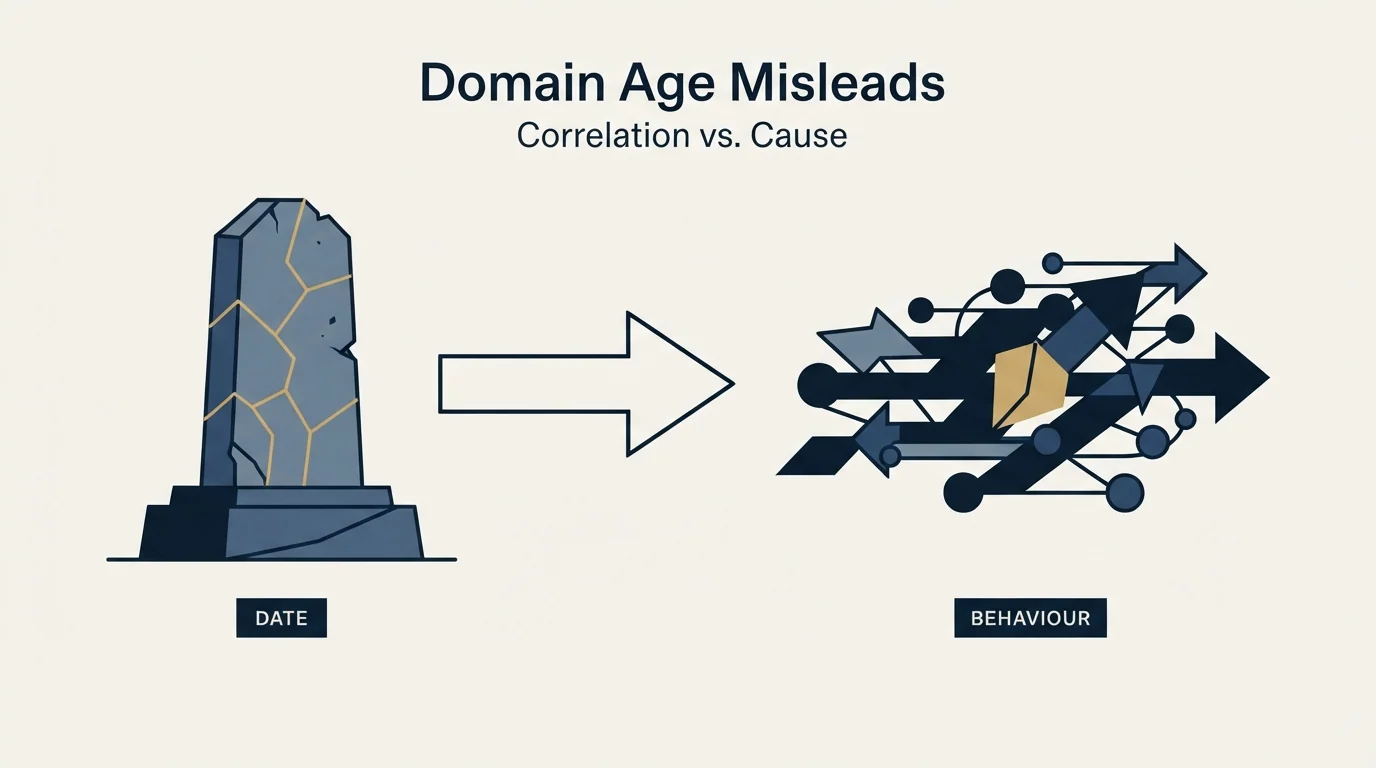
Buying an aged domain buys registration date, not standing. An expired domain bought at auction has an old registration and, from the point of view of a mailbox provider, either no email history or somebody else's. If the previous owner sent badly, the history you inherit is worse than nothing, and that history is not visible on any WHOIS lookup.
The word means something different in the neighbouring discipline. Search the term and the results are overwhelmingly WHOIS age-checking tools aimed at search marketers, where the debate is whether registration age is a ranking factor. That question and this one share a phrase and nothing else, and reading one body of material for answers about the other produces confident errors.
Age is not a substitute for warmup, and warmup is not waiting. Standing is built by sending mail that recipients accept and engage with, in a pattern that stays consistent. A domain that sat unused for three years and then sends a thousand messages on its first day is a new sender by every measure a receiver applies, and the spike is itself the problem.
Where it does bite, it bites at the recipient's gateway. An enterprise security product configured to distrust domains registered within some recent window will refuse mail regardless of your authentication or reputation. That is a policy at their end, it shows up as a cluster of rejections concentrated at organisations running that product, and there is no sending-side fix beyond having a domain older than their threshold.
It is the cheapest thing to plan and the most expensive to rush. Registering sending domains well before they are needed costs almost nothing and removes the constraint entirely. Needing them next week is the situation with no good options, which is the practical reason the topic matters at all.
- Time since first registration, from public records
- Visible to anyone with a WHOIS query
- Unchanged by anything you send
- Named in no major provider's published requirements
- Sending history at each receiver, over a rolling window
- Authentication that resolves and aligns
- Bounce and complaint rates from your list
- Volume consistency rather than volume alone
What this means when you are running outbound

Register early, use gradually. The whole of the practical advice fits in that sentence. Domains bought months before a campaign needs them are cheap, and the constraint disappears. Buying them the week before launch is what makes age feel like a problem, and no amount of money spent at that point buys back the time.
Warm before volume, and warm by sending. A new domain needs a period of modest, regular mail that recipients accept before it carries a campaign. How long depends on the receivers and the volume you are ramping to; the domain warmup guide covers the shape of it. What does not work is letting the domain sit idle and treating the calendar as progress.
Authenticate from the first message. A new domain with no records is asking receivers to form a view of an identity they cannot verify, which wastes the early sends that were supposed to be building the history. Records first, then the ramp.
Diagnose rejections by cluster, not by age. If mail is refused, check whether the refusals concentrate at organisations running one gateway product, which points at a recipient-side policy, or spread evenly across every receiving platform, which points at your own domain or list. Blaming age for an evenly-spread problem sends you shopping for domains when the cause is somewhere you could have fixed.
The related decision people are usually really asking about
When someone raises domain age, the question underneath it is generally about the sending domain strategy rather than about registration dates, and it is worth answering that instead.
The common arrangement in outbound is to send from separate domains rather than from the company's primary one, so that sending activity cannot damage the domain the business depends on for its ordinary mail. Those separate domains are new by construction, which is where the age anxiety comes from. The answer is not to buy age; it is to accept that a new domain needs a ramp, and to start the ramp early enough that it is finished when the campaign needs it.
That reframing changes what you plan. Instead of a purchase decision, it is a provisioning schedule: domains registered and authenticated a month or two ahead, warmed on a modest steady volume, and rotated into service as they become ready. The cost is planning rather than money, and it removes the entire class of problem.
It also removes the temptation that does real damage, which is running a campaign on a domain that is not ready because the campaign date arrived first. That produces a poor result and a damaged domain, and the damage takes longer to repair than the wait would have taken.
The aged-domain market, and what to check
If you are considering buying an aged domain anyway, there are two questions that decide whether it is worth anything, and neither is answered by the registration date.
The first is what the domain was used for. A domain that hosted a real business and sent ordinary mail is a different asset from one that was parked, or one that was used for spam and burned. The history you inherit is invisible in WHOIS and partly visible in archived web records and in whether the domain appears on public blocklists.
The second is whether it has any email history at all. Most expired domains have none that matters, so what you are buying is a registration date and a clean slate, which is close to what a new registration gives you at a much lower price. The blocklist check is worth running before purchase rather than after: a domain that arrives already listed is a purchase that starts with a delisting request, and delisting is not always granted.
- Yes: Sending domains are registered well before they are needed
- Yes: Authentication is in place before the first message
- Yes: A warmup ramp of real, accepted mail precedes campaign volume
- Yes: Rejections are read by cluster to separate gateway policy from your own problems
- Depends: Any purchased domain is blocklist-checked before money changes hands
- No: Buying an aged domain to skip the warmup
The short version
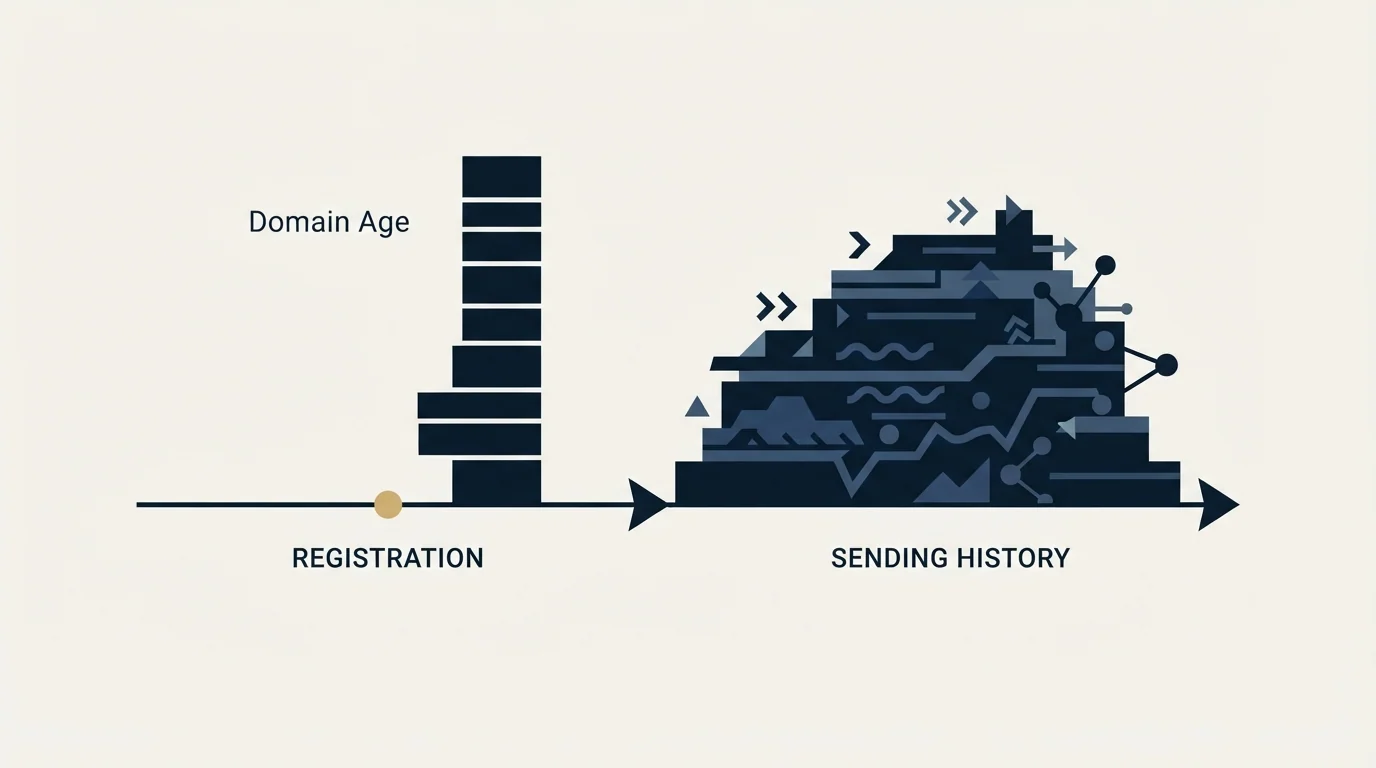
Domain age is a registration date. It correlates with being an established sender and it causes nothing, and no major provider's published requirements name it.
What receivers actually judge is history: whether authentication resolves and aligns, whether volume is consistent, whether the list produces bounces and complaints. A new domain performs poorly because it has no history, not because it is young, and the remedy is to build one by sending carefully rather than to acquire a date. Register early, authenticate before the first send, ramp deliberately, and keep the list clean enough that the history you build is worth having. If placement is poor on a domain that has been sending for months, age was never the variable, and a deliverability audit will find what was.
RevenueFlow runs cold email and LinkedIn outreach for B2B teams on sending domains we provision, authenticate and warm ourselves. See how the campaigns work.
Platform requirements verified as of mid-2026 against Google's published sender guidelines. Verify current requirements with the source before relying on them.
Frequently asked questions.
Frequently asked questions- Does domain age affect email deliverability?
- Indirectly. It appears in no major provider published requirements, and a new domain has no sending history for receivers to judge, so they default to caution. Some enterprise security gateways do apply explicit rules against recently registered domains, which is a recipient-side policy rather than a general filtering principle.
- Should I buy an aged domain for cold email?
- Rarely worth it. An expired domain bought at auction carries an old registration and either no email history or somebody else, and if the previous owner sent badly the history you inherit is worse than nothing. Check archived web records and public blocklists before purchase, since a listed domain starts with a delisting request.
- How old does a domain need to be before I can send from it?
- Age is the wrong variable. What a new domain needs is a warmup ramp of modest, regular mail that recipients accept, because standing is built by sending rather than by waiting. A domain that sat idle for three years and then sends a thousand messages on day one is a new sender by every measure receivers apply.
- Why do search results for domain age talk about SEO?
- Because the phrase belongs to two disciplines. In search marketing the debate is whether registration age is a ranking factor, and most results are WHOIS age-checking tools aimed at that audience. The two questions share a phrase and nothing else, and reading one for answers about the other produces confident errors.